If you’re just starting out, picking a putter can feel like a huge, complicated decision. Walk into any golf shop, and you’ll see a dizzying array of shapes, sizes, and brands. But here’s the good news: for a beginner, the choice is actually pretty simple. You can cut through all that noise by focusing on a mallet-style or a face-balanced putter.
These two designs are your best friends on the green because they’re built for one thing: making putting easier while you’re still learning.
That’s why it’s important to focus on selecting the best golf putters for beginners.
Finding Your First Golf Putter Without the Guesswork
When you’re new to golf, your main goal isn’t to find the “perfect” putter that a pro might use. Instead, you need a tool that helps you build a solid, repeatable stroke. It’s like learning to drive—you wouldn’t start with a high-performance manual sports car. You’d want something with power steering and an automatic transmission to make the process smoother.
For a new golfer, that means your putter needs to deliver on two key things:
- Forgiveness: It needs to bail you out when you don’t strike the ball perfectly dead-center.
- Stability: The putter head should resist twisting during your stroke, which helps you send the ball where you’re actually aiming.
Mallet and face-balanced putters are designed from the ground up to do exactly that. They provide a big, stable hitting area that gives you a welcome dose of confidence over every putt.
Why Your Putter Choice Matters So Much
Think about your last round, or even just a trip to the driving range putting green. How many of your shots were putts? For most beginners, putting can account for a staggering 40% of all strokes. That means improving your putting is, without a doubt, the fastest way to slash your scores and have a lot more fun.
Choosing a putter that works with your developing stroke—instead of against it—is the first and most important step.
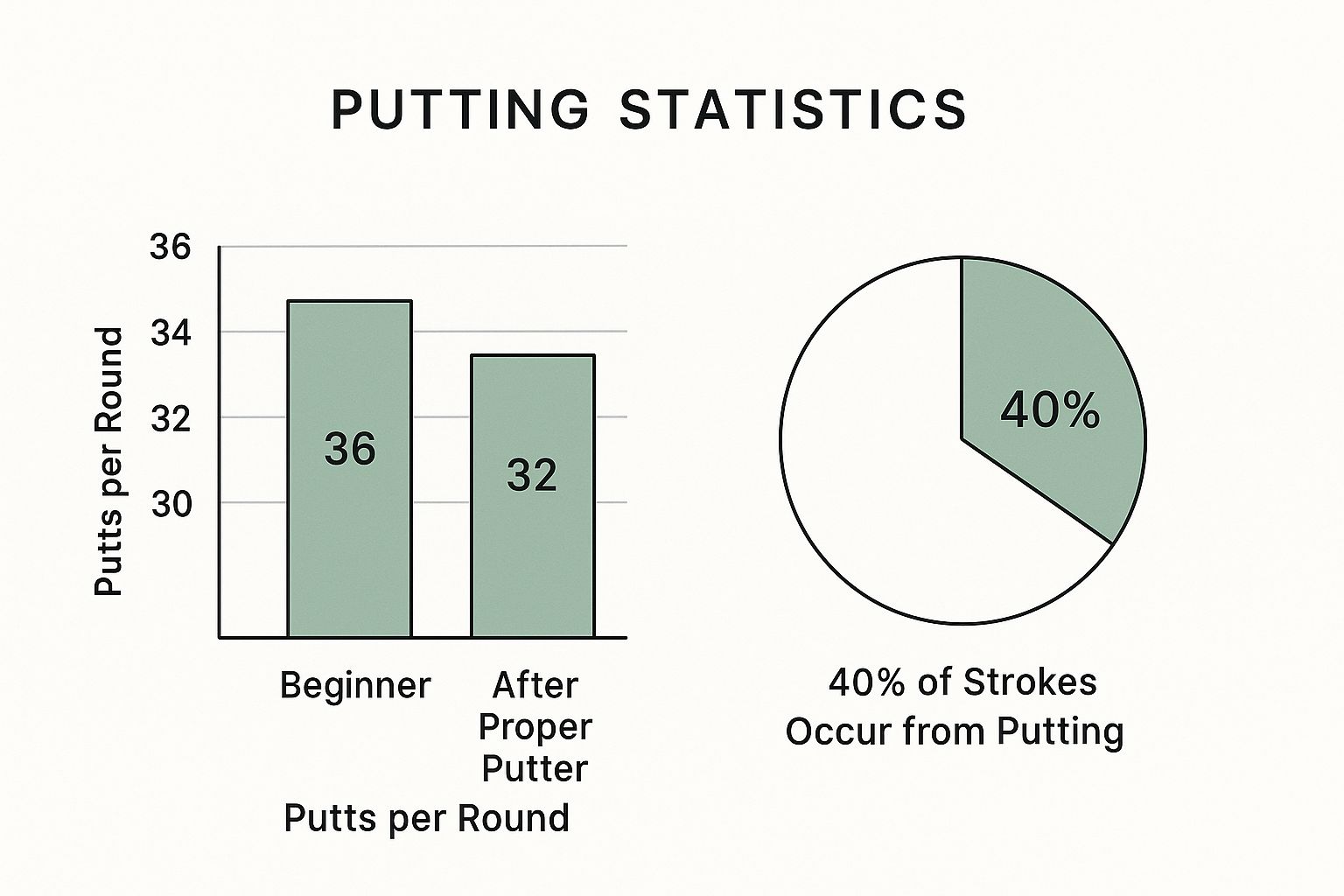
The numbers don’t lie. A putter that fits your stroke can literally shave strokes off your game right away.
This isn’t just a theory; it’s backed by what golfers are actually buying. Face-balanced putters, which are fantastic for a simple, straight-back-and-through stroke, currently hold a 57% market share. Right behind them are mallet putters, famous for their stability, making up about 43% of sales. You can dig into the full research on putter market trends if you love the data, but the conclusion is clear: these are the putters people trust.
To make it even clearer, here’s a quick breakdown of what makes these putters so great for new players.
Your Quick Guide to Beginner-Friendly Putters for Golf
This table gives you a side-by-side look at the two putter designs most recommended for new golfers, focusing on the features that actually help you learn.
| Feature | Mallet Putter | Face-Balanced Putter |
|---|---|---|
| Head Shape | Large, semi-circular or square-shaped head. Think big and stable. | Can be a mallet or a blade style, but the key is its weight distribution. |
| Best For | Golfers who struggle with alignment and off-center hits. The large size makes it easy to aim. | Players with a straight-back, straight-through putting stroke. It resists twisting. |
| Key Advantage | Maximum Forgiveness. The weight is pushed to the perimeter, which helps mis-hits travel straighter. | Stroke Stability. The face points skyward when balanced, promoting a square face at impact. |
| Visual Cues | Often has long, bold alignment lines that make it incredibly easy to see your target line. | The shaft often enters the head near the center, contributing to its balanced feel. |
Both options are fantastic starting points. You really can’t go wrong choosing either a mallet or a face-balanced putter to begin your golf journey.
Key Takeaway: Don’t get bogged down by all the technical jargon and flashy marketing. Your first putter should be a confidence-builder. Stick with a forgiving and stable design like a mallet or face-balanced model, and you’ll be on the right track from day one.
Choosing Your Putter Head: Mallet vs. Blade
The putter head is where club meets ball, and your first big decision is a classic one: mallet or blade? Think of this as picking your primary weapon for the greens; each is built for a different feel and putting stroke.
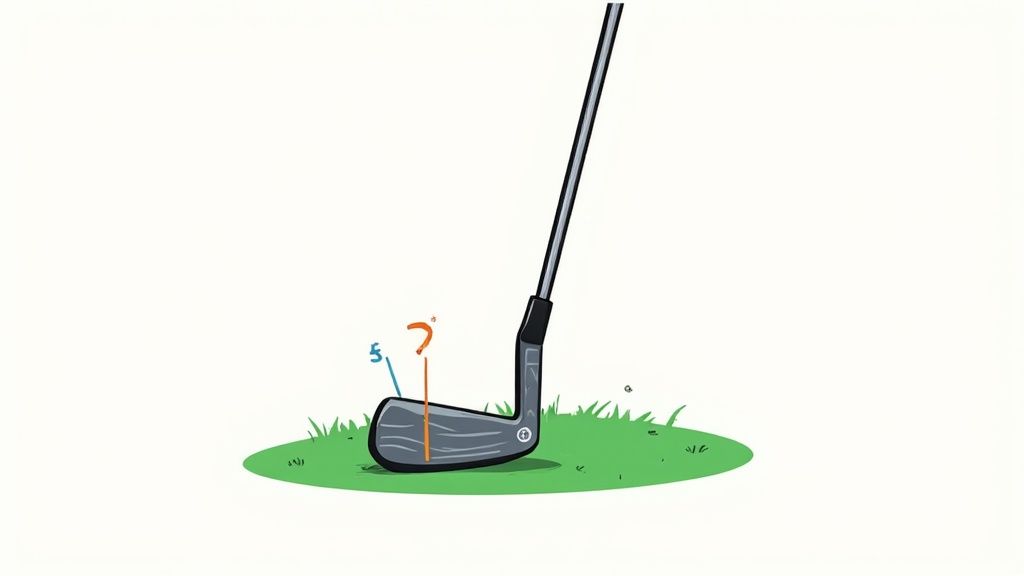
Mallet putters, with those larger, almost spaceship-like designs, are engineered for one thing above all else: stability. They are the absolute definition of forgiveness.
The Mallet Advantage for New Golfers
That bigger head on a mallet allows designers to push weight out to the absolute edges of the club. This creates a high Moment of Inertia (MOI), which is just a fancy way of saying the putter head fights twisting when you don’t hit the ball perfectly dead center. For a beginner, this is a total game-changer.
A mishit that would send the ball wobbling offline with a less forgiving putter will roll much, much truer with a mallet. It’s like having built-in training wheels for your putting stroke. This stability is precisely why mallets are so often recommended for new players. They build confidence fast by making your bad shots better.
The larger head size and perimeter weighting of a mallet putter are your secret weapons against inconsistency. They provide a stable platform that helps keep the putter face square at impact, leading to more putts starting on your intended line.
The numbers back this up. Mallet putters make up about 43% of the market, a huge number driven by their beginner-friendly designs. And here’s a telling stat: face-balanced designs, which are most common in mallets, hold a dominant 60% market share because they suit the straight-back, straight-through stroke so many new golfers are taught. You can dig deeper into the best-selling putter trends and what they mean for your game to see how the market is shifting.
What About Blade Putters in Golf ?
On the other side of the coin, you have the classic blade putter. With a sleeker, more traditional look, blades have historically been the choice of “feel” players—golfers with incredibly consistent, repeatable strokes.
Now, while old-school blades were notoriously tough to hit, modern blade putters have come a long, long way. They now incorporate forgiveness features that make them far more accessible than ever before. A modern blade offers a much cleaner look when you stand over the ball, which some golfers just prefer, and it can give you more direct feedback on the quality of your stroke.
So, who might still pick a blade to start?
- A Natural “Feel” Player: If you have solid hand-eye coordination and find the center of the putter face without much trouble, a blade might feel more intuitive to you.
- The Aspiring Golfer: Some beginners want to start with the equipment they aspire to use long-term. They’re willing to embrace the steeper learning curve for the payoff down the road.
Ultimately, the mallet vs. blade choice comes down to what you need right now. For the vast majority of new golfers, the forgiveness and stability of a mallet offer the quickest path to building confidence and shaving strokes off your score. It simplifies the learning process, letting you focus on the fundamentals of aiming and speed control without obsessing over a perfect strike every single time.
How Golf Alignment Aids and Face Inserts Help Your Game
Once you’ve settled on a mallet or a blade, it’s time to look at the features that directly influence your aim and feel. Modern putters are more than just hunks of metal; they’re packed with smart designs that make putting a whole lot easier, especially when you’re just starting out. Two of the most critical features are alignment aids and face inserts.
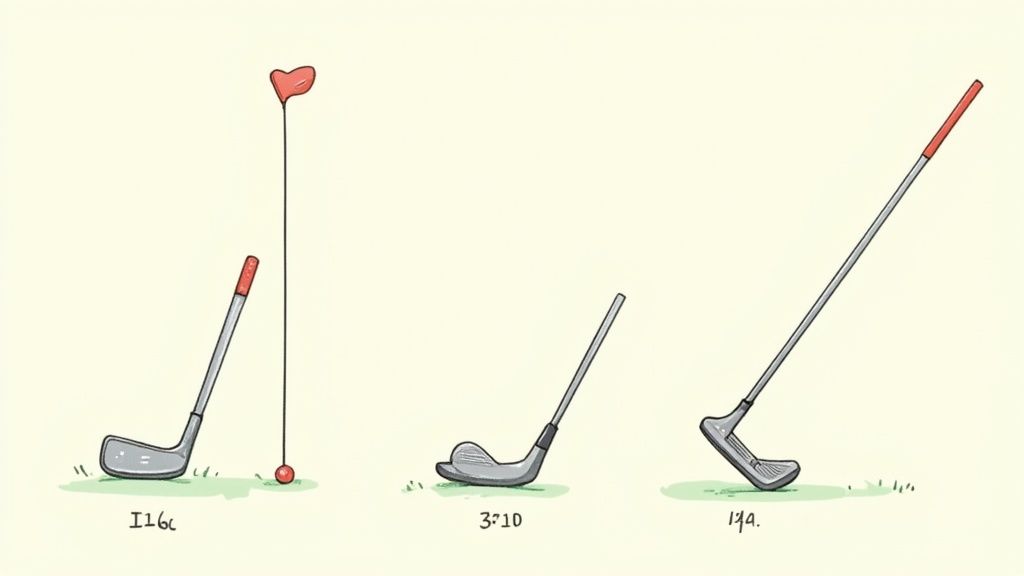
These aren’t just marketing buzzwords. Think of them as practical tools designed to help you solve the two biggest puzzles in putting: where to point the club and how hard to hit the ball.
Seeing the Line Clearly with Alignment Aids
Aiming a putter correctly is genuinely half the battle. This is where alignment aids—those lines, dots, and other visual cues on top of the putter head—become your best friend. They’re specifically designed to help your brain and eyes connect to see a clear path from your ball to the cup.
A single, bold line on a putter, for example, acts like the sight on a rifle. It gives you a definite point of reference to line up with your target. Some of the best golf putters for beginners take this concept even further.
- Long Lines: You’ll often see these on mallets. They can stretch from the face all the way to the back of the putter, creating a powerful visual runway toward the hole.
- Three-Ball Systems: Some putters use circles the size of a golf ball to help you frame the real ball at address. This makes lining up feel much more intuitive and natural.
- Contrasting Colors: High-contrast schemes, like a bright white line on a black putter head, make the alignment aid pop, helping your eyes lock in on your intended line.
The goal here is simple: find a putter with an alignment system that just looks right to you. When you look down and feel confident that you’re aimed correctly, you free yourself up to make a much more committed stroke.
A study of golfers found that a simple line on a putter can improve aiming accuracy by as much as 12%. For a new player, that small boost in confidence can make a huge difference over the course of a round.
Softening the Hit with Face Inserts
Once you’re aimed squarely at the target, the next piece of the puzzle is controlling your distance. This is where the face of the putter comes into play and why so many beginner-friendly putters have a face insert.
A face insert is a layer of a different material—often a soft polymer or urethane—that’s placed right on the putter’s hitting surface. This little piece of tech does two incredible things for a beginner:
- Improves Distance Control: A soft insert creates a more muted, consistent feel at impact. This helps you get a much better sense of how hard to hit the ball, which is especially crucial on fast greens where a gentle touch is everything.
- Promotes a Better Roll: The specialized materials in modern inserts are designed to grip the ball at impact, which reduces skidding and gets the ball rolling end-over-end much sooner. A pure roll means a more predictable path to the hole.
By understanding these two features, you’re well on your way to finding a putter that can seriously improve your performance on the green. For those ready to build on this foundation, you can master the green with these 7 essential putting techniques in golf.
Ultimately, choosing a putter with helpful alignment aids and a forgiving face insert gives you the right tools to build a consistent, confident putting stroke from the very start.
Getting the Right Fit: Length and Grip Matter
Think of a poorly-fit putter like a pair of shoes that are two sizes too big. Sure, you can walk in them, but you’ll look clumsy and feel completely out of sorts. It’s the same story on the putting green. If your putter is too long or too short, it forces you into an awkward posture, quickly building bad habits that are a real pain to fix later on.
Getting the length right is job number one. This is the bedrock of a comfortable, repeatable putting stroke. While a professional fitting is always a fantastic option, you can get a surprisingly accurate measurement right at home.
Finding Your Ideal Putter Length
Here’s a simple way to find your starting point. Stand in a comfortable, athletic golf stance—feet about shoulder-width apart, with a slight bend in your knees and from your hips. Now, just let your arms hang naturally at your sides. The distance from the top of your hands down to the ground is your ideal putter length.
Most standard, off-the-rack putters come in lengths of 33, 34, and 35 inches. Honestly, one of these will work perfectly for the vast majority of golfers. Unless you’re significantly taller or shorter than average, sticking with these standard sizes is a smart move for any beginner.
Why all the fuss about a few inches?
- A putter that’s too long forces you to stand too tall. This pushes your eyes inside the ball, making it tough to see your intended line clearly.
- A putter that’s too short makes you hunch over excessively. This often leads to a “handsy,” inconsistent flicking motion instead of a smooth, pendulum stroke.
Pro Tip: When you take your stance, your eyes should be positioned directly over the golf ball, or just a hair inside the line. This setup gives you the clearest possible view of the path to the hole and makes a simple, shoulder-driven stroke feel much more natural.
Why Your Putter Grip Is So Important
Your hands are your only connection to the club, so the grip is a huge piece of the puzzle. Over the last decade, we’ve seen a massive shift away from the classic, skinny putter grips toward thicker, oversized models. This isn’t just a trend; it’s a direct response to what helps amateur golfers most.
A thicker grip helps “quiet” your hands and wrists during the stroke. Many new players (and plenty of experienced ones!) get “wristy,” meaning they flick at the ball instead of using their shoulders to create a smooth, rocking motion. An oversized grip fills your hands more, making it physically harder to manipulate the clubface with those small, twitchy muscles. The result is a more stable, consistent stroke powered by the big muscles in your shoulders and back.
This innovation is part of a larger push by manufacturers to build gear that genuinely helps newcomers. Globally, top brands like Callaway, TaylorMade, and PING are putting a huge emphasis on features like forgiving clubheads and stabilizing grips. It’s no surprise that North America accounts for nearly 38.5% of the global revenue for beginner golf equipment, fueled by a culture that embraces new players. You can dig deeper into how manufacturers are designing beginner-friendly equipment on Credence Research.
Ultimately, choosing the right length and grip isn’t just a minor tweak. It’s a fundamental step in building a solid putting foundation. When a putter fits you correctly, it feels like a natural extension of your arms, giving you the confidence to roll the ball smoothly and start draining more putts.
How To Find A Great Putter On Any Budget
Finding one of the best golf putters for beginners doesn’t mean you have to empty your wallet. In fact, some of the smartest buys aren’t the newest, shiniest models on the rack. The real key is knowing where to look and what to look for—that’s how you get incredible value.
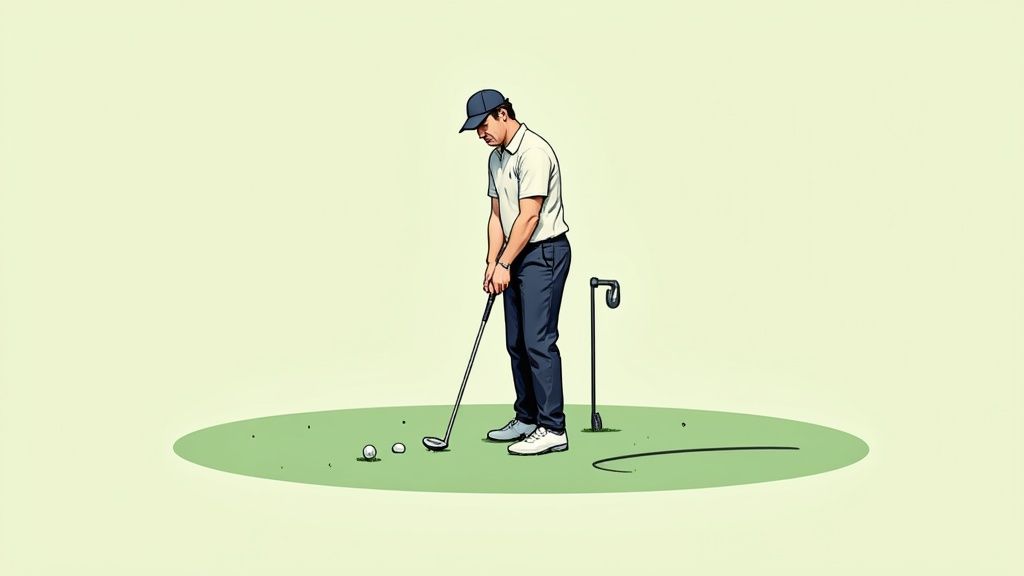
You can absolutely find a forgiving, high-performance putter that fits your game and your bank account. It’s all about shopping smart, not just spending big.
Setting Realistic Price Expectations
So, what does your money actually get you? A brand-new, modern putter from a top brand will generally start around $120-$150 and go up from there. This gets you the absolute latest in alignment aids and face insert technology. But honestly, you can find fantastic options well below that price point.
Here’s a quick guide to what you can expect as a beginner:
- Under $100: This is the sweet spot for hunting in the used market or for previous-year models. It’s not uncommon to find a premium mallet that was $200+ just a couple of seasons ago for a fraction of the original price.
- $100 – $200: In this range, you can easily walk away with a brand-new, high-quality mallet or a forgiving blade from nearly any major golf brand. Think of it as a great investment for a club you’ll probably use for years.
The real secret to smart shopping is understanding that putter technology doesn’t change drastically year-over-year. A two-year-old model from a reputable brand like Odyssey, PING, or TaylorMade will have nearly all the forgiveness you need at a significant discount.
This strategy is a cornerstone of playing golf on a budget, and you can learn more tips to save money in our dedicated guide.
Where To Hunt For Putter Bargains
While big-box golf retailers are great for trying out different models and getting a feel for what you like, the real treasures are often found elsewhere. Don’t be afraid to explore the pre-owned market—it’s where experienced players find some of the most amazing deals.
I’d recommend checking out these spots:
- Online Used Golf Stores: Websites that specialize in used clubs are a goldmine. They usually inspect and grade the condition of each club, so you know exactly what you’re getting before you even click “buy.”
- Previous-Year Models: Next time you’re at your local golf shop, just ask if they have any leftover inventory from last season. They’re often highly motivated to clear out old stock to make room for new arrivals, and you can reap the benefits.
- Local Second-Hand Shops: Places like Play It Again Sports can be hit-or-miss, I’ll admit. But every once in a while, you can stumble upon a diamond in the rough for an unbeatable price.
Inspecting A Used Putter
When you’re buying a used putter, a quick inspection can tell you everything you need to know.
First, check the shaft for any major dents or bending. Then, take a look at the grip. Is it cracked, slick, or totally worn out? A new grip only costs about $10-$15, so just be sure to factor that into your total budget.
Finally, examine the face for any deep dings or gashes that could affect how the ball rolls. A few minor cosmetic scuffs are totally fine and just prove the putter has seen some action. By being a savvy shopper, you can easily find a fantastic putter that gives you all the confidence you need without that premium price tag.
FAQ’s
We’ve thrown a lot of information at you, so it’s normal to have a few questions before you commit to a new putter. Let’s clear the air and tackle the most common concerns I hear from new golfers.
This is your final, no-nonsense gut check to help you buy with total confidence.
Do I Really Need a Putter Fitting as a Beginner?
Honestly, no. While a professional fitting is an incredible tool for experienced players, it’s not something to worry about right now. Your number one job is to get the length right, and you can nail that with the simple at-home method we talked about earlier. Don’t overcomplicate things.
For a new golfer, the massive forgiveness you get from a modern mallet head and the stability from an oversized grip will make a much bigger difference in your scores than the tiny tweaks from a fitting.
Key Takeaway: Put your money into a quality, forgiving putter for now. A professional fitting is something to look forward to once your putting stroke becomes more consistent. The right club for you today is one that makes learning the game easier.
How Much Should I Spend on My First Putter?
You absolutely do not need to drain your savings to get one of the best putters for beginners. In fact, you’d be surprised how many great options are out there for a reasonable price.
The sweet spot for a brand-new, high-quality putter from a top brand is between $100 and $200. In this range, you’re getting fantastic technology, tons of forgiveness, and a club that will serve you well for years to come. It’s a smart investment.
If your budget is under $100, the used market is your best friend. You can often snag a putter that was considered top-of-the-line just a couple of seasons ago for a fraction of the original price. Don’t get hypnotized by the $400+ putter on the pro shop rack; its advanced features are designed for elite players and won’t really help someone just starting out.
Will an Expensive Putter Make Me a Better Putter?
I get this one a lot, and the answer for a beginner is almost always a firm no. Your biggest and fastest improvements will come from two things: practice and building a solid, repeatable putting stroke. The price of your putter has almost nothing to do with either.
A high-end, milled putter might feel slightly different to a scratch golfer who can sense tiny vibrations at impact. But a beginner gains so much more from the raw forgiveness and stability built into modern mallets and forgiving blade designs.
Here’s a better way to think about it:
Practice is your engine. It’s what drives your improvement.
A forgiving putter is your power steering. It makes controlling the car much easier.
An expensive putter is like a fancy paint job. It looks great, but it doesn’t make the car perform any better.
A $150 putter that helps you consistently find the center of the face will do more for your scores than a $500 blade that punishes every slight mishit. Spend your money on a club that makes learning fun and invest your time on the practice green. That’s the real recipe for sinking more putts.
At Golf Inquirer, we believe the best gear is the kind that makes you excited to play. Discover more tips, find breathtaking courses, and elevate your game with us. Let’s explore the joy of golf together, one shot at a time. Learn more at Golf Inquirer.