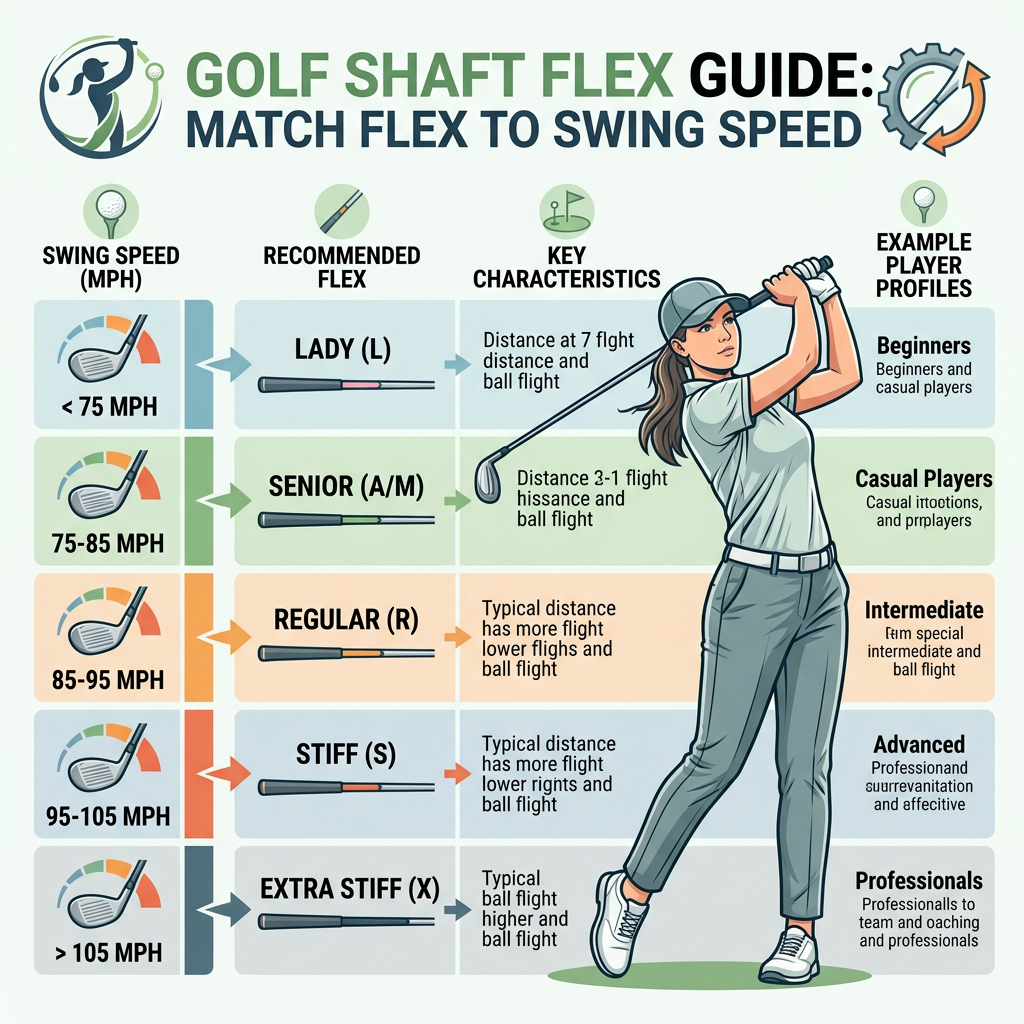
In golf, a shaft flex (often colloquially referred to as a “flex shaft,” though every golf club has a shaft with a specific flex rating) is a measurement of how much the shaft bends or “gives” during the golf swing.
Rather than being completely rigid like a steel pipe, a golf shaft acts like a spring. It bends during the backswing and downswing, and then uncoils right before impact to square the clubface and maximize power.
- What “shaft flex” really changes in Golf (and what it usually does not)
- A simple golf ball-flight rule: softer tends to go higher
- Match flex to driver swing speed in Golf (your best starting point)
- Tempo, transition, and release: the tiebreakers that matter in Golf
- Quick signs your golf club flex might be off
- A practical at-home check using one golf club and one target
- Driver flex versus iron flex (they do not have to match)
- Flex is only one dial: weight, torque, and bend profile also shape feel
- What a good fitting is really looking for in Golf
- Comfort matters, and it is part of performance
- A quick way to choose when you are between two flexes
- Keep your expectations realistic, and your results get better
- FAQ's
Picking the right shaft flex can feel like choosing between five mystery doors labeled L, A, R, S, and X. But flex is not a status symbol, and it is not a magic speed booster. It is a timing tool that helps your club arrive at impact with the face, loft, and feel that fit your swing.
Get it close, and your best swings show up more often. Get it wrong, and you may start “fixing” a ball flight problem with swing changes you do not actually need.
What “shaft flex” really changes in Golf (and what it usually does not)
Shaft flex is the shaft’s resistance to bending during the swing. During the transition and downswing, the shaft loads and unloads, and that motion can affect how much loft you deliver and how quickly the clubface tends to close. To learn more click here
Many golfers assume a softer shaft automatically creates more clubhead speed. Research and real-world testing suggest the speed piece is usually small. A flex change can produce a tiny uptick for some players and a tiny drop for others, often less than you would notice without a launch monitor. Where flex consistently shows up is in launch conditions: dynamic loft, launch angle, and spin.
That is why two golfers can swing the same speed, try the same driver head, and end up in different flexes. The goal is not “stiffest you can handle.” The goal is “best ball flight and dispersion for how you load the club.”
A simple golf ball-flight rule: softer tends to go higher
Flex is not the only factor in trajectory, but it nudges the pattern.
A more flexible shaft often makes it easier to deliver a touch more dynamic loft, which can mean a higher launch and more spin. That can help golfers who struggle to get the ball airborne or who need carry distance.
A stiffer shaft often helps keep launch and spin down, and it can feel more stable for players with a quick transition. It may also reduce the “left miss” for golfers who tend to flip the hands and shut the face.
Neither outcome is automatically better. Your best flex is the one that puts your launch and spin in a useful window while keeping your start lines and curvature playable.
Match flex to driver swing speed in Golf (your best starting point)
Swing speed charts are not laws, but they are great guardrails. If you are shopping without a fitting, start here, then fine-tune by ball flight and feel.
| Shaft Flex | Typical Driver Swing Speed | Common Launch/Spin Tendency | Who it often helps |
|---|---|---|---|
| Ladies (L) | Under 72 mph | Highest launch, highest spin | Very smooth tempos, very slow speed, needs help getting airborne |
| Senior / A-flex (A) | 72 to 83 mph | High launch, higher spin | Slower swing, wants more carry and a lighter feel |
| Regular (R) | 84 to 96 mph | Mid to high launch, moderate spin | Many amateurs, broad “middle” of speeds |
| Stiff (S) | 97 to 104 mph | Mid to low launch, lower spin | Faster swings, firmer feel, tighter timing |
| Extra-Stiff (X) | 105+ mph | Lowest launch, lowest spin | Very fast swings, aggressive transitions, wants stability |
If you do not know your speed, you can still estimate it. Many simulator bays show clubhead speed. Some range systems show it too. Even a phone-based estimate can at least tell you whether you are closer to A, R, or S.
Tempo, transition, and release: the tiebreakers that matter in Golf
Two golfers can both swing 100 mph and need different flexes.
One might have a smooth tempo, a gradual transition, and a “swinger” feel that loads the shaft gently. That player may get along with a slightly softer flex because the club has time to load and return consistently.
Another might have a fast takeaway, a hard change of direction, and a “hitter” move that yanks the handle. That player often prefers a stiffer flex or a firmer profile because the shaft is being stressed earlier and more abruptly.
Release timing plays into it, too. Golfers who release early can benefit from a setup that helps them deliver enough loft and keep the face from racing shut. Golfers who hold lag longer and release later may prefer a firmer tip feel to keep flight from climbing.
This is why “stiff” is not the same across brands, and why two shafts with the same flex label can feel completely different. Flex is a category, not a measurement standard.
Quick signs your golf club flex might be off
You do not need to be a club fitter to spot some patterns. Ball flight, strike quality, and your typical miss tell a story.
- Ballooning drives that climb and fall straight down
- Low bullets that struggle to carry hazards
- Big hooks that show up when you swing hard
- A “boardy” feel that makes you fight for rhythm
- A loose, whippy feel that makes timing unpredictable
Any of these can also come from swing mechanics, strike location, or loft settings, so treat them as clues, not a diagnosis.
A practical at-home check using one golf club and one target
If you have access to two flexes in the same clubhead (a friend’s club, a demo, or a fitting cart day), you can do a simple comparison session.
Hit 10 balls with each, alternating every two shots so fatigue does not bias the results. Use the same tee height, same target, and the same “stock” swing.
Watch for three things:
- Start line and curve: Which one starts closer to your target line and curves less?
- Carry consistency: Which one produces a tighter cluster of distances?
- Your hard swing: When you step on one, does it stay playable or fall apart?
If the softer option launches higher but also tightens your dispersion, that is not a problem. If the stiffer option launches lower but costs carry and feels like work, that is a problem.
Driver flex versus iron flex (they do not have to match)
Many golfers assume their whole bag must be one flex letter. In real life, mixed setups can work well.
Drivers and fairway woods are longer and often swung with more speed. Irons are shorter, and many players have a different tempo and strike intention with them. That is why you will see golfers play a Stiff driver shaft but Regular iron shafts, or a Regular driver shaft with slightly firmer wedges.
Also, iron shafts come in many weight classes, and weight can be just as influential as flex for feel and contact quality. A heavier shaft may help some golfers find the center more often, even if the flex letter stays the same.
Flex is only one dial: weight, torque, and bend profile also shape feel
If you have ever hit two “Stiff” shafts that behaved nothing alike, you have already met the other dials.
- Weight: Heavier can improve control and rhythm for some; lighter can help maintain speed and reduce fatigue.
- Torque: Lower torque often feels steadier and can reduce twisting; higher torque can feel smoother and help some golfers square the face.
- Bend profile (kick point): Where the shaft feels like it bends influences launch and spin tendencies.
A golfer might blame “wrong flex” when the real issue is that the shaft is too light, too heavy, or simply a poor profile match.
One sentence that saves time: try not to shop by the flex letter alone.
What a good fitting is really looking for in Golf
A fitting is not about chasing one perfect shot. It is about finding a setup that produces repeatable launch, spin, and direction across your normal swing range.
On a launch monitor, the big picture usually comes down to ball speed, launch angle, spin rate, and dispersion. You may see clubhead speed change slightly between shafts, but the more meaningful win is often tighter start lines, better strike pattern, and a flight that matches your intent.
If you are booking a session, going in with a plan helps.
- Your typical miss: Slice, hook, push, pull, or straight but inconsistent strike
- Your main goal: More carry, lower spin, tighter dispersion, better feel
- Your gamer ball: Use the ball you play, or at least one you can also test outdoors
- Your real swing: Bring the move you use on the course, not your “range swing”
A quality fitter will also ask about your course conditions. Wind, firmness, and altitude can change what “ideal” looks like.
Comfort matters, and it is part of performance
Flex and material choices can change how impact feels in your hands and arms. Many golfers with sore wrists, elbows, or shoulders prefer graphite and a smoother overall build because it can reduce harsh vibration. That is not a promise of injury prevention, but comfort is still valuable because it helps you practice and play more.
Also, if a super-light, very soft setup makes you swing out of your shoes, it may invite timing problems. The best equipment fit supports a good rhythm, not a frantic one.
A quick way to choose when you are between two flexes
A lot of golfers live on the border between Regular and Stiff, or between Stiff and X. If that is you, use this simple decision rule:
Pick the option that keeps your worst swing in bounds while still letting your good swing fly.
That usually means choosing the slightly softer option when you need launch, carry, and a smoother load, and choosing the slightly stiffer option when your miss is left, your transition is violent, or spin climbs when you go after it.
If you can, validate it outside. Range mats and indoor bays are helpful, but wind, slope, and real turf can reveal what your gamer setup actually does.
Keep your expectations realistic, and your results get better
A shaft change can absolutely improve your results, yet the improvement is often in playable trajectory and tighter dispersion, not a sudden 20-yard jump. When the flex fits, your timing gets simpler. When timing gets simpler, your swing gets calmer. And when your swing gets calmer, golf becomes more fun.
If you want a clean next step: check your driver swing speed, pick the flex band that matches it, then use tempo and ball flight to decide whether to go a touch softer or a touch stiffer. That approach gets most golfers very close, even before a full fitting.
FAQ’s
How can I estimate my shaft flex if I don’t have access to a launch monitor?
You can use your average full 7-iron distance as a reliable proxy. Hit about ten shots, throw out your best and worst strikes, and average the rest:
Under 130 yards: Ladies (L)
130 to 145 yards: Senior (A)
145 to 155 yards: Regular (R)
155 to 175 yards: Stiff (S)
175 yards and up: Extra Stiff (X)
Why might two golfers with the exact same swing speed need different shaft flexes?
Swing speed is only the primary starting filter; a golfer’s tempo and transition play a massive role. A player with a smooth, unhurried transition loads the shaft gradually and can often succeed with a softer flex. Conversely, a player with an aggressive, fast “hit from the top” transition applies sudden force and usually needs a stiffer profile to keep the clubface stable through impact, even if their raw speed isn’t exceptionally high.
What happens to your ball flight if your shaft flex is too soft or too stiff?
Too Soft: If the shaft bends too much for your speed, the clubhead arrives late and open, often causing high, ballooning shots, a lack of distance control, and a persistent miss to the right (for a right-handed golfer) or a hook caused by over-rotation.
Too Stiff: If the shaft doesn’t bend enough, you won’t load it properly, leading to a low launch angle, a weak or fading ball flight, and a rigid feel that lacks distance.