
Inside 120 yards, golf gets honest. The swing is shorter, the target is smaller, and the scorecard does not care that you were “between clubs.” When your wedges are spaced well, those in-between numbers start to disappear and your choices feel calmer.
Wedge gapping is simply building your scoring clubs so each one owns a clear yardage window, with predictable overlap for partial swings. It is part equipment, part planning, and it pays off fast.
- What wedge gapping really means (and what it isn’t) in Golf
- Start with your pitching wedge, not your sand wedge
- A practical golf wedge gapping chart you can copy
- Turn loft gaps into yardage gaps in golf
- Bounce and grind: the other half of a scoring golf wedge set
- Common wedge builds (and what they feel like on the golf course)
- A simple calibration session you can repeat each golf season
- Fixing the most common gapping problems in golf
- Using the chart without getting trapped by it
- FAQ's
What wedge gapping really means (and what it isn’t) in Golf
Most golfers think wedge gapping is only about buying a 52°, 56°, and 60°. That can work, but it is not the full story, because your pitching wedge loft might not be what you assume. The question is how to use a wedge gap correctly .
Wedge gapping is the process of spacing lofts so your full-swing carry distances are separated by a consistent amount, often in the neighborhood of 10 to 15 yards per club for many players. Loft gaps of about 4 to 6 degrees between wedges tend to produce that kind of distance separation, though your speed, strike, and ball choice can shift it.
A good gap is not about hitting perfect “stock” numbers every time. It is about removing the awkward ones where you feel forced to guide a swing.
A simple reality check helps. If you regularly face a number that makes you uncomfortable, the issue is often your wedge set, not your technique.
After you play a few rounds with intention, you will usually see one or two patterns:
- Big hole: one wedge flies much farther than the next
- Redundancy: two wedges go the same distance
- Forced swing: you keep trying to “take something off” a club that wants to be swung
Start with your pitching wedge, not your sand wedge
Your pitching wedge is the anchor. Modern iron sets vary a lot, and two clubs stamped “P” can be separated by several degrees of loft. That difference ripples through the rest of your scoring set.
If your pitching wedge is strong (lower loft), you will often need one more wedge or slightly stronger lofts to keep the yardage steps reasonable. If your pitching wedge is weaker (higher loft), you may already have built-in spacing and can keep the rest of the set more traditional.
This is why wedge gapping starts with a measurement, not a guess. A loft check at a shop, a fitting cart, or even looking up your iron specs online gets you on the right track.
You are not chasing someone else’s “perfect” wedge numbers. You are building a system from the club you already own.
A practical golf wedge gapping chart you can copy
Below is a compact chart you can use as a starting point. It assumes you carry four scoring wedges including the pitching wedge, with roughly 4 to 6 degrees between clubs.
These are not the only valid builds. They are common builds that tend to create clean distance steps for a wide range of golfers.
| Pitching Wedge Loft | Suggested Gap/Approach Wedge | Suggested Sand Wedge | Suggested Lob Wedge |
|---|---|---|---|
| 42° | 48° | 54° | 60° |
| 43° | 48° to 49° | 54° to 55° | 59° to 60° |
| 44° | 48° to 50° | 54° to 56° | 58° to 60° |
| 45° | 50° | 54° to 56° | 58° to 60° |
| 46° | 50° to 52° | 54° to 56° | 58° to 60° |
| 47° | 51° to 52° | 56° | 60° |
| 48° | 52° | 56° | 60° |
A note that matters: if your course has firm turf and you love bump-and-run shots, you might not need the highest loft option. If your course has small greens or steep bunkers, a higher loft lob wedge can feel like a safety net.
Turn loft gaps into yardage gaps in golf
Loft is the cleanest starting point, but the goal is distance control, not winning a loft spreadsheet.
To make the chart useful, translate it into carry numbers for your own swing. Think in three layers:
- Full swing carry: your “stock” wedge distances.
- Three-quarter swing carry: often the most reliable scoring swing.
- Half swing carry: your touch number when you want to keep spin and trajectory manageable.
You do not need a launch monitor to begin. A calm practice session with a rangefinder and consistent golf balls can get you close, especially if you focus on carry, not total distance.
It helps to aim for a simple structure: each full wedge should have a job, and your partial swings should fill in naturally. If you build wedges that are too close in loft, you can end up with two clubs that fight for the same number, which creates indecision.
A quick “bag math” check works well. If your pitching wedge flies 125 and your next wedge flies 105, that 20-yard gap will show up on the course over and over. That is the no-fun zone where you start steering swings.
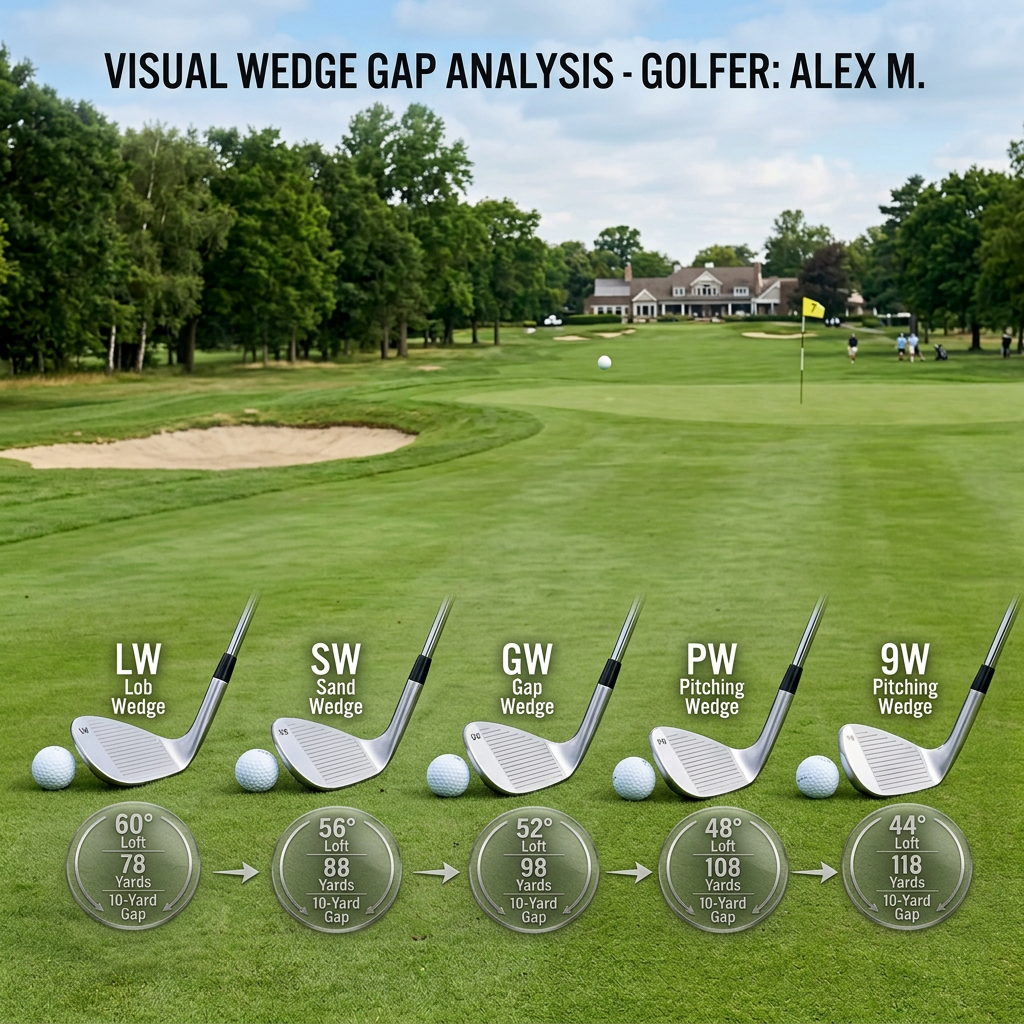
Bounce and grind: the other half of a scoring golf wedge set
Two wedges can share the same loft and behave like completely different clubs because of bounce and sole shape. Loft gaps help with distance. Bounce and grind help with turf and sand interaction.
Bounce is your friend when you tend to dig, when the turf is soft, or when bunkers are fluffy. Lower bounce can shine from tight lies and firmer conditions, especially when you like to open the face.
Your “sand wedge” does not have to be only for sand. Many golfers use it as a main greenside club because the bounce can make chips and pitches more forgiving.
To keep it practical, match bounce to your typical conditions and your strike pattern:
- Soft fairways and soft sand: favor more bounce, especially in the sand wedge
- Firm turf and tight lies: consider lower bounce options, especially in the lob wedge
- Steep divots: bounce helps the club glide rather than dig
- Shallow sweepers: lower bounce can keep the leading edge from sitting too high
If you only change one thing, make your sand wedge the most forgiving sole in the bag. It is the club you reach for when you are a little nervous.
Common wedge builds (and what they feel like on the golf course)
Many golfers land in one of these patterns. None is “best,” but each has a clear personality once you start playing with it.
A four-wedge setup is the classic scoring build: pitching wedge plus three specialty wedges. It gives you fewer forced partial swings and clearer choices inside 120.
A three-wedge setup can be excellent too, especially if you like learning one versatile wedge for lots of shots. The trade-off is you will see more in-between yardages that require a dialed three-quarter swing.
Most of the time, the decision comes down to what you need at the top of the bag. If you carry extra fairway woods or hybrids, you may choose three wedges. If you play a lot of partial wedge shots and care about dialed numbers, four wedges often fits better.
A small reminder: you are allowed to build your wedge set around the shots you actually hit, not the shots you want to hit.
A simple calibration session you can repeat each golf season
Wedges change. Grooves wear, strike patterns shift, and a new ball can move your numbers. A short calibration routine once or twice a year keeps your gaps honest.
Pick a calm day, use one model of ball, and measure carry distances. Hit enough shots that you trust the average, not the best one.
Bring structure so you do not drift into random practice:
- Start point: measure your pitching wedge carry first
- Target: aim for consistent 10 to 15 yard full-swing spacing between wedges
- Partial swings: record a comfortable three-quarter number for each wedge
- Reality check: repeat any club that produces a surprise outlier
Write the results on a small card, a note on your phone, or a label inside your yardage book. Then commit to those numbers on the course.
Fixing the most common gapping problems in golf
Some gapping issues come from the wedge set. Others come from how wedges are fit into the iron set.
If your pitching wedge is very strong and your next wedge is a traditional sand wedge, you can create a big hole without realizing it. That is where a gap wedge earns its name.
Another common issue is a lob wedge that overlaps too much with the sand wedge. If both clubs fly similar distances on full swings, one of them becomes a “feel” club only, and you may not want that in your scoring set.
Lie angle and shaft weight can also affect how a wedge performs. If one wedge feels unusually heavy or light compared to your irons, it can change delivery and contact, which changes distance. Many golfers keep wedge shafts similar in weight profile to their iron shafts for consistency, though fittings vary.
If you are stuck with a stubborn yardage gap, you have a few clean options: adjust lofts (bend a wedge a degree or two), swap one loft, or commit to a specific partial swing as a “stock” shot for that number. The right move depends on whether the gap shows up on full swings or only when you are trying to take something off.
Using the chart without getting trapped by it
A gapping chart is a starting line, not a rulebook. Your course, your ball flight, and your comfort shots matter.
If you love hitting a controlled 54° from 95 yards and you trust it under pressure, keep that. Build around it. If you never hit a full lob wedge and only use it for greenside touch, then distance gapping at the very top may matter less than bounce and face control.
The best scoring sets usually share one trait: they remove indecision. When you stand over an 86-yard shot, you want one club and one swing to feel obvious.
That is what good wedge gapping gives you, and it is why it often shows up on the scorecard faster than almost any other equipment change.
FAQ’s
What is wedge gapping, and why does it matter?
Wedge gapping is the systematic spacing of lofts (and resulting carry distances) across your set of scoring clubs—typically your Pitching Wedge (PW), Gap Wedge (GW), Sand Wedge (SW), and Lob Wedge (LW).
Proper gapping eliminates “distance dead zones” inside 125 yards. If your wedges are spaced too far apart, you are forced to make uncomfortable half-swings or push clubs past their limits, leading to poor contact and inconsistent distance control.
What is the ideal loft gap between wedges?
The standard rule of thumb is 4 to 5 degrees of loft between each wedge, which usually translates to a 10-to-15-yard gap in carry distance with full swings.
A common modern wedge set setup looks like this:
Pitching Wedge: 44° – 46° (~120–130 yards)
Gap Wedge: 50° (~105–115 yards)
Sand Wedge: 54° (~90–100 yards)
Lob Wedge: 58° (~75–85 yards)
Note: Stronger lofted irons in modern sets mean many Pitching Wedges are now 42° to 44°, which often requires adding a second gap wedge or adjusting lofts down the line.
Should I gap my wedges based on loft or distance
Always gap based on carry distance, not just loft. Loft is a great starting baseline, but actual carry distance is influenced by clubhead design, shaft type, face technology, and your swing speed.
For instance, a set-matching Pitching Wedge (which is hollow-body or cavity-back) launches higher and jumps faster off the face than a traditional forged blade-style Gap Wedge, even if the loft gap is only 4 degrees. Use a launch monitor to measure actual carry distance for each club rather than relying purely on the stamped loft numbers.
How do I fix a distance gap if I have a 20+ yard jump between two wedges?
You have three primary ways to fix a glaring distance gap:
Adjust the lofts: A club technician can bend forged wedges up to 1–2 degrees stronger (less loft) or weaker (more loft) to dial in your distances.
Change your set structure: Drop a long club (like a 3-wood or 5-wood) to add a 4th wedge if you currently only play 3.
Master a sub-swing system: Use a systematic partial swing (like the “Clock System”—e.g., taking your Sand Wedge to a 9 o’clock arm position) to consistently hit precise intermediary distances without changing equipment.
At Golf Inquirer, we know it’s these little details that separate good golfers from great ones. Our goal is to give you the kind of insights that not only help you score better but also let you enjoy the game more. To keep learning, explore more tips and guides at https://golfinquirer.com.