Ever stood on the first tee, looked at the scorecard, and wondered why you get more handicap strokes on one course than another? The secret is hiding in plain sight: two little numbers called the Course Rating and Slope Rating. Understanding what is course rating and slope is essential for every golfer.
Think of them as a golf course’s DNA. The Course Rating tells you how tough a course is for a top-tier ‘scratch’ golfer. The Slope Rating, on the other hand, is all about us—it measures the difficulty for an average ‘bogey’ golfer. Together, they make sure your handicap works fairly, everywhere.A Golfer’s Guide to Handicap Numbers
- Decoding Golf’s Difficulty Numbers
- The Foundation of Fairness: Understanding Course Rating in Golf
- Why Slope Rating Matters for the Everyday Golfer
- How Are Golf Course Ratings Actually Calculated?
- How to Calculate Your Golf Course Handicap
- Finding and Using Golf Course Ratings in Your Game
- Understanding What is Course Rating and Slope
- FAQ's
Decoding Golf’s Difficulty Numbers
Let’s try a simple analogy. Imagine a car’s top speed is its Course Rating. It’s a raw measure of performance under ideal conditions. Now, think about the Slope Rating as the car’s handling—how much harder does it get for an average driver to control as the conditions get tougher?
These two numbers are the engine behind the World Handicap System (WHS). They work together to ensure a round played at a beast like Bethpage Black can be fairly compared to one at your friendly local muni. It’s the system that lets golf be golf, no matter where you play.
The Foundation of Fair Play in Golf
Without these ratings, your handicap would be almost meaningless. It would be impossible to tell if shooting an 85 was a fantastic score on a brutally tough course or a mediocre one on an easy layout. The system gives your score critical context.
This allows golfers to:
- Compete on a level playing field: You can have a fair match against anyone, on any rated course in the world.
- Track your real progress: Your handicap reflects your true potential, not just your raw scores on your home course.
- Set smarter goals: Knowing a course’s difficulty helps you manage expectations and craft a better strategy for the day.
This system became the standard for a reason. Since January 1, 1990, all golf associations in the U.S. have officially used the USGA Course Rating System, and its principles have shaped competitive golf ever since. You can dig into its history and impact in more detail on the USGA’s rating system on Wikipedia.
At its core, the Course Rating and Slope system is all about leveling the playing field. It’s the math that makes a friendly wager between a 5-handicap and a 20-handicap both fair and fun, no matter where you tee it up.
Golf Course Rating vs Slope Rating at a Glance
To really get a handle on this, let’s break down the core differences in a simple table. This is the first step to truly understanding what course rating and slope are and how they affect your game every single time you play.
| Attribute | Course Rating | Slope Rating |
|---|---|---|
| Primary Golfer | Scratch Golfer (0 Handicap) | Bogey Golfer (~20 Handicap) |
| What It Measures | The predicted score for a scratch player. | The relative difficulty for a bogey player compared to a scratch player. |
| Analogy | A car’s top speed. | How difficult the car is to handle at high speeds. |
Seeing them side-by-side makes the distinction clear: one number is for the pros, and the other is for the rest of us. Together, they create a complete picture of a course’s challenge.
The Foundation of Fairness: Understanding Course Rating in Golf
Let’s break down the first piece of the handicap puzzle: the Course Rating. This isn’t just some random number on the scorecard. Think of it as a finely tuned evaluation of a golf course’s difficulty, but specifically for a “scratch golfer”—that’s someone who plays to a 0.0 handicap.
It’s the ultimate benchmark. If a course has a rating of 72.1, it means a top-tier scratch player is expected to shoot an average score of 72.1 there on a normal day. This number is the bedrock that every other golfer’s score is measured against.
This whole idea didn’t just pop up overnight. As golf exploded in popularity early in the 20th century, the need for a standardized system became obvious. Clubs had their own local methods, which was messy. By 1960, the United States Golf Association (USGA) stepped in, creating a unified system based on yardage and other key challenges. This laid the groundwork for the modern ratings we use today. You can actually trace this evolution back and see how the old systems stacked up by reading the history of course rating at SCGA.org.
What Does the Number Actually Mean?
A lot of golfers think the Course Rating should just be the same as the course’s par. While they’re often close, they measure two totally different things. Par is what an expert golfer should score, but the Course Rating is what they’re predicted to score.
For example, a par-72 course could easily have a Course Rating of 73.5. This tells you the course plays tougher than its par for a scratch player, maybe because of its length, narrow fairways, or tricky greens. On the flip side, a rating of 70.8 on that same par-72 course means it plays a bit easier for that elite golfer.
That little decimal point is packed with information. It’s not just pulled out of a hat; it accounts for dozens of subtle on-course factors to give a true sense of the challenge.
The Course Rating is the objective truth of a golf course’s difficulty. It strips away opinion and replaces it with a data-driven prediction, forming the bedrock of a fair and portable handicap system for every golfer.
How Is the Rating Determined in Golf ?
So, how do they land on such a specific number like 72.1? It’s a meticulous process. A trained team from an authorized golf association walks the course and conducts an in-depth evaluation. They’re not just looking at the yardage on the scorecard; they analyze the effective playing length and every obstacle a golfer might face.
The team assesses a ton of factors that influence scoring for a scratch player:
- Topography: Do uphill shots add sneaky yardage? Do downhill approaches make the hole play shorter?
- Fairway Width: Are the landing areas generous or are you threading the needle off the tee?
- Green Size and Contours: Are the greens big and welcoming, or are they postage stamps with crazy undulations?
- Hazards: They carefully measure the placement and severity of every bunker, water hazard, and out-of-bounds stake.
This entire process is the engine behind the World Handicap System, which is designed to be portable and fair so golfers of all abilities can compete on an even playing field, no matter where they are.
As you can see, the whole system is built on these precise evaluations. This universal standard is only possible because of the detailed, objective data gathered during a course rating. It’s the essential starting point that makes handicaps and net scores actually work the way they’re supposed to.
Why Slope Rating Matters for the Everyday Golfer
Sure, the Course Rating tells you how tough a track is for a scratch player, but the Slope Rating is the number that really hits home for the rest of us. Think of it as the great equalizer in golf, making sure the game is fair whether you’re a weekend hacker or a serious club competitor.
Let’s try a hiking analogy. Imagine two trails. Both are five miles long, but one is a gentle stroll through the woods, while the other is a steep, rocky climb up a mountain. The Course Rating is like the trail’s length—it’s the same for everyone. The Slope Rating is the steepness. It tells you just how much harder that climb is for an average hiker compared to a professional mountaineer.
In golf terms, Slope measures how much more difficult a course is for a bogey golfer (someone who shoots around a 20 handicap) than for that elite scratch player. This is where the beauty of the handicap system truly shines.
A higher Slope Rating means the course is littered with features that punish a higher-handicapper’s mistakes more severely—things like forced carries over water, thick, grabby rough, or wildly contoured greens. A scratch golfer might miss a fairway and still have a decent shot at the green, but for a bogey golfer, that same mistake could lead to a double bogey or worse.
Demystifying the Slope Rating Scale in Golf
The Slope Rating scale wasn’t just pulled out of thin air; it’s a finely tuned range that covers every type of course imaginable. When the USGA introduced it back in 1987, the goal was to measure the relative difficulty for a bogey golfer versus a scratch player. The scale runs from a low of 55 (a walk in the park) to a high of 155 (an absolute monster), with 113 being the benchmark for a course of “standard” difficulty.
What’s interesting is that while 113 is the theoretical average, if you look at the data for most courses in America, the actual average is closer to 120. That’s a good indicator of how modern course design has evolved. You can dig deeper into what slope means in golf on Burlingameccwnc.com.
So, how does this play out on the course?
- A Slope below 113: This course is pretty straightforward. You’ll find fewer hazards and less severe penalties for offline shots, making it much more forgiving for the average player.
- A Slope above 113: Get ready for a challenge. This course is going to be proportionally tougher for a bogey golfer. We’re talking tighter fairways, more bunkers and water in play, and greens that will test your nerve. A course with a 135 slope is a whole different beast for the average player than one rated at 115.
The infographic below really brings this to life, showing how a higher slope gives a player more handicap strokes for the round.
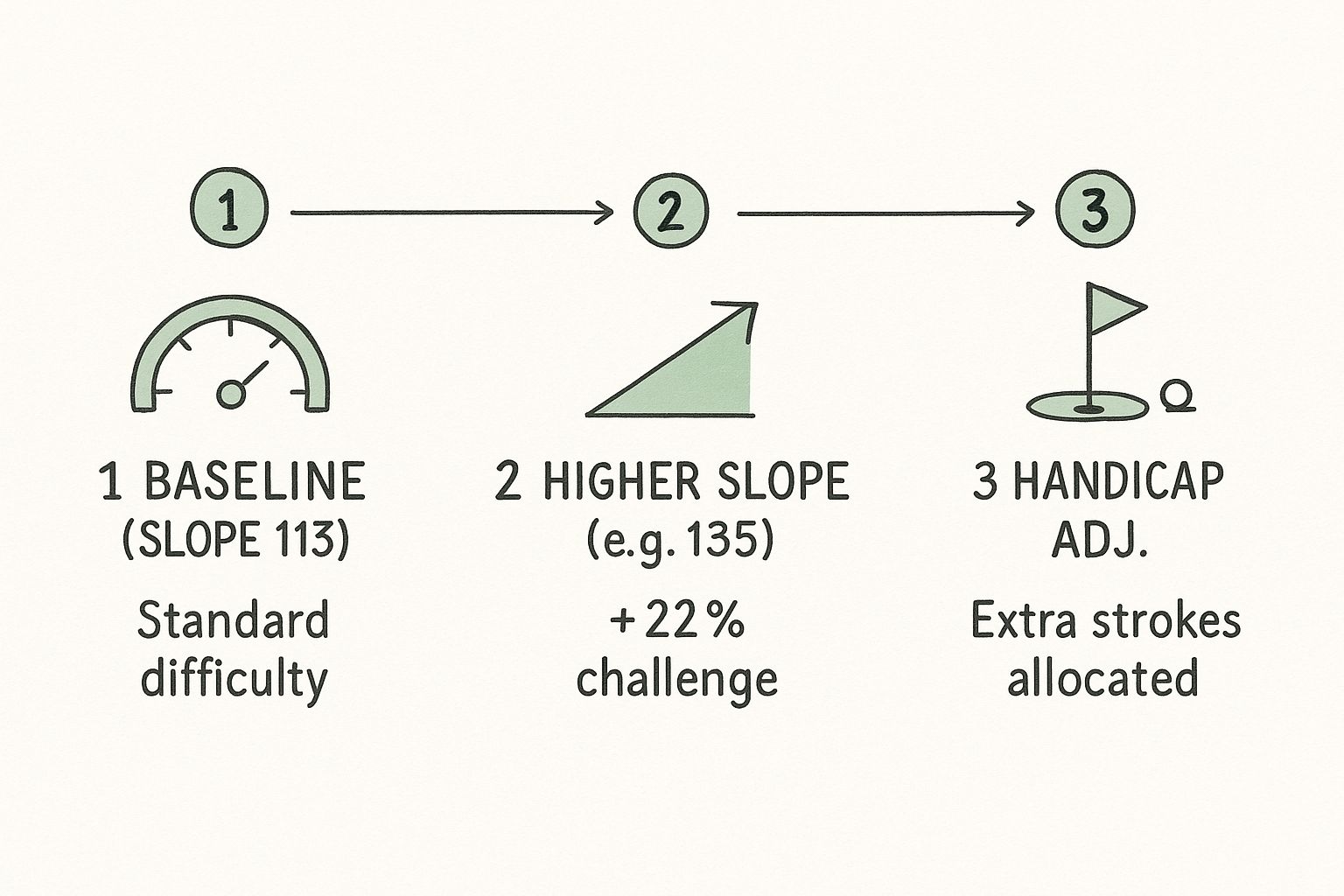
As you can see, when you step onto a tougher course, your handicap adjusts to give you more strokes, which is what keeps the game fair.
Making Your Golf Handicap Portable
At its core, the most important job of the Slope Rating is to make your handicap “portable.” Your official Handicap Index is a measure of your potential on a course of standard difficulty (that magic number, 113). But let’s be real, you rarely play a “standard” course.
That’s why you calculate a Course Handicap before every single round. The formula uses the Slope Rating of the specific tees you’re playing that day to adjust your Handicap Index up or down.
Think of your Handicap Index as your “traveling” handicap. The Slope Rating is like the local currency exchange rate—it converts your index into the right number of strokes for that course, on that day.
For instance, a golfer with a 15.0 Handicap Index would get 15 strokes on a course with a 113 slope. But if you take that same golfer to a championship-level beast with a slope of 141 (think Augusta National during the Masters), they would get a lot more strokes. This simple adjustment is what allows a 15-handicap from Florida to have a fair match against a 15-handicap from Scotland on a completely neutral course.
Without the Slope Rating, your handicap would be pretty much useless anywhere but your home club. It’s the key that unlocks fair competition across the entire world of golf, ensuring your skill—not the quirks of the course—decides the match.
How Are Golf Course Ratings Actually Calculated?
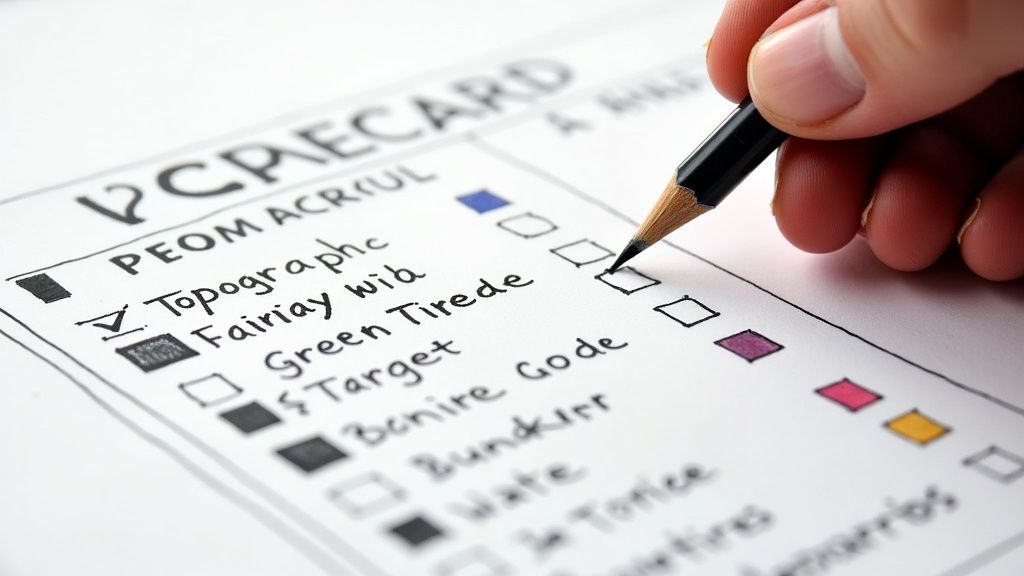
Those numbers you see on a scorecard, like 73.5/135, aren’t just pulled out of thin air. They’re the final product of a super detailed and objective evaluation carried out by a team of trained raters from an authorized golf association, such as the USGA or a state-level group.
These folks don’t just go out for a quick 18 and jot down their thoughts. Their process is a meticulous, hole-by-hole deep dive into the entire course, and they look at it from two totally different perspectives: the scratch golfer and the bogey golfer. That dual viewpoint is the secret sauce—the difference in how those two golfers experience the course is what ultimately shapes the Slope Rating.
Their mission? To turn every potential challenge on the course, from a tricky lie to an intimidating water hazard, into cold, hard data.
The On-Site Evaluation Process in Golf
The rating process is way more scientific than most golfers imagine. It all starts with measuring the course’s true playing length. This isn’t just about the yardage on the scorecard; they account for things like elevation changes, doglegs, and prevailing winds that can make a hole play much longer or shorter than it looks on paper.
Once they nail down that effective yardage, the team gets to work on a deep obstacle assessment for every single hole. They use a standardized checklist of ten specific factors that can add strokes to a player’s score.
This incredibly detailed evaluation becomes the course’s difficulty blueprint. It ensures the final numbers you see are a true reflection of every single challenge the course throws at you. For more on how these challenges are intentionally crafted, check out our guide to understanding golf course design and how it affects play.
A course rating is not an art; it’s a science. Trained raters systematically break down every hole into a series of data points, removing personal bias to create a standardized, objective measure of difficulty that is fair for every golfer.
The Ten Key Obstacle Factors in Golf
For each of the ten main obstacles, raters assign a number from 0 (non-existent) to 10 (extremely difficult). They do this twice for every single hole on the course—once from the perspective of a scratch player, and again for a bogey player.
This process gives them a massive amount of data on how different skill levels will handle the same challenges.
The table below breaks down the key factors raters are trained to evaluate. It’s a fascinating look into the science behind the numbers on your scorecard.
| Key Obstacle Factors in Course Evaluation |
| Obstacle Factor | What Raters Look For
| Topography | How do uphill/downhill shots impact play? Do uneven lies in the fairway make things tricky?
| Fairway | How wide are the landing zones for both scratch and bogey golfers? Tighter fairways get a higher score.
| Green Target | How tough is it to hit the green on approach? This considers the green’s size, firmness, and receptiveness.
| Rough and Recoverability | What’s the height and thickness of the rough? How hard is it to get back in play after a miss?
| Bunkers | Raters evaluate the size, depth, and placement of bunkers and how likely they are to catch a shot.
| Out of Bounds/Extreme Rough | How close is the OB to the fairway? How severe is the penalty for a major miss?
| Water Hazards | Is there water in play? Raters look at the likelihood of finding it and if it requires a forced carry.
| Trees | They assess the size, density, and strategic placement of trees that can block shots or force a certain play.
| Green Surface | This is all about the putting challenge—the contours, tiers, and overall speed of the greens.
| Psychological | This covers subtle, intimidating visual elements that can mess with a player’s decision-making.
This systematic approach ensures that every aspect of the course’s difficulty is captured and quantified fairly.
Completing the Difficulty Profile in Golf
After evaluating the course against all ten factors for both player types, all that data gets compiled.
It’s a mountain of information. We’re talking about hundreds, if not thousands, of individual data points covering every nook and cranny of the course.
Finally, this raw data is plugged into complex formulas developed by the USGA. These algorithms crunch the numbers and spit out the two final ratings that end up on the scorecard: the Course Rating and the Slope Rating. It’s a process built from the ground up to be consistent, objective, and fair for everyone who tees it up.
How to Calculate Your Golf Course Handicap
So, how do all these numbers—the Course Rating and Slope Rating—actually help you on the first tee? This is where the rubber meets the road. All that careful evaluation boils down to one simple, powerful purpose: turning your personal Handicap Index into a Course Handicap for the specific set of tees you’re playing today.
Think of your Handicap Index as your baseline skill level on a perfectly average course (one with a Slope Rating of 113). But let’s be honest, almost no course is perfectly average. They’re either tougher or easier, and your handicap needs to adjust accordingly. This quick calculation is what levels the playing field, ensuring a fair game whether you’re at your home club or a bucket-list destination.
The Golf Course Handicap Formula Explained
At first glance, the math might look a little intimidating, but it’s much simpler than it appears. This formula is the engine that makes the whole World Handicap System work, allowing you to take your game anywhere.
Here’s the official formula:
Course Handicap = Handicap Index x (Slope Rating / 113) + (Course Rating – Par)
Let’s break down what each part is actually doing:
- Handicap Index: This is your number. It’s a measure of your potential playing ability, ready to be adjusted for the course of the day.
- Slope Rating / 113: This is the heart of the adjustment. Dividing the course’s Slope by the baseline of 113 tells you how much harder the course plays for a bogey golfer versus a scratch golfer. If the result is above 1.0, you get extra strokes. If it’s below 1.0, you get fewer.
- Course Rating – Par: This is the final tweak. It accounts for the difference between the course’s difficulty for a scratch player (Course Rating) and its par, adding one last layer of precision.
This formula is the key to understanding what is a golf handicap and seeing how it applies universally, from the local muni to a U.S. Open venue.
Putting the Formula into Practice in Golf
Let’s walk through a real-world example to see how this all shakes out.
Imagine you’re a golfer with a 15.0 Handicap Index, and you’re trying to decide where to play today. You have two very different options.
Example 1: The Beastly Championship Course
- Slope Rating: 135
- Course Rating: 73.8
- Par: 72
Let’s plug those numbers into the formula:
- First, the Slope adjustment: 15.0 x (135 / 113) = 15.0 x 1.194 = 17.91
- Next, the Rating vs. Par tweak: 73.8 – 72 = 1.8
- Add them together: 17.91 + 1.8 = 19.71
After rounding, your Course Handicap for the day is 20. That tough slope and high course rating mean you get five extra strokes compared to your index. You’ll need them!
Example 2: The Friendly Local Track
- Slope Rating: 110
- Course Rating: 69.5
- Par: 71
Now, let’s run the numbers for the easier layout:
- First, the Slope adjustment: 15.0 x (110 / 113) = 15.0 x 0.973 = 14.59
- Next, the Rating vs. Par tweak: 69.5 – 71 = -1.5
- Add them together: 14.59 + (-1.5) = 13.09
On this course, your Course Handicap rounds down to 13. The easier setup means you actually get two fewer strokes than your index.
Why This Calculation Is a Game-Changer in Golf
This simple piece of math is the foundation of fair competition in golf. As you can see from our examples, the exact same 15.0 Handicap Index golfer gets a completely different number of strokes depending on the challenge ahead. They get 20 strokes on the brute and only 13 on the friendly neighborhood course.
That’s a massive seven-stroke difference, all made possible by the Course and Slope Ratings. The system ensures you’re playing against the unique difficulty of that specific course on that specific day. It’s what lets a 5-handicap and a 25-handicap have a genuinely competitive match. Before you tee off next, take thirty seconds to calculate your Course Handicap—it empowers you to play smarter and with a lot more confidence.
Finding and Using Golf Course Ratings in Your Game
Okay, you’ve got the theory down on what course rating and slope are. Now for the fun part: finding these numbers and actually using them to your advantage on the course. What good is knowing a course’s difficulty if you can’t find the info before you tee it up?
Thankfully, you don’t have to be a detective to track them down. Courses want you to know this stuff, so they make it pretty easy to find the Course Rating and Slope Rating for every set of tees.
Where to Find the Ratings in Golf
You’ll rarely have to search hard for these critical numbers. They are almost always displayed right where you’d expect to see them.
Here are the most common places to look:
- The Scorecard: This is the old-school, tried-and-true spot. Just about every scorecard has a little box listing the Course Rating, Slope Rating, and yardage for each tee color.
- On the First Tee: Lots of courses have a sign near the first tee box showing a map of the hole. Look closely, and you’ll usually find the ratings for all the tees listed right there.
- The Golf Course Website: In today’s world, most clubs put their scorecard or a dedicated ratings page right on their website. It’s a great way to check before you even leave the house.
- Official Handicap Apps: This is your most reliable digital source. An official handicap app, like the USGA’s GHIN system, has a massive, searchable database of every rated course in the country.
Don’t just glance at the ratings—actively use them. Picking a course or tee box that matches your game can be the difference between a fun, challenging round and a frustrating, demoralizing slog.
Applying Ratings to Your Golf Game Plan
Finding the numbers is step one. The real magic happens when you use them to make smarter choices about how and where you play. These numbers give you the power to shape your golf experience for max enjoyment and the right amount of challenge.
For instance, if you’re a high-handicapper looking for a round to build some confidence, seek out a course with a lower Slope Rating, maybe something under 120. On the flip side, if you’re a low-handicapper gearing up for a tournament, you might want to test yourself on a beast with a Slope above 135 to see what your game is really made of.
This strategic approach ensures every round serves a purpose, whether it’s for fun, practice, or serious competition.
Understanding What is Course Rating and Slope
To fully appreciate the game, it’s crucial to grasp what is course rating and slope, as these two metrics shape your golfing experience.
FAQ’s
Even after getting the hang of Course and Slope Ratings, a few tricky questions always seem to pop up. Let’s walk through some of the most common ones golfers ask. Clearing these up will help you use this knowledge to your advantage on the course.
Can a Course Have a High Course Rating but a Low Slope?
You bet. It might sound strange, but it happens. This kind of course is a specific beast: it’s incredibly long but doesn’t have a lot of teeth. Picture a wide-open, 7,500-yard track with hardly any hazards, flat greens, and barely any rough.
For a scratch golfer, that sheer length is a massive challenge, earning it a high Course Rating. But for a bogey golfer, there’s not much trouble to get into—no water to carry, no deep bunkers to escape. Because the difficulty doesn’t ramp up much for the average player, it gets a low Slope Rating.
This is where the handicap system really shines. It understands that “hard” means different things to different golfers. Length is a huge deal for scratch players, but for bogey players, it’s often the hazards and the chance to recover from a bad shot that matter more.
How Often Are Golf Courses Re-Rated?
Courses don’t get rated once and then left alone for good. Typically, an authorized golf association will swing by to re-evaluate a course every 10 years or so, just to make sure the numbers are still accurate.
But that timeline can get fast-tracked. The biggest reason for a sooner re-rate is a major renovation. If a club decides to overhaul its layout, a new evaluation is a must. Common triggers include:
Adding or taking away multiple sets of tees
Completely redesigning the green complexes
Putting in new water hazards or changing the bunker strategy
Any of these can totally change how a course plays, so the Course and Slope Ratings need a fresh look to keep your handicap calculations fair and accurate.
Do Weather Conditions Affect the Official Rating?
Great question. The simple answer is no—the numbers printed on the scorecard don’t change with the weather. The Course and Slope Ratings are set based on normal playing conditions for that area. Think of them as the baseline difficulty.
But the World Handicap System (WHS) has a pretty slick way to account for a brutal day on the links. It’s called the Playing Conditions Calculation (PCC).
Here’s how it works: the system looks at all the scores posted on a course for a specific day. If everyone’s scores are way higher than expected—maybe due to howling winds, pouring rain, or punishing tournament pin positions—the PCC automatically applies an adjustment. This little tweak ensures one tough round doesn’t unfairly tank your Handicap Index.
At Golf Inquirer, we believe diving into the details of the game, like Course and Slope Rating, makes every round that much better. Check out our magazine for more deep dives, course reviews, and gear guides to help you play your best. Discover more at https://golfinquirer.com.