Putting is the one part of golf where “feel” sounds like a soft concept, yet it shows up on the scorecard in the loudest way possible. That’s why the mallet vs. blade question never really goes away. The right choice can make your start line look cleaner, your misses smaller, and your speed control more predictable.
Still, this is not a personality quiz. It’s mostly physics, stroke shape, and how your eyes like to aim.
- What actually changes when you switch heads?
- What is the primary physical difference in appearance between a blade putter and a mallet putter?
- Which putter type—blade or mallet—generally offers more forgiveness when you hit the ball off-center (miss the sweet spot), and why?
- How do you generally match a blade or mallet putter to your natural putting stroke (straight-back-straight-through vs. an arcing stroke)?
- Which type of putter is traditionally known for providing more "feel" and feedback, and which is often praised for easier distance control on long putts?
What actually changes when you switch heads?
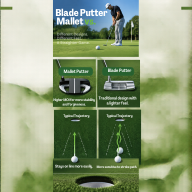
A blade putter is compact, traditional-looking, and typically built as a simple heel-toe shape. A mallet is larger and extends rearward, often with wings, cavities, or “two-ball” style shapes. That extra real estate is not just for looks. It lets designers push mass away from the face and out toward the perimeter, which raises MOI (moment of inertia), meaning the head resists twisting when you miss the center.
That one detail explains why many golfers immediately feel “steadier” with a mallet, especially on short putts under pressure.
Blades fight back a little more on mishits. Some golfers love that because the feedback is instant and honest. Others find it punishing.
Here’s a compact way to think about it:
| Feature | Blade putter | Mallet putter |
|---|---|---|
| Head size | Small and narrow | Larger, extends back |
| MOI stability | Lower, more twist on misses | Higher, more resistant to twist |
| Sweet spot | Smaller | Larger |
| Alignment visuals | Usually minimal (line or dot) | Often bold lines, shapes, and contrast |
| Typical balance | More toe-hang options | Many face-balanced options (toe-hang exists too) |
| Feel at impact | Crisp, lots of feedback | Often softer or more muted |
| Common build | One-piece milled steel | Often multi-material with perimeter weighting |
One sentence takeaway: mallets tend to protect you from your average strike, blades tend to tell you the truth about it.
Golf Stroke match: face balance, toe hang, and your natural arc
Your putter head style matters less than your putter balance. A lot of people buy a “mallet” thinking it’s automatically for a straight stroke, or buy a “blade” assuming it’s automatically for an arcing stroke. The more accurate idea is this: face-balanced designs often suit straighter strokes, and toe-hang designs often suit strokes with more arc.
Face-balanced means the face wants to stay looking up when you balance the shaft on a finger. Toe-hang means the toe droops down, which encourages the face to rotate more naturally.
So what stroke do you have?
Most golfers have some arc, because the putter swings on a tilted plane. The question is how much arc you create, and whether you tend to fight the putter face (pushing it open, flipping it closed, or steering it).
If you want a simple self-check, try these after you’ve rolled a few putts to get loose:
- Balance test: Rest the shaft on one finger and see if the face points up (face-balanced) or the toe drops (toe-hang).
- Stroke trace: Roll five 8-footers while a friend watches from behind, note if the head tracks fairly straight or swings inside on the backstroke.
- Short arc
- Strong arc
- Miss pattern: Repeated misses right can point to a face that stays open (often helped by more toe-hang), repeated misses left can point to a face that closes too easily (often helped by more face balance).
That last bullet is not a strict rule, but it’s a useful clue when your reads are decent and the ball still keeps missing on the same side.
Forgiveness vs. feedback: what you gain, what you give up in Golf
Mallets are popular because they can make a “good miss” better. Catch the ball a half inch toward the toe and a high-MOI head is less likely to twist, so the face angle at impact changes less, and the ball starts closer to where you aimed.
That’s also why mallets often feel great from five feet. You tend to get more putts that start on line, even when contact is not perfect.
Blades can shine when you are prioritizing speed control and face awareness. The head is usually smaller and sometimes slightly lighter, and the feedback through your hands can be more detailed. On long putts, that detail can help you calibrate pace, especially if you like to feel the strike rather than rely on a heavy head “doing it for you.”
There’s also a mental side here. Some players stand over a big mallet and feel guided. Others feel crowded and start manipulating the stroke. Some players look down at a blade and feel free. Others feel they have to be too perfect.
Neither reaction is wrong. It’s information you can use.
Alignment is a skill, not just paint
A mallet often comes with more alignment help because it has more surface area for lines, dots, channels, and contrasting colors. If you struggle to aim the putter face consistently, those visuals can be a real difference maker.
A blade tends to give you a clean look, which is great if your eyes naturally aim well, or if busy alignment marks make you overthink.
At Golf Inquirer, we keep coming back to a simple point: putter choice works best when it supports solid setup habits. If your eyes are not in a repeatable place, or your shoulders aim left while your putter aims right, no amount of alignment paint can save you.
A quick practice option that pairs well with either style is an “alignment gate” using two tees (or two alignment sticks) to train start line.
- Goal: Start the ball on your intended line without “cheating” the face.
- Setup: Place two tees just wider than your ball, about 6 to 12 inches in front of it on your start line.
- Progression: Begin at 3 feet, make 10 clean rolls, then move to 5 feet while keeping the same tempo.
This drill is simple, but it exposes face control fast. Many golfers learn that their “bad read” was actually a face that was never aimed where they thought.
The fit variables that beat the head style
It’s tempting to treat mallet vs. blade as the main decision. In reality, basic fit can overwhelm head shape.
A putter that’s too long often forces you more upright, changes where your eyes sit relative to the ball, and can push the toe up at address. A putter that’s too upright or too flat can also change face direction at impact because the sole is not interacting with the turf the way it was designed to.
If you only do three checks when testing putters, do these:
- Length: Can your arms hang naturally, with your eyes comfortably over or slightly inside the ball line?
- Lie: Does the sole sit flush, not toe-up or heel-up?
- Loft and launch: Does the ball start rolling quickly, or does it skid and hop?
Many golfers are shocked by how quickly their aim improves when length and lie match their posture, even with the same head style they’ve been using for years.
Who tends to prefer what (and why it keeps changing)
Beginners often do well with mallets because the stability and alignment cues reduce the penalty for imperfect contact. When you are learning to start the ball on line, a bigger sweet spot and a quieter face can keep the experience positive.
Intermediate golfers are where things get interesting. This is the group that usually has a recognizable stroke pattern and a repeatable pace, but still carries a common weakness: either short-putt nerves or inconsistent speed on long putts. A mallet can calm the short game down. A blade can sharpen distance feel. Many golfers end up in the middle with “cavity blade” shapes or compact mallets that blend both.
Advanced players can succeed with either, and plenty of great putters have used blades for decades. At the same time, more elite players have moved into mallets in recent years because the modern designs raise the floor on off-center strikes and can help start line consistency. When the margins are tiny, a slightly better “average” roll matters.
So if you love the look of one style, you are not locked in. Trends shift because equipment changes, and because golfers change.
A practical tryout plan for your next testing session
Trying putters by rolling two random balls on a practice green is how a lot of money gets wasted. You want a quick test that separates aim, start line, and speed.
Bring one ball, pick one hole, and keep your routine consistent. Then do a short session that forces real comparisons.
- 10 putts from 5 feet (flat if possible)
- 10 putts from 15 feet (a gentle breaker)
- 5 lag putts from 30 feet (focus on finishing distance)
Pay attention to what misses look like. With one putter you might miss in the correct direction but with poor speed. With another you might control speed but start it offline. That difference tells you what the head is doing for your stroke.
After that, check one last thing that golfers skip: how you aim it before you make a stroke. Set the putter down, step back, and see if it’s actually aimed where you think it is. If a mallet’s alignment makes your aim more reliable, that’s a big deal. If a blade frames the ball better for your eyes, that’s also a big deal.
The best putter is the one that lets you set up calmly, aim clearly, and roll your stock stroke without mid-stroke corrections. That can be a blade. That can be a mallet. Your job is to find the one that makes the simple version of your putting show up more often. To see more click here
FAQ’s
What is the primary physical difference in appearance between a blade putter and a mallet putter?
Blade Putters: These have a traditional, classic, and sleek design. They are typically narrow and thin from front to back, looking more like a traditional iron or blade.
Mallet Putters: These have a much larger, heavier, and more rounded or geometric head shape. The mass is often spread wider or stretched further backward behind the face to include alignment lines, shapes, or cutouts.
Which putter type—blade or mallet—generally offers more forgiveness when you hit the ball off-center (miss the sweet spot), and why?
Mallet putters generally offer more forgiveness. Because of their larger size and design, manufacturers can push more weight to the perimeter and the back of the clubhead. This higher MOI (Moment of Inertia) prevents the putter face from twisting when you strike the ball off-center, helping off-center putts stay closer to your intended target line and distance.
How do you generally match a blade or mallet putter to your natural putting stroke (straight-back-straight-through vs. an arcing stroke)?
Arc Stroke (Door-Open-Door-Close): Golfers with an arcing stroke usually benefit from blade putters (or mallets with specific “toe-hang” hosels) because the design encourages the putter face to rotate naturally during the stroke.
Straight-Back-Straight-Through Stroke: Golfers who take the putter straight back and through usually prefer face-balanced mallet putters, which are designed to resist rotation and keep the face square to the target line throughout the stroke.
Which type of putter is traditionally known for providing more “feel” and feedback, and which is often praised for easier distance control on long putts?
Blades are traditionally known for providing sharper feel and feedback. Because they have less mass, you can feel more precisely where you hit the ball on the face.
Mallets are often praised for making distance control easier on long putts. Their higher stability means that even if your stroke speed varies slightly or you miss the center, the ball tends to roll out more consistently.
At Golf Inquirer, we believe that understanding the game is the first step to enjoying it more. For more tips, gear reviews, and course guides to fuel your passion for golf, visit us at https://golfinquirer.com.