
If you’ve ever hit a shot that felt perfect, only to watch it sail stubbornly offline, you know one of golf’s deepest frustrations. You start questioning your grip, your swing, your timing… but what if the real problem was locked in before you even started your takeaway? Understanding how to aim in golf is crucial.
More often than not, the culprit isn’t your swing—it’s your aim.
In this article, we will explore effective techniques on how to aim in golf, ultimately helping you achieve lower scores.
Why Your Golf Aim Is Quietly Sabotaging Your Swing
Here’s a secret that great players understand: a bad swing is often just an athletic reaction to a bad setup. Your body is incredibly smart; if it senses the clubface is pointing away from the target, it will instinctively try to reroute the club mid-swing to get the ball back on line.
This subconscious correction is the hidden source of so many slices, hooks, and that dreaded feeling of inconsistency. You’re not fixing a swing flaw in the moment; you’re creating one by trying to overcome a setup mistake.
The Clubface vs. Body Alignment Riddle in Golf
To truly master your aim, you have to get your head around a two-part puzzle. Picture a set of railroad tracks leading to your target.
- Clubface Aim: This is the inner rail. It’s where the face of your club is pointed, and it’s the #1 factor determining where your ball starts its flight.
- Body Alignment: This is the outer rail. It’s the line created by your feet, hips, and shoulders. This line should run parallel to your target line, not directly at it.
The classic amateur mistake? Aiming the entire body—feet, hips, and shoulders—right at the flagstick. For a right-handed player, this almost guarantees the clubface will be pointing wide right of the target, forcing you to make that compensating, inconsistent swing.
“Many swing flaws are not flaws at all. They are athletic compensations to a faulty setup. If you set up poorly, you will have to make an athletic move to get the ball to the target.”
So, what’s the difference between these two critical setup concepts? Let’s break it down.
Aim vs Alignment Key Differences in Golf
This table clears up the two most critical setup concepts in golf and why they both matter so much.
| Concept | What It Controls | Common Mistake |
|---|---|---|
| Clubface Aim | The ball’s initial starting direction | Pointing it somewhere other than the intended start line. |
| Body Alignment | The swing path the club will follow | Pointing your feet/shoulders directly at the target instead of parallel to it. |
Getting these two elements to work in harmony is the foundation of a repeatable, accurate golf shot.
One of the biggest reasons golfers rush this process and get it wrong is a simple lack of focus. Exploring strategies to improve mental clarity and focus can make a huge difference in your pre-shot routine. A clear mind lets you slow down and set up correctly every single time.
Your Repeatable Process for Perfect Aim in Golf
The secret to consistently good golf isn’t a magical swing thought you stumble upon. It’s a rock-solid, repeatable process that begins long before you think about swinging. Let’s get one thing straight: if you’re aiming with your feet first, you’re setting yourself up for failure. That one mistake is the root of so many compensations and offline shots.
Instead, we’re going to build a routine that puts the clubface in charge, right where it belongs.
This whole process kicks off from a different perspective: standing several feet directly behind your golf ball, looking straight down the line toward your target. From here, you get a clean, unbiased view of the shot you want to hit. Take a second to really see the ball’s entire flight—the launch, the curve, and where it’s going to land.
Find Your Intermediate Target
Now for the single most important part of aiming correctly. While you’re still behind the ball, find an “intermediate target.” This isn’t the flagstick or the middle of the fairway. It’s a tiny, specific point just one to three feet in front of your ball that sits perfectly on your target line.
This could be anything:
- A blade of grass that’s a slightly different color
- A fallen leaf or a small twig
- The edge of an old divot
This little spot is your new mission. It is infinitely easier to aim your clubface at something two feet away than something 200 yards downrange. This simple trick takes the overwhelming scale of the golf course completely out of the equation.
By focusing on a nearby spot, you simplify the task of aiming from a long-distance challenge to a short, precise placement. It’s the single most effective way to guarantee your clubface is pointing exactly where you want it.
Once you’ve locked onto your intermediate target, you can walk into the shot. The first thing you do is place the clubhead down, aiming its leading edge squarely at that leaf or blade of grass. Don’t even think about your feet until that clubface is set perfectly. This is your foundation.
This infographic breaks down the destructive chain reaction that starts with even the slightest bit of poor aim.
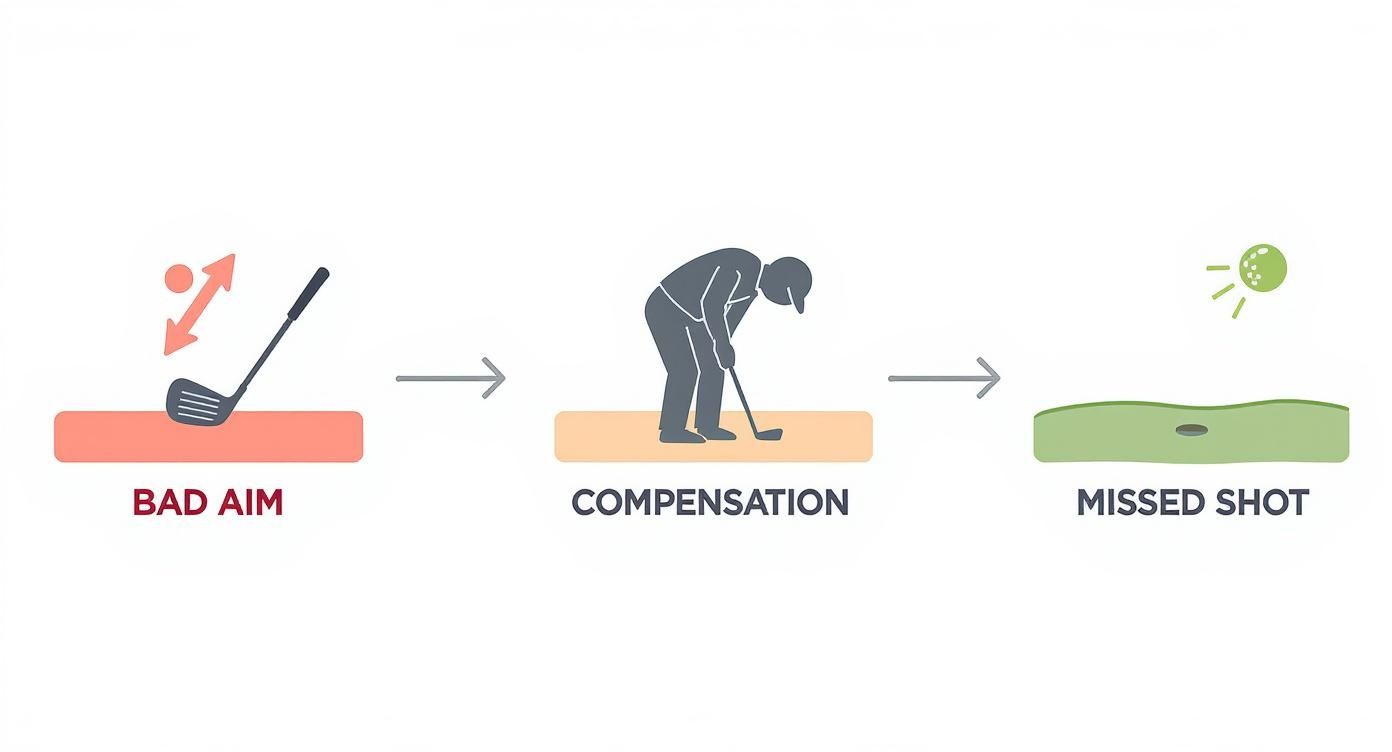
As you can see, a tiny aiming error forces your body to make a major swing compensation, which almost always leads to a missed shot.
Build Your Stance Around the Clubface
Only after the clubface is aimed correctly do you build your stance around it. This is where the “railroad tracks” imagery really comes to life. Your clubface is pointed down one rail, aimed directly at the intermediate target. Your body—that’s your feet, hips, and shoulders—should align with the other rail, running perfectly parallel to the first.
Think of it this way:
- Clubface First: Sole the club behind the ball. Aim the face directly at your intermediate target.
- Feet Next: Set your feet. The line across your toes must be parallel to the line your clubface is on.
- Hips and Shoulders Last: Finally, get your hips and shoulders to match your feet, completing that parallel setup.
This clubface-first approach guarantees your body alignment is supporting your aim, rather than dictating it. By making this routine a non-negotiable part of every single shot, you eliminate the guesswork and create a reliable foundation for a consistent, on-target swing. Your body will stop trying to make those last-second, miracle adjustments because you’ve already done the hard work correctly from the start.
How to Aim Strategically on the Golf Course
A repeatable aiming process is your ticket to consistency, but scoring well requires more than just pointing the club in the right direction. The best golfers elevate aiming from a mechanical task to a strategic weapon. They’re not just hitting shots; they’re playing a game of chess against the course, and their aim is the opening move.
This means you stop seeing the flagstick as your only target. Instead, you start seeing the entire green or fairway as a collection of smart targets and no-go zones. That mental shift is what separates the scratch players from the mid-handicappers struggling to break 90.
Think Like a Scratch Player
The single best way to slash strokes off your score isn’t about making more birdies—it’s about making fewer double bogeys. The quickest path to that? Aim for the fattest part of the green, every single time, regardless of where the pin is. That tricky pin tucked behind a bunker is a sucker’s bet for most amateurs.
PGA Tour data reveals a fascinating truth: long-game accuracy and smart target selection are what truly separate the best from the rest. Data shows that amateurs with handicaps above 15 miss the green a staggering 60% of the time from just 100 yards out. Why? Often, it’s because they’re firing at flags instead of playing the percentages.
Aiming for the center of the green dramatically increases your chances of hitting it, which is the fastest way to better scores. If you’re interested in the numbers, you can discover more about how data analytics is changing golf strategy and learn from these findings.
This strategic thinking isn’t just for your approach shots, either. It applies to every club in the bag.
Factoring in the Variables
Once you’ve picked a smart target, you have to adjust for the day’s conditions. Great aim isn’t static; it’s a dynamic skill that adapts to the environment.
Here are the key variables you absolutely must consider:
- Your Natural Shot Shape: If you play a consistent fade (left-to-right for a right-hander), you need to aim to the left of your real target. Let your natural ball flight bring the shot back. Fighting your go-to shape is a recipe for disaster.
- Wind Direction and Strength: A crosswind is a game-changer. If you have a 15 mph wind blowing from left to right, you need to aim significantly left of your target and let the wind push the ball back. Don’t try to hold the ball against the wind; learn to use it.
- Elevation Changes: An uphill shot will generally fly shorter and might draw more, so you may need more club and aim slightly to the right. A downhill shot will fly longer and tend to fade, so you might club down and aim a bit left.
Your goal on every shot should be to select a target that gives your most common shot pattern the best chance of ending up in a good spot. It’s all about managing your misses.
Think about it this way: you’re on a par 4 with water all down the right side. The smart play is to aim for the left side of the fairway. This gives you a massive buffer. Even a poorly struck shot will likely find the short grass or left rough, keeping you in the hole. An aggressive line down the middle brings that water directly into play. Strategic aiming is just good risk management.
Golf Drills to Make Accurate Aim Automatic
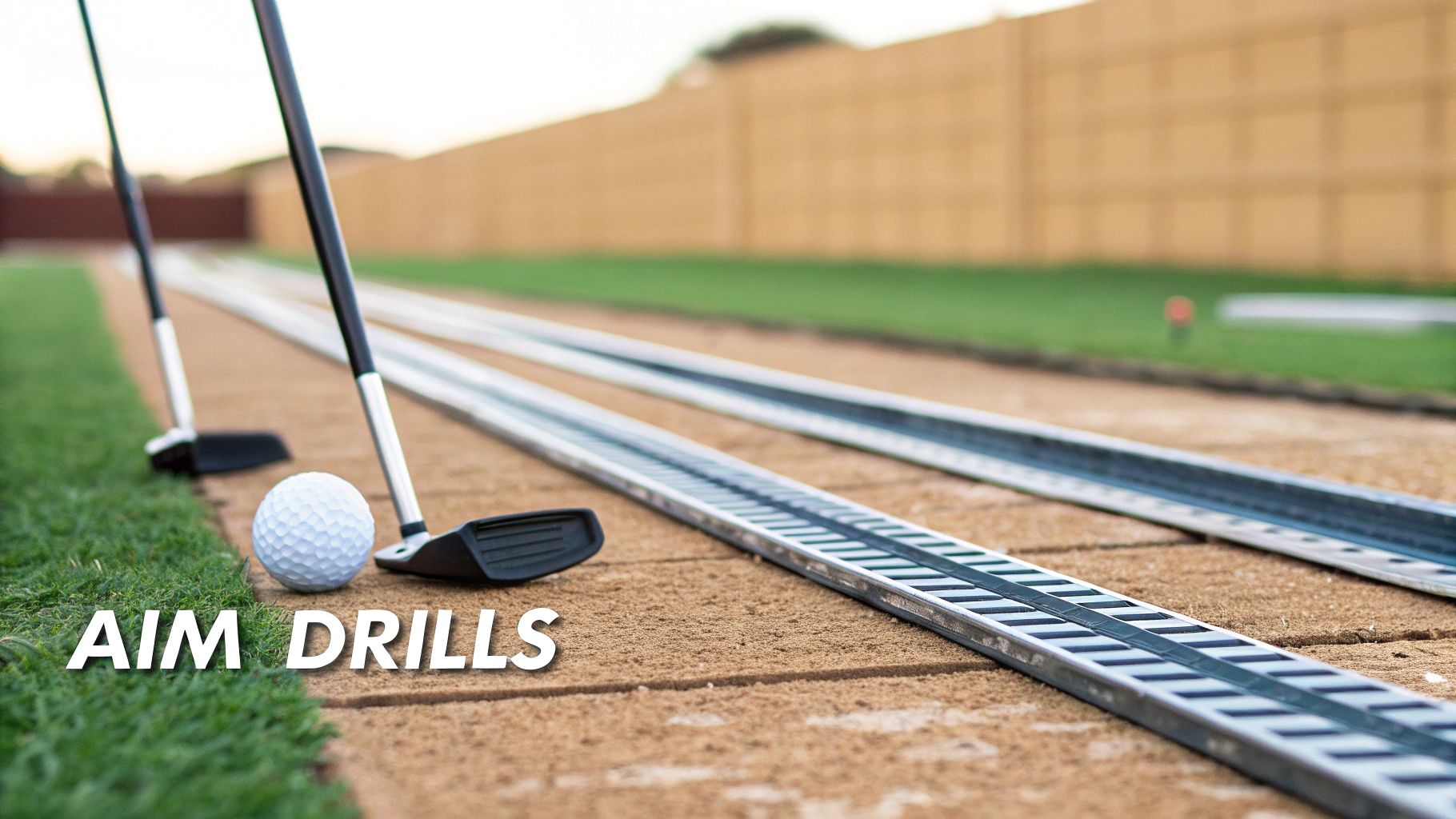
Consistent aim isn’t something you just learn; it’s a skill you have to train until it becomes second nature. To get there, you’ve got to move beyond theory and put in the reps on the driving range.
The real goal is to build such strong muscle memory that you can trust your setup under pressure without overthinking it. These drills are designed to do just that—hardwire the correct aiming process into your brain and body by giving you instant, powerful feedback that’s impossible to ignore.
The Railroad Tracks Drill in Golf
This is the absolute foundation for anyone serious about aiming correctly. It gives you a clear, undeniable visual of the parallel lines you need to create with your clubface and your body. It’s a game-changer.
- Equipment Needed: Two alignment sticks or even a couple of extra golf clubs.
- The Setup: Lay one stick on the ground pointing straight at your target. This is your ball-to-target line. Now, place the second stick parallel to the first, just inside where your feet will go. This one represents your body line.
- The Feel: When you take your stance, your toes should be right up against that body-line stick. Look down. You should see perfect railroad tracks. This setup forces you to feel the difference between where your club is aimed and where your body is aligned.
With this visual guide, you can hit shot after shot knowing your alignment is spot-on. If you want to go deeper, exploring some excellent golf alignment stick drills can add even more variety to your practice.
The railroad tracks drill removes all the guesswork. If your shots are still flying offline, you know the problem is your swing path or clubface at impact—not your initial aim.
The Gate Drill in Golf
Once you’ve grooved your overall alignment, the gate drill helps you dial in your clubface control and ensures the ball is starting on your intended line. A shot that starts online has a much, much higher chance of finishing there.
This one is brilliant for golfers who struggle to consistently hit their intermediate target.
- Equipment Needed: Two golf tees. That’s it.
- The Setup: After setting your alignment, stick two tees in the ground about a foot in front of your golf ball. They should be just slightly wider than the ball itself, creating a narrow “gate” for the ball to pass through on its way to the target.
- The Feel: The challenge is simple: hit the ball clean through the gate without clipping either tee. This sharpens your focus like a laser on starting the ball exactly where your clubface is pointed. Getting it through the gate is that immediate, positive feedback that tells you you’ve delivered the club correctly.
By making these two drills a regular part of your practice, accurate aim stops being a conscious chore and starts becoming an automatic, confident part of your setup.
Using Tech to Diagnose Your Aiming Faults in Golf

In golf, what you feel and what’s real are often two completely different things. You might swear you’re aimed perfectly down the pipe, but the ball flight tells a totally different story. Instead of falling into the trap of endless guessing, you can use modern tech to get cold, hard facts about your alignment and shot patterns.
And the best part? You already have an incredibly powerful diagnostic tool right in your pocket. Your smartphone camera is all you need for tour-level feedback on your setup.
It’s simple. Just prop your phone up on a tripod or your golf bag to record your setup from a “down-the-line” view. This angle, looking straight from behind you toward the target, reveals the unfiltered truth about your body’s alignment. You’ll see instantly if your shoulders, hips, and feet are actually parallel to the target line or if they’re pointing somewhere else entirely.
Uncovering Your True Miss Pattern
Beyond your phone, more advanced tools can give you even deeper insights into where your shots are really going. This is where shot-tracking apps and personal launch monitors are game-changers. These devices track every shot, revealing your specific dispersion patterns over hundreds of swings.
Seeing your shot groupings plotted on a screen is an eye-opener. You might discover that 80% of your missed fairways are to the right. That’s not just a random bad shot; it’s a consistent, predictable pattern.
That consistent miss 15 yards to the right of your target probably isn’t a swing flaw. It’s an aiming problem that you can correct on the very next shot by adjusting your starting line.
This data-driven approach takes all the frustration and guesswork out of practice. Advanced launch monitors give you precise ball flight data, letting you analyze your misses with quantitative certainty. What the data often shows is that golfers have highly repeatable miss patterns, and simply adjusting the aim point can produce immediate improvement.
By embracing these tools, you stop making adjustments based on vague feelings and start making them based on facts. You can check out our guide on the best golf launch monitor options to find a tool that fits your budget and practice needs. This technology transforms practice from a guessing game into a focused, efficient process for real improvement.
FAQ’s
Even when you feel like you’ve got a solid pre-shot routine, the golf course has a way of throwing curveballs that make you second-guess everything. Let’s tackle some of the most common questions that pop up when you’re standing over the ball, wondering where on earth to point.
Getting these right can be the difference between a tap-in birdie and a frustrating bogey.
Should My Body Point at the Target?
This is easily the biggest alignment mistake I see amateur golfers make. The short answer is no. The only thing that should point directly at your target (or your intermediate spot) is the clubface.
Think of it like this: your body—your feet, hips, and shoulders—should be set up parallel to your target line. It’s the classic railroad track analogy for a reason. One rail points to the target (the ball and clubface), and the other rail (your body) runs parallel to it. If you aim your body at the pin, you’re almost guaranteed to swing “over the top,” leading to a pull or a slice.
How Can I Double-Check My Aim During a Round?
You don’t need to carry alignment sticks with you to make sure you’re set up correctly. The quickest and easiest way is to just use the club in your hands.
Once you take your stance, hold the club across your chest, resting it on your shoulders. Step away and take a look. For a right-handed golfer, the shaft should be pointing parallel left of your final target, not right at it. You can do the same thing by placing the club on the ground against your toes. It’s a five-second check that can save you a world of hurt.
What’s the Trick to Aiming on Uneven Lies?
Uneven lies are where great aim really pays off, because the slope itself is going to change where the ball goes. You have to play chess, not checkers, and aim for the shot the hill will give you.
Here’s a quick guide to get you started:
Ball Above Your Feet: The slope will naturally make the ball fly left. You need to aim a bit to the right of your target to counteract it.
Ball Below Your Feet: This lie promotes a shot that flies to the right. Aim a little to the left to bring it back online.
Uphill Lie: The slope adds loft to your club and usually sends the ball left. Again, aim a little to the right.
Downhill Lie: This lie de-lofts the club and often causes a miss to the right. You’ll want to aim a touch left of where you want the ball to end up.
When you’re starting out, make small adjustments. A few feet is often all it takes. With a little practice, you’ll get a feel for how much different slopes impact your shots.
At Golf Inquirer, we’re all about breaking down the fundamentals to help you play better, more enjoyable golf. For more tips, in-depth gear reviews, and guides to courses you’ll love, check out our other resources at https://golfinquirer.com.