The spot in your bag between fairway woods and mid irons can feel like a constant negotiation. Some days you want height and carry. Other days you want a flatter flight you can steer. That’s why the hybrid vs. long iron question keeps coming back, even for golfers who already “know” what they prefer.
At Golf Inquirer, we like to treat this decision like good course management: pick the tool that gives you the highest chance of a useful miss. Not the most impressive shot on the range, the most reliable shot on the course.
- What actually separates a hybrid from a long iron in Golf ?
- The flight you get in golf : high-and-soft vs. low-and-chasing
- Quick comparison table: what changes in real golf play
- When a hybrid is the better call in golf
- When a golf long iron still earns a spot
- Lie matters more than loft in golf
- Distance gaps: the sneaky reason people struggle with hybrids in golf
- A simple on-golf course decision filter
- A practical guide by situation
- How to hit each golf club without overthinking it
- Building a smarter top end of the bag
- FAQ's
What actually separates a hybrid from a long iron in Golf ?
A hybrid is built like a small fairway wood that’s shaped to look more iron-like at address. Most hybrids have a larger, hollow head, a shallower face, and a wide, rounded sole. That design pushes weight low and back in the clubhead, which tends to help the ball launch higher and stay online when you miss the center. To learn more click here
A long iron (think 3, 4, and often 5 iron) is a more compact, solid-headed club with a higher center of gravity and less built-in help. When you strike it well, it can produce a strong, penetrating flight and consistent distance windows. When you miss it, the drop-off in carry can be steep.
One quick note that surprises a lot of golfers: the hybrid that “replaces” your 4 iron might not go the same distance as your 4 iron. Hybrids can fly farther at the same stated loft because of head design, shaft length, and how they deliver speed and launch.
The flight you get in golf : high-and-soft vs. low-and-chasing
Most golfers see a clear pattern:
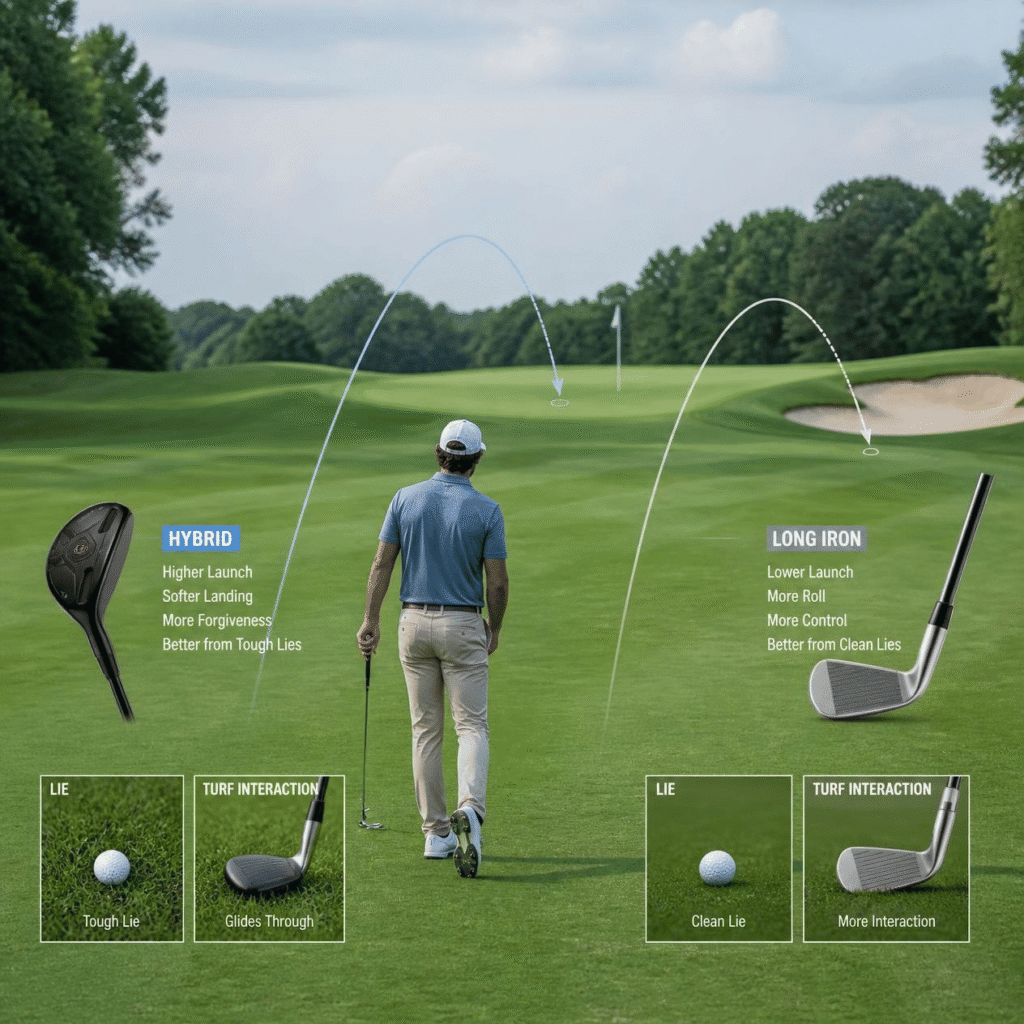
- Hybrids launch higher and land steeper, which helps approach shots stop on the green.
- Long irons tend to fly lower with more run, which can be useful in wind or when you want the ball to chase up a firm fairway.
Neither is automatically better. The better choice is the one that matches the shot you need and the strike you can repeat.
Here’s a simple way to think about it: if your “typical” contact is slightly thin or slightly toward the toe, a hybrid usually keeps the shot playable. If your “typical” contact is centered and you like controlling trajectory, a long iron might feel like home.
Quick comparison table: what changes in real golf play
| Category | Hybrid (typical) | Long Iron (typical) |
|---|---|---|
| Launch and landing | Higher launch, steeper landing | Lower launch, more roll |
| Forgiveness on mishits | Higher | Lower |
| Rough and uneven lies | Usually better | Can snag and lose speed |
| Working the ball | Often wants to fly straight, can be draw-biased | Easier to shape for skilled players |
| Best miss | Often short but near line | Can be short and offline if strike is poor |
| Common roles | Long approaches, rescue shots, tight-tee club | Wind shots, punch shots, precision gaps |
When a hybrid is the better call in golf
A hybrid is at its best when you need help getting the ball up, or you need the club to keep doing its job even when your strike is not perfect.
After you’ve looked at the lie and the carry number, a hybrid is often the practical play in these situations:
- Thick rough
- A ball sitting down
- A long carry over trouble
- A long approach into a firm, elevated, or guarded green
- A tight tee shot where you still want some height
A lot of golfers also like hybrids on par 3s in the 170 to 210-yard range, because the higher flight gives you a better chance to hold the green. Even when you miss, you’re more likely to finish somewhere pin-high rather than coming up well short.
After a paragraph like that, the most useful next step is to decide what you want your “default” long-game club to do. Here are the hybrid strengths that show up most often on the course:
- Easy launch
- Helpful from messy lies
- Confidence on long carries
- Solid distance even on slight mishits
When a golf long iron still earns a spot
Long irons are not outdated. They’re just more demanding. If you have the speed to launch them and the consistency to strike them, they can give you a flight that a hybrid sometimes struggles to copy.
A long iron often makes sense when your priority is controlling height and direction in tougher conditions. It can be the right play when:
- The wind is up and you want to keep the ball down.
- You need a controlled chase shot into a backstop or up a ramped fairway.
- You’re playing under tree branches and need a true punch.
- Your hybrid tends to over-draw and you want a straighter start line.
This is also where better players often separate themselves: they can vary trajectory with a long iron without changing the club. A hybrid can be worked, but many models are designed to help the ball launch and turn over. That can be great until the hole screams “hold it off into the wind.”
Lie matters more than loft in golf
Golfers love debating loft charts. Loft is important, but lie is often the deciding factor.
A hybrid’s wider sole tends to glide through grass. A long iron’s thinner sole can cut cleanly through a tight fairway, yet it can also dig or twist when the ball is sitting down. So before you pick based on yardage, take two seconds to rate the lie:
If the ball is sitting clean and you can strike down on it, the long iron has a fighting chance.
If the ball is sitting low, slightly behind grass, or on an uneven patch, the hybrid usually gives you more margin.
Distance gaps: the sneaky reason people struggle with hybrids in golf
One of the most common bag problems we see is a distance overlap that makes decision-making harder, not easier.
Because hybrids can be longer than the irons they “replace,” you can end up with two clubs that go the same number. Or you might create a bigger gap above your longest iron than you planned. That’s why your set makeup should be based on your carry yardages, not the number on the sole.
This table gives a rough feel for how loft and carry can differ between long irons and comparable hybrids (your results will vary with speed, strike, and shaft):
| Club | Typical Loft Range (°) | Common Carry Tendency |
|---|---|---|
| 3 iron | 18 to 20 | Lowest launch, demands speed |
| 4 iron | 20 to 22 | Penetrating, can be hard to hold greens |
| 5 iron | 23 to 25 | Transition club for many players |
| 3 hybrid | 19 to 21 | Higher launch than 3 iron, often longer carry |
| 4 hybrid | 22 to 24 | Versatile long approach and tee club |
| 5 hybrid | 25 to 28 | Easy height into long par 3s and par 5s |
If you are unsure where the overlap is, a range session with a launch monitor is great, but you can learn a lot with a simple on-course check: pay attention to which club reliably carries a hazard and which club only clears it when you flush it.
A simple on-golf course decision filter
When you’re standing over a long shot, it helps to remove emotion and pick the club that matches the requirement. Try this quick filter the next time you’re stuck between hybrid and long iron:
- Start with carry: pick the club that clears the trouble with a normal strike.
- Check the landing: do you need height to stop it, or run to reach it?
- Read the lie: clean lie can support an iron, rough usually favors a hybrid.
- Pick your miss: which miss leaves a simple next shot?
That last point is big. Golf is easier when your “bad” shot is still a golf shot.
A practical guide by situation
Sometimes you just want a cheat sheet. Here are common moments where each club tends to shine, written the way we’d talk through it in a casual foursome.
Hybrid tends to win when: you need launch, you need carry, or the lie is questionable.
Long iron tends to win when: you need a flatter flight, you want the ball to run, or you’re trying to keep spin and height down.
If you want it even cleaner, use this two-part list and keep it in mind during your next round:
- Trouble carry: Hybrid more often gives you the height to get over it
- Wind management: Long iron can keep the flight from ballooning
- Rough escape: Hybrid sole and shape usually slide through better
- Tight tee shot: Either can work, pick the one you start on line most often
- Green holding: Hybrid’s steeper landing angle helps on firm greens
- Low runner: Long iron is built for that shot shape and window
How to hit each golf club without overthinking it
Hybrids and long irons reward slightly different feels. You can play both with the same basic swing, but a couple setup cues help.
With a hybrid, many golfers do better when they feel “sweepy but not sloppy.” You still want a descending strike, just not the steep chop that can make the hybrid dig or snap left. Ball position is often just forward of where you’d play a mid iron, depending on your swing.
With a long iron, the priority is clean contact first. If you try to help it into the air, the strike usually moves thin, and the ball never climbs. A calm, compressed hit is the goal, even if the shot looks lower than you think it should.
One sentence that saves strokes: if you need to “try harder” to hit the long iron, it’s probably the hybrid’s job.
Building a smarter top end of the bag
A lot of golfers do best with a blended setup. You do not have to choose a side.
Common patterns that work well:
- Keep one long iron (often a 4 or 5) for flight control, add a hybrid above it.
- Replace the 3 and 4 irons with hybrids, keep the 5 iron as the bridge club.
- Use hybrids for approaches and a long iron or utility iron mainly as a tee club.
If your long iron is only used twice a month, that’s not a moral failure. That’s useful information. The top end of the bag should match the shots you actually face on your courses, with your usual conditions, under your usual pressure.
The best test is simple: play three rounds and track your long shots. When you hit a hybrid, do you finish closer to your target more often? When you hit a long iron, do you control the flight better and avoid the big miss? Let the results pick for you, then commit and practice the winner.
FAQ’s
What are the main design differences between a hybrid and a long iron?
Hybrid: Features a hollow, wood-like head with a wider sole and a lower, deeper center of gravity. This design promotes a higher launch angle and greater forgiveness on off-center hits.
Long Iron: Typically refers to 2, 3, or 4 irons. They feature a traditional blade or cavity-back design with a narrower sole and higher center of gravity, built to produce a penetrating, piercing ball flight.
Why is it generally easier to hit a hybrid than a long iron?
Forgiveness and Launch: Hybrids have a larger clubface and perimeter weighting, making it much easier to get the ball airborne—especially from difficult lies like the rough or fairway bunkers.
Clubhead Speed: The graphite shafts and lighter overall weight of hybrids often allow golfers to generate slightly more clubhead speed compared to a traditional steel-shafted long iron.
When should a golfer choose to use a long iron?
Control in the Wind: Because long irons produce a lower, more piercing trajectory with less spin, they are ideal for playing into strong head-winds where a high-launching hybrid might balloon and lose distance.
Shot Shaping and Versatility: Golfers with higher swing speeds often prefer long irons for working the ball (fades or draws) and for executing lower punch shots out from under tree branches.
How can you decide which club to put in your bag for specific distances?
How can you decide which club to put in your bag for specific distances?
Match Your Strengths: Test both on a launch monitor to compare your descent angle and stopping power. If you struggle to hold the green with a 4-iron because it lands too flat and rolls off the back, a hybrid is the better choice.
Course Conditions: Swap clubs based on the course setup. Firm, fast fairways and windy links courses favor the versatility of long irons, while lush courses with thick rough or elevated greens make hybrids invaluable.
At Golf Inquirer, we know it’s these little details that separate good golfers from great ones. Our goal is to give you the kind of insights that not only help you score better but also let you enjoy the game more. To keep learning, explore more tips and guides at https://golfinquirer.com.