If you’ve ever heard golfers talking about their “index” or how many “strokes” they’re getting and felt a little lost, you’re not alone. The secret to how a weekend player can have a fair match against a seasoned veteran is the golf handicap. It’s the game’s brilliant equalizer, a numerical adjustment that levels the playing field for everyone.
Understanding what is a handicap in golf can transform how you approach the game.
Think of it as a head start for the less experienced golfer. It’s the magic behind the curtain that makes golf so uniquely competitive and social, no matter your skill level.
What a Golf Handicap Really Means for You

A common mix-up is thinking a handicap is just your average score. It’s not.
Instead, your handicap represents your potential to play well. It’s a numerical measure of your demonstrated ability, calculated from your best recent rounds. It shifts the focus from comparing raw scores to measuring how well you played against your own capability.
Why It’s the Golf Game’s Great Equalizer
So, why does this matter to you? It all comes down to two key things: fair competition and a clear way to track your own improvement.
- Keeps Things Competitive: A handicap is what allows a 20-handicap golfer to go head-to-head with a 5-handicap player and still have a real shot at winning. It makes friendly matches and tournaments exciting for everyone, regardless of skill.
- Shows Your Progress: Your handicap index provides a concrete number to measure your game. As you improve, your handicap goes down. It’s an honest, objective benchmark of your journey in the sport.
To make this all work, the system relies on two critical metrics for every golf course: the Course Rating and the Slope Rating. These numbers grade a course’s difficulty, ensuring your handicap is adjusted fairly whether you’re playing an easy local course or a brutal championship layout. We’ll dive deeper into how those work in a bit.
First, let’s get the key terms straight.
Core Handicap Concepts at a Glance
| Concept | Simple Explanation |
|---|---|
| Handicap Index | Your official skill level, calculated from your best scores and portable to any course. |
| Course Handicap | The specific number of strokes you get on a particular course for that day’s round. |
| Course Rating | A number indicating the difficulty of a course for a “scratch” (0-handicap) golfer. |
| Slope Rating | A number (from 55 to 155) that shows how much harder a course is for a “bogey” golfer versus a scratch golfer. |
Think of these as the fundamental building blocks. Understanding them is the first step to using your handicap to make the game more rewarding.
Where Did the Golf Handicap Even Come From?
The idea of making a golf match fair isn’t some modern invention—it’s a tradition that goes way back, long before we had official rulebooks or fancy apps to track our scores. The concept was born from a simple need: to level the playing field so any two golfers could have a competitive match. It all started with informal wagers on the windy, rugged links of Scotland.
This wasn’t about complex formulas back then. It was practical. Better players would simply “give” a few strokes to their opponents, making for a much more exciting and balanced game. This spirit of friendly competition was so ingrained in golf that it was being written about as far back as the 17th century.
From a Student’s Diary to a Global System
Believe it or not, the earliest known mention of handicapping in golf comes from a student’s diary. On January 21, 1687, a young man in Edinburgh named Thomas Kincaid jotted down a note about the practice. That little historical nugget proves that golfers have been trying to make the game fair for well over 300 years. If you’re curious, you can get a quick rundown on the early days of golf handicapping.
For centuries, these methods were all over the place. They were informal, varying from one club to the next. Every group had its own system for sizing up a player’s skill, which worked fine for local games but fell apart when golfers from different clubs tried to compete.
The game desperately needed a universal language for skill—a single, standardized system that would work on any course, for any player.
This push for consistency is what finally led to a more organized approach. In 1911, the United States Golf Association (USGA) stepped in and introduced the first official national handicap system. It created a unified framework that would eventually grow into the global system we use today. Knowing these roots gives you a deeper appreciation for just how clever the system is, and how it makes modern golf a game anyone can enjoy.
How a Golf Handicap Is Actually Calculated
The math behind your handicap might seem mysterious, but it’s a pretty logical process. Forget about complex formulas; it’s more like putting together a puzzle. It all starts with your performance on the course and ends with a single number that levels the playing field.
The entire system is designed to measure your potential, not just what you shoot on an average day.
Everything kicks off with your Adjusted Gross Score. This isn’t just the raw number of strokes you took. It’s a tweaked score that caps the maximum number of strokes on any single hole. This prevents one disaster hole from unfairly skewing your entire handicap calculation.
Turning a Score into a Differential
Once you have your Adjusted Gross Score, the system needs to know how tough the course was. This is where the Course Rating and Slope Rating come into play. These two numbers are critical because they add context to your score.
Think about it this way: shooting a 90 on a brutal, narrow course with lightning-fast greens is far more impressive than a 90 on your local, wide-open muni. The goal is to see how well you played relative to the challenge.
By combining your score with the course’s difficulty, you get a Score Differential. You can think of this as the “true value” of your round. It’s a universal metric that lets you fairly compare a round played at Pebble Beach to one played anywhere else in the world. If you want a deeper dive on these terms, our complete golf glossary from A to Z has you covered.
Finding Your Handicap Index
Your final Handicap Index isn’t an average of all your rounds. Instead, the system looks at your most recent 20 scores and cherry-picks the best 8 Score Differentials. By using only your best performances, the handicap truly reflects what you’re capable of on a good day.
Here’s a simple breakdown of how it all comes together:
- Step 1: You go out and shoot a 92, but after adjustments for that one bad hole, your Adjusted Gross Score is 90.
- Step 2: The system uses the course ratings to calculate the Score Differential for that round. Let’s say it ends up being 18.4.
- Step 3: You keep playing and posting scores until you have at least 20 recorded.
- Step 4: The system automatically identifies your best 8 Score Differentials out of those 20 rounds.
- Step 5: Finally, it averages those 8 differentials to give you your official Handicap Index.
This journey, from casual bets between friends centuries ago to the sophisticated system we use now, has always been about one thing: fairness.
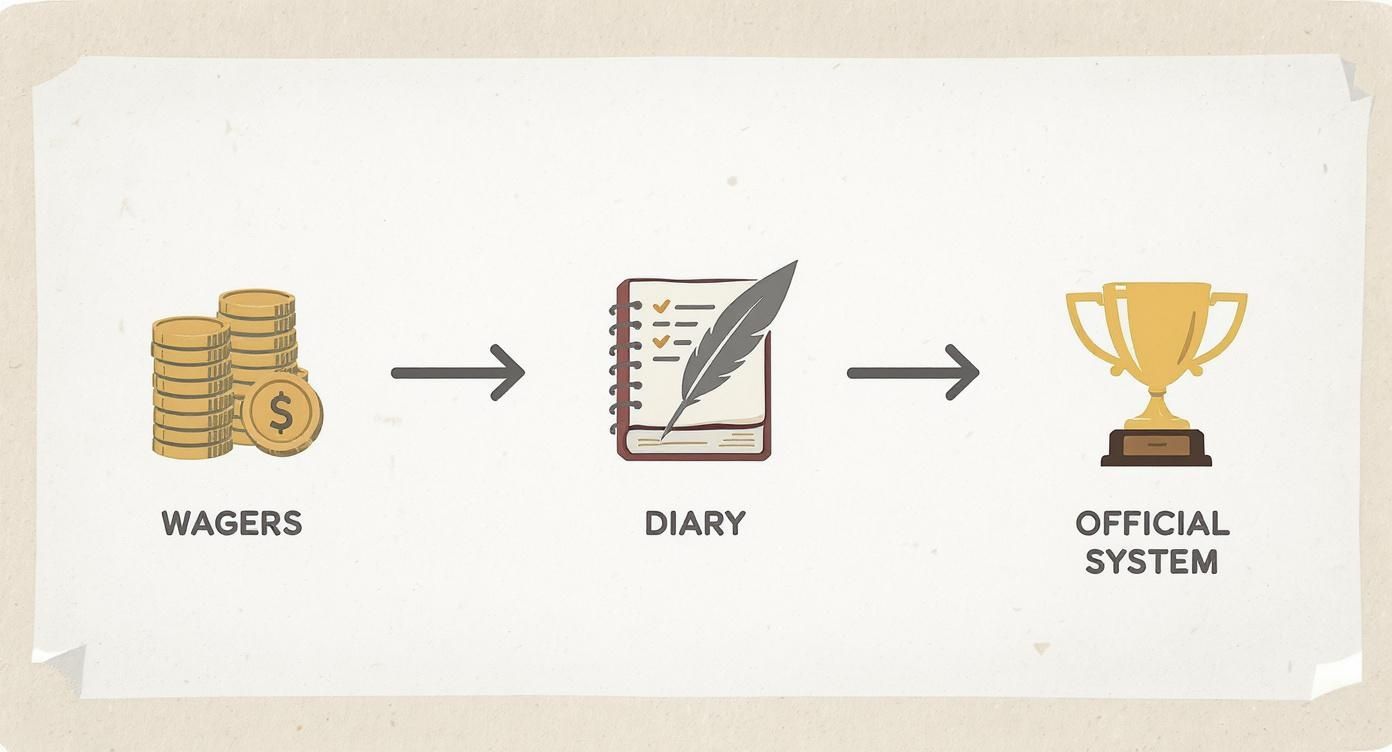
As you can see, what started as a simple way to even the odds has become a data-driven process. This modern approach ensures every golfer’s handicap is a true and accurate reflection of their game, no matter where they tee it up.
Decoding Golf Course Rating and Slope Rating
Ever glanced at a scorecard and seen those two numbers that look a bit like a secret code? Those figures, the Course Rating and Slope Rating, are the secret ingredients that make the entire handicap system work. Think of them as the universal translator for golf, ensuring your game is measured fairly no matter where you play.
They’re essentially a golf course’s DNA. They quantify its unique challenges, from the sheer length of the fairways to the trickiness of the greens. Understanding how these ratings work is the key to seeing how a golf handicap truly levels the playing field.

Golf Course Rating Explained
Let’s start with the easy one: Course Rating. This number is all about the pros. It estimates what a top-tier scratch golfer—someone with a 0 handicap—is expected to shoot on a given course under normal playing conditions.
So, if a course has a rating of 72.1, a scratch player should finish right around that number on an average day. This figure is the baseline for a course’s difficulty, factoring in obstacles and the total yardage a highly skilled player has to navigate.
In short, the Course Rating sets the standard. It answers the question, “How tough is this course for a really, really good golfer?”
Understanding Slope Rating in Golf
While Course Rating is for the scratch player, the Slope Rating is for the rest of us. This number, which can range from 55 (a walk in the park) to 155 (a brutal test), measures how much harder a course gets for the average “bogey golfer” compared to that scratch player.
A high slope doesn’t just mean a course is hard; it means it gets disproportionately harder for the average player. The bunkers seem deeper, the water wider, and the greens smaller. This is what truly makes your handicap portable, adjusting fairly from your home course to a championship monster like Bethpage Black.
The introduction of the Slope System by the United States Golf Association (USGA) in the 1980s was a game-changer. For the first time, a handicap earned at one club was truly comparable to one from another, making matches between players from different home courses genuinely fair. For more details, the history of golf handicapping is a fascinating read.
Golf Course Rating vs Slope Rating Explained
It’s easy to mix these two up, but they serve very different purposes. Here’s a simple breakdown to keep them straight:
| Metric | Who It Measures For | What It Tells You |
|---|---|---|
| Course Rating | Scratch Golfer (0 Handicap) | The expected score for an elite player on a normal day. |
| Slope Rating | Bogey Golfer (Approx. 18 Handicap) | How much more difficult the course plays for an average golfer vs. a scratch golfer. |
Think of it this way: Course Rating tells you the baseline difficulty, while Slope Rating tells you how steep the challenge gets as your skill level changes.
Together, these two ratings ensure your handicap is a true measure of your potential, no matter where you swing the sticks. If you want to dive deeper into why certain layouts are tougher than others, check out our guide on understanding golf course design and how it affects play.
How to Get Your Own Official Handicap in Golf
Ready to get a real measure of your game? Getting an official handicap is much easier than you might think, and it’s the key to unlocking fair, competitive golf. It allows you to truly track your progress and see how you stack up against any other player, on any course.
The journey starts when you join an authorized golf club or association. Now, that doesn’t have to mean an exclusive private club. Many public courses, regional golf associations, and even some online groups are authorized to issue a Handicap Index.
Finding a Golf Club and Posting Your Scores
The most common path is joining a club that’s connected to a major governing body like the United States Golf Association (USGA). Under the World Handicap System (WHS), these organizations provide a standardized way to track your game.
Once you’re a member, you’ll get access to a system—usually an app like GHIN or a website—to post your scores after every round. This single habit is the most important part of keeping your handicap accurate.
The secret is consistency. You have to post every eligible score—the good, the bad, and the ugly. Only then will your handicap be a true reflection of how you’re actually playing.
Hitting the Magic Number for Your First Handicap in Golf
So, how many rounds does it take? To get your very first official Handicap Index, you need to log scores from a total of 54 holes. The cool part is you can mix and match how you get there.
- Three 18-hole rounds
- Six 9-hole rounds
- Any combination of 9 and 18-hole rounds that adds up to 54 holes
As soon as you’ve posted the required scores, the system crunches the numbers and issues your initial Handicap Index. From that point on, it updates automatically the day after you post a new score, giving you an up-to-date reflection of your game.
Understanding What Is a Handicap in Golf
FAQ’s
Every golfer I’ve met, from weekend players to serious competitors, has questions about how handicaps work in the real world. Let’s cut through the confusion and get straight to the practical stuff you’ll actually use on the course.
Think of this as your go-to guide for talking about the game with confidence.
What’s a Good Handicap for a Beginner?
First off, just establishing a handicap is a huge win! If you’re new to the game, getting your handicap under 30 is a fantastic milestone and a great first goal to aim for.
To give you some perspective, the average handicap for men hovers around 14, while for women, it’s closer to 28. But honestly, the number itself isn’t the point. The real goal is to use it as a personal yardstick to see how much you’re improving. It’s all about your own progress, not comparing yourself to anyone else.
The most important thing for a beginner is not the number, but the journey. A handicap is simply a roadmap that shows you how far you’ve come and where you’re headed next.
Do I Really Need a Handicap to Play Golf?
Absolutely not! For a casual weekend round with friends or a trip to the driving range, you don’t need an official handicap to enjoy the game.
Where it becomes essential, however, is in organized play. If you want to jump into a club tournament, a charity scramble, or a competitive league, an official handicap is almost always required. It’s the universal system that levels the playing field and ensures the competition is fair for everyone involved.
Can My Handicap Actually Go Up?
Yes, and you should expect it to! It’s completely normal. Think of your handicap as a rolling average of your best recent performances, not a trophy you win and keep forever.
If you hit a rough patch or play a few tough courses, your handicap will likely tick upward to reflect that. This is a good thing—it ensures the number remains an honest measure of your current ability, moving up and down just like the highs and lows of the game itself.
At Golf Inquirer, we believe that understanding the game’s details makes it that much more enjoyable. Whether you’re a beginner trying to break 100 or a veteran fine-tuning your skills, we’re here to guide you on your journey. Explore more tips, gear reviews, and course highlights at https://golfinquirer.com.