
Forget adding another 10 yards to your drive for a moment. If you genuinely want to see your scores drop—and I mean this weekend—you need to get comfortable with chipping a golf ball. This one skill, used inside 50 yards from the hole, is the single fastest way to turn those frustrating bogeys into pars and salvage a round after a missed green.
Why Chipping Is Your Shortcut to a Lower Score

So many amateur golfers are obsessed with the driver, convinced that a monster tee shot will magically fix their game. But here’s the honest truth: most strokes are lost—or saved—in the short game.
Think about your last round. How many times did you miss the green and find yourself in that tricky spot just off the fringe? That’s where a solid chipping game becomes your best friend. It takes the pressure off your approach shots because you know, even if you miss, you have the confidence to get up and down.
The Numbers Don’t Lie
Let’s look at the stats for a second. The average golfer shooting around 90 only hits about 5 greens in regulation per round. That means you’re facing roughly 13 chip or pitch shots every time you play. Even the pros on the PGA Tour only hit about 12 greens on average, which shows you just how vital chipping is at every single level of the game.
A reliable short game completely changes your mindset. Instead of dreading a missed green, you start seeing it as an opportunity. This shift lets you play more freely, knowing you’ve got the tools to handle whatever the course throws at you.
The fastest way to improve isn’t a massive swing overhaul. It’s building a simple, repeatable chipping motion you can trust under pressure. This is where you’ll see immediate, lasting results on your scorecard.
Building Confidence One Chip at a Time in Golf
Getting good at chipping a golf ball does more than just lower your scores; it builds an incredible amount of confidence. Every crisp, clean chip that settles close to the pin proves to you that you can execute when it counts.
Here are a few key benefits of making your short game a priority:
- Fewer Double Bogeys: A good chip can turn a potential disaster into a one-putt par or a simple tap-in bogey. It’s a true scorecard saver.
- Less Pressure on Your Putter: When you chip it close, you’re left with short, simple putts instead of those daunting lag putts from across the green.
- Smarter Course Management: With a strong short game, you can play smarter shots into the green, aiming for safer spots instead of feeling like you have to hit a perfect shot every time.
As you work on your short game and watch your scores drop, you might also be interested to explore premier golf communities where you can put your new skills to the test. At the end of the day, dedicating practice time to chipping delivers the biggest return on investment for any golfer looking to get better.
Building a Simple and Repeatable Chipping Setup in Golf
There’s nothing more satisfying than the crisp click of a perfectly struck chip shot. That feeling starts long before you ever take the club back. Where most amateurs go wrong is trying to hit a “mini” version of their full swing. Forget that. Let’s build a simple, repeatable foundation from the ground up.
This isn’t a power shot. It’s a finesse move designed for absolute control. We’re trying to create a setup that naturally promotes a downward strike, guaranteeing you catch the ball first, then the turf.
Narrow Your Stance for Stability
First things first: bring your feet much closer together. I’m talking about one clubhead-width apart. It’s going to feel strange at first if you’re used to a wide stance, but trust me, it’s the key.
A narrow stance is critical for two big reasons:
- It kills hip movement. A wide stance practically begs your hips to turn, which is great for a driver but a disaster for a chip. A narrow base keeps your lower body quiet and lets your arms and shoulders do all the work.
- It simplifies everything. With less body rotation, there are fewer moving parts to mess up. This makes your chipping motion incredibly easy to repeat, especially under pressure.
This one small change immediately sets you up for that simple “pendulum” motion we’re after, instead of a full-body heave that leads to skulls and chunks.
Ball Position and Weight Forward
Alright, now let’s dial in where the ball and your weight should be. These two go hand-in-hand to create that descending blow that nips the ball perfectly off the grass.
Position the ball back in your stance. A great starting point is just inside your trail foot (that’s your right foot for right-handers). Placing it here makes it nearly impossible to hit up on the ball—the number one cause of those bladed chips that scream across the green.
Next, get your weight forward. You want to feel a good 60-70% of your pressure on your lead foot (your left foot). To really get this sensation, imagine a straight line running from your lead shoulder down to your lead foot. Your goal is to keep your body stacked over that lead side for the entire shot.
Here’s a great mental trigger: Feel like your zipper or belt buckle is slightly ahead of the golf ball at address. This one thought automatically pushes your weight forward and gets your hands in the perfect spot.
Position Your Hands for Success
The last piece of the setup puzzle is your hands. They absolutely must be pressed slightly forward, so they are ahead of the golf ball. Golfers call this “shaft lean,” and it’s non-negotiable for crisp contact.
This forward press achieves two crucial things. First, it takes a little loft off the club for a more predictable, lower flight. More importantly, it ensures your hands lead the clubhead through impact. When your hands lead, you naturally strike down on the ball, pinching it cleanly. It’s the perfect recipe for chipping consistency.
How To Choose The Right Golf Club For Any Chip Shot
Are you one of those golfers who instinctively grabs the same wedge for every single chip shot? If so, you’re making the game a lot harder than it needs to be. The secret to a killer short game is letting the club do the work for you, and that all starts with making a smarter choice before you even take your stance.
Think of your clubs as a toolbox, with each one designed for a very specific job. Using a sand wedge when an 8-iron would do the trick is like trying to tap in a tiny nail with a sledgehammer. By using different clubs, you can stick to the same simple, repeatable chipping motion for almost any situation around the green.
The Rule of 12 Made Simple
A fantastic way to start thinking differently about club selection is the “Rule of 12.” It’s a straightforward system that helps you visualize how much the ball will fly versus how much it will roll with different clubs. It’s not an exact science, but it gives you a brilliant framework for picking the right tool.
The basic idea is to pick a landing spot on the green. From that spot, you pace off the distance to the hole. This ratio of air time to ground time is what helps you decide which club to pull.
- Short Carry, Long Roll: Need to get the ball onto the green quickly and let it run out like a putt? A lower-lofted club, like an 8-iron or 9-iron, is your best friend here.
- Long Carry, Short Roll: Have to carry a bunker or some nasty rough and need the ball to stop quickly? This is where your sand wedge or lob wedge earns its keep.
Great chipping is all about minimizing air time and getting the ball rolling. This is why you see pros experimenting with everything from hybrids to long irons for certain shots—they’re just trying to manage how the ball behaves once it hits the green. The PGA has some great insights on how different lofts affect your shots that are worth reading.
This image breaks down some key chipping data, comparing carry distances for different wedges and highlighting the best ball position for most chip shots.
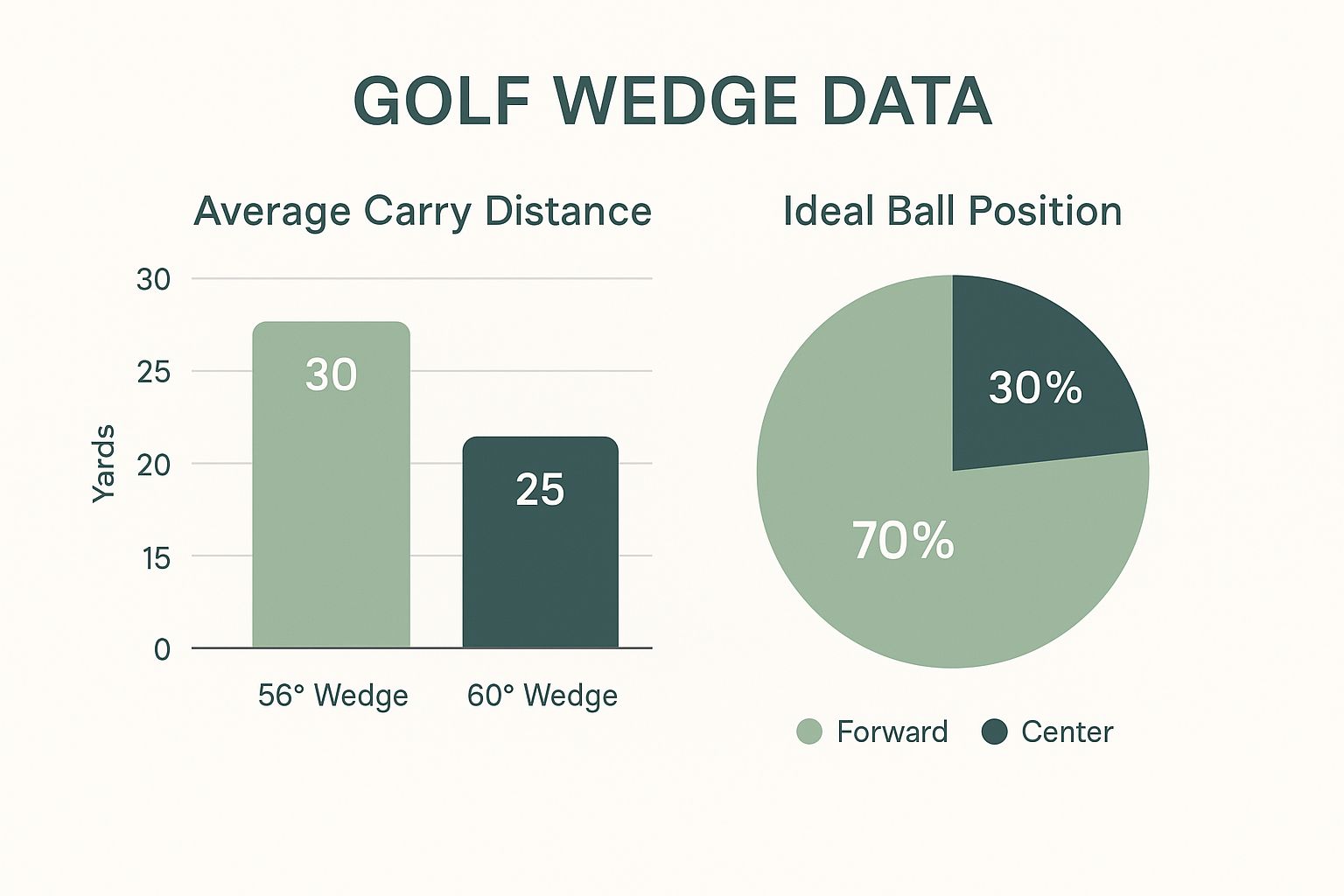
As the data shows, a less-lofted wedge will carry farther, and most players find a forward ball position gives them the best results for crisp contact.
Comparing Your Golf Club Options
Let’s walk through a real-world scenario. You’re 15 yards from the hole. You have 5 yards of fringe to carry and then 10 yards of green to the pin. This is a classic “bump-and-run” situation, and grabbing a high-lofted wedge is almost always the wrong play.
Instead of your 56-degree sand wedge, try a pitching wedge. If you’re curious, you can learn all about what degree is a pitching wedge and see why its loft is so versatile. For this shot, a small, controlled stroke with a pitching wedge will pop the ball over the fringe and let it release smoothly toward the hole. An 8-iron would require an even smaller, more putt-like motion.
The goal is always to take the least amount of loft that can safely carry the ball to your landing spot. This strategy drastically reduces your margin for error and leads to more consistent results when chipping a golf ball.
To make this even clearer, here’s a quick reference table to help you choose the right club based on the flight and roll you need.
Chipping Club Selection Guide
| Club | Typical Loft | Flight Characteristics | Roll Characteristics | Best Used When |
|---|---|---|---|---|
| Lob Wedge (LW) | 58-62° | High, soft flight | Minimal roll | You have very little green to work with and need to stop the ball quickly. |
| Sand Wedge (SW) | 54-58° | Medium-high flight | Some roll-out | Carrying a bunker or rough with a decent amount of green to work with. |
| Pitching Wedge (PW) | 44-48° | Lower, more penetrating | Significant roll | You need about 50/50 carry to roll; great for basic chip shots. |
| 9-Iron | 40-44° | Low flight | Mostly roll | The pin is far back and you have lots of green to let the ball run. |
| 8-Iron | 36-40° | Very low flight | Maximum roll | Essentially a putt from the fringe; minimal air time needed. |
Think of this table as your starting point. Get out on the practice green and hit a few shots with each of these clubs to get a feel for how the ball reacts. Soon enough, picking the right club will become second nature.
Mastering Your Pendulum Chipping Swing in Golf

A great chipping motion is all about feel and rhythm, not brute force. Think of it as a simple pendulum—a repeatable, controlled action that takes the guesswork out of your short game. If you’re trying to generate speed, you’re already on the wrong track. This is all about control.
Honestly, the best way to think about your chipping stroke is that it’s nearly identical to your putting stroke. You wouldn’t use your wrists or sway your body on a five-footer, right? The same logic applies here. We want a small, efficient motion driven by the big muscles: your shoulders and chest.
Keep the Triangle Intact
Here’s a concept that will immediately improve your contact: maintain the “triangle” formed by your arms and shoulders. When you set up to the ball, your arms hang naturally, creating a distinct triangle with your shoulders as the top. That triangle needs to move back and through as a single, connected unit.
This is where most amateurs get it wrong. They get “handsy,” breaking their wrists or moving their arms independently of their body. That shatters the triangle and is the root cause of inconsistent contact—those dreaded bladed shots that scream across the green or chunked shots that flop a few feet in front of you.
The secret to a pure strike is to just rock your shoulders back and forth, letting the clubhead go along for the ride. Your hands and arms should feel totally passive, like they’re just holding on.
By keeping this structure solid, you’ll ensure the club returns to the ball on the correct arc, time after time. It’s the single most important key to eliminating those frustrating misses around the green.
The Quiet Lower Body
While your upper body is rocking like a pendulum, your lower body’s job is to do… well, pretty much nothing. A stable lower half is the anchor of a reliable chipping stroke. There should be absolutely no hip rotation, no swaying side-to-side, and no major weight shift during the swing itself.
Remember the setup—that narrow stance and forward weight press. We did that for a reason. It locks your lower body into a stable position so your upper body can pivot around your spine without any extra moving parts.
- No Hip Turn: Keep your hips square to the target line from start to finish.
- Minimal Knee Flex: Your knees should be soft but stable. Don’t let them bend or straighten excessively.
- Weight Stays Forward: Your weight needs to stay planted on that front foot throughout the entire motion.
This kind of disciplined control is what separates the pros from everyone else. A PGA Tour player chipping from 20 yards consistently lands their shots within 6 feet of the hole. That insane precision comes from a repeatable, quiet motion. To see how much proximity matters, check out these golf statistics by handicap and see its direct impact on scoring.
At the end of the day, a great pendulum swing feels incredibly simple. It’s just a smooth, one-piece takeaway and a gentle rotation through to a controlled finish. Once you master this feeling, you’ll have a chipping action you can count on.
Effective Chipping Drills You Can Do Anywhere
Reading about the perfect chipping technique is a great start, but let’s be honest—real improvement happens through practice, not just reading. You have to turn theory into feel.
The good news is you don’t need to live at the golf course to get this done. These are my favorite drills designed to ingrain a solid chipping motion, and you can practice them almost anywhere, from your backyard to your living room carpet.
The Towel Drill for Crisp Contact
One of the most common faults I see is hitting the ground behind the ball, leading to that dreaded “fat” shot. The Towel Drill is the perfect fix. It forces you to make a clean, descending strike that catches the ball first.
Here’s the simple setup:
- Lay a small towel flat on the ground.
- Place a golf ball about six inches in front of the towel.
- Take your normal chipping stance and start hitting shots.
If you even clip the towel before the ball, your club is bottoming out too early. The feedback is instant and undeniable. Your goal is to miss the towel completely, striking the ball cleanly and then brushing the grass afterward. This simple drill quickly trains you to get your weight forward and keep your hands leading the clubhead through impact.
A clean strike isn’t about luck; it’s about controlling the low point of your swing. This drill forces you to manage your swing arc—the cornerstone of consistent chipping.
The One-Handed Drill for Better Body Sync
Are your wrists getting a little too active in your chipping motion? An overly “wristy” or “flippy” swing is a huge source of inconsistency. The One-Handed Drill is fantastic for killing this habit and teaching you to use your bigger muscles to control the club.
Just grab a wedge with only your lead hand (your left hand if you’re a righty). Tuck your trail hand behind your back to keep it out of the action. Now, make small, pendulum-like swings, focusing on rocking your shoulders and chest to move the club.
You’ll immediately realize you can’t generate any power by flicking your wrist; you have to rotate your body through the shot. This syncs up your arm and body movement, creating a much more stable and repeatable motion. After a few swings, put your trail hand back on the club and try to recreate that same connected feeling.
The Landing Zone Drill for Distance Control
Great chippers don’t just hit solid shots—they control their distance with surgical precision. The Landing Zone Drill is designed to sharpen this skill by shifting your focus from the hole to your landing spot.
Set up a target in your yard or at the practice green. A bucket, a different colored towel, or even a headcover works perfectly. Your only goal is to land your chip shots directly onto that target.
- Notice how the ball reacts with different clubs (say, a 9-iron vs. a sand wedge).
- Move your landing zone closer and farther away to practice shots of varying lengths.
- Pay close attention to how much the ball rolls out after it lands.
This drill teaches you to visualize the shot and execute it based on carry distance, not just the final destination. Honing this skill will make you far more adaptable to different green speeds and pin locations.

FAQ’s
Let’s walk through some of the most common questions and sticky situations golfers face with their short game.
What If the Ball Is in the Rough?
Chipping out of thick grass is a whole different animal. The number one priority is making solid contact and preventing the grass from grabbing your club and twisting it offline.
Forget about being delicate. You need a steeper, more decisive swing to chop down and through the grass. Think less of a sweep and more of a pop. I often recommend opening the clubface just a touch and grabbing a sand wedge. The extra bounce will help the club skim through the turf instead of digging in and getting stuck.
How Do I Handle an Uphill or Downhill Lie?
Playing from a slope is all about adapting your setup. If you remember one thing, make it this: tilt your shoulders to match the angle of the slope. This simple move is the key to swinging with the hill, not against it, which is crucial for clean contact.
Uphill Chip: When you match your shoulders to an uphill lie, you naturally add loft to the club. To compensate, I’d suggest taking less loft, like a pitching wedge or 9-iron. This will help you get a lower, more controlled flight instead of a high pop-up that goes nowhere.
Downhill Chip: Same rule applies—match those shoulders to the downhill slope. This has the opposite effect, taking loft off the clubface. Your shot will come out low and fast with a lot of rollout. Grab your most lofted club, like a 60-degree wedge, and plan to land it well short of the hole to let it release.
Should I Chip with a Hybrid or a Putter?
Absolutely. Sometimes the smartest decision you can make is to leave the wedge in the bag. If you’re just off the green on the fringe or in very short grass with nothing between you and the hole, using a hybrid or the toe of your putter can be a game-saver.
This shot, often called a “Texas wedge,” takes the dreaded chunk or thin shot completely out of the equation. Just use your normal putting stroke—a simple, smooth pendulum motion. It’s all about minimizing risk and getting the ball rolling as soon as possible. It’s a high-percentage play that can save you a ton of strokes.
A huge part of chipping is choosing the shot with the biggest margin for error, not necessarily the most heroic one. A simple bump-and-run with an 8-iron or hybrid is often a much smarter play than a high-risk flop shot.
At the end of the day, mastering your chipping comes down to knowing the fundamentals and then being creative enough to adapt them to whatever the course throws at you.
Here at Golf Inquirer, we know that a sharp short game is the fastest path to lower scores and more fun on the course. For more expert tips, gear reviews, and guides to improve your game, check us out at https://golfinquirer.com.