Time spent on the putting green is more than just a quick warm-up before your round—it’s the single fastest way to start slashing strokes from your scorecard. This is where you groove your stroke, build bulletproof confidence, and finally say goodbye to those dreaded three-putts for good.
Why Your Golf Putting Range Time Is a Game Changer
Let’s be honest. Most golfers wander onto the putting green, drop a few balls, and mindlessly roll them toward a hole before rushing to the first tee. It’s treated as an afterthought, not a dedicated training session. But what if you started treating it like your own personal short-game laboratory?
When you put in structured time on the putting green, you’re making a direct deposit into your on-course performance. It’s how you turn frustrating bogeys into tap-in pars and pars into easy birdies. Shifting from a “let’s just roll a few” mindset to purposeful practice builds an unshakeable foundation for your entire game.
The Rise of Dedicated Practice Facilities
The secret is out. As golf continues to boom, so does the demand for quality places to work on your game. It’s a global trend that shows just how critical good practice areas have become for golfers who are serious about improving.
According to a 2023 report from the R&A, the number of on-course golfers outside the US and Mexico shot up to 42.7 million—that’s 3.1 million new players in just one year. It’s a massive 44% jump since 2016, and it puts a spotlight on the need for better, more accessible practice facilities. You can dive into more of the data on golf’s growing popularity and see how it’s shaping the game.
Forget that shiny new driver for a minute. The fastest way to drop your handicap is by mastering the flat stick. Every minute you spend with intention on the putting green pays you back immediately on the scorecard.
From Warm-Up to Workout
To make a real difference, your time on the putting range needs a purpose. You’re not just trying to make putts; you’re developing the skills to make them when they actually count. That means drilling down on the fundamentals of great putting.
Here’s what focused practice actually gets you:
- Builds Real Muscle Memory: Doing the right drills over and over again ingrains a consistent, repeatable stroke and nails down your speed control. Soon, it becomes second nature.
- Boosts Your Confidence: There’s nothing like successfully completing a tough drill to give you the nerve to stand over a tricky five-footer and know you’re going to drain it.
- Sharpens Your Green Reading: Purposeful practice forces you to actually pay attention to break and speed, making you a much better green-reader on any course you play.
With courses and ranges getting more crowded, you can’t afford to waste time. Show up with a plan, and you can turn even a busy practice green into a super-effective training session that delivers results you can see.
Building a Foundation for Consistent Putting in Golf

A great putt starts long before your club ever moves. I see it all the time—golfers rush their setup, then act surprised when the ball veers offline. Consistency on the putting green comes from one thing: a solid, repeatable foundation that takes the guesswork out of the equation.
Think of it this way: would a mason start laying bricks on an uneven patch of dirt? Of course not. Your putting setup is that same critical groundwork. A proper routine gives you a mental and physical checklist, ensuring you’re in the best possible position to make a confident stroke every single time.
Creating Your Personal Practice Station
Instead of just scattering some balls and hitting them aimlessly, take two minutes to build a “practice station.” This little ritual is a game-changer. It trains your body and your eyes to recognize what a correct setup feels like, which is the key to taking it from the practice green to the course.
Your station doesn’t need to be fancy. In fact, you’ve probably got everything you need right in your bag. Here’s how I lock in my own fundamentals:
- Putter Face Alignment: I lay an alignment stick (or even just another club shaft) on the ground, pointing it directly at the hole. As I address the ball, I make sure my putter face is perfectly square to that line. It’s instant, non-negotiable feedback on my aim.
- Body Line Check: Next, I’ll place a second alignment stick parallel to the first one, just on the outside of my feet. This becomes my reference for my feet, hips, and shoulders. A quick glance down tells me if my body is aimed parallel to my target line, not open or closed.
- Ball Position Marker: A simple tee or a coin does the trick here. I use it to mark the correct ball position in my stance—for me, that’s just a touch forward of center. This stops the ball from creeping around in my stance, which can completely change the roll of a putt.
By building this station, you’re not just practicing; you’re calibrating. You’re teaching your body what ‘square’ and ‘aligned’ actually feels like, turning a conscious effort into an unconscious skill.
Nailing Your Posture and Stance
With your station set up, the last piece of the foundation is your posture. A stable base is non-negotiable for a smooth, pendulum-like stroke.
Your stance should be wide enough that you feel athletic and balanced, but not so wide that it restricts the natural rocking of your shoulders.
From there, bend from your hips, not your waist. Let your arms hang naturally down from your shoulders. Your eyes should be directly over the ball or just slightly inside the target line. This setup creates stability and ensures your stroke is powered by your bigger shoulder muscles, not your twitchy, unreliable hands.
Every putt you hit from your station reinforces this solid, repeatable posture, making it second nature when you step onto the course for real.
Eliminating Three-Putts with Distance Control Drills in Golf
There’s nothing that kills a scorecard—or your mood—faster than the dreaded three-putt. You stripe a drive, stick your approach, and then proceed to take three clumsy stabs at it from 40 feet. It’s infuriating.
But here’s the thing: most three-putts aren’t caused by a bad read or a wobbly stroke. They’re a direct result of poor distance control.
The goal from long range isn’t to be a hero and drain a 40-footer. The smart play, the one that keeps your score from ballooning, is to cozy the ball up to the hole for a stress-free tap-in. This is where dedicated work on the putting range golf green pays massive dividends, helping you calibrate that all-important feel for speed.
When you focus on drills that hardwire distance control, you stop gambling and start playing the percentages. This skill alone can shave a handful of strokes off your round and eliminate one of the biggest frustrations in the game.
Calibrating Your Stroke With The Ladder Drill
One of my all-time favorite ways to dial in my speed is the “ladder drill.” It’s so simple to set up but gives you immediate, undeniable feedback on how the length of your backstroke translates to the distance the ball rolls.
To get started, find a relatively flat spot on the practice green. You don’t even need a hole for this one.
- Place five tees in a straight line, each one about three feet farther from you than the last. This gives you targets at 3, 6, 9, 12, and 15 feet.
- Start with the closest tee. Hit a putt with the goal of getting the ball to stop as close to the tee as possible without rolling past it.
- Move on to the next tee, consciously making a slightly longer backstroke.
- Work your way up and down the “ladder,” really focusing on the feel of each stroke.
This exercise forces you to build a mental library connecting a specific motion to a specific distance. Over time, you’ll develop an instinct for how much juice to give a putt, which is invaluable on the course. While this drill is all about speed, remember that marrying it with an accurate line is the other half of the equation. For a deeper dive on that, our guide on how to read greens has you covered.
Playing Games To Master Feel
Another fantastic way to hone your distance control is to stop “practicing” and start “playing.” The “zone putting” game is perfect for this because it directly simulates the real-world goal: get the ball into a tap-in radius.
The objective of a long putt is not to make it, but to leave yourself with a putt you can’t miss. Great lag putting removes pressure and eliminates costly mistakes.
Pick a hole that’s at least 30 feet away. Now, imagine a three-foot circle around the cup—that’s your target zone. I like to outline it with a few tees to make the target obvious.
Hit ten putts from that distance. The goal isn’t to hole out; it’s to get every single ball to stop inside that circle. This simple shift in focus—from the hole itself to the area around it—is the secret to great lag putting. Keep score and try to beat your personal best every time you hit the green.
My Go-To Drills for Nailing Distance Control in Golf
Here’s a breakdown of simple but powerful drills I use on the putting range to develop a reliable feel for speed and distance.
| Drill Name | How to Set It Up | What It Accomplishes |
|---|---|---|
| Ladder Drill | Place 5 tees in a line at 3, 6, 9, 12, and 15 feet. Putt to each one. | Builds a mental connection between backstroke length and putt distance. |
| Zone Putting | From 30+ feet, imagine a 3-foot circle around the hole. Try to get 10 balls inside it. | Shifts focus from making the putt to lagging it close for an easy two-putt. |
| Eyes-Closed Putting | From 15-20 feet, take your setup, close your eyes, and hit the putt. | Forces you to rely entirely on feel, heightening your sense of speed and stroke. |
| Fringe-to-Fringe | Putt from one edge of the green to the other, trying to stop the ball on the opposite fringe. | Excellent for developing a feel for very long putts and controlling speed on different slopes. |
These drills aren’t fancy, but they are incredibly effective. Incorporate them into your practice, and you’ll quickly see those frustrating three-putts start disappearing from your scorecard.
Gaining Confidence on Short Pressure Golf Putts
We’ve all been there. You’re standing over a simple five-footer to save par, and suddenly it feels like the most important shot of your life. Your palms get a little sweaty, the stroke feels jerky, and the hole looks like it’s shrinking.
There’s nothing more demoralizing in golf than missing those little tap-ins.
This is where time spent on the putting green becomes your greatest weapon. Making these “must-make” putts isn’t just about aim; it’s about grooving a stroke so reliable and building a mindset so strong that confidence is practically automatic. It’s time to stop hoping they go in and start knowing they will.
The Gate Drill for a Perfect Start Line
One of the biggest culprits behind missed short putts is a putter face that isn’t perfectly square at impact. If you’re off by even a single degree, that ball can easily lip out from just a few feet away. My absolute go-to fix for this is the “gate drill.” It’s simple, but man, is it effective.
All you need is a couple of tees.
Set them up on your target line just a little wider than your putter head, a few inches in front of your ball. The only goal here is to swing your putter head cleanly through this ‘gate’ without hitting either tee.
This drill gives you instant, undeniable feedback. Hit the inside tee? Your path is coming from the outside-in. Clip the outside tee? You’re swinging inside-out. When you can consistently swing through that gate, you’ve proven to yourself that your putter is traveling down the right path with a square face. That’s the secret to starting putts on line, every single time.
Master Every Break With the Clock Drill
Once you’ve got your start line dialed in, it’s time to face reality: most putts on the course aren’t dead straight. The “clock drill” is a classic for a reason—it forces you to handle all kinds of different breaks from short range, perfectly simulating the kind of pressure you’ll face in a real round.
Here’s how to set it up:
- Find a hole on a sloped part of the green.
- Place four to six golf balls in a circle around the cup, each about three feet out, like numbers on a clock face.
- Now, work your way around the circle and try to sink every single one.
You’ll immediately face an uphill putt, a downhill slider, a right-to-left breaker, and a left-to-righter, all in just a few minutes. This is how you train your brain to quickly adjust aim and speed for different lies, making you a much more versatile and dangerous putter. The real challenge? Don’t move on until you’ve holed them all.
Confidence on short putts comes from knowing you’ve made that exact putt a hundred times before in practice. Drills aren’t just for mechanics; they’re for building a library of successful memories you can draw on under pressure.
Taming the Mental Game
The final piece of the puzzle is all in your head. You can have the most technically perfect stroke in the world, but if you step up to a pressure putt thinking about the miss, you’ve already lost. You have to quiet your mind by focusing on your process, not the outcome.
The explosion in training aids shows just how seriously golfers are taking this. The global golf training aids market was valued at around USD 827.1 million in 2023 and is expected to climb to $1.24 billion by 2030. This tells you that players are investing heavily in tools and techniques to sharpen their game, especially on the greens. You can discover more insights about the golf training market and see this trend for yourself.
Instead of worrying about the consequences, just concentrate on your pre-putt routine. Pick your line, commit to it, and trust yourself to make a good stroke. That’s how you turn those costly three-putt bogeys into clutch, round-saving pars.
Your 60-Minute Purposeful Practice Plan for Golf
Showing up to the putting green without a plan is one of the biggest wastes of time in golf. Seriously. Just mindlessly rolling putts to the same hole over and over again won’t make you better. It just digs your existing habits—good or bad—even deeper.
A structured, 60-minute session on the putting range golf green is how you make real, lasting improvements that actually show up on your scorecard. This isn’t about hitting hundreds of balls. It’s about making every single minute count by focusing on the skills that matter most: distance control, short-range accuracy, and performing when you feel a little pressure.
Think of it as a dedicated workout for your short game. Each part is designed to strengthen a specific putting muscle.
Breaking Down Your Hour of Power
A solid practice plan is all about balance. You need to develop your skills, but you also need to challenge yourself in ways that feel like you’re actually out on the course. Here’s a blueprint you can take to the green today.
- First 20 Minutes: Calibrate Your Speed. Forget the hole for a bit and start with lag putting. Your only goal is to dial in your feel for distance. Hit putts from 30, 40, and 50 feet, focusing only on getting the ball to stop within a three-foot circle of your target. Use the Ladder Drill or a Zone Putting game to build that reliable touch.
- Next 20 Minutes: Nail the Short Ones. Now it’s time to move into your scoring zone: the 3-10 foot range. This is where you turn three shots into two. I like to start with the Gate Drill to make sure my roll is pure and the putter face is square at impact. After that, I’ll switch to the Clock Drill around a single hole to get comfortable sinking putts with all kinds of different breaks. Repetition here is what builds that rock-solid confidence over the must-make putts.
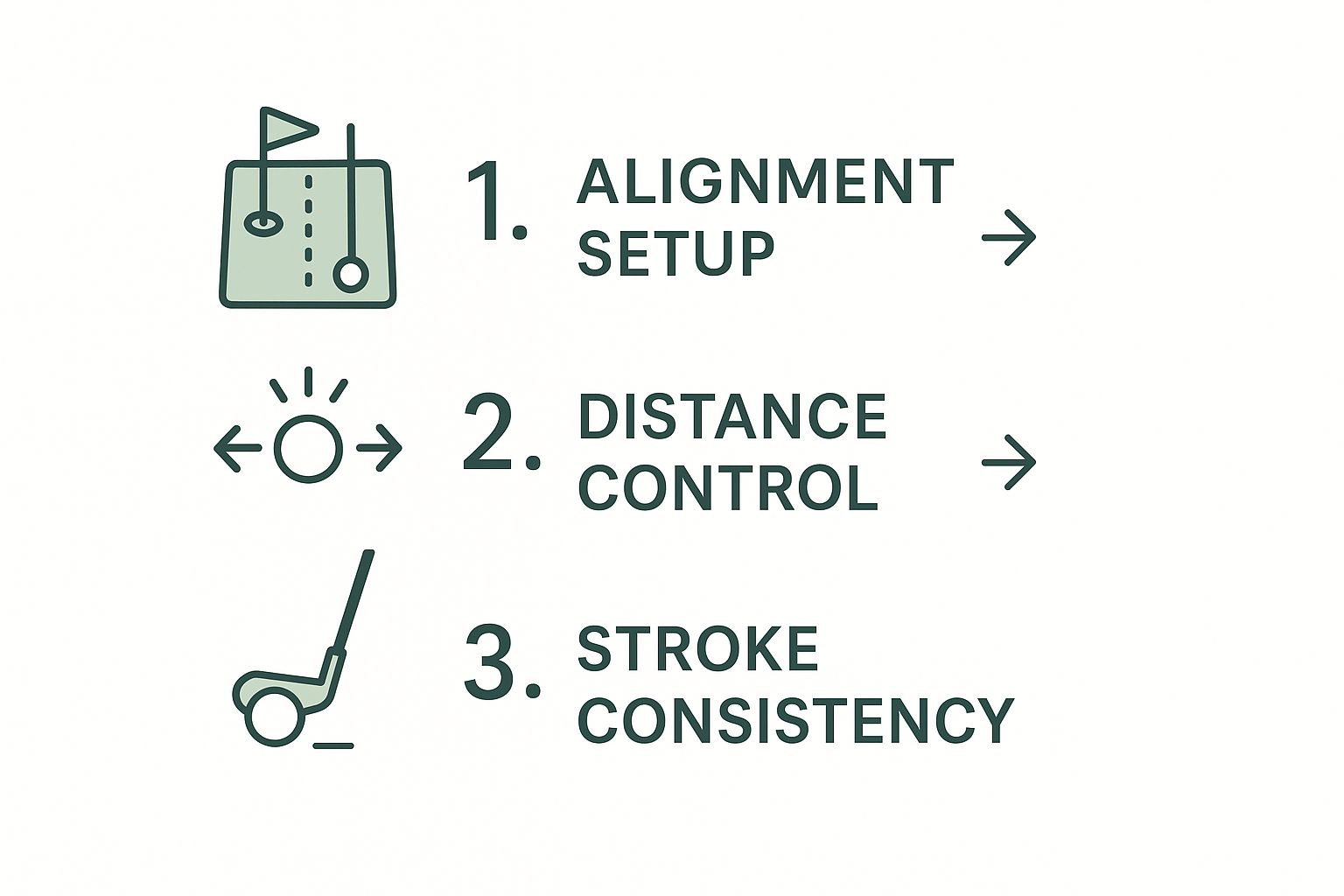
Following this kind of sequence—alignment, then distance, then consistency—is the key to building a putting game that holds up. You’re building a solid foundation before moving on to the tricky stuff.
Finishing Strong with Pressure Drills
The last 20 minutes are for making it count. This is where you add a little bit of pressure to your practice so you’re ready for the real thing on the course.
Turn it into a competitive game. My personal favorite is a simple nine-hole putting course. Just pick nine different spots on the green with varying lengths and breaks. Play each one as a par-2, and keep score. The goal is simple: try to beat your “score” every time you practice. For a deeper dive into structuring your time, check out our complete guide to golf drills and practice routines.
The goal of a structured plan isn’t just to practice putting; it’s to practice scoring. By adding pressure and consequences, you train your mind to perform when it matters most.
This purposeful approach is exactly why you see so many dedicated practice facilities popping up. The global market for golf driving ranges was valued at USD 592.01 million and is expected to hit USD 1.27 billion by 2033. That growth shows just how much golfers want quality places to work on their game.
And of course, being prepared is part of the plan. A small detail like keeping your practice gear dry and protected can make a huge difference in your focus and comfort during these sessions.
FAQ’s
Let’s dive into some of the most frequent questions I get asked about putting practice. I’ll give you some quick, straight-to-the-point answers to help you practice smarter, build real confidence, and finally see those results on your scorecard.
Look, even the most dedicated players have questions about how to get the most out of their time on the practice green. It’s so easy to just go through the motions and fall into old, unproductive habits. But a few simple tweaks to your approach can unlock huge improvements.
How Often Should I Practice Putting to See Real Improvement?
This one’s simple: consistency over intensity, every single time. You’ll get far more out of two focused, 30-minute sessions a week than you will from one marathon two-hour grind once a month.
Short, purposeful practice builds skill that actually sticks. When you consistently groove specific drills for distance control and alignment, you’re building habits that won’t desert you under pressure. And at a bare minimum, spending 10-15 minutes before a round to get a feel for the green speed is non-negotiable.
The secret isn’t logging endless hours. It’s about making the time you do spend as high-quality and focused as possible.
What’s the Biggest Mistake Golfers Make on the Practice Green?
Mindless repetition. I see it all the time. A golfer drops three balls in the same spot and hits them to the same hole over and over without a clear goal. That’s not practice; it’s just exercise.
That kind of routine does absolutely nothing to prepare you for the variety and pressure you face on the course. The second biggest mistake? Only practicing on the flat, straight putts. You have to seek out the tricky ones—the uphill grinders, the slick downhill sliders, and the big breakers.
Your practice has to mimic the course. Have a clear intention for every single putt you hit.
Are Putting Training Aids Actually Worth Using?
Absolutely, but with one major string attached: you have to use them the right way. The best, simplest aids provide instant, honest feedback that your own eyes can easily miss.
A few that genuinely work:
An alignment mirror: Fantastic for making sure your eyes are directly over the ball—a fundamental for a consistent setup.
A putting gate: Just two tees spaced slightly wider than your putter head. This is the ultimate test for starting the ball on your intended line with a square face.
A simple chalk line: Great for seeing your stroke path and making sure you’re rolling it end-over-end on short putts.
Most courses have no problem with you using these tools. Just be considerate and find a spot where you won’t get in anyone’s way. The key is to use them to diagnose and fix a specific flaw, not as a crutch you can’t putt without.
Here at Golf Inquirer, we’re all about smarter practice for more enjoyable golf. To find more tips, check out our latest gear reviews, and read stories that fuel your passion for the game, explore all our articles at https://golfinquirer.com.