
If you’re serious about lowering your golf score, you need to shift your focus. Forget the fantasy of a complete swing overhaul and start thinking about smart, incremental improvements. The real secret is mastering your game from 100 yards in, making better decisions on the course, and building a mental game that stops you from bleeding strokes.
Your Realistic Path to a Lower Golf Score
Let’s be real—dropping strokes from your handicap isn’t about some magic bullet you find on the driving range. It’s a game of inches, a series of small adjustments that stack up over 18 holes. This guide isn’t about generic tips; it’s a practical framework for making real, measurable progress. Every golfer’s journey involves understanding how to lower golf score better.
So, forget trying to bomb it 300 yards like the pros. We’re going to zero in on the areas that actually move the needle for the average golfer. You’ll quickly see why tracking a few simple stats is a total game-changer and how understanding your own shot patterns is the foundation for a game plan you can trust under pressure.
Small Gains Lead to Big Results in Golf
The good news? Golfers are genuinely getting better. Data from over 2.3 million rounds reveals that average scores improved from 15.31 over par in 2019 to 14.97 in 2024. In that same window, the average handicap dropped from 14.6 to 13.9.
Those aren’t massive leaps. They’re the result of small, consistent improvements, which is exactly the principle this guide is built on. We’ll show you how to shave off those crucial strokes by focusing on what matters most:
- High-Impact Areas: Prioritizing the parts of your game that save the most strokes, like chipping and lag putting.
- Smarter Decisions: Learning to manage the course to avoid those dreaded big numbers and penalty strokes.
- Purposeful Practice: Making sure your time at the range actually translates to lower scores on the course.
As you start down this path, remember that consistent energy and focus are key. Keeping your body fueled with healthy high-protein snack ideas can make a huge difference in managing hunger and maintaining concentration through the back nine.
The goal isn’t perfection; it’s progress. Shaving just one or two strokes per round by eliminating simple mistakes can lower your handicap significantly over a season.
When you’re trying to figure out where to start, it helps to know which areas will give you the most bang for your buck. I’ve put together a table that breaks down the highest-impact areas for saving strokes without needing to tear your swing apart. Think of it as a priority list for your practice time.
Key Focus Areas for Immediate Golf Score Improvement
| Area of Focus | Why It Matters | Actionable Tip |
|---|---|---|
| Short Game (Inside 50 Yards) | Roughly 40-50% of your shots happen here. Getting up-and-down just once more per round saves a full stroke. | Spend 60% of your practice time on chipping and pitching. Use one club (like a sand wedge) and master hitting it to three different distances. |
| Lag Putting | Eliminating three-putts is the fastest way to drop your score. Good speed control from distance is far more important than holing a few 10-footers. | Practice rolling putts from 30-40 feet to a three-foot circle around the hole. Don’t even worry about making them; just get the speed right. |
| Avoiding Penalty Strokes | A single shot out-of-bounds or in the water can wreck a hole. Playing smart and avoiding these big mistakes is critical. | When in doubt, club down. It’s better to be 15 yards short of the green than to be reloading from the tee box. Know your “safe” miss. |
| Course Management | Knowing your personal shot distance and tendencies allows you to play to your strengths and avoid trouble. | Instead of aiming for the flag, aim for the center of the green. This simple shift in mindset dramatically increases your greens in regulation. |
Focusing on these key areas first will build a solid foundation. You’ll start seeing immediate results on your scorecard, which builds the confidence you need to tackle the more complex parts of the game later on. Mastering the fundamentals of how to lower golf score will change your game for the better.
Stop Wasting Strokes Around the Green
If you really want to know how to shave strokes off your score, forget the driving range for a second. The real magic happens on that little patch of grass surrounding the green. For most of us, this is where a promising hole goes to die. You miss the green, and what should have been a simple par turns into a mad scramble for bogey… or worse.
But it doesn’t have to be that way. The game from 100 yards and in is where you can make serious, immediate gains. This isn’t about hitting flashy, high-risk flop shots. It’s about building a rock-solid, reliable plan for when you’re not on the dance floor, giving you the confidence to save strokes in every single round.
Master Your Wedge Distances in Golf
Just grabbing a wedge and banging balls at the range is a waste of your time. You need a system. One of the simplest and most effective methods I’ve seen is the “clock system.”
Picture your body as the face of a clock—your head is at 12, your feet are at 6. Your lead arm is the hour hand, and you’re just going to practice swinging it to different points on the clock.
- 7:30 Swing: Think of a short, controlled backswing. This is your money shot for delicate little chips.
- 9:00 Swing: Your arm comes back parallel to the ground. This will become your standard, go-to pitch shot.
- 10:30 Swing: This is a classic three-quarter swing. It gives you more pop without sacrificing control.
Next time you’re at the range, take your wedges and hit 10-15 balls at each of these three positions. Zap the carry distance for each one with a rangefinder. Write these numbers down—put them in your phone, on a yardage card, whatever works—and memorize them. Just like that, you have nine reliable yardages you can pull out of your back pocket under pressure.
Eliminate Three-Putts for Good
Is there anything more soul-crushing in golf than a three-putt? It just feels like a completely wasted stroke. The secret to killing them off isn’t about draining every monster putt; it’s about getting your first putt—the lag putt—cozy enough for a simple tap-in.
Forget trying to make everything outside of 15 feet. Your new goal is to lag every long putt inside a three-foot circle around the hole. This single mindset shift will dramatically reduce your three-putts.
Here’s a fantastic drill for you. Go to the practice green and place four tees in a box shape about three feet around the cup. Now, from 30, 40, and 50 feet away, just focus on rolling putts that stop inside that box. Don’t even worry about the hole. Your only goal is speed and distance control. Developing this kind of feel is a huge leap forward if you want to lower your golf score. To really nail this down, check out our complete guide on short game mastery and putting techniques.
Chipping with a Purpose
When you’re practicing your chipping, stop aiming for the pin. It’s a beginner’s mistake. Instead, start focusing on a specific landing zone.
Pick a precise spot on the green where you want the ball to land, and then visualize how it will release and roll out to the hole. For a speedy downhill chip, your landing zone will be much shorter, letting gravity do the heavy lifting. For an uphill shot into the grain, you’ll need to fly it much closer to the pin. This is how the pros think.
And the data backs this up. Recent stats from amateur golfers show that focusing on these small details works. Golfers have managed to cut their three-putts per round from 2.1 to 1.9, and even missed putts from inside five feet have dropped by over 20% since 2019. These are the small wins that add up to big results on the scorecard. You can dive into more of these fascinating golfer improvement stats on Golf Monthly.
Play Smarter, Not Harder on the Golf Course
So much of good golf isn’t about raw power or a picture-perfect swing. It’s about sound decisions. Honestly, you can shave strokes off your game right now, without a single swing change, just by learning to think your way around the course. This is all about making choices that keep you out of trouble and get rid of those blow-up holes for good.
It all starts on the tee box. For most golfers, it’s an automatic reflex: grab the driver on a par 4 or 5. But the best play is the one that sets you up for an easy next shot, and that isn’t always the longest one.
Develop a Simple Game Plan
Before you even step up to your ball, have a plan. Take a good look at the hole layout. Where’s the trouble? Water hazards, deep bunkers, or those dreaded white stakes are absolute score-killers. Your number one job is to take them completely out of the equation.
If you see the fairway pinch in right where your driver normally lands, maybe hitting a 3-wood or a hybrid is the play. Leaving yourself 160 yards from the middle of the fairway is infinitely better than being 120 yards out but punching out from behind a tree. This conservative approach is the secret to consistency.
The primary goal on every tee shot is simple: put the ball in play. Forgetting about a few extra yards and prioritizing accuracy will save you more strokes in the long run than you can possibly imagine.
This same thought process has to continue with your approach shots. Stop fire-honing in on sucker pins tucked behind bunkers or hugging the edge of the green. Just aim for the fattest part of the green—the center. This mental shift gives you a massive margin for error. A slight mishit still finds the putting surface, while that hero shot at the flag could easily leave you in a hazard.
Knowing When to Attack and When to Lay Up
Smart course management also means being honest with yourself about your game. On a long par 5, the temptation to “go for it” in two can be overwhelming. Before you pull the headcover off that 3-wood, ask yourself a simple question: What’s the most likely outcome here?
A realistic assessment might go something like this:
- Best Case: You pure it and the ball lands on the green, leaving you an eagle putt. (How often does this really happen?)
- Likely Case: You hit it okay, but it ends up in a tricky greenside bunker or some thick rough.
- Worst Case: You slice it into the woods or a water hazard, and suddenly a double bogey is staring you in the face.
If the risk is way bigger than the reward, the smart play is to lay up. Pick a club that will leave you at your absolute favorite wedge distance—that perfect 80-100 yard shot you’ve been practicing. You just turned a risky gamble into a high-percentage play for a birdie or, at worst, an easy par.
This infographic breaks down a simple decision-making process when you’re around the green.
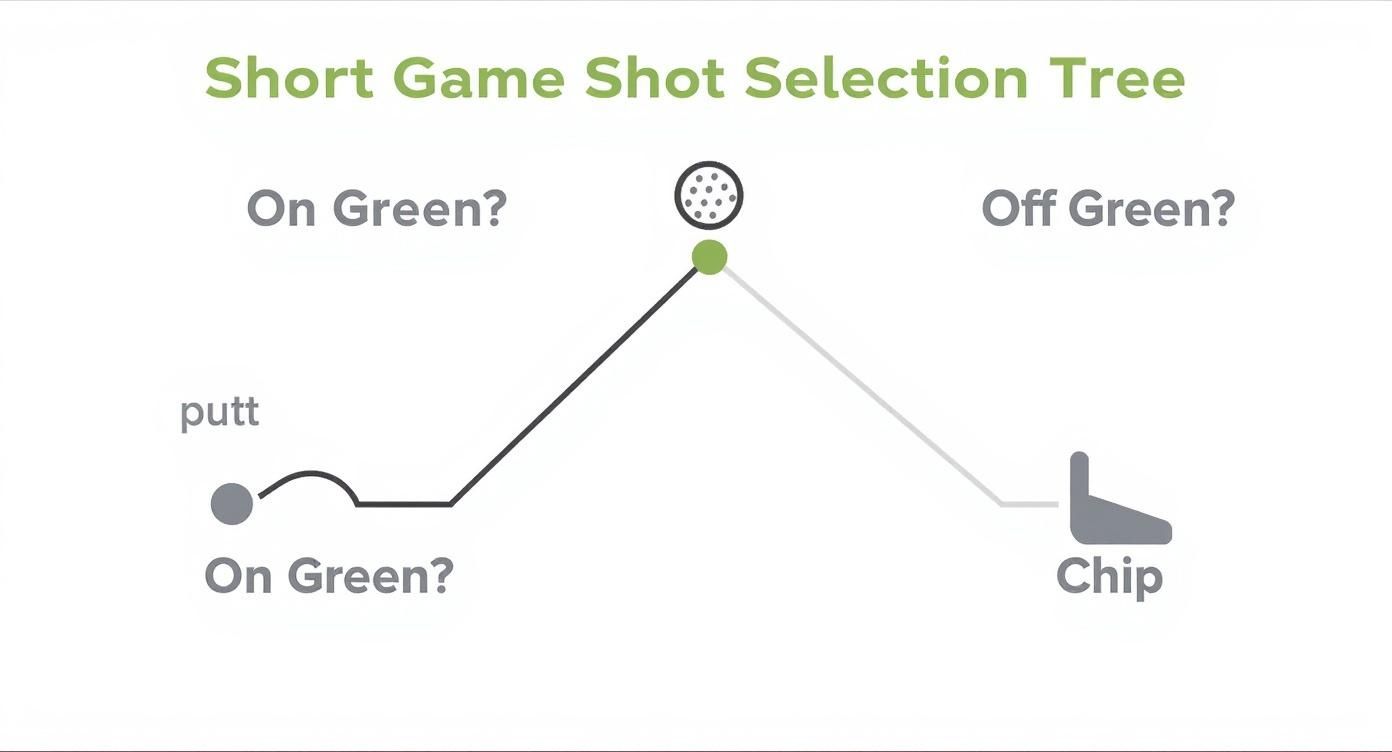
It really is that simple: if you’re on the green, putt. If you’re off, chip. It’s all about choosing the highest percentage shot, which is the heart and soul of smart golf. By consistently making better decisions, you’ll find yourself in fewer tough spots and watch those scores finally start to drop.
Golf Practice with Purpose Not Just Repetition
We’ve all been there: grabbing the jumbo bucket of range balls and just machine-gunning them into the distance. It feels productive, and hey, it’s fun to just swing away. But that kind of mindless repetition rarely, if ever, actually lowers your scores where it counts.
The real secret is to make a mental shift. Stop thinking of it as just “hitting balls” and start treating it as “training for performance.” This means every single ball you hit has a job. You pick a specific target, you go through your entire pre-shot routine just like you would on the course, and you honestly evaluate the outcome. This is how you turn a simple range session into powerful, course-specific practice.
Your New One-Hour Practice Plan
If you’re serious about getting better, you need a plan that reflects the reality of the game. It’s crazy how many golfers spend 80% of their practice time pounding the driver when nearly half their shots during a real round happen from 100 yards and in. To see real improvement, you have to flip that ratio on its head.
Here’s a simple, balanced one-hour plan that will get you started:
- First 15 Minutes (Warm-Up & Putting): Don’t just start banging balls. Begin with short putts to see the ball drop and build some confidence. After that, move on to some lag putting drills where your only mission is to nail the speed.
- Next 20 Minutes (The Scoring Zone): Dedicate this entire block to chipping and pitching. Don’t just hit to a generic area; pick a specific landing spot and practice hitting different shots to it—low-running pitches, high soft floaters, the works.
- Next 15 Minutes (Mid-Irons): Now it’s time to work up through the bag. Grab your 7, 8, and 9-irons and focus on precision. Aim for tiny targets, not just the big green expanse of the range.
- Final 10 Minutes (The Big Dogs): Finish up by hitting your driver and fairway woods. But don’t just swing for the fences. Picture a specific hole at your home course. See the fairway, pick your target, and try to hit it.
This structured approach guarantees you’re giving your scoring clubs the attention they deserve. If you’re looking for even more ways to make your range time effective, our guide has some great golf driving range tips to sharpen your skills.
One of my favorite things to do on the range is play a “simulated round.” I’ll hit a driver, then immediately grab the iron I’d need for the approach, followed by a chip. It forces you to deal with the variety and pressure of a real round, making your practice so much more effective.
Train Your Body, Not Just Your Swing
Working on your swing is one piece of the puzzle, but don’t forget about the engine—your body. Even a basic fitness program can add yards to your drive and boost clubhead speed, which absolutely translates to lower scores.
But here’s a sobering thought: all the physical training in the world can be undone by poor instruction. Shockingly, some studies have shown that a staggering 70% of golfers who take lessons don’t actually see their scores improve. This just goes to show how critical it is to find quality coaching and pair it with the kind of purposeful practice we’re talking about. You can learn more about what really predicts success by seeing how they model elite golf performance on the European Tour.
Build a Resilient Mental Game for Golf
Let’s be honest. The biggest thing holding you back from a lower golf score probably has nothing to do with your swing mechanics. It’s the six inches between your ears. A rock-solid mental game is the unseen force that helps you shake off a bad shot, commit to the next one, and stop one mistake from blowing up your entire round.
Think about it this way—every golfer on the planet, including the pros you see on TV, hits absolutely terrible shots. The real difference is that elite players have a mental toolkit to absorb the mistake, hit the reset button, and put 100% of their focus on what’s next. You can build this exact same resilience.
Taming Your Inner Critic
Negative self-talk is a scorecard killer. Period. When you stand there fuming over a topped fairway wood or a brutal three-putt, you’re just building up tension that will poison your next swing.
A strong mental game means you have to deal with this head-on. There are plenty of proven strategies to break negative thought patterns out there, but it starts with a simple decision to stay in the present.
Here’s a trick I love: the “10-Yard Rule.” You get exactly ten yards to be mad, frustrated, or disappointed after a bad shot. Vent, mutter under your breath, whatever you need to do. But once you’ve walked those ten yards, it’s over. Your mind is now completely on the next task.
Crafting a Golf Pre-Shot Routine You Can Trust
A consistent pre-shot routine is your best defense against pressure. It’s a mental anchor that quiets the outside noise, narrows your focus, and tells your body, “Okay, it’s time to go.” It doesn’t need to be some elaborate, 2-minute production, but it must be consistent.
A simple yet powerful routine could look like this:
- Stand Behind the Ball: This is your command center. See the shot you want to hit—the flight, the landing zone, the roll. Make all your decisions right here.
- Take a Practice Swing: Make one or two smooth practice swings focusing purely on the tempo you want. Don’t get bogged down in mechanics; just feel the rhythm.
- Address and Go: Step up to the ball, take one final look at your target, and pull the trigger. Once you’re over the ball, the thinking part is done. It’s time to trust it.
A great pre-shot routine isn’t just for full swings; it’s absolutely critical for putting. Having a reliable process before every putt builds trust and keeps your nerves from hijacking your stroke when you’re standing over a must-make five-footer.
At the end of the day, a resilient mental game is all about acceptance. You’re going to hit bad shots. The weather might turn ugly. You’ll definitely get a bad bounce or two. None of that is in your control.
What you can control is how you react. By focusing on your process and letting go of the outcome, you’ll not only play better golf but actually enjoy the ride a whole lot more.
Use Your Data to Find Easy Wins in Golf
You can’t improve what you don’t measure. Vague feelings like “my driver was off today” or “I putted poorly” aren’t going to cut it if you seriously want to lower your golf score. To make real, tangible progress, you have to swap those gut feelings for cold, hard facts.
Tracking just a few key stats is the fastest way to get an honest look at your game. It shines a spotlight on exactly where you’re bleeding strokes, allowing you to stop guessing and start focusing your practice where it’ll actually make a difference.
What to Track for Maximum Impact
You don’t need a PhD in analytics for this. A simple system you create on your scorecard or a free golf app can give you all the data you need. The goal isn’t to overanalyze a single round, but to spot patterns over five, ten, or even twenty rounds.
Start with these four simple metrics:
- Fairways Hit: Did your tee shot land in the short grass? A simple checkmark for yes, an ‘L’ for a miss left, or an ‘R’ for a miss right is all you need.
- Greens in Regulation (GIR): Did your approach shot find the putting surface in the regulation number of strokes? For example, getting on the green in two shots on a par 4.
- Putts Per Round: Just count them up. This is the most direct way to see if your flat stick is your friend or your enemy.
- Scrambling: When you missed the green, did you still walk away with par or better? This “up-and-down” stat reveals the true strength of your short game.
Collecting this data turns vague frustrations into actionable insights. Discovering that you miss 70% of your fairways to the right gives you a specific, solvable problem to take to the range.
This data-driven approach is catching on. In the United States alone, over 3.35 million golfers kept a Handicap Index in 2024, a jump of nearly 30 percent since 2020. It’s a clear sign that more golfers are getting serious about tracking their performance. You can read more about how golfers are tracking their scores on Golf.com.
FAQ’s
Many golfers ask themselves how to lower golf score effectively. The answer lies in strategic practice and smart decision-making on the course.
Of course, even with the perfect roadmap, questions are going to pop up. Here are some of the most common ones I hear from golfers trying to break their scoring barriers, along with some straight-up advice.
How Many Strokes Can I Realistically Shave Off This Season?
For the average mid-handicapper, knocking 5-7 strokes off your typical score in a single season is a fantastic, yet totally achievable, goal. This isn’t going to happen by accident, though. It means getting out for purposeful practice at least twice a week and really digging into your course management and short game.
If you’re a higher handicapper (think 20+), you can see even more dramatic drops. Shaving 10 or more strokes is well within reach, simply by cutting out the silly mistakes like penalty shots and those dreaded three-putts.
What’s the Absolute Fastest Way to Drop My Score?
I’ll tell you the same thing I tell everyone: dedicate 60% of your practice time to your game from 100 yards and in. No question about it.
Get deadly with your lag putting to kill three-putts, and find a chip shot you can trust under pressure. This is where most amateurs bleed strokes, which means it’s also the place where you can make the biggest gains, fast.
Think about it this way: if you could just get up-and-down twice more per round, that’s two strokes right there. That simple change is often the difference between shooting 91 and finally breaking 90.
Should I Focus on Mashing It for Distance or Hitting It Straight?
Accuracy. Every. Single. Time.
Being 20 yards shorter but sitting pretty in the middle of the fairway is a million times better than a monster drive that ends up in the woods or a water hazard. Smart, strategic golf that keeps the ball in play will always win out over wild, uncontrolled power.
Shifting your mindset from “how far” to “how playable” is a huge step in learning how to lower your golf score for good.
At Golf Inquirer, we’re obsessed with helping every golfer get better and enjoy the game more. Whether it’s tips and tricks, deep dives into gear, or course spotlights, we’re here to fuel your passion for the game. Explore more of our guides and articles at https://golfinquirer.com.