
Stepping onto a golf course for the first time can feel like walking into a conversation where everyone’s speaking a different language. To truly get into the game, you first have to learn the talk. Understanding golf terminology for beginners is your key to unlocking not just the rules, but the entire experience. This guide is your personal translator, built to make you feel right at home from the very first tee. It gets even better – for this reason and many others we have created ” The comprehensive guide of Golf terminology” ( 159 Golf Terms at your fingertips). Check it out here
Why Knowing Golf Lingo Matters
Learning the vocabulary of golf is about so much more than just sounding like you know what you’re doing. It has a real, direct impact on how you play and how quickly you improve. When you understand the terms, you can finally grasp what your buddy is telling you about your swing, follow course etiquette without feeling lost, and make smarter decisions on every shot. It’s the foundation for everything else.
This isn’t about memorizing a dictionary. It’s about building a mental framework that helps you see the course with a strategic eye and communicate clearly. When someone mentions the “fairway,” asks about your “handicap,” or yells “Fore!,” you’ll know exactly what they mean and how to react.
What You Will Learn in This Guide
To make things as easy as possible, we’ve broken down the essential golf terminology for beginners into a few key categories. This way, you can build your knowledge one step at a time and feel confident you’re not missing anything.
Here’s a quick look at what we’ll cover:
- Essential Scoring Terms: You’ll learn the meaning of Par, Birdie, and Bogey to finally understand how your score is tracked.
- Parts of the Golf Course: We’ll walk through the difference between the Tee Box, Fairway, Rough, and the Green.
- Decoding Your Golf Clubs: Figure out when you should be reaching for a Driver versus an Iron or a Putter.
- Common Shots and Swings: We’ll define everything from a perfect Drive to that dreaded Slice everyone talks about.
By the end of this guide, you won’t just know the definitions; you’ll understand the context. That’s what really matters on the course. True confidence comes from knowing not just what a term means, but why it’s important.
Think of this glossary as your go-to reference anytime you hear a new word. For a broader look at the game, you can also check out our guide on mastering the basics of golf for beginners to build on what you learn here.
Essential Scoring Terms Every Golfer Must Know
Learning how to keep score is what turns a nice walk in the park into a real game of golf. It’s the language of the sport, and it all starts with one simple but crucial idea: Par.
“Par” is probably the most common golf term you’ll ever hear. It’s the expected number of shots an expert golfer should take to get the ball in the hole. Every hole on the course has a par, usually a 3, 4, or 5, based on its length. Add them all up, and you get the par for the whole course—typically around 72. If you can match that, you’ve had a great day! Once you get the hang of par, all the other scoring terms are just ways of describing how you did in relation to it. If you want to dive a little deeper, you can discover more insights about golf’s essential terms to round out your knowledge.
Now that you’ve got a handle on par, the fun part begins. The rest of the scoring language simply falls into place, describing whether your score on a hole was better or worse than that baseline number.
Understanding Scores Better and Worse Than Par
Making a score that’s better than par on any given hole is an awesome feeling, especially when you’re just starting out. Those moments have special names you’ll love hearing on the course. On the flip side, scores over par are much more common for the rest of us, and they have their own lingo, too.
Here are the key scoring terms you’ll hear every round:
- Birdie: This is when you finish a hole in one stroke under par. So, getting a 3 on a Par 4 is a birdie. A fantastic achievement!
- Eagle: Even better than a birdie, an eagle is a score of two strokes under par. Sinking your ball in 3 shots on a Par 5 is a classic example of an eagle.
- Bogey: A bogey means you took one stroke over par. A score of 5 on a Par 4 is a bogey, and it’s a very common score for golfers of all levels.
- Double Bogey: As the name suggests, this is two strokes over par. Taking 6 shots to complete a Par 4 gets you a double bogey.
These words are the building blocks for talking about your game. Trust me, hearing someone shout “Nice birdie!” after a good hole is one of the best feelings in golf.
“Your score is a direct reflection of your game on that particular day. Don’t get discouraged by bogeys; celebrate the birdies and learn from every hole. Consistency comes with practice.”
To help it all stick, just think of it as a ladder. Anything under par with a cool name is a step up. Anything over par is a step down, but also a learning opportunity for the next hole.
Common Golf Scores Explained
To make things crystal clear, here’s a quick-reference table that lays it all out. It shows you the score’s name, how it relates to par, and what it looks like on a typical Par 4 hole. This is a handy little cheat sheet for any beginner trying to remember all the new golf terminology for beginners.
| Score Name | Strokes Relative to Par | Example on a Par 4 |
|---|---|---|
| Eagle | -2 | 2 strokes |
| Birdie | -1 | 3 strokes |
| Par | 0 | 4 strokes |
| Bogey | +1 | 5 strokes |
| Double Bogey | +2 | 6 strokes |
Keep this chart in mind as you play. Before you know it, talking about birdies and bogeys will feel completely natural, and you’ll be one step closer to sounding like a seasoned pro.
Getting to Know the Lay of the Land: Parts of a Golf Course
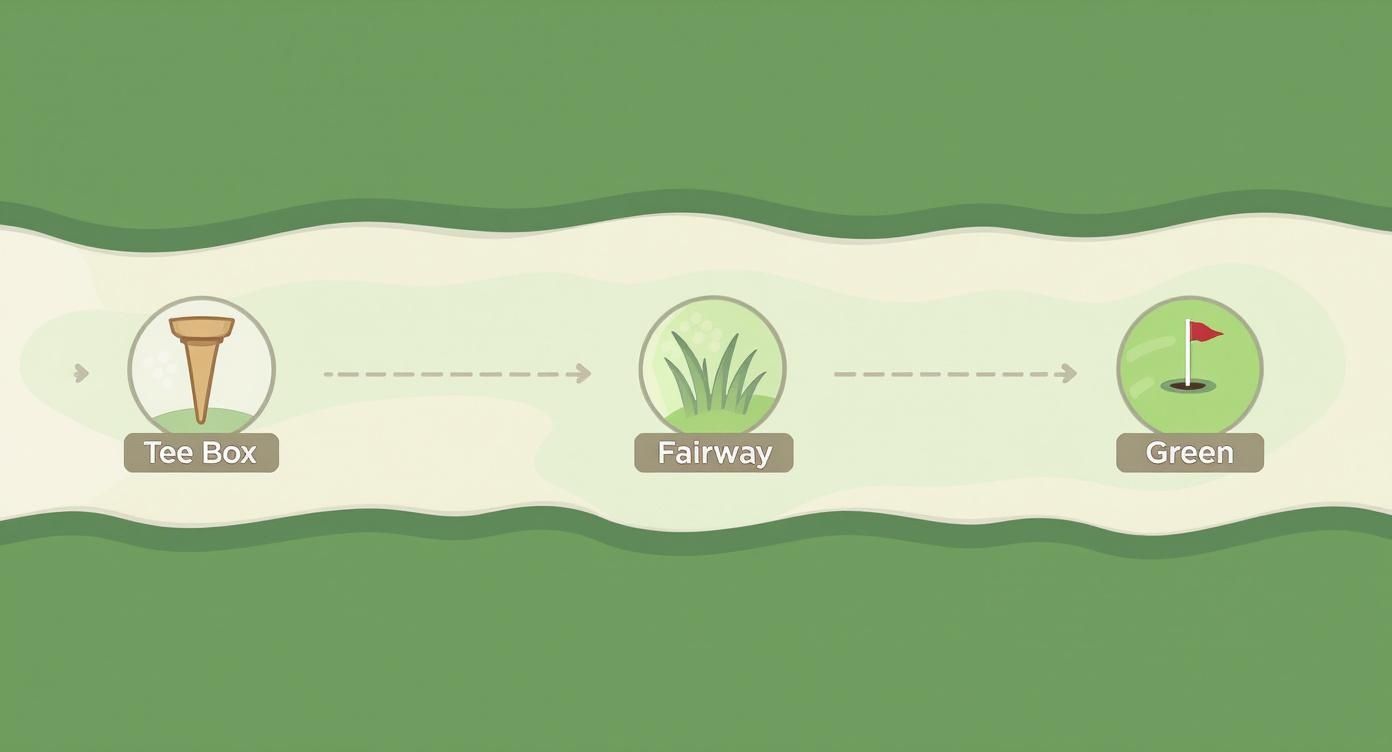
A golf course isn’t just a giant, manicured lawn; it’s a strategically designed playing field with distinct areas that dictate how you approach every single shot. Getting a handle on the layout is fundamental to understanding golf terminology for beginners, so think of this section as your course map. Every hole you play follows a clear path from a starting point to the final cup.
Your journey on each hole starts at the Tee Box (sometimes called the Teeing Ground). This is the flat, rectangular patch of turf where you hit your first shot, or drive. You’ll see several sets of colored markers here, which signal different starting points based on skill. As a newcomer, you’ll likely play from the forward tees (often red or white), while more seasoned players tee off from further back.
From the tee box, your primary target is the Fairway. This is the beautifully mown “highway” that runs toward the green. Landing your ball here gives you the best possible lie for your next shot. A solid drive that finds the fairway is the first step to a successful hole.
Navigating the Challenges Off the Fairway
Of course, golf rarely goes exactly as planned. Stray shots are part of the game. Surrounding the pristine fairway is the Rough, an area with longer, thicker grass that’s deliberately challenging to hit from. You’ll need more power to get your ball out of the rough, and it’s much harder to control your distance and accuracy.
Courses also feature specially designed obstacles, or Hazards, to test your strategy and shot-making. The two you’ll encounter most often are:
- Bunkers: Also known as sand traps, these are hollowed-out areas filled with sand. Getting stuck in a bunker requires a specific type of shot with a club like a sand wedge to pop the ball out and onto the green.
- Water Hazards: This is a catch-all term for any pond, lake, creek, or stream on the course. If your ball takes a swim, you’ll have to take a penalty stroke and drop a new ball in a designated spot.
Learning to steer clear of these trouble spots is a core skill called course management, which you’ll build over time. Beyond the course itself, it’s also great to know about the different types of places you can play, from your local public course to fantastic golf resorts with integrated golf experiences.
A classic beginner mistake is trying to be a hero when you’re in trouble. More often than not, the smartest play from deep rough or a tough spot is to simply punch the ball back into the fairway, even if it doesn’t get you much closer to the hole.
Reaching Your Final Target: The Green
After you’ve made your way down the fairway (and hopefully avoided the hazards), your final destination is the Putting Green. This is where you’ll find the shortest, most perfectly manicured grass on the entire hole, designed to let the ball roll true. All the action on the green revolves around the Hole (or Cup), which is always 4.25 inches in diameter.
To help you spot the hole’s location from a distance, a Flagstick (or Pin) is placed right in the middle of it. Once your ball is safely on the green, it’s time to pull out your putter and make those final, delicate strokes to roll the ball into the cup. Knowing these distinct parts of the course is the first step toward thinking like a golfer and planning your shots with purpose.
Decoding the Clubs and Equipment in Your Golf Bag
Your golf clubs are your tools of the trade. Knowing what each one does is like a carpenter knowing the difference between a hammer and a saw. Getting this part of golf terminology for beginners down will help you confidently choose the right tool for every shot you face on the course.
Every club is designed for a specific job, and that job is mostly determined by its loft—the angle of the clubface.
Generally, a higher loft sends the ball flying higher but over a shorter distance, which is perfect for shots approaching the green. A lower loft gives you a longer, lower shot, exactly what you want for getting max distance off the tee.
Your Arsenal: The Different Types of Golf Clubs
Think of your clubs as belonging to four main families, each with a specialized role. Learning which family to turn to in different situations is a huge step toward playing smarter golf.
A standard set of clubs includes:
- Woods: Funny enough, these are now made of metal, not wood. They have the biggest heads and the lowest lofts, all designed to hit the ball farther than any other club. The Driver (also called a 1-wood) is the king of this category, used almost exclusively from the tee box for maximum distance.
- Irons: This is your most versatile group of clubs, typically numbered from 3 to 9. The lower-numbered irons (like a 3- or 4-iron) have less loft and are built for longer shots from the fairway. The higher-numbered irons (like an 8- or 9-iron) have more loft for shorter, more precise shots aimed at the green.
- Wedges: Think of these as your specialty tools for short-range precision. Wedges have the highest lofts of any club, designed to pop the ball high into the air so it lands softly on the green. They’re also your go-to clubs for getting out of sand bunkers.
- Putter: This is the club you’ll probably use more than any other. It has a flat face designed to do one thing: roll the ball smoothly across the green and into the hole.
If you want a detailed breakdown of how lofts vary across clubs, a chart can be a super helpful visual guide. You can find a good one here: https://golfinquirer.com/degrees-of-golf-clubs-chart/
Essential Gear Beyond the Clubs
Beyond the clubs themselves, a few small but mighty accessories are crucial for playing a proper round of golf. Knowing what they are and when to use them is key to good course etiquette.
You should always have these items in your bag or pocket:
- Tee: A small peg used to prop the ball up for your first shot on each hole’s tee box. Using a tee makes it much easier to strike the ball cleanly with your driver or wood.
- Ball Marker: A small, flat object (a coin works great) used to mark your ball’s spot on the green. You place it directly behind your ball before picking it up to clean it or to get it out of another player’s putting line.
- Divot Tool: When your ball lands on the green from a high approach shot, it often leaves a small dent called a divot or pitch mark. This simple two-pronged tool is used to repair that mark, which helps keep the green smooth for everyone.
Master your equipment, and you master a huge part of the game. One of the biggest mistakes a beginner makes is grabbing the wrong club simply because they don’t understand its purpose.
Finally, while walking the course is fantastic exercise, many courses are quite spread out. It’s worth looking into the different types of golf carts available, as they can make navigating the course a lot more enjoyable, especially on a hot day.
A Glossary of Common Shots and Swing Terms

Once you’ve got a handle on the course layout and what each club in your bag does, it’s time to talk about the shots themselves. Every swing you take has a name and a purpose, and knowing the lingo is key to talking about your game—whether you’re celebrating a perfect shot or trying to figure out what went wrong with a bad one.
These terms are the language of golf, describing everything from what you intended to do before you swung to what the ball actually did in the air. We’ll break them down into three key groups: the basic shots that make up a round, the way the ball curves through the air (both good and bad), and finally, the dreaded mishits every golfer knows all too well.
Getting this vocabulary down is your first step toward diagnosing your own swing on the course. For example, knowing the difference between a slice and a shank is crucial for understanding what you need to fix.
Foundational Golf Shots Explained
From the first tee box to the final tap-in, you really only rely on a few core shots to get the ball from Point A to Point B. Each one calls for a different club and a slightly different technique, all tailored to a specific situation you’ll face on the course. Getting comfortable with these is how you build a solid round of golf.
These are the four big ones you’ll hear constantly:
- Drive: This is the big one. Your opening shot on longer holes (Par 4s and 5s), always hit from the tee box. The goal is pure distance, trying to get yourself as far down the fairway as possible. You’ll almost always use a driver for this.
- Approach Shot: After your drive, this is any shot you hit with the goal of landing the ball on the green. Depending on how far you are from the hole, an approach could be hit with anything from a fairway wood to a short iron.
- Chip: A delicate, short shot played from just off the green. A good chip has a low trajectory; it’s designed to pop onto the green and then roll out towards the hole, almost like a putt.
- Putt: This is the finishing touch, played on the green with your putter. It’s a smooth, controlled stroke meant to roll the ball right into the cup.
Understanding Ball Flight and Curve
Even for the world’s best players, the golf ball rarely flies perfectly straight. The spin you put on the ball at impact will make it curve one way or the other. When you control that curve, it’s a skill; when you don’t, it’s a common beginner mistake.
For a right-handed golfer, the terms are as follows (for lefties, just reverse the directions!):
- Draw: A shot that curves gently from right to left. This is a desirable shot shape for many skilled players because it can often add a little extra distance.
- Fade: The opposite of a draw. This shot curves gently from left to right. Golfers often use a fade when they need more control, as the ball tends to land a bit softer.
- Hook: This is what happens when a draw goes wrong. It’s a severe, uncontrolled curve from right to left that usually sends the ball way off target.
- Slice: The most infamous mishit for new golfers. A slice is a sharp, uncontrolled curve from left to right that robs you of both distance and accuracy.
Beginner’s Tip: When you’re just starting out, don’t get bogged down trying to hit a perfect draw or fade. Your main goal should be making solid contact with the ball. Focus on limiting the big misses—especially that slice.
Common Mishits Every Beginner Should Know
Speaking of misses, some shots are so bad they’ve earned their own names in the golf world. Don’t get discouraged when these happen, because they happen to everyone, from weekend hackers to tour pros. Knowing the name for your particular brand of bad shot is the first step in learning how to fix it.
Here are a few of the most frustrating (but common) results:
- Shank: This is easily one of the most dreaded words in golf. A shank happens when you hit the ball with the hosel (where the clubhead connects to the shaft). The result is a ball that shoots off violently to the right (for a righty).
- Duff: You might also hear this called a “chunk” or hitting it “fat.” This is when your club hits the ground way behind the ball, digging up a huge piece of turf. The ball usually travels a painfully short distance.
Understanding the Golf Handicap System
One of the coolest things about golf is its unique ability to let players with wildly different abilities compete fairly against each other. How is that possible? It all comes down to the Handicap system, a fundamental concept you’ll hear about constantly, whether you’re a beginner or a seasoned pro.
The idea of a “handicap” is what levels the playing field. The modern system really took shape in the early 20th century, with the United States Golf Association (USGA) rolling out a standardized formula way back in 1911. In simple terms, a handicap is a number representing how many strokes over par a golfer is expected to shoot on a course of average difficulty. For a deeper dive into the origins of golf’s unique language, you can learn more about the history of golf terms.
Basically, it’s a numerical reflection of your potential. The lower the number, the better the player. A “scratch golfer” is someone with a 0 handicap, meaning they’re expected to shoot par or better. A beginner, on the other hand, might start with a handicap of 30 or even higher. This number is then used to adjust your final score, making the game competitive for everyone involved.
How a Handicap Works in Practice
Think of your handicap as giving you a head start, like a few bonus strokes before you even tee off. It allows you to subtract a certain number of strokes from your total score at the end of the round. This introduces two crucial terms every golfer needs to know: Gross Score and Net Score.
Here’s a quick breakdown of how they work:
- Gross Score: This is your raw score—the actual number of strokes you took to complete the round. If you hit the ball 100 times, your gross score is 100. Simple as that.
- Net Score: This is where the magic happens. It’s your gross score minus your handicap strokes. So, if your gross score was 100 and your handicap is 20, your net score is 80.
In a handicapped tournament or a friendly match, it’s the net score that usually determines the winner. This brilliant system means a player who shoots a gross 100 can go head-to-head with someone who shoots an 85 and still have a real shot at winning.
The handicap system is designed to measure your potential, not just a single good or bad day. It encourages improvement and makes friendly competition possible for everyone, regardless of experience.
Calculating Your Handicap
Getting an official handicap isn’t based on just one round of golf. It’s a calculated average of your best recent scores, but it also cleverly factors in the difficulty of the courses you’ve played. Two key ratings are used to determine just how tough a course is:
- Course Rating: This number estimates what a scratch golfer (a 0 handicap) would be expected to score on that course. A rating of 72.5 means a top-tier player would likely average half a stroke over par.
- Slope Rating: This measures how much more difficult a course is for a “bogey golfer” (someone who averages one over par per hole) compared to a scratch golfer. The scale runs from 55 to 155, and a higher slope rating means the course gets exponentially harder for the average player.
Don’t worry, you won’t need to crunch these numbers yourself. To get an official handicap, you’ll submit your scores through a registered golf association or an approved app. The system does all the heavy lifting, calculating and updating your handicap as you post more scores. Getting a handle on this system is a huge step in your golf journey.
FAQ’S
Even with the basics down, some golf terms can still trip you up on the course. This is where we clear the air on the most common questions I hear from new players, giving you quick, straight-to-the-point answers to lock in your understanding. Think of it as your final cheat sheet before you tee it up.
We’ll tackle everything from the two most dreaded mishits to the one word you absolutely must know for safety. Getting these right will do wonders for your confidence and help you feel right at home with the game’s etiquette.
What’s the Difference Between a Hook and a Slice?
Ah, the age-old question that plagues nearly every golfer at some point. For a right-handed player, a slice is that infuriating shot where the ball takes a sharp, uncontrolled curve to the right. It’s easily the most common miss for beginners.
A hook is the complete opposite—a shot that curves hard from right to left. While pros hit controlled versions of these shots (a fade for a slice, a draw for a hook), the amateur’s hook and slice are accidents. They’re almost always caused by a problem with your swing path or the clubface angle when you hit the ball. And for lefties? Just flip the directions: a slice curves left, and a hook curves right.
What Do “Fore” and “Mulligan” Mean?
These two words are part of golf’s everyday vocabulary, but they couldn’t be more different. One is a critical safety call, while the other is a friendly, unofficial do-over. You need to know both.
Here’s the breakdown:
Fore! This is hands-down the most important word for staying safe out there. It’s a warning you yell at the top of your lungs when your ball is heading toward other people. If you hear someone shout “Fore!”, don’t look—duck and cover your head immediately.
Mulligan: This is a casual term for a do-over. If you duff your first tee shot, your buddies might offer you a mulligan, letting you hit another one without penalty. The key thing to remember is that mulligans are never allowed in official competitions or any round you plan to post for your handicap.
How Is a Chip Different From a Pitch?
New players often confuse chipping and pitching because both are short shots played around the green. The real difference lies in how the ball flies and what you’re trying to accomplish.
A chip shot is a low-flying shot that spends most of its time rolling on the ground. You’d hit a chip when you’re just off the green with nothing in your way. The goal is to just bump it onto the putting surface and let it roll out toward the hole like a long putt.
On the other hand, a pitch shot flies much higher, lands softly, and stops quickly. You’ll need a pitch when you have to carry the ball over something—like a bunker, a pond, or thick rough—and have it plop down on the green with very little roll.
The easiest way I learned to remember this is with a simple phrase: “Chip and run, pitch and stop.” It perfectly captures the intent behind each shot.
What Is the 19th Hole?
Finally, we have one of golf’s most cherished terms, and it has absolutely nothing to do with playing another hole. The 19th Hole is simply slang for the clubhouse bar or restaurant.
It’s where you go after your round to settle up bets, grab a drink, and relive the good (and bad) shots of the day. The 19th Hole is a huge part of the game’s social culture, reminding us that golf is just as much about camaraderie as it is about the final score.
At Golf Inquirer, we believe that understanding the language of golf is the first step toward falling in love with the game. We’re here to guide you with tips, course reviews, and gear advice to make every round more enjoyable. Explore more at https://golfinquirer.com and let’s tee up your passion for golf together.