
Before you even think about swinging the club, let’s talk about where it all starts: your stance. If you’re new to golf, getting your setup right is probably the single most powerful thing you can do to build a swing you can count on.
It’s the foundation for everything that follows.
Your Stance: The Unsung Hero of a Great Golf Swing
It’s so easy for new golfers to get obsessed with hitting the ball hard. They want to crush it right out of the gate. But let me share a little secret from years of playing this frustratingly wonderful game: all that power is completely wasted without a solid, stable base to unleash it from.
Think of it like trying to build a house on a shaky foundation. No matter how well you build the walls, the whole thing is destined to crumble. Your golf swing is exactly the same. Your stance is that solid ground.
Setting Yourself Up for Success in Golf, Not Frustration
A good golf stance for beginners isn’t some complicated secret. It’s just about creating a balanced, athletic position that allows you to rotate through the ball with power and grace. This setup is your command center—it dictates your swing path, your power, and ultimately, where that little white ball ends up.
Don’t just take my word for it. Studies on new golfers show a direct line between setup mistakes and bad shots. It turns out that a staggering 85% of high-handicap beginners have fundamental flaws in their stance, like tilted shoulders or letting their head drift in front of the ball. These tiny mistakes at the start force you to make wild compensations during the swing, which is a recipe for inconsistency. You can dive deeper into this by checking out what golf instruction experts have to say about a balanced setup.
Your setup doesn’t guarantee a perfect shot, but a poor setup almost guarantees a bad one. It’s your first opportunity to put yourself in a position for success.
By dialing in a few key checkpoints before every single shot, you start building the right habits into your muscle memory from day one. Trust me, it makes the learning curve a whole lot less steep.
Here’s exactly why a solid stance is non-negotiable:
- It Gives You Rock-Solid Balance: A stable base means you can swing with speed and not feel like you’re going to fall over.
- It Unlocks Your Rotation: The right posture and foot width lets your hips and shoulders turn freely, which is where real power comes from.
- It Forges Consistency: When you start from the same solid position every time, your swing becomes predictable. And predictability is the name of the game in golf.
Now, let’s break down the essential pieces you should be thinking about for every shot.
Here’s a simple mental checklist I give all my students. It’s a great way to make sure you’re ready to go before you pull the trigger.
Quick Reference for Golf Stance Fundamentals
| Stance Component | Beginner’s Goal | Why It Matters for Consistency |
|---|---|---|
| Foot Width | Shoulder-width apart for mid-irons | Provides a stable base for balance and rotation without restricting movement. |
| Weight Distribution | 50/50 split between both feet | Prevents swaying and promotes a centered turn, keeping you balanced throughout the swing. |
| Knee Flex | A slight, athletic bend | Engages your leg muscles for stability and allows your hips to rotate properly. |
| Spine Angle | Hinge from the hips, not the waist | Creates space for your arms to swing freely and maintains your posture during the swing. |
| Alignment | Feet, hips, and shoulders parallel to the target line | Ensures you are aimed correctly so a good swing sends the ball where you want it to go. |
Keep these fundamentals in your back pocket. Mastering them doesn’t require a ton of athletic ability—just a little attention to detail before you swing. It’s the fastest way to start hitting better shots, period.
Finding Your Ideal Foot Placement and Width for a Golf Stance
Alright, let’s get down to your feet. It’s so easy to overlook, but where you place them is the true foundation of your entire swing. This isn’t just about feeling comfortable; it’s about building a stable platform that’s tailored to the exact shot you’re trying to hit.
For most shots, especially with a mid-iron like a 7-iron, the classic shoulder-width stance is your best friend. Just set your feet so they are directly under your shoulders. This setup is the perfect sweet spot between stability and rotational freedom, letting your body turn through the shot without feeling stuck.
Adjusting Your Stance for Different Golf Clubs
Of course, one size doesn’t fit all in golf. A powerful drive needs a different foundation than a delicate chip shot, and your footwork needs to adapt.
- Driver and Woods: Go wider. Position your feet so they’re just outside your shoulders. This wider base gives you the solid platform you need to unleash a powerful, sweeping swing and generate maximum clubhead speed.
- Short Irons and Wedges: Bring your feet in a bit. A slightly narrower stance, with your feet just inside your shoulders, gives you more control for those precise shots into the green. It helps you get the club striking down on the ball, which is key for accuracy.
This picture gives you a great visual for that standard, go-to iron setup.
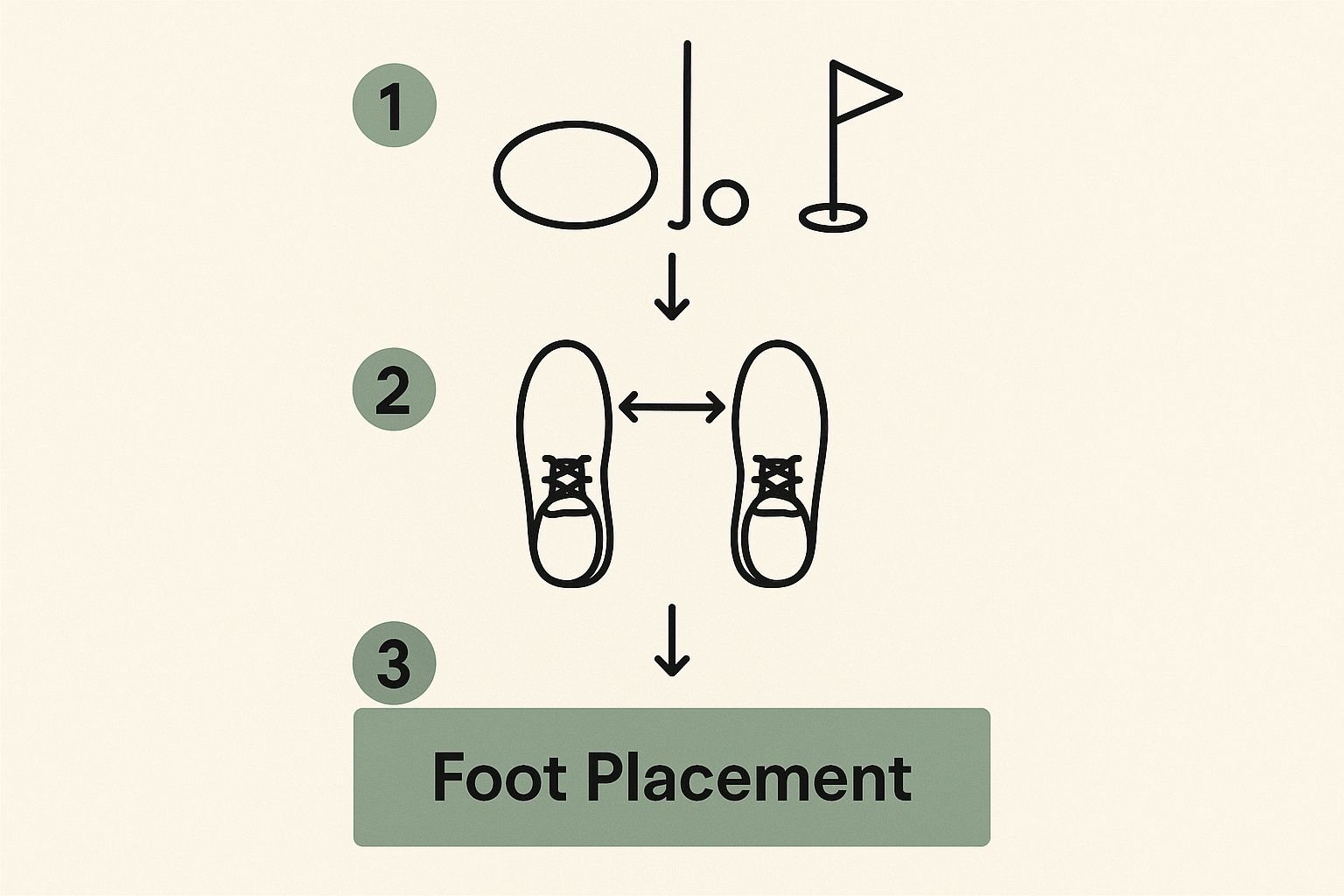
As you can see, it’s all about creating a balanced, athletic position that you can repeat time and time again.
The Finishing Touch for a Golf Stance Flaring Your Feet
Here’s one last little tweak that can make a huge difference: foot flare. Most experienced golfers angle their feet outward just a bit, and for good reason. It can seriously improve your range of motion.
Try flaring your lead foot (the one closest to the target) out by about 20-30 degrees. This simple move opens up your hips and makes it so much easier to rotate through impact. Your trail foot only needs a slight flare, maybe 10 degrees, which can help you complete a fuller backswing.
These aren’t rigid rules. Get out on the range and play around with what feels best for your body. If your stance is too narrow, you’ll feel wobbly. Too wide, and you’ll lock up your hips and kill your rotation.
It all comes down to practice. To get a better feel for this, you can try some of the exercises in our guide to golf drills and practice routines. Your goal is to find that one stance that feels powerful, balanced, and—most importantly—repeatable.
Building an Athletic Posture and Balance in Golf
Once your feet are set, it’s time to dial in your posture. The goal here is to create a truly athletic stance. Don’t think stiff or rigid; instead, picture a shortstop waiting for a ground ball or a tennis player ready to return a serve. They’re balanced, engaged, and poised for action. That’s exactly the feel we’re chasing.
The key is to hinge from your hips, not bend from your waist. A great mental cue is to imagine you’re about to sit on a tall barstool—just push your hips back. This simple move sets your spine at the correct angle and lets your arms hang down naturally from your shoulders. Make sure you avoid rounding your upper back, as that’s a classic swing-killer that restricts your rotation.
Finding Your Neutral Spine and Knee Flex in Golf
A good golf posture is built on a relatively straight back. It’s not just about golf; understanding how posture affects your body is crucial for overall health and preventing injury. After you’ve hinged from the hips to set your spine, add a slight, athletic flex to your knees. You’re not trying to do a deep squat, just bending them enough so you can feel your leg muscles switch on.
This photo nails that balanced, ready-to-go position.

See how his back is straight but tilted forward from the hips? His arms are hanging freely, creating plenty of room to start the swing. That’s what you want.
Distributing Your Weight for Stability in Golf
Okay, let’s get you balanced. Your weight should feel like it’s centered over the balls of your feet, giving you a solid, grounded connection to the turf. If you’re too far back on your heels, you risk falling backward during the swing. Too far forward on your toes, and you’ll lurch toward the ball. A good way to find the sweet spot is to rock gently from your heels to your toes until you settle into that stable middle ground.
Pro Tip: While in your stance, try to wiggle your toes inside your shoes. If you can do it easily without losing your balance, you’re in a great spot. This little check confirms you’re grounded and ready to make a powerful, controlled turn.
For most standard iron shots, your weight should be split evenly, 50/50, between your left and right foot. Stable footing is everything, which is why a good pair of golf shoes can genuinely improve your connection to the ground. This balanced foundation is what stops you from swaying and helps you rotate around a fixed point—the real engine of a repeatable golf swing.
How to Align Your Body for a Straighter Golf Shot
Getting your stance right is a huge piece of the puzzle, but it’s only half the battle. If your body is pointed in the wrong direction, even the most perfect swing will send your ball flying off-target. Proper alignment trips up so many new players, but trust me, it’s one of the easiest things to fix once you know the secret.

The best trick I’ve ever learned for alignment is to picture a set of railroad tracks. Your ball and the clubface are on one rail, aimed directly at your target. Your body—that’s your feet, hips, and shoulders—sits on the other rail, running perfectly parallel to the first one. This parallel setup is absolutely everything.
The Railroad Track Method
Let’s stick with that railroad track image. If you’re a right-handed golfer, you’re standing on the left track. Your feet, hips, and shoulders should all be lined up with it. The ball and clubface are on the right track, pointed exactly where you want the ball to go.
A classic beginner mistake is aiming your body at the flagstick. I see it all the time. When you do that, you’re actually setting up your club to aim way out to the right, and you’ll spend the whole swing trying to correct for it.
For a lot of new golfers, proper alignment just feels… weird. It’s not intuitive at first. In fact, a study of amateur players found that over 90% of those with a slice alignment problem actually had their feet aimed correctly. The real culprit? Their shoulders were wide open, pointing way left of the target.
Use an Intermediate Target
Here’s a pro tip that will change your game: stop trying to aim at something 150 yards away. It’s almost impossible to do accurately. Instead, make your life a whole lot easier by picking an intermediate target.
Walk behind your ball and look down the line towards your final target. Now, find something just a few feet in front of your ball that’s on that same line—it could be a discolored blade of grass, a small leaf, an old divot, anything. Your only job now is to line up your clubface to that tiny, close-up spot.
Once that clubface is square to your intermediate target, you can build your stance around it. Set your feet, hips, and shoulders parallel to that line.
This little routine removes all the guesswork from aiming. It naturally forces your body into that correct parallel position and will boost your accuracy almost immediately. Making this a habit is one of the fastest ways to go from inconsistent to reliable, ensuring all those great swings you’re practicing actually produce great results.
How a Good Stance Actually Lowers Your Golf Score
So, how does standing over the ball correctly actually lead to better numbers on your scorecard? It’s simple, really. A solid, repeatable golf stance is the bedrock of consistency, and consistency is everything in golf.
When you set up to the ball the same way every single time, you create a stable platform to swing from. This directly leads to more consistent contact with the ball. Suddenly, you’re not just hoping to hit the fairway; you’re expecting to. You’ll start finding more greens in regulation, which is the quickest way to stop scrambling for bogeys and start having real looks at birdie.
Seeing Real Results on the Golf Course
This isn’t just theory—it’s about seeing tangible improvement, fast. I’ve seen it time and again with new players. Those who really focus on their setup—getting their foot placement, ball position, and posture right—often see their greens-in-regulation (GIR) percentage jump by 15-20% in just a few months.
Think about it this way: amateurs who shoot around 95 tend to average about 37 putts per round. Just by refining your stance, you can improve your approach shots, leave yourself shorter putts, and easily get that number down to 34 or even lower. Those are real strokes saved. If you want to dive deeper, there’s a great breakdown of what fundamentals beginners should focus on. A reliable setup removes variables. Instead of hoping for a good shot, you start building a system that produces them.
Want a simple way to track this? The next time you play, just jot down how many greens you hit. As you spend more time on the range working specifically on your stance, watch that number start to climb. Your scorecard will be the ultimate proof that a great golf game truly starts before you ever take the club back.
FAQ’s
Even when you think you have the basics down, a few questions always seem to pop up on the driving range. Let’s tackle some of the most common ones I hear from players trying to lock in a solid, repeatable stance.
How Far Away From the Ball Should I Stand?
This is probably the most-asked question, and for good reason. The easiest way to find your sweet spot is to get into your athletic posture first—bend from the hips, flex your knees, and keep that spine relatively straight.
Now, just let your arms hang down naturally from your shoulders. Don’t reach for the ball. The spot right below your hands is where the club’s grip should be. This little trick is a game-changer because it stops you from either crowding the ball or reaching for it, two of the biggest power-sappers for beginners.
Does My Stance Change With Different Clubs?
Absolutely, but the adjustments are small and predictable. You’re really only tweaking two things: the width of your stance and where the ball is positioned between your feet.
Driver: This is your widest stance, a little wider than your shoulders. The ball should be lined up just inside your front (lead) heel.
Mid-Irons: Think of this as your “home base.” Your feet should be about shoulder-width apart, with the ball right in the middle of your stance.
Wedges: For your scoring clubs, bring your feet a bit closer together. You’ll also want to play the ball just a touch back from the center of your stance.
Nailing these subtle changes is what helps you create the right angle of attack for every club in your bag. It feels like a minor detail, but it pays off big time in how cleanly you strike the ball.
How Can I Tell if My Weight Is Balanced Correctly?
The feeling you’re chasing is “grounded” and “athletic.” Your weight should be distributed evenly over the balls of your feet, not leaning back on your heels or tipping forward onto your toes.
Think of it this way: you should feel ready to react, almost like a shortstop waiting for a grounder. If someone gave you a light nudge, you wouldn’t stumble. A great little self-check is to try wiggling your toes inside your shoes. If you can lift them up slightly without losing your balance, you’re in a great spot.
Here at Golf Inquirer, we know that building a great game starts with a solid foundation. If you’re looking for more tips, honest gear reviews, and everything else you need to improve your game, come see us at https://golfinquirer.com.