Ever glanced at a scorecard, seen a number like 72.1 next to “Course Rating,” and just nodded along, pretending you knew what it meant? You’re definitely not alone. It can feel like insider jargon, but it’s actually pretty simple.
Put plainly, the Course Rating is the score an expert scratch golfer is expected to shoot on a particular course under normal playing conditions. Think of it as the baseline measure of a course’s difficulty, but specifically for a top-tier player. It’s not the same as par—it’s a much more precise evaluation of the challenge ahead.
Decoding the Numbers on Your Golf Scorecard
The Course Rating is like a standardized test score for the golf course itself. If a course has a rating of 72.1, it’s telling you that a scratch golfer—someone with a zero handicap—should average a score of 72.1 on a typical day out. It’s a precise evaluation that goes way beyond just adding up the par for 18 holes.
This single number gives you a quick, objective snapshot of the challenge you’re about to face before you even stick a tee in the ground.
But that rating only tells half the story. Its partner in crime, the Slope Rating, is designed to measure difficulty for the average golfer, often called a “bogey golfer.”
Together, the Course Rating and Slope Rating paint a complete picture of a course’s difficulty for players of all skill levels. This is what allows the handicap system to create a fair and balanced game, whether you’re playing with your pro buddy or a total beginner.
This infographic gives you a visual breakdown of where to find these crucial numbers on your scorecard.
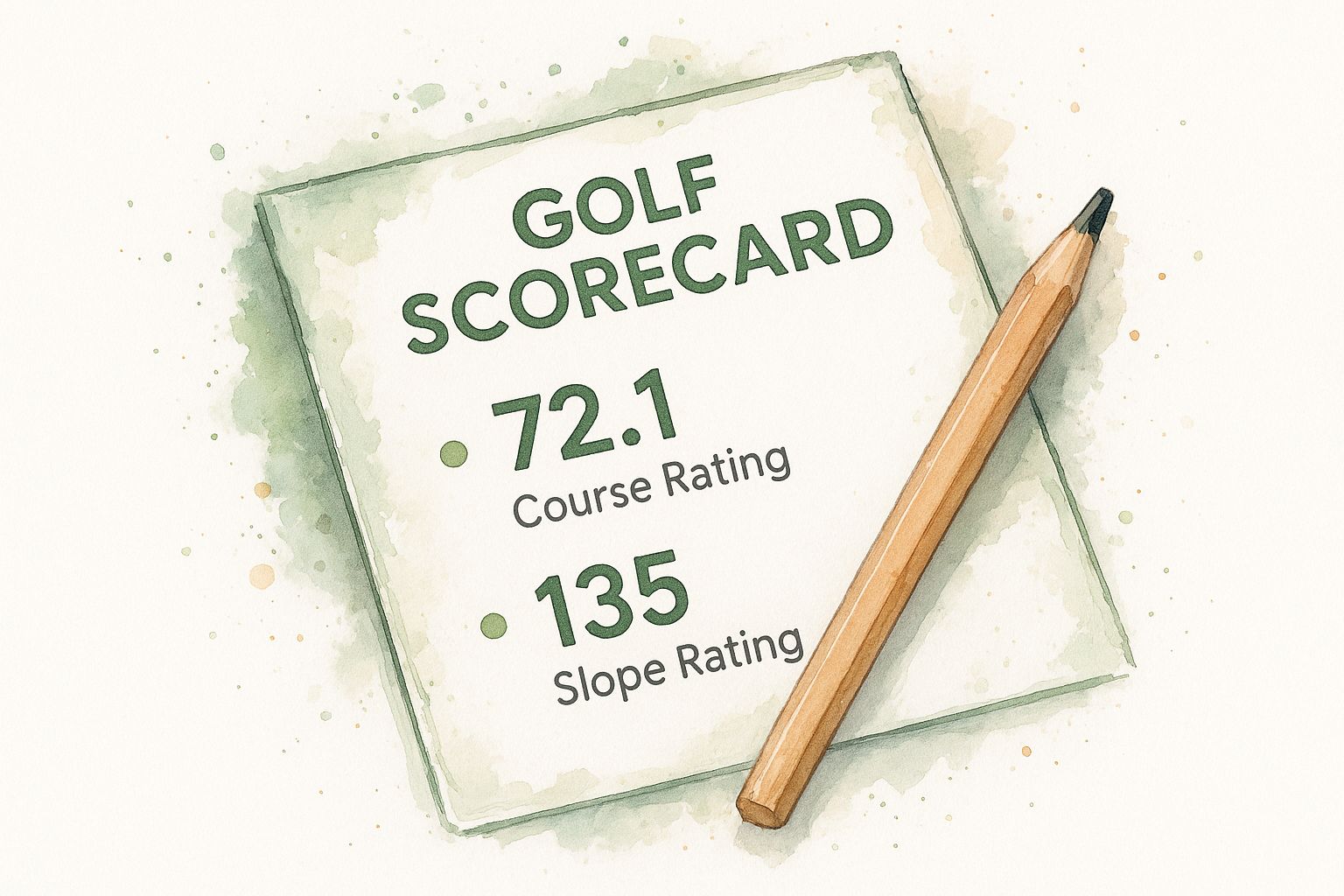
As the image shows, you have the Course Rating (72.1) and the Slope Rating (135). Understanding how these two numbers work together is the first real step to getting the most out of your scorecard and your game.
Golf Course Rating vs. Slope Rating: What’s the Difference?
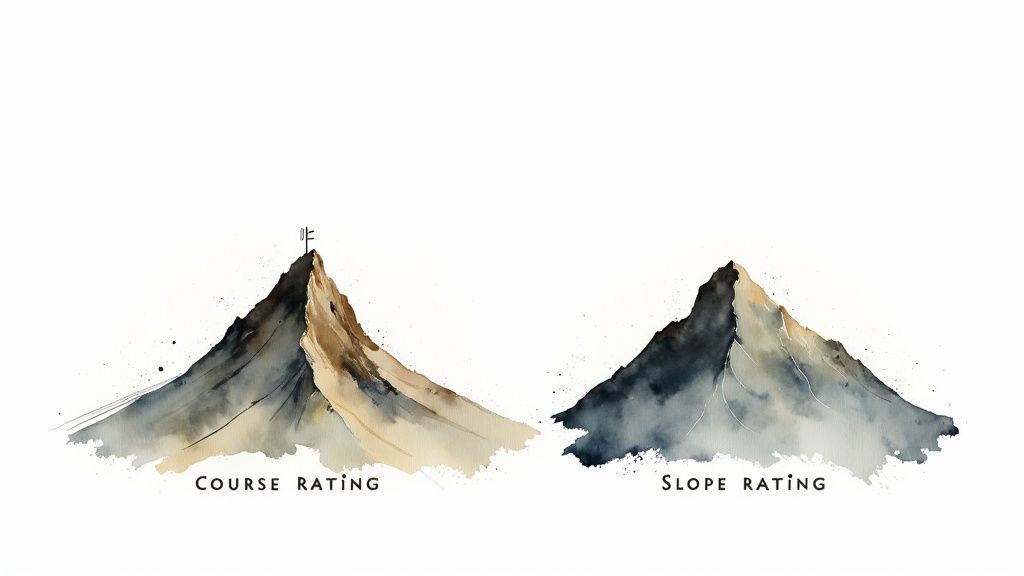
It’s easy to get Course Rating and Slope Rating mixed up. They both tell you how tough a course is, but they’re talking to two completely different golfers.
Here’s a simple way to think about it: Course Rating is like a mountain’s total height. It’s a fixed number that tells an expert climber exactly what they’re up against. The Slope Rating, on the other hand, is the mountain’s steepness and terrain. It shows how much harder that same climb gets for an average person compared to the seasoned pro.
This is the key to understanding why a course that looks straightforward on the scorecard can feel like a beast in reality. The Course Rating is laser-focused on one type of player: the scratch golfer. It’s the baseline score the pros are expected to shoot.
The Slope Rating? That one’s for the rest of us.
How Slope Rating Adjusts for Your Golf Game
When the USGA rolled out the Slope Rating system nationwide in 1987, it was a huge leap forward for creating a truly fair handicap system. Unlike Course Rating, Slope is all about the “bogey golfer”—someone who typically plays with a handicap around 20.
Slope quantifies just how much more difficult a course plays for the average Joe compared to an expert. A high Slope number means your misses are going to hurt a lot more. Think forced carries over water, deep bunkers, and lightning-fast greens that seem to repel every putt.
Key Takeaway: Course Rating tells a scratch golfer how hard the course is for them. Slope Rating shows how much harder it gets for everyone else.
This is why you might see a course with a fairly low Course Rating but a really high Slope. On paper, it doesn’t look long, but those narrow fairways and tricky hazards will punish any shot that isn’t perfect, making it a real challenge for higher handicappers.
To keep things straight, here’s a quick side-by-side look at how they differ.
Golf Course Rating vs Slope Rating at a Glance
This table breaks down the core differences so you can quickly tell them apart on the scorecard.
| Feature | Course Rating | Slope Rating |
|---|---|---|
| Target Player | Scratch Golfer (0 Handicap) | Bogey Golfer (~20 Handicap) |
| What It Measures | Predicted score for an expert | Relative difficulty for non-experts |
| Typical Range | 67-77 | 55-155 (113 is average) |
In short, Course Rating gives you the baseline difficulty, while Slope Rating adds the context for your specific skill level. Both numbers work together to give you a complete picture of the challenge ahead.
How a Golf Course Gets Its Official Rating

A golf course rating isn’t just some number pulled out of a hat. It’s the product of an incredibly detailed, on-the-ground evaluation by a trained team, usually from a state or regional golf association authorized by the USGA.
These folks don’t just glance at the scorecard. They walk every single hole, analyzing dozens of factors that could add a stroke here or there. Think of them as course detectives, armed with rangefinders and clipboards, meticulously documenting every potential challenge the architect laid out.
Golf: What Are They Actually Measuring?
The evaluation team digs way deeper than just the total yardage. They’re trained to see the course through the eyes of both a scratch golfer and a bogey golfer, quantifying every subtle (and not-so-subtle) feature that makes a hole tough.
Here are just a few of the key obstacles they measure:
- Topography: This isn’t just about hills. It includes everything from awkward uphill lies on an approach shot to severe slopes around the green that can send a good shot rolling into trouble.
- Fairway Width: They measure how wide the fairway is at typical landing areas for both scratch and bogey golfers, gauging just how much pressure is on you to hit it straight off the tee.
- Green Target: How big is the green? More importantly, how receptive is it? A tiny, firm green that repels shots is a world away from a large, soft one that acts like a dartboard.
- Bunker Severity: Raters assess every bunker’s placement, depth, and even the type of sand. They’re calculating the real penalty for finding the beach.
- Penalty Areas: They look at where water hazards and other trouble spots are located. Is that creek just for looks, or does it genuinely threaten your tee shot?
Getting a feel for the official rating process can really deepen your appreciation for the nuances of golf course design and how it affects play. You start to see that every mound and bunker was placed with a purpose, and the rating is a reflection of that strategy.
All this data gets crunched into a formula that spits out the final Course Rating and Slope Rating. This is exactly why two courses with the same yardage can have wildly different ratings—one might be a straightforward, wide-open layout, while the other is a strategic minefield of hazards and tricky greens.
Putting Golf Course Ratings to Work in Your Game
Okay, theory is great, but how do these ratings actually help you on a Sunday morning? This is where it all clicks. Course Rating and Slope Rating are the key ingredients for figuring out your Course Handicap.
Your Course Handicap is the magic number that translates your general skill level (your Handicap Index) into a specific number of strokes for the exact set of tees you’re playing that day. This is the engine of the World Handicap System, designed to create a level playing field for everyone.
It’s how a 5-handicap player can have a totally fair match against a 20-handicap player on any course—from a friendly local muni to a beast like Bethpage Black. It all boils down to one simple, but powerful, calculation.
Calculating Your Golf Course Handicap
The formula itself is refreshingly simple. It just takes your skill (Handicap Index), factors in the difficulty of the course (Slope Rating), and uses 113 as the baseline for a course of average difficulty.
Here’s what the math looks like:
Course Handicap = (Your Handicap Index) x (Slope Rating of Tees Played / 113)
Let’s run a quick scenario. Imagine you have a 15.0 Handicap Index and you’re trying to decide where to play this weekend:
- Course A (Easier): Slope Rating of 110
- Course B (Harder): Slope Rating of 140
At the easier Course A, your calculation is (15.0 x 110 / 113) = 14.6. That rounds up to a Course Handicap of 15. You get 15 strokes.
But take on the much tougher Course B, and the math changes: (15.0 x 140 / 113) = 18.5. This rounds up to a Course Handicap of 19. You get four extra strokes to help you tackle that much harder layout.
This simple math is precisely why knowing what does golf course rating mean is so important. It gives you the power to pick the right tees, set realistic expectations, and make sure every match you play is as fair as it can be, regardless of where you’re teeing it up.
Ultimately, understanding how this works makes you a smarter, more strategic golfer. If you’re ready to go a bit deeper, check out our detailed guide on what is a golf handicap. This is the kind of knowledge that helps you prepare for any round, on any course.
The Evolution of Fair Play in Golf
The sophisticated rating system we use today wasn’t born overnight. It’s the result of more than a century of tweaks, all driven by a single goal: to make golf a fairer game for everyone. Looking back at how we got here helps you appreciate why knowing what does golf course rating mean is so central to the sport.
Believe it or not, the earliest systems were incredibly simple, mostly just looking at a course’s total length to guess how tough it was. But as golf exploded in popularity, it became obvious that yardage alone couldn’t tell the whole story.
From Yardage to Obstacles in Golf
The real game-changer came in the early 20th century. The first official USGA Course Rating System was put in place back in 1911, thanks to a forward-thinking proposal by Leighton Calkins, a key member of the Handicap Committee. For a while, these ratings still leaned heavily on yardage and par.
Over the next few decades, though, the system started getting smarter. By 1963, the USGA had rolled out a method that blended yardage with obstacle assessments. A few years later, in 1967, ratings began using decimal points for the first time—a small detail that made a massive difference in accuracy. If you want to dig deeper into the nuts and bolts, you can explore the history of course rating with the SCGA.
The introduction of obstacle assessments was a huge leap forward. For the first time, the system officially acknowledged that a nasty bunker or a well-placed water hazard could make a hole just as tough as an extra 50 yards of fairway.
This constant drive for fairness is what ultimately gave us the Slope system, which built on the solid foundation of the Course Rating. This evolution is why the numbers on your scorecard today do a pretty fantastic job of reflecting the challenge you’re facing, no matter where you tee it up.
FAQ’s
Now that we’ve pulled back the curtain on how course ratings are calculated, let’s tackle a few common questions golfers have. Think of this as a quick FAQ to clear up any lingering confusion.
What is a difficult Course Rating or Slope Rating?
“Difficult” is always a bit subjective, but the numbers give us a pretty clear picture. For scratch golfers, a Course Rating that climbs above 74 is a major red flag. The higher it gets, the tougher the test, and the more strokes even an expert is expected to take.
For the rest of us, the Slope Rating tells the real story.
The average Slope Rating for a course in the U.S. is about 120. Any course that starts pushing well past that number is designed to punish the average golfer’s mistakes more severely.
Once you see a Slope Rating of 135 or higher, you know you’re in for a serious challenge. These are the courses that demand precision—think tight fairways, forced carries over water, cavernous bunkers, and slick, contoured greens that can make a three-putt feel inevitable.
Does a high rating mean a course is better?
Not at all. A high rating just means a course is harder—it has nothing to do with its conditioning, scenery, or how much fun it is to play. Some of the most beloved courses on the planet have moderate ratings because they offer a fair and strategic test of golf, not just a brutal one.
A course with a lower rating might be the perfect spot for a relaxed afternoon round or for working on a new swing thought. “Better” is all about what you’re looking for that day.
How often are courses re-evaluated?
How often are courses re-evaluated?
A golf course is a living thing. Trees mature, bunkers get a facelift, and greens are redesigned. To keep things accurate, the USGA requires that every course gets re-rated at least once every 10 years.
However, state and regional golf associations will often step in to re-rate courses more frequently, especially if major renovations have taken place. This ensures the numbers you’re playing against reflect the course as it stands today. You can even spot regional trends; for instance, coastal states often have tougher courses with slope ratings of 121 or more due to wind and terrain. Meanwhile, many public tracks in middle America fall under 118. You can find more cool stats like these at PopeOfSlope.com.
At Golf Inquirer, we’re all about helping you understand the game on a deeper level. From decoding your scorecard to finding your next must-play course, we’ve got you covered. Check out more of our tips, gear reviews, and guides at https://golfinquirer.com.