Your golf grip is your one and only connection to the club. It’s a simple fact, but easily one of the most overlooked parts of the game. If you want your hands to work in harmony, promote a clean swing path, and give you maximum control, getting the right golf grip size is non-negotiable. This isn’t just about what feels comfortable; it’s about the very mechanics of your entire swing.
- Why Your Grip is the Steering Wheel for Your Golf Club
- How to Measure Your Hand for the Right Grip in Golf
- Decoding Golf Grip Sizes and Charts
- How an Incorrect Grip Wrecks Your Golf Shots
- Fine-Tuning Your Feel with Grip Tape
- Choosing a Golf Grip Beyond Just the Size
- Got Questions About Golf Grip Size? We’ve Got Answers.
Why Your Grip is the Steering Wheel for Your Golf Club

Imagine your grip as the steering wheel for your clubhead. You wouldn’t try to navigate a tight corner in a race car with the steering wheel from a monster truck, would you? The same logic applies here. A grip that’s too big or too small forces your hands into a constant battle for control, leading to sloppy shots and a serious loss of power.
This subtle struggle is often the hidden culprit behind golf’s most frustrating problems—from that nagging hook you can’t shake to a weak slice that robs you of precious distance. Nailing the right size isn’t a minor tweak; it’s a foundational piece of your equipment setup.
The Impact on Your Golf Swing Mechanics
When a grip fits your hands perfectly, you can hold the club with light, even pressure. This relaxed state is the secret sauce for a fluid, powerful swing. But the wrong grip throws a wrench in the works, introducing tension and messing with your natural motion.
- Shot Accuracy: A proper grip makes it worlds easier to square the clubface at impact, shot after shot.
- Power and Distance: It frees up your wrists to hinge naturally, which is where you generate that explosive clubhead speed.
- Overall Consistency: By eliminating a huge variable, a correctly sized grip helps you build a swing you can actually repeat under pressure.
The right grip size can be one of the fastest ways to improve your entire game and build confidence on the course. It takes the guesswork out and lets your swing do what it’s supposed to.
And more golfers are catching on. In 2023, the global golf grip market was valued at a hefty USD 1.1 billion and is projected to climb to around USD 1.9 billion by 2033. This boom is fueled by players like you and me seeking customized fits to gain more control and reduce strain on our hands and wrists.
Ultimately, understanding how crucial your grip is is the first step toward playing better golf. For a deeper dive, check out our hand-by-hand guide on the importance of your golf grip.
How to Measure Your Hand for the Right Grip in Golf
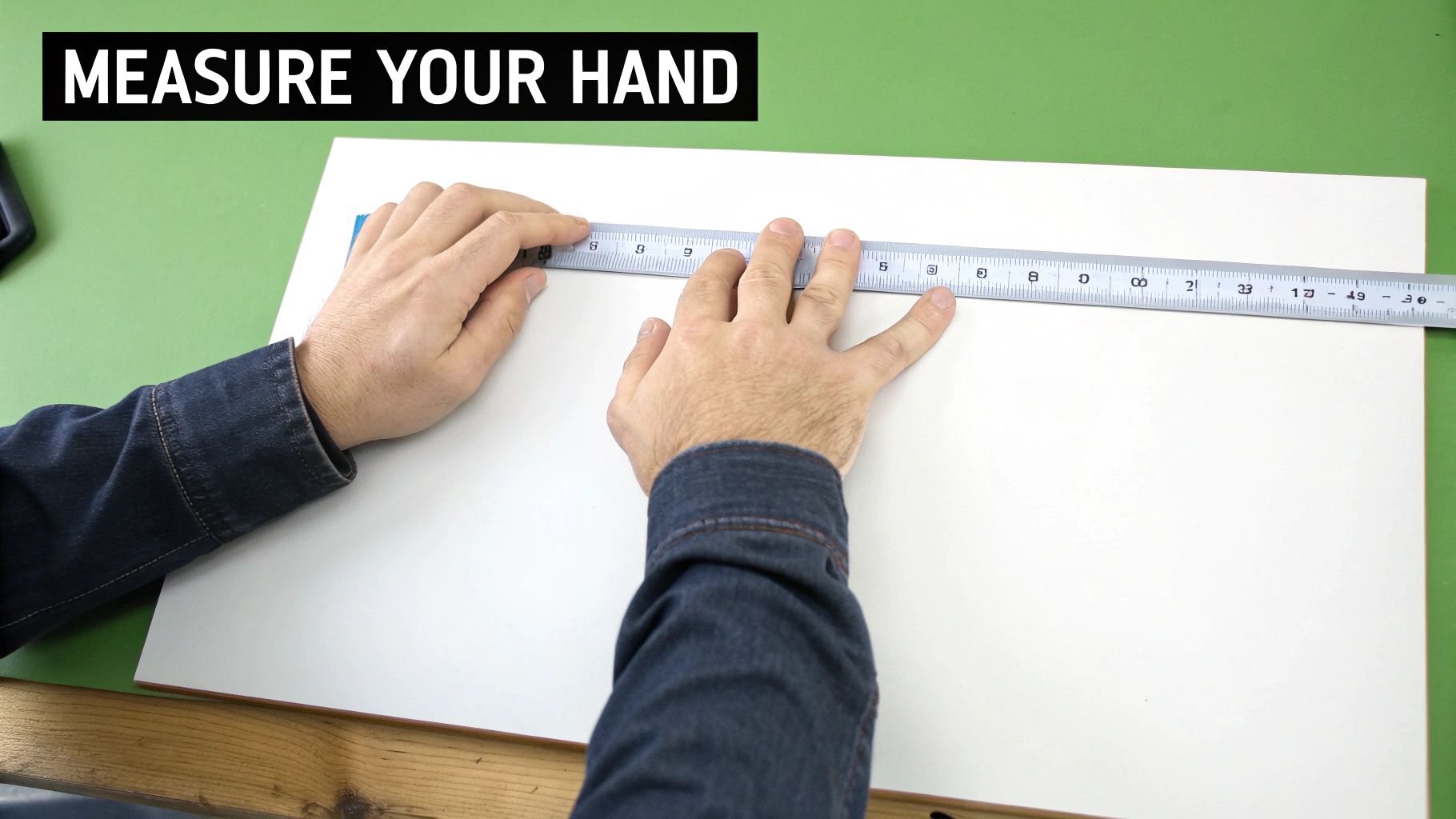
Figuring out your perfect golf grip size isn’t some dark art—it’s a straightforward process that starts with a ruler and two quick measurements. Think of it like getting a custom-tailored suit. The right fit feels natural and lets you perform at your best. The same principle applies to how your hands connect with the golf club.
Taking these measurements gives you the hard data you need to match your hand to a standard grip size. It removes all the guesswork, giving you a solid, fact-based foundation for finding a grip that feels less like a piece of equipment and more like an extension of your arm.
The Two Critical Hand Measurements
All you need is a standard ruler. Take your time, because accuracy is everything; measure twice if you need to be sure. These two numbers are the industry-standard specs used to pinpoint your recommended golf grip size.
-
Overall Hand Length: Place the end of the ruler at the major crease at the base of your palm where it joins your wrist. Now, measure in a straight line from that point all the way to the tip of your longest finger (usually the middle finger). This number is a great baseline and often corresponds with your glove size.
-
Longest Finger Length: Next, isolate that same longest finger. Measure it from the crease where it meets your palm to the very tip. This second measurement is crucial for fine-tuning the fit, as finger length dramatically affects how your hand wraps around and secures the club.
Why both? Because together they tell the whole story. Someone might have a medium-length hand overall, but their fingers could be unusually long, which would likely push them into a midsize grip for better control. Without both measurements, you’re just guessing.
A study of everyday golfers found that over 70% were playing with the wrong size grip, and most of the time, it was too small. This quick measurement is the fastest way to make sure you’re not in that majority.
Translating Measurements into Action
Once you have your two numbers jotted down—your total hand length and your longest finger length—you’re ready to put them to work. These aren’t just random stats; they’re the keys to unlocking a more consistent, comfortable, and powerful golf game.
Hang onto these dimensions. They are your personal specs, the blueprint for building a better connection to every club in your bag. In the next section, we’ll plug these into a simple chart to translate them into a specific grip category, from Undersize to Jumbo. This is where you’ll see exactly how your hand dictates the perfect grip for your swing.
Decoding Golf Grip Sizes and Charts
So you’ve got your hand and finger measurements. Great. Now it’s time to turn those numbers into an actual golf grip size. This is where we connect the dots between your unique anatomy and the gear you’ll be holding for every single shot. It’s less about complicated math and more about understanding a few simple industry standards.
The golf world breaks down grip sizing into four main categories. You can think of them like t-shirt sizes—each one is designed to fit a general range of hand sizes, so you don’t get bogged down in tiny increments. This system gives everyone a clear place to start.
The Main Golf Grip Size Categories
Nearly every grip manufacturer uses the same basic sizing framework. While the rubber compounds, textures, and colors will change from brand to brand, the core dimensions are surprisingly consistent across the board.
- Undersize/Junior: Just as it sounds, this grip is for golfers with smaller hands. It’s a common choice for many women and younger players.
- Standard: This is the default grip you’ll find on almost any club sold off the rack. It’s designed to fit the “average” golfer but, as we know, not everyone is average.
- Midsize: A noticeable step up from Standard, this size is a game-changer for players with slightly larger hands or longer fingers.
- Jumbo/Oversize: This is the biggest grip you can get, offering the most surface area and thickness for golfers with very large hands.
Here’s a common trap: don’t just assume “Standard” is right for you because it’s the default. Your personal measurements are what matter. Letting your data guide you is the secret to finding a grip that works with your hands, not against them.
Matching Your Measurements to a Grip Size
To make things easy, we can use a simple chart to match your measurements to one of those four categories. This takes all the guesswork out of the equation and points you directly to your recommended size.
Golf Grip Size Recommendation Chart
Use your hand and middle finger measurements to find your recommended golf grip size in this chart.
| Hand Measurement (Glove Size) | Middle Finger Length | Recommended Grip Size |
|---|---|---|
| Under 7 inches | Less than 2.75 inches | Undersize/Junior |
| 7 to 8.75 inches | 2.75 to 3.5 inches | Standard |
| 8.25 to 9.25 inches | 3.5 to 4 inches | Midsize |
| Over 9.25 inches | More than 4 inches | Jumbo (Oversize) |
Simply find the rows that correspond to your measurements. This will give you the perfect starting point for your grip selection.
Understanding Grip Core Size in Golf
There’s one more piece to this puzzle: the core size. This is the diameter of the hole on the inside of the grip, and it needs to match the diameter of your club’s shaft butt. The two most common core sizes are .580 and .600 (measured in inches).
Think of it like putting a tire on a wheel—the inner ring of the tire has to match the outer ring of the rim. A .600 grip is made for a .600 shaft, and a .580 grip is made for a .580 shaft. Simple enough.
But here’s a little insider tip: you can mix and match to fine-tune the final feel. If you install a smaller .580 core grip onto a larger .600 shaft, the rubber has to stretch a bit more. This makes the final installed grip feel just a touch thicker. It’s a subtle way club fitters add another layer of customization.
How an Incorrect Grip Wrecks Your Golf Shots
Alright, you’ve taken your measurements and found your recommended golf grip size. Now, let’s talk about why this actually matters out on the course. This is where the rubber meets the road. A poorly sized grip isn’t just a small detail; it’s often the root cause of some of the most stubborn swing flaws that drive golfers crazy.
Think of your grip as the control panel for the clubface. When it fits right, your hands work together naturally, delivering the club squarely to the ball without conscious manipulation. But when the size is off, your hands start making tiny, subconscious adjustments that can throw your entire swing out of whack.
When Your Golf Grip Is Too Small
A grip that’s too small is one of the most common reasons amateur golfers develop a nasty hook. Because the grip doesn’t properly fill your hand, your fingers and wrists tend to get way too involved in the swing. It encourages a premature, “flippy” rotation of the hands right through the impact zone.
This extra hand action slams the clubface shut too quickly, turning what should have been a straight shot into a ball that dives hard to the left (for a righty). You might even feel like you have a secure hold, but that feeling is actually your hands working overtime—exactly what we want to avoid.
The infographic below gives a great visual of the different grip size categories, helping you see where your measurement might place you.
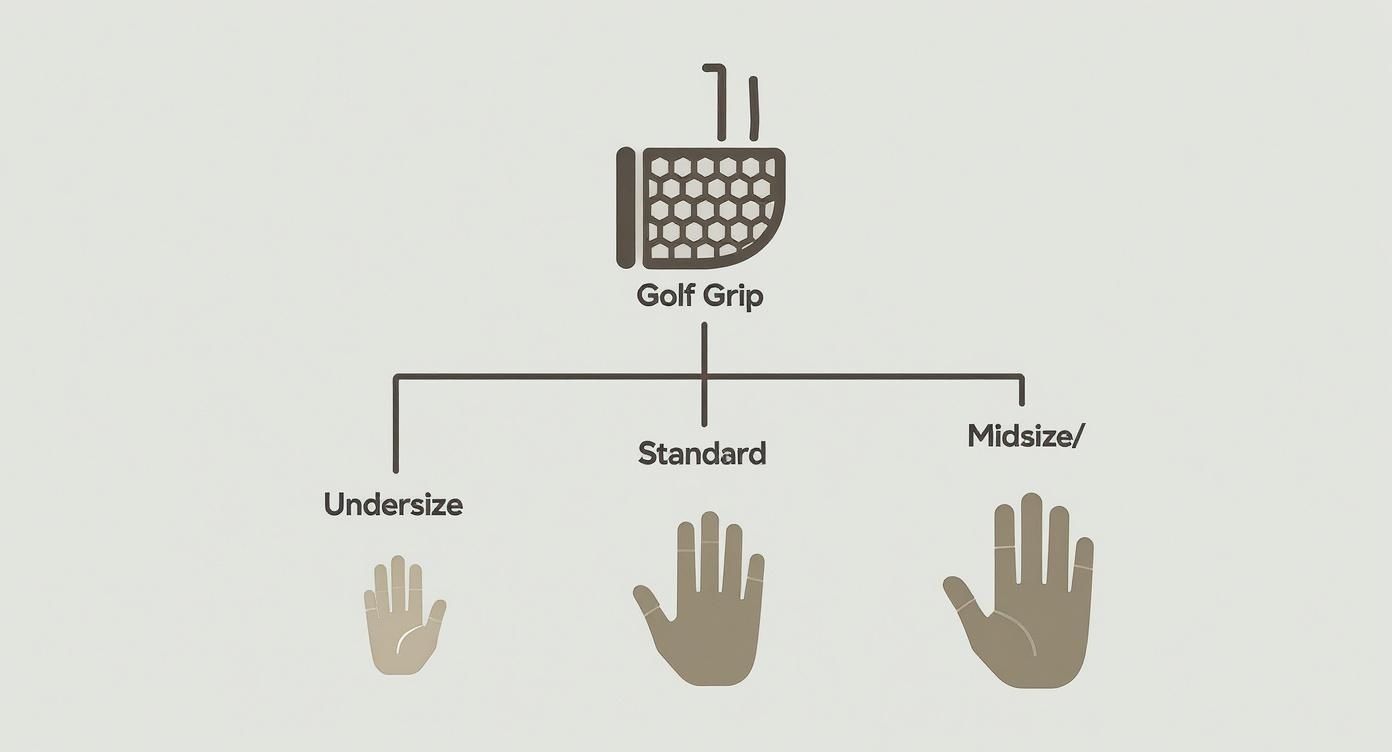
This chart breaks down the progression from Undersize all the way to Jumbo, with each step designed to fit a different hand size and finger length.
When Your Golf Grip Is Too Large
Going the other way, a grip that’s too big can be just as destructive, usually leading to a weak slice or a push. When the grip is too chunky, it physically restricts your wrists from hinging and unhinging naturally. Imagine trying to sign your name with a marker the size of a Pringles can—you’d lose all fine motor control.
That same restriction prevents your hands from releasing the club properly through impact.
Key Takeaway: An oversized grip slows your hands down, preventing them from squaring the clubface in time. The face stays open at impact, sending the ball weakly off to the right.
Once you diagnose this cause-and-effect, you can stop blaming your swing for a problem that’s actually rooted in your equipment. It’s a total game-changer.
- Small Grip Symptom: A nagging hook that shows up even when your swing feels perfectly on plane.
- Large Grip Symptom: A persistent slice or push that just won’t go away, often coupled with a frustrating loss of distance.
Spotting these patterns is the first step. The right grip size frees up your hands to do their job, giving you that perfect blend of stability and fluid motion you need for a powerful, repeatable golf swing.
Fine-Tuning Your Feel with Grip Tape
So what happens when your hand measurement puts you right on the fence between a Standard and a Midsize grip? Don’t worry, you’re not alone. Countless golfers find themselves in this exact spot—one size feels just a little too small, but the next size up feels like you’re holding a baseball bat.
This is where grip tape becomes your best friend. Instead of making a big leap to a completely different grip size, you can use extra layers of tape to subtly “build up” your current grip. It’s the perfect way to make micro-adjustments and dial in the exact thickness that feels just right in your hands.
How Grip Tape Affects Size
The concept is refreshingly simple. Before installing a new grip, your club fitter just adds a few extra wraps of tape around the shaft. Each layer adds a tiny bit of thickness, gradually increasing the final diameter of the grip once it’s slid on.
The best part? It’s a standardized process, so you can get the same feel on every single club in your bag.
The industry-standard formula is easy to remember: one full wrap of grip tape increases the final grip size by +1/64th of an inch. This means four extra wraps will build a Standard grip up to the exact dimensions of a Midsize grip.
This level of precision is a game-changer. If a Midsize grip feels just a hair too big, you can simply ask your fitter to install a Standard grip with two extra wraps. This creates a custom size that sits perfectly between the two off-the-shelf options, giving you a truly personalized fit.
Pros and Cons of Building Up Your Grips in Golf
Building up a grip is a fantastic way to customize your feel, but it’s smart to look at both sides before you commit.
-
Pros:
- Ultimate Customization: You can achieve a precise thickness that simply isn’t available in standard sizes.
- Cost-Effective: Adding a few layers of tape is often cheaper than buying a whole new set of pricier Midsize or Jumbo grips.
- Easy Experimentation: It lets you test out slightly larger sizes without fully committing to a major change.
-
Cons:
- Slightly Firmer Feel: Extra layers of tape can make the grip feel a bit firmer and deaden some of the natural feel compared to a grip that is manufactured at that size.
- Installation Matters: It takes a skilled club builder to apply the tape smoothly and consistently. A sloppy job can lead to lumps or an uneven feel.
Ultimately, using tape to adjust your golf grip size is an excellent strategy for any player chasing that “just right” feel. It bridges the gap between standard sizes and puts the power of true customization directly into your hands.
Choosing a Golf Grip Beyond Just the Size
While nailing the correct golf grip size is a huge first step, it’s not the last word on the matter. Think of it like buying a car. You’ve picked the right model—that’s the size—but now it’s time to decide on the interior and the tires. Details like the grip’s material and texture truly complete the experience and make it perform exactly how you need it to.
The material you choose has a massive impact on the feel, tackiness, and how your grip performs when things get a little damp. Every type offers a unique advantage, so the key is to match the material to your personal preference and the conditions you typically play in.
Grip Materials and Textures
Different materials and surface patterns are engineered for very specific needs, whether it’s for certain weather or just what feels best in a player’s hands.
- Traditional Rubber: This is the workhorse of the grip world, and for good reason. All-rubber grips offer a soft, comfortable feel with plenty of feedback. They’re a fantastic all-around choice for most golfers playing in moderate conditions.
- Corded Grips: These grips are a game-changer in wet or humid weather. They have cotton cord fibers woven right into the rubber, creating a much rougher, firmer texture. This provides maximum traction, making them perfect for players in humid climates or for those whose hands tend to sweat.
- Soft Polymers: Newer synthetic materials have brought a super tacky, almost sticky feel to the market. These grips are often incredibly soft and do a phenomenal job of dampening vibrations from mishits, giving you a comfortable hold that’s less abrasive.
The right texture creates a confident connection to the club without needing a death grip. This encourages a lighter, more relaxed hold, which is absolutely essential for a fluid, powerful golf swing.
Just as the grip connects you to the club, the right golf glove connects you to the grip. To learn more about how these two critical pieces of gear work hand-in-hand, check out our complete golf gloves guide to find your perfect pairing.
And once you’ve got your gear dialed in, why not think about where you’ll put it to the test? Combining a passion for golf with a relaxing getaway is the perfect reward. If that sounds good, you might want to explore top golf and spa resorts that let you hone your skills and unwind in style.
Got Questions About Golf Grip Size? We’ve Got Answers.
Even after you’ve got the basics down, a few questions about golf grip size always seem to pop up. Nailing these details is a huge part of feeling confident over the ball, so let’s clear up a few common queries we hear in a club fitting.
One of the biggest questions is whether every club in the bag needs the same grip size. The answer is a resounding yes. Consistency is king in this game. Having the same grip size from your driver all the way down to your wedges ensures your hands have the exact same relationship with the club on every single swing.
Think about it—this kind of uniformity is what builds repeatable mechanics and muscle memory. You don’t want your hands to feel one thing with your driver and something completely different with your 8-iron.
Answering Your Top Grip Questions
Another classic question involves gloves. Should you wear one when you’re measuring your hand? Absolutely. Since you play with a glove, you need to measure with a glove. It’s the only way to get a true reading of how much space your hand will actually take up when you’re out on the course.
Here are a few other rapid-fire answers to common questions:
- How often should I regrip my clubs? The rule of thumb is once a year or every 40 rounds, whichever comes first. Grips lose their tackiness and firmness over time from heat, dirt, and oil, even if they don’t look completely worn out.
- Can a grip be too tacky? Not really. A tacky grip is your friend because it helps you maintain lighter grip pressure. The goal is to find a texture that feels secure without making you feel like you have to strangle the club.
- Does weather affect my grip choice? Definitely. If you often play in wet or humid conditions, corded or more aggressively textured grips are a must-have. They do a much better job of wicking away moisture than standard rubber grips.
Getting your golf grip size right isn’t a one-time fix. It’s an ongoing part of maintaining your equipment. As your grips wear down, so does your connection to the club.
Don’t be afraid to experiment a little, either. Your feel for the club can change over time, so what felt perfect last season might need a small tweak today. Staying on top of it ensures your gear is always helping your swing, not hurting it.
At Golf Inquirer, we believe a well-informed player is a better player. Dive into more tips, tricks, and gear guides to elevate your game by visiting us at https://golfinquirer.com.