
If you’re trying to improve your swing speed, let’s get one thing straight: swinging out of your shoes isn’t the answer. That’s just a fast track to a pulled muscle and a lost ball. Real, lasting speed comes from a smarter approach—a blend of golf-specific fitness, proven training drills, and a solid grasp of how the body creates power. This guide is all about cutting through the noise and giving you the real-world techniques that actually add yards to your drives and help you improve swing speed.
The Real Source of Explosive Swing Speed in Golf

So many golfers think hitting it farther means either getting huge at the gym or just gritting their teeth and swinging harder. But the truth is, the source of real speed is more elegant than that. It’s less about brute strength and more about power—which is the magic combination of strength and velocity.
Here’s an easy way to picture it: a world-class powerlifter might deadlift 500 pounds, but that doesn’t mean they can generate the whip-like speed needed for an explosive golf swing. The goal isn’t just to be strong; it’s to be fast. This is why you see lanky, wiry tour pros who seem to effortlessly create incredible clubhead speed. They’ve mastered power, not just strength.
To get there, you need a clear roadmap. Let’s break it down into three core pillars that work together to build the sustainable power you’re chasing.
Your Roadmap to a Faster Golf Swing
This quick overview highlights the three key areas we’ll cover to help you build sustainable speed and power.
| Pillar | What It Covers | Why It Matters |
|---|---|---|
| Technique | Optimizing your swing mechanics, sequencing, and use of ground force. | Efficient movement ensures every ounce of energy you create is funneled directly into the golf ball instead of being wasted. |
| Fitness | Building explosive strength, core stability, and crucial mobility. | A well-conditioned body can generate more rotational force and handle the stress of a high-speed swing, which also helps prevent injury. |
| Equipment | Using the right training aids and playing with properly fitted clubs. | The right tools, like speed sticks or a driver shaft that matches your swing, can unlock your speed potential and give you instant feedback. |
Understanding how these three pillars work together is the first step. You simply can’t focus on one area and expect massive results. A golfer with picture-perfect technique but poor physical conditioning will eventually hit a hard ceiling. On the flip side, a strong athlete with flawed mechanics will leak power all over the place.
The key takeaway is this: You can’t shoot a cannon out of a canoe. Your body has to be a stable, powerful platform to generate and transfer that immense force. This means all speed training is built on a foundation of a strong, healthy, and mobile body.
By giving each of these pillars the attention they deserve, you create a complete system for improvement. This guide will walk you through actionable steps in each category, moving beyond generic tips to give you a structured plan for unlocking the fastest, most powerful swing of your life.
Building Your Power Source with Golf Fitness

I see it all the time: golfers think raw arm strength is the secret to a faster swing. But your arms are just along for the ride. The real engine of your swing—your true power source—is your lower body and core.
Building functional strength in these areas is how you learn to improve swing speed in a way that’s not just powerful, but sustainable for the long haul.
Let’s forget about bicep curls and bench presses for a minute. We’re not training for a bodybuilding show; we’re training to be more athletic and explosive golfers. That means focusing on movements that directly translate to the powerful, rotational sequence of the golf swing.
Train Movements for Golf , Not Just Muscles
The best golf fitness programs focus on how your body moves as a single, coordinated unit. It’s all about creating a stable base, generating force from the ground up, and channeling that energy through a tight, responsive core.
Think of it like a kinetic chain. If you have a weak link anywhere in that chain, you’re going to leak power. To build this chain, we need the right tools—ones designed for explosive power, not just lifting heavy.
- Medicine Balls: Perfect for developing rotational speed. Exercises like slams and rotational throws teach your body to load and unload energy with serious force.
- Kettlebells: For building hip-driven power, nothing beats a kettlebell. The kettlebell swing is probably the single best exercise for ingraining the powerful hip hinge that drives a high-speed golf swing.
- Plyometrics: We’re talking about jumping exercises, like box jumps. They train your fast-twitch muscle fibers to fire more rapidly, giving you that “snap” and explosiveness you need at impact.
These tools are all about training your body to generate force quickly, which is the very definition of power. If you want to dive deeper into this, our guide on https://golfinquirer.com/how-to-enhance-the-power-of-your-swing/ offers even more insight into building a solid foundation.
The core principle is simple: your body has to be strong enough to handle the speed you want to create. Trying to swing faster with an unprepared body is a recipe for inconsistency and, even worse, injury.
Your Foundational Power Exercises in Golf
Ready to build your engine? Start by working these three movements into your fitness routine. They directly target the key muscle groups responsible for generating clubhead speed.
1. Kettlebell Swings
This is not a squat; it’s a powerful hip hinge. By snapping your hips forward, you generate a massive amount of force that travels right up through your core. This is the exact motion that powers the downswing, teaching you to initiate the sequence with your lower body. Start light and focus on explosive form for 3-4 sets of 10-15 reps.
2. Medicine Ball Rotational Slams
Stand with your side to a solid wall. Mimic your backswing by rotating away from it, then explosively fire your hips and core to slam the ball into the wall. This is pure rotational power and helps sync up your lower body and torso. Aim for 3 sets of 5-8 reps on each side.
3. Box Jumps
This one is all about lower-body explosiveness. Find a sturdy box or platform at a height you can manage safely. From a dead stop, jump up onto the box, landing softly. This trains your glutes and quads to produce maximum force in a split second—critical for pushing off the ground during your swing.
Of course, training hard is only half the battle. You need to recover properly to build sustained power and avoid burnout. Implementing effective strategies for faster recovery is a non-negotiable part of the process. Consistent, smart training paired with adequate rest is the real formula for long-term speed gains.
Using Speed Training to Break Your Limits in Golf
Alright, we’ve built the physical engine. Now it’s time to teach that engine how to redline. This is where we retrain your nervous system to shatter its old speed limits. The secret sauce? A powerful technique called overspeed and underspeed training. For any golfer serious about adding yards, this is a total game-changer.
The idea is actually pretty straightforward. Your brain has a built-in “governor” that caps how fast you can swing, mostly to protect your body from injury. To reset that governor, you have to prove to your brain that it’s safe to move faster.
We do this by swinging tools that are both lighter and heavier than your normal driver. When you swing something lighter, your body physically moves faster than it’s used to, which recalibrates your neuromuscular system to a new top speed. On the flip side, swinging something heavier builds the specific, functional strength you need to control all that newfound speed.
The Science of Varied Weight Training in Golf
This isn’t just locker-room theory; it’s backed by solid science. The goal is to find that sweet spot in your training that pushes for more speed without wrecking your swing mechanics. Research has shown that using clubs with strategically varied weights can lead to serious gains.
For instance, one study found that training with a club just 10% lighter than a standard driver produced almost double the clubhead speed improvement compared to a club that was 20% lighter. It turns out the much lighter club actually caused negative changes in the swing’s motion. The takeaway is huge: how you do speed training is just as important as the fact that you’re doing it.
A Practical Speed Training Protocol
You don’t need a high-tech sports lab to put this into practice. Speed sticks are the most common way to go, but you can get creative and make a DIY version by simply turning your driver upside down or even just using an alignment stick. The focus here isn’t on hitting a ball—it’s purely about moving the club as fast as you possibly can while maintaining good form.
Here is a basic warm-up flow to get your body prepped for this kind of explosive work.
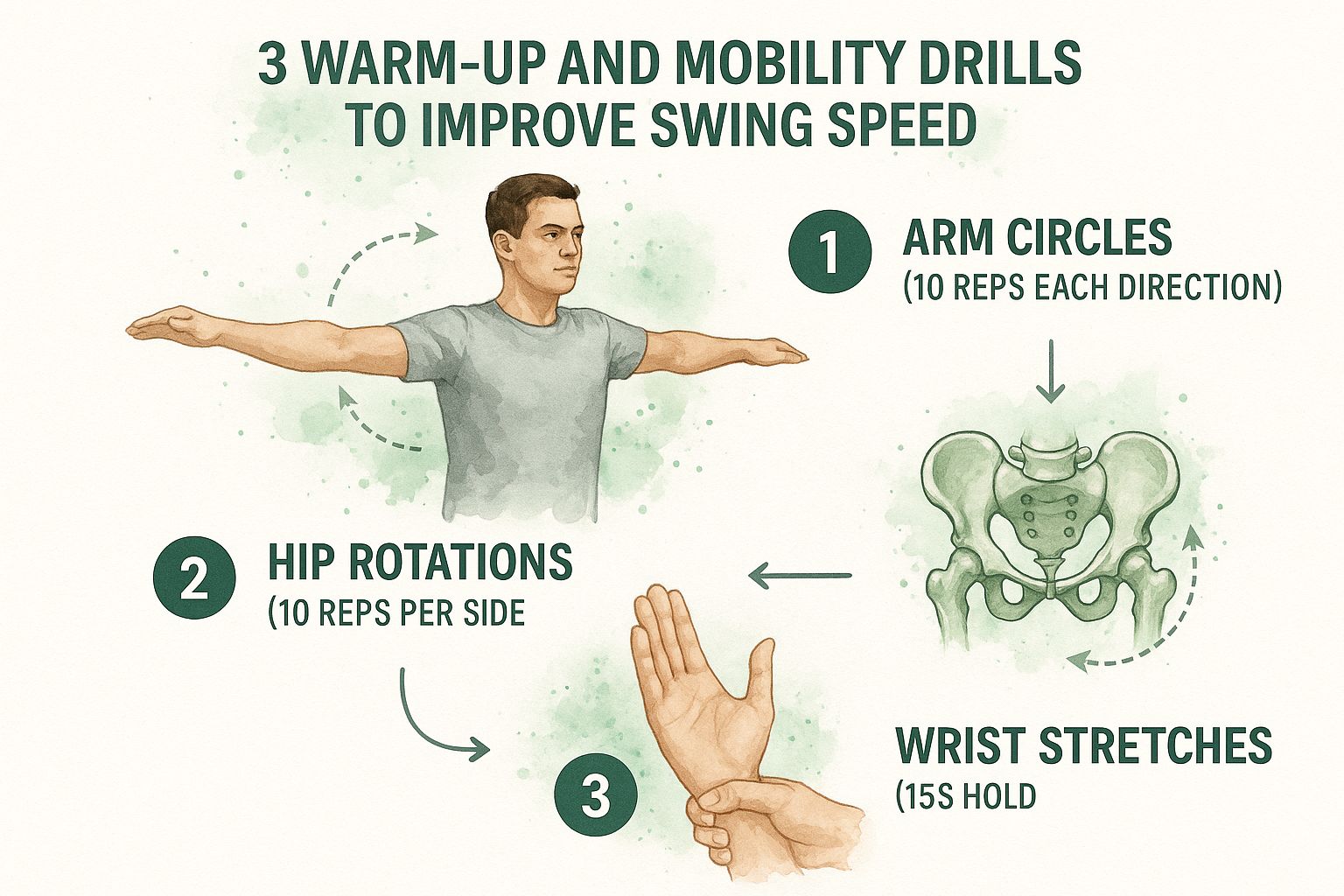
This sequence gets the key players—your shoulders, hips, and wrists—ready for high-velocity movement, which goes a long way in preventing injury.
Once you’re loose, the protocol is simple. The key is to swing with maximum intent on every single rep, followed by full recovery.
- Light Stick: 5-8 swings at 100% effort.
- Medium Stick (Your Driver): 5-8 swings at 100% effort.
- Heavy Stick: 5-8 swings at 100% effort.
Crucial Insight: Don’t rush this. The rest period between your sets is just as important as the swings. Take at least two to three minutes to fully recover. This isn’t cardio; it’s a neurological workout. Your muscles need to be fully recharged to fire at their absolute maximum speed.
By cycling through these different weights, you’re essentially tricking your body into becoming more athletic. You’re building raw power with the heavy stick and then teaching your body how to unleash it with explosive velocity using the light one. Weaving these kinds of sessions into your regular schedule is one of the most effective golf drills and practice routines you can adopt for real, lasting speed gains.
Unlocking Hidden Power from Your Opposite Side

Here’s a technique that almost every amateur golfer ignores, yet it’s a secret weapon for top trainers and pros. It feels completely backward at first, but the results are undeniable: training your non-dominant side. If you’re a right-handed golfer, that means taking swings as a lefty, and vice versa.
This isn’t about becoming a switch-hitter on the course. It’s about creating balance, improving coordination, and teaching your body how to decelerate more effectively. That last part is the real magic. Your ability to slam on the brakes after impact is directly linked to how fast you can accelerate into the ball.
Think of it like a high-performance car. A vehicle with incredible acceleration also needs elite brakes to handle that speed safely. By training the “braking” muscles on your opposite side, you give your nervous system the confidence to let go and fire your dominant-side muscles with much greater velocity.
Building a Symmetrical Athlete
Your golf swing is a violent, one-sided movement. Over thousands of reps, this creates significant muscular imbalances that can limit your athletic potential and even lead to injury. Swinging from your non-dominant side helps counteract this, building a more balanced and resilient body.
This practice also refines your body’s proprioception—its awareness of where it is in space. It forces you to feel the correct sequence in a totally new way, which often cleans up flaws in your regular swing without you even realizing it. The awkwardness you initially feel is just your brain building new neural pathways, making your entire system smarter and more efficient.
A documented case study over six weeks showed a golfer who incorporated non-dominant swings into their training increased driver swing speed by nearly 15 mph. The improvement was tied directly to better kinetic sequencing, proving how this drill optimizes muscle firing patterns to generate and transfer force. You can dive deeper into the dramatic effects of this training in this case study on non-dominant side swings.
Your Opposite-Side Drill
Integrating this into your routine is simple. You don’t need to hit balls, and you don’t even need a perfect-looking swing. The goal here is purely athletic.
Here’s how to do it:
- Grab a mid-iron or a speed stick. You want something you can move easily without much thought.
- Take 10-15 swings from your non-dominant side. Just focus on maintaining your balance and creating a smooth, fluid motion.
- Feel the sequence. Pay attention to how your hips, torso, and arms are working together. Don’t force it.
- Switch back to your dominant side for 5 swings. Notice how much more stable, balanced, and free your body feels. The difference can be immediate.
Tack this drill onto every warm-up. It might feel strange for a week or two, but the payoff is a more powerful, coordinated, and injury-proof body. This simple addition is one of the most effective ways to improve swing speed because it addresses the very foundation of your athletic ability.
Taking Your New Speed from the Range to the Golf Course
So, you’ve put in the hours. You’ve hammered away with the speed sticks, swung until your non-dominant side feels almost normal, and the launch monitor is spitting out numbers that make you grin. But then you step onto the first tee—tight fairway, water right—and poof. That easy, flowing speed is gone.
This is the final boss battle in the quest for speed: actually trusting it when a score is on the line. The driving range is a lab; the golf course is the real world, complete with pressure and consequences. Closing that gap is as much a mental game as it is a physical one.
It’s completely normal to revert to old, comfortable habits under pressure. The body gets tight, the swing gets short and “steery,” and all that speed you worked so hard to unlock stays trapped inside. The trick is to bring that fluid, athletic motion from your practice bay to the first tee.
From Practice Swings to Real Swings
One of the biggest speed-killers out there is a tense, static start over the ball. A great way to fight this is to bake a continuous, rhythmic motion into your swing, and a classic drill is perfect for the job.
The Step Drill is an absolute game-changer for this. It physically forces you to start your swing with your lower body, not with a quick, tight snatch of the hands and arms.
- Start with your feet together, holding your driver like you’re about to hit a real shot.
- As you start your backswing, take a small step with your right foot (for right-handers).
- Right as you feel yourself reaching the top of the swing, step forward toward the target with your left foot.
- Let that forward step pull your downswing through, allowing your body to uncoil naturally and just release the club through the ball.
This simple move makes it almost impossible to get tight and static. It grooves a proper weight shift and sequence, helping you tap into that same athletic flow you found in your speed training.
Pre-Round Activation and On-Course Cues
Your warm-up is more than just a few lazy stretches. It’s your chance to wake up those fast-twitch muscle fibers. Before you even tee up a ball, grab your driver, flip it upside down so you’re holding the head, and make a few full-speed “whoosh” swings. This reminds your body and brain what fast feels like without the pressure of making perfect contact.
Once you’re on the course, ditch the mechanical thoughts. Trying to remember a dozen swing positions is a recipe for disaster. Instead, find a single, simple athletic cue. Something like “finish tall” or “swing through to the target” keeps the technical junk out of your head and lets your body do what you’ve trained it to do.
The goal is to swing freely, not carefully. Standing over the ball, your focus should be on your target, not on “trying” to swing fast. You have to trust that the speed is already in there—it’s part of your swing’s DNA now.
This isn’t just theory; the pros live by this. In-depth data from PGA Tour players who use speed sticks shows consistent clubhead speed gains between 3 and 9 mph. These aren’t just temporary bumps; they’re sustained improvements that show up under the gun. You can even review the tour data on these training aids yourself. It’s all the proof you need: training fast really does help you play fast.
Incorporating targeted drills can significantly enhance your ability to improve swing speed, allowing golfers of all levels to unlock their potential.
FAQ’s
How can I improve swing speed effectively? Focus on specific exercises, proper technique, and consistent practice.
Once you decide to seriously chase more speed, questions start popping up. It’s a new world of training and a ton of information to sift through. Let’s tackle some of the most common hangups so you can get to work with confidence.
A big one I always hear is, “How fast can I actually see a difference?” While every golfer’s body responds a little differently, with consistent training—even just two or three focused sessions a week—you can see real, measurable speed gains in as little as 4 to 6 weeks. The secret isn’t crushing yourself every day; it’s about consistency. Small, regular efforts build up in a big way over time.
Another hot topic is strength training. Do you need to look like a powerlifter to launch the ball? Absolutely not.
Strength Versus Speed
The goal here isn’t to become a bodybuilder. In fact, just getting massively strong won’t automatically make you swing faster. Real power is a mix of strength and velocity. That means your work in the gym should be about explosive, athletic movements, not just grinding out the heaviest lift possible.
Here’s a simple way to think about it:
Heavy Lifting: This builds your engine—your raw potential to create force. It’s the foundation.
Speed Training: This teaches your body how to fire that engine quickly. It’s the accelerator pedal.
You need both, but your training should always tilt towards creating athletic power, not just pure, brute force.
Will Speed Training Wreck My Swing?
This is a totally valid concern, but the answer is a firm no—as long as you do it the right way. Speed training isn’t about taking a hundred wild, out-of-control hacks at a golf ball. The best training methods, like overspeed training, are done without a ball. This is key because it separates the act of building raw speed from the skill of hitting the ball.
By isolating the speed training, you’re just teaching your body to move faster. When you go back to hitting balls, you can focus on your normal tempo and making solid contact. The new speed just blends right in without you having to force it.
Finally, what about getting older? Is it even possible to get faster? Yes. While it’s true we naturally lose some fast-twitch muscle fibers as we age, the right kind of training can seriously slow that down and even reverse it a bit. Things like plyometrics and explosive exercises are your best friend for building and keeping speed, no matter your age. It is never too late to get faster.
At Golf Inquirer, we believe that understanding why you’re doing something is just as important as the drills themselves. For more tips, gear reviews, and inspiration to elevate your game, visit us at https://golfinquirer.com.