
Ever wondered how to calculate golf handicap? It’s simpler than you might think. The basic idea is to turn your recent scores into a Score Differential for each round. Then, you find the best 8 from your last 20 rounds and average them out. That average becomes your official Handicap Index—a number that levels the playing field on any course. This guide will show you how to calculate golf handicap effectively. To understand how to calculate golf handicap, you must know the underlying principles and formulas.
If you’re looking for guidance, here’s a comprehensive overview on how to calculate golf handicap that will help simplify the process.
Understanding how to calculate golf handicap is crucial for every golfer aiming to compete fairly. A well-calculated golf handicap ensures that all players have an equal chance on the course.
What a Golf Handicap Really Means for Your Game
Now that you know how to calculate golf handicap, let’s dive deeper into what affects your score and how you can improve it. You’ve probably been on the first tee and heard someone say they’re a “15 handicap.” It’s a term that gets thrown around a lot, but what does it actually mean? A golf handicap isn’t just your average score. Think of it as a measure of your potential ability, designed to make the game fair for everyone.
It’s the ultimate equalizer. It’s the magic number that lets a scratch golfer have a genuinely competitive match against a weekend warrior who’s just happy to break 100. The whole point is to measure what you could shoot on a good day, not what you usually do. This is why the system focuses on your best recent performances—it keeps the number a true reflection of your skill.
Today, nearly every golfer around the globe uses the World Handicap System (WHS), which neatly brought all the old, confusing regional systems under one roof.
The Core Idea Behind the Golf System
The WHS is built on a simple and fair principle: track your performance over time to get an accurate Handicap Index. It all boils down to a few key steps:
- You Post Your Scores: After every round you play, whether it’s 9 or 18 holes, you submit your score.
- The System Calculates Differentials: Each score is converted into a “Score Differential.” This is a crucial step because it accounts for the difficulty of the course. A 95 on a beast of a course is a much better performance than a 95 on an easy local track, and the differential reflects that.
- It Averages Your Best: The system then looks at your last 20 scores, picks out the best 8 Score Differentials, and averages them. That final number is your Handicap Index.
This standardized approach has been around for a while. The USGA actually rolled out the first formal handicap system way back in 1911 to bring some order to competitive play. Before that, it was a bit of a free-for-all. This change created a credible way for golfers of all abilities to compete on equal footing.
Here’s a common myth we need to bust: your handicap should be your average score over par. Nope. In reality, you’re only expected to play to your handicap about 20% of the time. Most of your rounds will naturally be a few strokes higher, and that’s perfectly normal.
Before we jump into the formulas, getting these basics down is a game-changer. We’ve got a complete guide on what is a golf handicap that dives even deeper. Understanding the “why” makes the “how” a lot easier to follow.
Key Golf Handicap Terms at a Glance
Get familiar with these essential terms before we dive into the calculations. It’ll make everything click. For practical insights on how to calculate golf handicap, refer to our additional tips and strategies.
| Term | What It Means |
|---|---|
| Handicap Index | Your official handicap, calculated to one decimal place (e.g., 14.2). It’s portable and travels with you to any course. |
| Course Handicap | Your handicap for a specific course and set of tees, adjusted for its difficulty. This is the actual number of strokes you get. |
| Adjusted Gross Score | Your gross score adjusted for any holes where you went over the maximum allowed score (Net Double Bogey). This is the number you post. |
| Course Rating | The expected score for a scratch golfer from a specific set of tees. A higher number means a tougher course. |
| Slope Rating | Measures how much more difficult a course is for a bogey golfer compared to a scratch golfer. It ranges from 55 to 155. |
| Score Differential | The key value calculated for each round that accounts for your score and the course’s difficulty. Your best 8 of these are averaged. |
Knowing these terms will make the formulas and examples that follow much clearer.
Calculating Your Golf Handicap Index from Your Scores
Alright, so you’ve got the lingo down. Now for the fun part: seeing how your performance on the course actually turns into that all-important Handicap Index. The World Handicap System (WHS) uses a straightforward, two-step process that all starts with one crucial calculation for every round you play: the Score Differential.
Think of this number as the heart of the entire system. It’s what lets you compare a 95 you shot on a beast of a course with a 95 on your easy local muni. Without it, your handicap would just be a jumble of meaningless scores.
Finding Your Golf Score Differential
To figure out the Score Differential for any round, you just need three key pieces of info from your scorecard:
- Your Adjusted Gross Score (AGS): This is your score for the round after we’ve capped any blow-up holes (more on that in a bit). For now, let’s just use your raw score.
- The Course Rating: This tells you what a scratch golfer is expected to shoot from the tees you played.
- The Slope Rating: This measures how much tougher the course gets for a bogey golfer compared to a scratch player.
The formula itself looks like this:
(Adjusted Gross Score – Course Rating) x 113 / Slope Rating = Score Differential
So what’s with the 113? That’s simply the Slope Rating of a course with “standard” difficulty, and it acts as the baseline for the whole equation. This formula is what standardizes your score, turning it into a number that can be compared against rounds played on any course, anywhere in the world.
Let’s walk through a real-world example. Say you just finished a round and shot a 92.
- Your Score (AGS): 92
- Course Rating: 71.8
- Slope Rating: 128
Plug those numbers into the formula:
(92 – 71.8) x 113 / 128 = 17.8
Boom. Your Score Differential for that round is 17.8. You’ll need to run this calculation for every single score you post.
This is where those numbers printed on your scorecard—the Course Rating and Slope Rating—really come into play. They provide the necessary context to make sense of your score.
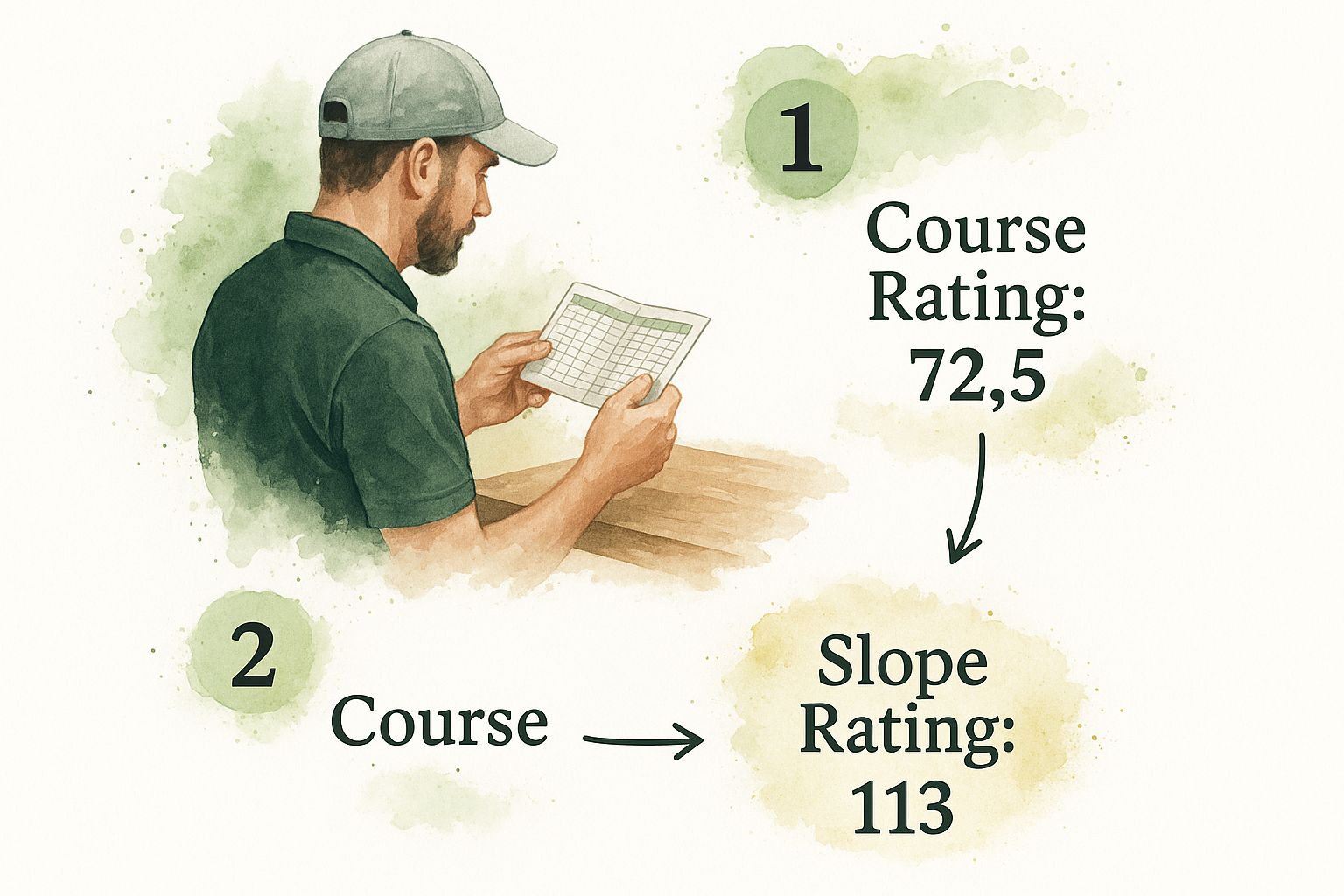
As you can see, those ratings aren’t just random numbers. They’re the specific metrics that anchor your performance to the reality of the course’s difficulty.
From Differentials to Your Handicap Index in Golf
Once you have at least 20 scores posted, the WHS can calculate your official Handicap Index. The system doesn’t just average all your Score Differentials—that would include your best days, your worst days, and everything in between. Instead, it’s all about measuring your demonstrated potential.
Here’s how it works:
- The system looks at your 20 most recent Score Differentials.
- From that list, it cherry-picks the 8 lowest ones (representing your best rounds).
- Finally, it calculates the average of those 8 best differentials.
That average is your official Handicap Index.
Let’s say your eight best differentials were 17.8, 16.5, 18.2, 17.1, 19.0, 16.8, 17.5, and 18.5. The average of those numbers comes out to 17.6. Your Handicap Index would be 17.6.
This “best 8 of 20” method is designed to reflect what you’re capable of on a good day. It’s why you’re only really expected to play to your handicap about 20% of the time. The result is a fair, honest number that truly levels the playing field.
Converting Your Index to a Golf Course Handicap

So, you’ve got your Handicap Index. You’re all set, right? Not so fast. This is a crucial detail a lot of golfers get wrong: your Index isn’t the number of strokes you’ll get on any given day.
Think of your Handicap Index as your portable, universal measure of golfing skill—it travels with you. Your Course Handicap, on the other hand, is the specific number of strokes you get for a particular course, from a specific set of tees. It’s tailored for that day’s round.
This conversion is the real magic of the handicap system. It’s what keeps the game fair whether you’re playing your easy home course or tackling a monster like Pebble Beach. The system bumps your handicap up or down based on the course’s difficulty, so you’re always competing on a level playing field. A higher Course Handicap means the course is tougher for you; a lower one suggests an easier round.
We owe this practical piece of the puzzle to the Slope System, one of the biggest leaps forward in modern golf, introduced back in the early 1980s. It was designed to level the playing field when golfers of similar ability play courses of wildly different difficulties. The Slope Rating ranges from 55 (easiest) to 155 (hardest), with 113 being the baseline for a course of standard difficulty. If you’re interested in the nitty-gritty, the USGA.org has a great piece on the history of the Slope System.
The Formula for Your Daily Strokes in Golf
So, how do you figure out how many strokes you get? The calculation itself is pretty simple. You’ll usually find a conversion chart in the pro shop, and most handicap apps will do the math for you. Still, knowing how it works helps you appreciate the system.
The main formula for your Course Handicap is this:
Course Handicap = Handicap Index x (Slope Rating / 113)
Let’s walk through a real-world example. Say your Handicap Index is 15.2 and you’re about to play from the blue tees, which have a Slope Rating of 135.
- First, divide the Slope Rating by the baseline of 113: 135 / 113 = 1.194
- Next, multiply your Handicap Index by that result: 15.2 x 1.194 = 18.14
- Finally, you round to the nearest whole number.
Your Course Handicap for this round is 18. On a tougher-than-average course like this one, you get nearly three extra strokes. Now, if you teed it up at an easier course with a Slope of 105, your Course Handicap would drop down to 14. See how it works?
Adding the Course Rating and Par Adjustment
Okay, there’s one more layer to this for the sticklers out there. A more complete version of the formula fine-tunes the calculation even further by factoring in the difference between the Course Rating and the course’s Par. This gives you an even more precise number.
Here’s the full formula:
Course Handicap = [Handicap Index x (Slope Rating / 113)] + (Course Rating – Par)
Let’s use our same example, but now we’ll add the other variables:
- Handicap Index: 15.2
- Slope Rating: 135
- Course Rating: 72.8
- Par: 72
First, you do the main calculation we did before: (15.2 x (135 / 113)) = 18.14
Next, figure out the adjustment: (72.8 – 72) = +0.8
Finally, add them together and round: 18.14 + 0.8 = 18.94, which rounds up to 19.
With this more precise calculation, you get 19 strokes for the day. That’s the number you’ll use to adjust your hole-by-hole scores, making the game as fair as it can possibly be.
Posting Your Golf Scores the Right Way
An accurate Handicap Index is only as good as the scores you post. It’s the classic “garbage in, garbage out” scenario. If you want a handicap that truly reflects your ability—and is fair to everyone you play against—you have to know the right way to enter your scores.
It all boils down to something called the Adjusted Gross Score (AGS). This is the magic number you actually post for handicap purposes, and spoiler alert: it’s often different from the number you circle on your scorecard. The whole point of the AGS is to prevent one or two disastrous holes from completely torpedoing your handicap calculation.
The system that makes this all work is a rule called Net Double Bogey. Think of it as a safety net. It sets a maximum score you can take on any single hole, and that maximum is based on your Course Handicap. This cap smooths out the inevitable blow-up holes, preventing a single “11” on a par-4 from unfairly inflating your Handicap Index for months.
Understanding Net Double Bogey
So, what exactly is a Net Double Bogey? It’s the highest score you can post on any given hole for handicap purposes. The formula is actually pretty simple:
Par of the hole + 2 (for double bogey) + any handicap strokes you get on that hole.
Let’s walk through a real-world example. Imagine you’re playing a par-4 where you get one handicap stroke (you’d see a dot or a “1” next to that hole on the scorecard). Your maximum score for that hole would be:
- 4 (Par) + 2 (Double Bogey) + 1 (Handicap Stroke) = 7
So, even if you took a dreaded 9 on that hole, you would only record a 7 for your Adjusted Gross Score. If you don’t receive a stroke on a par-5, your max score would be 5 + 2 + 0 = 7. This rule is a golfer’s best friend, ensuring a couple of bad swings don’t misrepresent your actual skill level.
This idea of adjusting scores to better reflect a player’s ability has been evolving for decades. The system has seen a lot of changes over the years, dating back to the mid-20th century. By 1967, the USGA had moved to using the best 10 of a player’s last 20 rounds, a foundation that eventually evolved into today’s “best 8 of 20” model. You can dive deeper into the history of the golf handicap system on Wikipedia).
Handling Different Scoring Scenarios in Golf
Let’s be honest, golf doesn’t always fit into a neat 18-hole box. Life happens, the sun sets, or maybe you just want to squeeze in a quick nine. The World Handicap System has clear guidelines for these common situations.
- Posting a 9-Hole Score: Absolutely post it! The system is smart. It will hold onto that 9-hole score until you post another one. It then seamlessly combines the two to create a single 18-hole score differential.
- Incomplete Rounds: What if you play more than nine but less than 18? If you play between 10 and 17 holes, you can still post that score. For any holes you didn’t finish, the system adds what you would be expected to score (par plus any handicap strokes you would have received) to create a full 18-hole total.
- When a Score Doesn’t Count: Not every round is eligible for posting. Scores from rounds where you played alone or in formats like a scramble don’t count toward your handicap. The spirit of the rule is that you should only post scores from rounds where you are generally playing by the Rules of Golf.
Sticking to these posting rules is non-negotiable if you want a handicap you can trust. It ensures every score you enter contributes fairly to the calculation, giving you a number that accurately reflects your game.
Debunking Common Golf Handicap Myths
The golf world is swimming in “locker room logic,” and the handicap system seems to attract more than its fair share. Let’s cut through the noise and bust a few of the most persistent myths you’ll hear on the course. Getting these straight will give you a lot more confidence in your own number and how you talk about your game.
One of the biggest misconceptions is that your handicap is just your average score over par. It seems logical, right? If you usually card a 90 on a par-72 course, your handicap should be 18. But that’s not how it works at all.
Your Handicap Index is a measure of your potential ability, not your average day out. It’s calculated using only the best 8 of your last 20 scores. Because the system is designed to reflect your best golf, you should only expect to play to your handicap about 20% of the time. Don’t get discouraged if most of your rounds are a few shots higher—that’s completely normal.
You Don’t Need an Expensive Golf Club Membership
Another old-school myth is that you need to be a member of a fancy country club to get an official handicap. While that might have been the case decades ago, it’s simply not true anymore. Today, getting an official number is easier and more accessible than ever.
You can get a legitimate Handicap Index through several modern, affordable routes:
- Online eClubs: Most official golf associations, like the ones for your state or region, now offer eClub memberships for a small yearly fee.
- Public Courses: Tons of public and municipal courses are licensed to issue official handicaps. Just ask in the pro shop.
- Golf Leagues: If you’re joining a local golf league, handicap services are often part of the deal.
All of these options plug you directly into the World Handicap System, so you can be sure your handicap is official and accepted wherever you tee it up.
The whole point of the handicap system is to level the playing field. It’s what makes the game fun and competitive for everyone, allowing a scratch player and a high-handicapper to have a fair match.
Your Index Isn’t Your Final Number in Golf
Finally, a lot of golfers think their Handicap Index is the number of strokes they get, period. This is a crucial one to get right. Your 14.2 Handicap Index is your portable skill rating, but it has to be converted into a Course Handicap based on the specific tees you’re playing that day.
A really tough track with a high Slope Rating will give you more strokes to work with, while an easier course will give you fewer. This is the adjustment that makes the system truly fair, ensuring an equitable game no matter how challenging the layout. Understanding this final step is the key to using the handicap system correctly and enjoying a truly fair match against your buddies.

In summary, knowing how to calculate golf handicap will empower you to play better and ensure fair matches with other golfers.
FAQ’s
How to Calculate Golf Handicap
We’ve walked through the nuts and bolts of how a handicap is calculated, but let’s be honest, that’s when the real questions start popping up. Here are some of the most common things golfers ask when they’re getting into the system. Understanding how to calculate golf handicap is essential for both competitive and casual play alike. For those still asking how to calculate golf handicap, remember the key steps to accurately determine your score and maintain a fair play environment.
How Many Rounds Do I Need for My First Handicap?
One of the best features of the World Handicap System (WHS) is how quickly you can get an official number next to your name. Gone are the days of needing a massive backlog of scores.
You can actually get your first Handicap Index after submitting just 54 holes worth of scores. The system is super flexible about how you get there. For example, you could submit:
Three 18-hole rounds
Six 9-hole rounds
A mix of both, like one 18-holer and four 9-hole rounds
Once you hit that 54-hole mark, an initial Handicap Index is generated. It will continue to get more accurate as you add more scores, eventually settling in based on the best 8 of your most recent 20 rounds.
What Happens If I Shoot an Exceptionally Good Score?
We all have those days where everything just clicks. The WHS has a smart way to handle it when you post a score that seems way better than your current handicap.
If you submit a score that produces a Score Differential that’s 7.0 strokes or better than your Handicap Index at the time, it triggers what’s called an Exceptional Score Reduction (ESR).
The system automatically applies a -1.0 or -2.0 stroke adjustment to your Index, depending on just how amazing your round was. This keeps your handicap from lagging behind a sudden jump in your playing ability.
It’s a great feature that maintains the integrity of the whole system, ensuring your handicap is a true reflection of what you’re capable of on the course.
Can I Calculate My Handicap Manually?
You absolutely can. Running the numbers yourself with the formulas we’ve covered is a fantastic way to really get a feel for how your scores turn into a Handicap Index. It demystifies the whole process.
However, there’s a big catch: a handicap you calculate on a spreadsheet isn’t an official handicap. For any kind of competition or tournament play, you need a Handicap Index that’s been issued by an authorized golf association or a licensed club that uses the WHS.
Using an official service like the USGA’s GHIN platform is crucial because it handles all the complex adjustments automatically, like the Playing Conditions Calculation (PCC) and the ESR we just talked about. So, by all means, do the math for your own understanding, but stick to an official service for the real deal.
Once you’ve got that official number, the real fun begins: watching it drop. For some practical tips, check out these 5 ways to lower your golf handicap by 3 strokes.
At Golf Inquirer, we’re dedicated to helping you enjoy every aspect of the game, from understanding the rules to finding the perfect gear. Explore our articles and guides to elevate your experience on the green. Visit us at https://golfinquirer.com.