
Let’s cut to the chase. If you want to finally get rid of that slice with your driver, you have to fix two things: your swing path and your clubface. Get these two working together, and that infuriating curve to the right will straighten itself out. In this guide, we’ll discuss how to fix a slice with your driver.
It’s all about approaching the ball from the inside with a square clubface at the moment of truth. Let’s make that happen.
Understanding how to fix a slice with your driver is essential for every golfer looking to improve their game.
Getting to the Root of the Slice in Golf
That dreaded “banana-ball” that starts left of the fairway only to veer wildly into the trees on the right isn’t just bad luck—it’s pure physics.
For the vast majority of us amateur golfers, a slice comes from a very predictable sequence of moves. Before we dive into any drills, let’s understand what’s actually going wrong in your swing so you know what you’re fixing.
Think of your swing path as the highway your clubhead takes to the ball. A slicer’s path almost always comes from “outside-in.” This means on the downswing, your club starts by moving away from your body (“outside” the target line) and then cuts across the ball toward your body (“in”) through impact. This is what your buddies call an “over the top” swing.
When you combine that outside-in path with a clubface that’s open (pointing to the right of your target for a righty), you’ve created the perfect storm for a slice. Your club is literally glancing across the side of the ball, putting that ugly sidespin on it that sends it sailing offline.
The Two Golf Slice Culprits: Path and Face
How your ball flies is all about the relationship between your club’s path and its face angle. Let’s break down the two problem children here:
- The Outside-In Swing Path: This is the real engine of the slice. It’s that “over the top” motion that feels powerful but sends all the energy in the wrong direction.
- The Open Clubface: This is what starts the ball to the right and puts the spin on it. Even with a perfect path, a wide-open face is going to send the ball curving.
In fact, one of the biggest reasons for a slice, which plagues about 90% of amateur golfers, is a downswing that’s just too steep. This steepness is what forces that outside-in path and causes that dramatic curve. You can learn more about the main causes of a slice and how to fix them on Golf Sensei Training.
The key takeaway here is simple: you can’t fix a slice by only dealing with one of these problems. A square clubface won’t do you any good if your path is still cutting across the ball, and an inside-out path is useless if your face is still pointing out to the right at impact. They have to work together.
Most golfers get a slice because of a few common setup or swing flaws. The good news is that sometimes, a small adjustment is all it takes to see a big difference. Here’s a quick-reference table to help you diagnose what might be going wrong and a simple fix to try on the range.
Quick Fixes for Common Slice Causes in Golf
| Common Cause | Quick Fix | Why It Works |
|---|---|---|
| Weak Grip | Strengthen your grip by turning both hands slightly to the right (for a right-handed player). You should see at least two knuckles on your left hand. | This encourages the clubface to close naturally through impact, preventing it from staying open. |
| Open Stance | Close your stance. Align your feet, hips, and shoulders parallel to the target line, or even slightly closed (aiming a little right of the target). | An open stance often promotes an outside-in swing path. Closing it helps encourage an inside-out path. |
| Ball Too Far Forward | Move the ball position slightly back in your stance, more in line with the heel of your lead foot instead of the toe. | An overly forward ball position gives the clubface more time to open up before impact. This simple change can help you catch it squarer. |
| “Over the Top” Move | Feel like you’re dropping your hands straight down from the top of your backswing before you start to turn, keeping your back to the target for a split second longer. | This shallows out the club and helps it approach the ball from the inside, neutralizing the steep, outside-in path. |
Remember, these are quick adjustments to experiment with. One of them might just be the “aha!” moment you need to start hitting straighter drives.
How Your Grip Controls the Golf Clubface
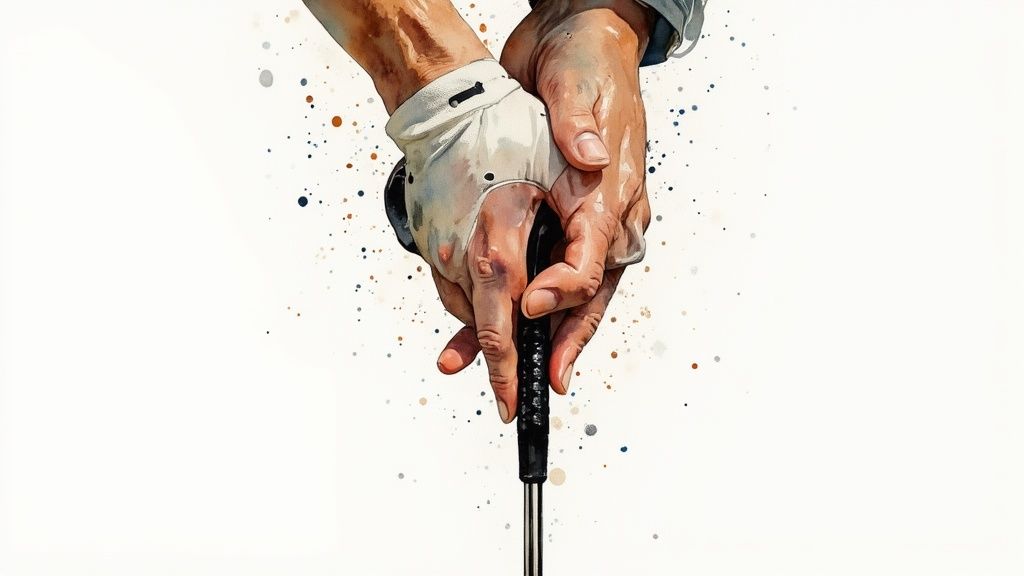
So many golfers chase complicated swing fixes, but often, the root of a nasty slice is right there in your hands. Your grip is your only connection to the club. If it’s off, you’re setting yourself up for an open clubface before you even start your takeaway.
One of the biggest slice-producers is a “weak” grip, where your hands are rotated too far toward the target (to the left for a right-handed player). This position makes it nearly impossible to square the clubface at impact without some wild, last-second flip of the hands. The result? A clubface that arrives wide open, glancing across the ball and sending it spinning off to the right.
Finding a Neutral to Strong Grip
Let’s do a quick check. Take your normal driver grip and look down at your lead hand (your left hand if you’re a righty). How many knuckles can you see? If the answer is one, or maybe even none, your grip is almost certainly too weak.
To fix this, simply rotate both of your hands slightly away from the target (to the right) on the club. You’re aiming for a spot where you can comfortably see two to three knuckles on that lead hand. This is what we call a neutral to slightly “strong” grip.
This isn’t about squeezing the club harder. It’s simply about positioning your hands to work with your swing, not against it. For a deeper dive, check out this guide on the importance of grip, explained hand-by-hand.
A stronger grip pre-sets your hands in a more powerful position. This small change encourages your wrists to release naturally through impact, helping the clubface square up and even close slightly—which is exactly what you need to kill that slice.
When you look at the mechanics, an open face at impact is the primary cause of a slice, and it often stems directly from an improper grip. By starting with a better hold on the club, you’re not just putting a band-aid on the problem. You’re fixing the very foundation of your entire swing.
Retraining Your Golf Swing Path from the Inside
Okay, your grip is sorted. Now it’s time to tackle the real engine of that nasty slice: your swing path.
The vast majority of slicers are victims of the dreaded “over-the-top” move. This is where the downswing starts with an aggressive lunge from the shoulders and arms, throwing the club outside the correct path. The result? An outside-in swing that chops across the ball, creating the sidespin that sends it sailing into the right-hand trees.
To hit a powerful, straight drive, we need to completely reverse that sequence. The goal is to feel the downswing starting from the ground up, letting the club naturally drop “into the slot” behind you. This is what creates an inside-to-out swing path, where the clubhead travels from inside the target line, makes solid contact, and then continues out toward your target.
This simple infographic breaks down exactly what a slice-free swing should look like.
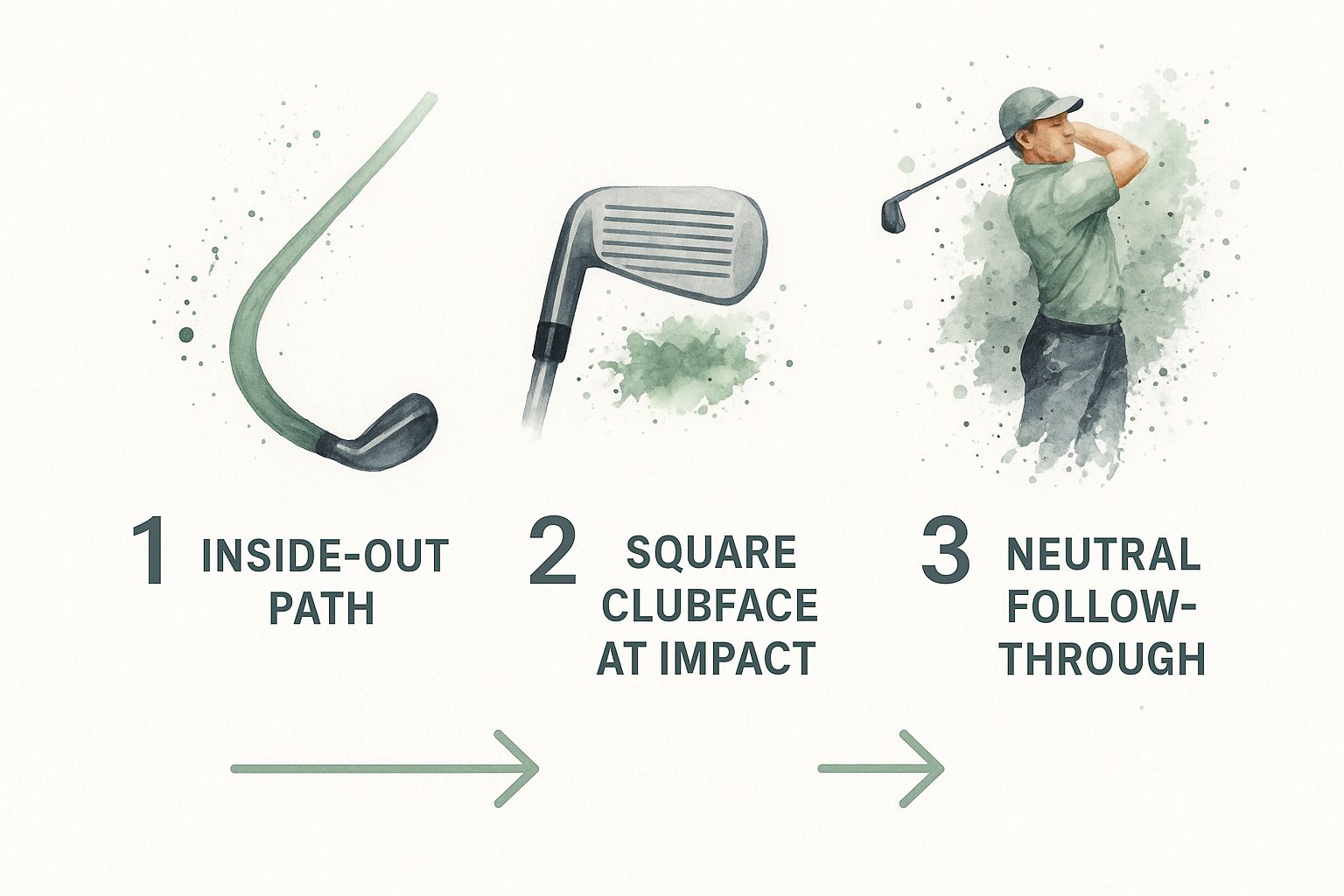
Getting a clear mental picture of this inside-out path is the first step, but now we need to ingrain it into your muscle memory.
Drills to Groove an Inside Path in Golf
Thinking about changing your path is one thing; feeling it is something else entirely. Drills that give you instant, physical feedback are by far the fastest way to make a lasting change. You have to practice with a purpose, not just mindlessly hit balls at the range.
A classic drill that I always recommend is the “Headcover Drill.” It’s incredibly simple but works wonders.
- Setup: Grab your driver’s headcover (or an empty range basket works too) and place it about a foot outside and a foot behind your golf ball.
- Execution: Now, just try to hit the golf ball without hitting the headcover during your downswing.
- Feedback: If you come over the top, you’ll smash the headcover. Every single time. To miss it, you are forced to drop the club to the inside.
This drill is so effective because it physically blocks your old, slice-producing motion. It essentially makes the correct inside-out path the only path to success, helping you finally feel what it’s like for the club to approach the ball from the proper angle.
Another fantastic exercise is the “Gate Drill.” For this one, you’ll place two headcovers or alignment sticks on the ground to create a “gate” for your club to swing through just after impact. This drill is great because it encourages you to keep the clubhead moving out toward the target instead of pulling it sharply across your body to the left.
For more ideas, you can explore a ton of other effective golf drills and practice routines that help build solid habits. The key is that these drills retrain your body to swing from the inside, which is an absolute non-negotiable step if you want to finally fix that slice with your driver.
Setting Up for a Straighter Drive in Golf
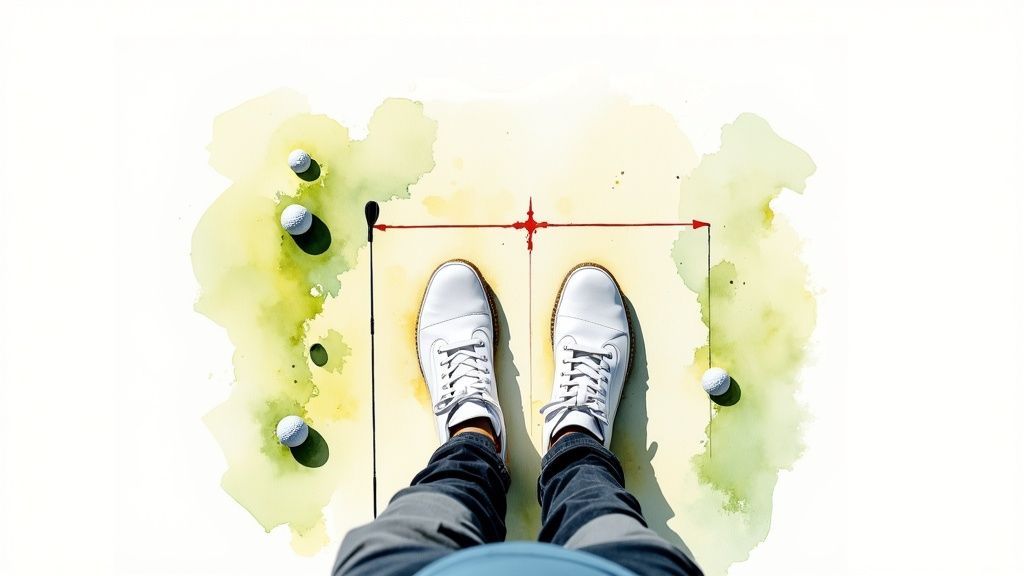
Before you even worry about your swing, let’s talk about what happens before the club even moves. A bad setup can poison a drive from the start. A lot of slicers fall into the trap of aiming their body way left of the target, thinking they’re playing for the slice. It feels logical, but it’s a huge mistake that actually causes the slice by forcing that dreaded outside-in swing path.
Think of a good setup as the foundation of your house. If it’s crooked, everything else you build on top of it will be, too. When your body is aligned properly, you give yourself a fighting chance to make a solid, inside-out swing. Get this right, and you’ve already eliminated a massive variable.
Fine-Tuning Your Alignment and Posture
The goal here is simple: get your body parallel to the target line. Imagine a set of railroad tracks. One rail is the line from your ball to the target. The other rail is the line your feet, hips, and shoulders create. They need to be perfectly parallel.
Here’s a common killer for amateurs: they aim their shoulders directly at the target. This actually points your body far to the left, which all but guarantees an over-the-top swing. Instead, pick a spot just a few feet in front of your ball on the target line. Align your clubface to that spot first, then set your body parallel to that line.
This isn’t something you can just eyeball, especially at first. Alignment sticks are your best friend on the driving range for building this habit.
Here’s a quick drill to bake it into your muscle memory:
- Lay one stick on the ground pointing straight at your target. This is your ball-to-target line.
- Place the second stick parallel to the first, just inside where your feet will go. This is your body line.
- Tee up the ball just inside your lead heel (your left heel if you’re a righty). This helps you catch the ball on the upswing for maximum distance.
- Now, set your feet, hips, and shoulders square to that second stick.
This simple routine gives you instant visual feedback. You’ll know immediately if your body is trying to cheat and aim left. By training yourself to start from a neutral, powerful position, fixing that slice becomes a whole lot easier.
Can the Right Driver Help Your Slice in Golf ?
Look, working on your swing is always going to be the number one way to finally kill that slice. There’s no magic bullet. But let’s be real—modern golf technology can be a massive help along the way. Think of it less as a cure-all and more as a powerful tool that makes your hard work pay off faster.
Many of today’s drivers have adjustable sole weights, which are a game-changer. These are small, movable weights on the bottom of the clubhead that let you tweak the center of gravity. For slicers, the money move is sliding that weight toward the heel. This little adjustment helps the toe of the club rotate faster through impact, making it much easier to square up the clubface. A square face means a straighter shot—it’s that simple.
Getting to Know Offset Drivers
Another piece of tech designed specifically for players fighting a slice is the offset hosel. If you look at an offset driver, you’ll notice the clubface is set back just a tiny bit from the shaft.
That subtle design feature gives you a crucial split-second longer for your hands to lead the clubhead and for the face to close at impact. It might not sound like much, but that tiny delay is often the difference between leaving the face wide open (hello, slice!) and delivering a square strike.
Offset drivers position the clubface slightly behind the hosel, which delays its impact with the ball, allowing more time for the face to square up. This results in a measurable reduction in slicing tendencies. For instance, some models with prominent offset features have been reported by users to reduce slices by up to 50%. You can explore more about the best drivers for slicers on Golf Monthly.
At the end of the day, no driver will single-handedly fix a wild out-to-in swing path. But pairing smart technology like adjustable weights or an offset design with your swing improvements can absolutely speed up the process. It makes your good swings even better and, just as importantly, makes your bad swings a lot less punishing.

Effective Strategies on How to Fix a Slice with Your Driver
FAQ’s
As you start working on your swing and trying these new drills, some questions are bound to come up. It’s a natural part of the process. Let’s tackle some of the most common ones I hear from golfers trying to finally get rid of that dreaded slice.
One of the biggest frustrations I hear is, “Why do my fixes work on the range but disappear on the course?” This is classic. It almost always comes down to pressure and falling back into old, comfortable habits.
On the range, you’re relaxed. You can focus on that one mechanical thought without any consequences. But the second a scorecard is in your hand and a tight fairway is staring you down, your brain hits the panic button and defaults to the swing it knows best—your old, reliable slice.
The only way through this is repetition. You have to groove the new feelings so deeply that they become your new default, even when the first-tee jitters kick in.
Is It Better to Aim Left?
This is a huge trap for slicers, and I see it all the time. Please, stop aiming left to “play” your slice. It almost always makes the problem worse.
When you aim your body way left of the target, you’re subconsciously encouraging an even more severe “over-the-top” swing path as your arms try to reroute the club back toward the actual target. You’re essentially fighting yourself.
Instead, you have to commit. Align your feet, hips, and shoulders parallel to where you actually want the ball to go. You’ve got to trust that the new swing you’re building will produce a straighter shot.
Here’s a pro tip: A better strategy is to feel like you’re aiming slightly right of the target (for a right-handed golfer). This promotes the feeling of an inside-out path, which is exactly the feeling you need to cure your slice for good.
How Long Will It Take to See Results?
This is the million-dollar question, and the honest answer is: it’s different for everyone. But what I can tell you is that consistency is far more important than intensity. Hitting one massive bucket of balls once a month won’t cut it. Three smaller, focused practice sessions each week will get you there much faster.
Here’s a realistic timeline of what you might expect:
Initial Feel: You’ll likely feel a difference in your very first session, especially with something like a grip change or a new drill. The ball might even do something new!
Consistent Results: Seeing that new feel translate into reliably better shots on the course can take a few weeks of dedicated practice.
Permanent Change: Really ingraining the fix so it becomes your automatic, unconscious swing? That can take a couple of months.
Don’t get discouraged if your progress isn’t a straight line. You’ll have good days and bad days. Just focus on the small wins and trust the process.
At Golf Inquirer, we believe that understanding the game is the first step to enjoying it more. For more tips, gear reviews, and course guides to fuel your passion for golf, visit us at https://golfinquirer.com.