Walking into a golf shop can feel like stepping into a sea of endless options. To pick out the right golf clubs, you need a clear plan that cuts through the noise. It really boils down to three things: honestly assessing your skill level, matching the equipment to your body, and understanding the basic components before you even think about the price. This guide will help you understand how to pick out golf clubs, turning a daunting task into an exciting part of your golf journey. You will learn how to pick out golf clubs effectively.
To summarize how to pick out golf clubs: prioritize your needs, assess your skill level, and ensure that each club fits your swing.
Why the Right Golf Clubs Will Transform Your Game
It’s easy to get lost in brand names and marketing hype, but the secret to better golf isn’t about buying the most expensive set on the rack. It’s about personalization. The right clubs should feel like an extension of your body and swing, designed to make the game easier, not harder. Understanding how to pick out golf clubs is not just about brands; it’s about finding the right fit for your game.
Think of it this way: you wouldn’t run a marathon in shoes that are two sizes too big. The same logic applies here. Using clubs that fight your natural tendencies—whether they’re too long, too stiff, or not forgiving enough—forces you to make awkward compensations. That leads to frustration and bad habits that are tough to break down the road. As you progress, the question of how to pick out golf clubs becomes even more important; choosing the right equipment can significantly impact your performance.
Beyond the Price Tag of Golf Clubs
The goal is to find equipment that complements your current game while giving you room to grow. This guide is your lifeline, designed to cut through the noise and focus on what truly matters. Many golfers still wonder how to pick out golf clubs that will enhance their performance. This guide aims to clarify those uncertainties. We’ll explore how to pick out golf clubs by focusing on a few key areas:
- Honest Game Assessment: Understanding your strengths, weaknesses, and common misses is the foundation for everything.
- Personalized Fit: Matching club length, lie angle, and shaft flex to your body and swing speed makes a world of difference.
- Understanding the Tech: Knowing how club heads and shafts are designed to help different types of players.
- Budgeting Smartly: Deciding when a custom fitting provides more value than a top-of-the-line brand name.
The golf equipment market is massive for a reason. With a global value projected to reach USD 5.45 billion by 2032, manufacturers are constantly creating specialized gear for a growing and diverse player base. You can explore more data on the golf club market trends and see how this growth impacts your choices.
The most important takeaway is this: A well-fit, moderately priced set of clubs will always outperform a premium, ill-fitting set. Your journey to better golf starts with making an informed and personal choice.
Honestly Assess Your Current Golf Skill Level

Before you even start window shopping for a shiny new driver, the first and most crucial step is to get brutally honest about your game. Forget your ego. It doesn’t matter what clubs your buddies are hitting. The whole point is to find equipment that helps the golfer you are right now, not the one you dream of becoming next season.
This isn’t about your official handicap; it’s a gut check on your tendencies out on the course. Where are your typical misses? Do you have trouble just getting the ball airborne? Is making solid contact your number one goal? Answering these questions truthfully sets the entire foundation for picking the right gear.
Trying to play clubs that are too advanced is like learning to drive in a Formula 1 car. It’s not just difficult, it’s incredibly frustrating and counterproductive. The right clubs, on the other hand, breed confidence, making the game way more fun and actually helping you get better, faster.
To help you pinpoint where you stand, here’s a quick breakdown of what clubs generally fit different players. This isn’t about strict rules, but it’s a solid starting point for matching club technology to your on-course reality.
Club Types by Golfer Skill Level
| Skill Level | Key Club Features | Primary Goal | Example Club Type |
|---|---|---|---|
| Beginner | Large sweet spot, perimeter weighting, wide sole, high launch | Forgiveness & Consistency | Super Game-Improvement Irons |
| Intermediate | Balanced forgiveness & feel, thinner topline, moderate offset | Distance & Workability | Players Distance Irons |
| Advanced | Compact head, minimal offset, thin sole, high feedback | Precision & Shot Shaping | Muscle-Back / Blade Irons |
This table shows how club design evolves as a player’s needs shift from pure forgiveness to ultimate control. Find your category, and you’ll be on the right track.
Are You a Beginner Golfer?
If you’re new to golf, play less than 10 times a year, or are still grinding to break 100 consistently, you’re in the beginner camp. And that’s fantastic! Your main challenge right now is probably inconsistency. One shot feels pure, and the next one dives into the trees.
The magic word for you is forgiveness.
You need clubs engineered to minimize the damage from off-center hits. Think of them as bigger bumpers in a bowling alley—they help keep your ball in play even when your swing isn’t quite dialed in.
Look for clubs labeled “game improvement” or “super game improvement.” These irons are packed with features built specifically to help you succeed:
- Large Clubfaces: A bigger hitting area means you have more room for error. You don’t have to be perfect to get a good result.
- Wide Soles: The bottom of the club is wider, which helps it glide through the turf instead of digging in on “fat” shots.
- Perimeter Weighting: This design trick moves weight to the outer edges of the clubhead, making it much more stable on mishits.
For new players, the only priority should be getting the ball in the air consistently and having fun. Highly forgiving clubs make that happen and help you avoid the early-stage frustration that makes so many people quit the game.
If you’re just starting out, our complete guide on the best golf clubs for beginners has specific recommendations that will get you going in the right direction.
Are You an Intermediate Golf Player?
You’ve likely moved into the intermediate zone if you play regularly, have a solid grasp of your swing, and consistently shoot in the 80s or low 90s. You’re making solid contact pretty often but still have your share of misfires.
At this stage, you’re searching for a blend. You still appreciate some forgiveness, but you’re also starting to crave more feel and the ability to shape shots on command. This is where “players distance” irons enter the picture. They look sleeker and more compact than game-improvement models but still have enough tech under the hood to bail you out on your off days.
You might also start digging into more specialized gear. Maybe your driver is producing too much spin, costing you yardage, or you realize you need a wedge with a different bounce angle for the firm fairways you usually play on. Your focus shifts from simply making contact to optimizing your ball flight.
Are You an Advanced Golf Player?
If you carry a single-digit handicap and regularly post scores in the 70s, you’re in the advanced or “player” category. Your ball-striking is a legitimate strength, and your misses are far less dramatic.
Your priority is precision and control. You want to work the ball, hitting draws and fades when the hole calls for it. For you, “muscle-back” or “blade” irons are a real possibility. These clubs offer incredible feedback and workability but are famously unforgiving on anything less than a perfect strike.
Shaft selection also becomes paramount at this level. You need a shaft flex and weight profile that’s perfectly synced with your high swing speed and tempo to produce a piercing, consistent ball flight. Custom fitting is no longer a luxury; it’s a non-negotiable step to fine-tune your equipment and squeeze every ounce of performance out of your game.
Match Your Golf Clubs to Your Body and Swing
Once you’ve taken an honest look at your game, the next step is getting personal—with your own body. Golf clubs aren’t a one-size-fits-all deal; they’re tools that have to work with your unique physical build. Trying to play with a club that’s too long or too short is a fast track to developing bad posture and funky swing habits you’ll have to unlearn later.
Think of your body as the blueprint for your perfect set of clubs. Simple measurements, like your height and wrist-to-floor distance, are the starting point for figuring out the right club length. These numbers dictate how you stand over the ball, and getting them right helps you build a balanced, athletic setup from day one.
This is exactly why you’ll see so many different specs available for the same club model. The whole industry is moving toward fitting the club to the person, not the other way around. In fact, North America makes up about 45% of the global golf club market’s revenue, driven by a huge demand for custom-fit gear. Why? Because the data shows it leads to real improvements in accuracy and distance. You can read the full research on the golf club market to see just how much this is changing what people buy.
Why Golf Club Length Is So Important
Of all the fitting variables, club length is the most fundamental. It has a direct impact on your posture, your balance, and the path your club travels on. If a club is too short, you’re forced to hunch over, which cramps your swing and leads to all kinds of inconsistent shots.
On the flip side, a club that’s too long will make you stand too tall and upright. This tends to flatten out your swing plane, making it a real challenge to control the clubface—a classic recipe for pulling the ball left (for a righty). Most “standard” length clubs are built for a male golfer somewhere between 5’9″ and 6’1″, but that’s just a rough guideline.
This chart gives you a good idea of how height affects the length you need.
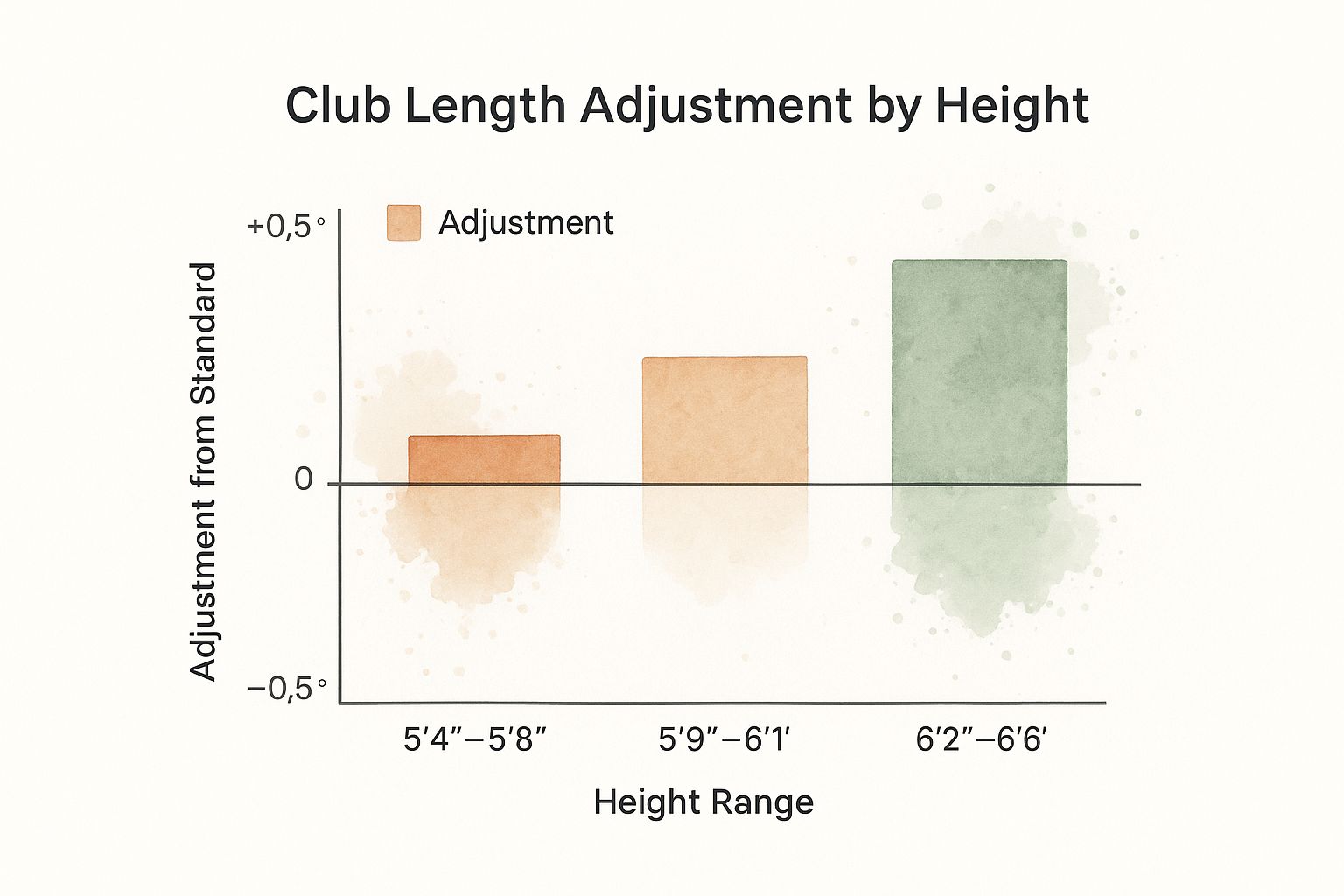
As you can see, just a couple of inches of height can mean needing a half-inch adjustment in your clubs to get you into a proper address position.
You can get a pretty good idea of what you need with a quick measurement at home.
DIY Wrist-to-Floor Measurement:
- Stand up straight on a hard floor, with your arms hanging naturally at your sides.
- Have a friend measure from the crease in your wrist straight down to the floor.
- Compare that number with your height, and you can find your recommended starting length on most standard fitting charts.
This simple check can tell you right away if you should be looking for clubs that are longer, shorter, or have a different lie angle than the standard ones on the rack.
Demystifying Lie Angle in Golf
While length sets up your posture, lie angle is all about shot direction. It’s simply the angle between the shaft and the sole of the club when you set it down behind the ball. If that angle is wrong for your swing, the clubface won’t be pointing at your target when you make contact. When considering how to pick out golf clubs, remember that personalization is key. Identifying your unique needs and preferences will enhance your game.
- Too Upright: If the toe of the club is sticking up at impact, the face will point left of your target. This is a super common reason for a consistent pull or hook.
- Too Flat: If the heel of the club is up in the air, the face will point to the right. This will have you fighting a frustrating push or slice that no swing change seems to fix.
Even being off by a degree or two can send the ball yards offline, especially with your shorter irons. During a fitting, a pro will often put impact tape on the sole of your club. You hit a ball off a special lie board, and the mark left on the tape instantly reveals if the club is sitting flat, toe-up, or heel-up at impact.
Getting the lie angle right is one of the quickest ways to tighten your shot dispersion. It ensures that when you make a good swing, the clubface is actually aimed where you think it is.
Don’t Overlook Grip Size
Finally, let’s talk about grip size. It seems like a small detail, but it has a massive impact on what your hands do during the swing. The right grip size lets you hold the club with light, even pressure, which encourages a smooth release of the clubhead through the ball.
A grip that is too small can make your hands get overly active, often causing a quick hook as they roll over too fast. On the other hand, a grip that’s too large can restrict your hands and wrists, making it tough to release the club properly. This is a common cause of a slice or a weak shot that just floats off to the right.
Figuring out the right size is easy. Take your normal grip. The fingertips of your ring and middle fingers on your top hand should just barely brush against your palm. If they’re digging in, the grip is too small. If there’s a noticeable gap, it’s too big. This simple, critical fix helps sync your hands with the rest of your swing for much better clubface control.
Understand the Engine of Your Golf Club
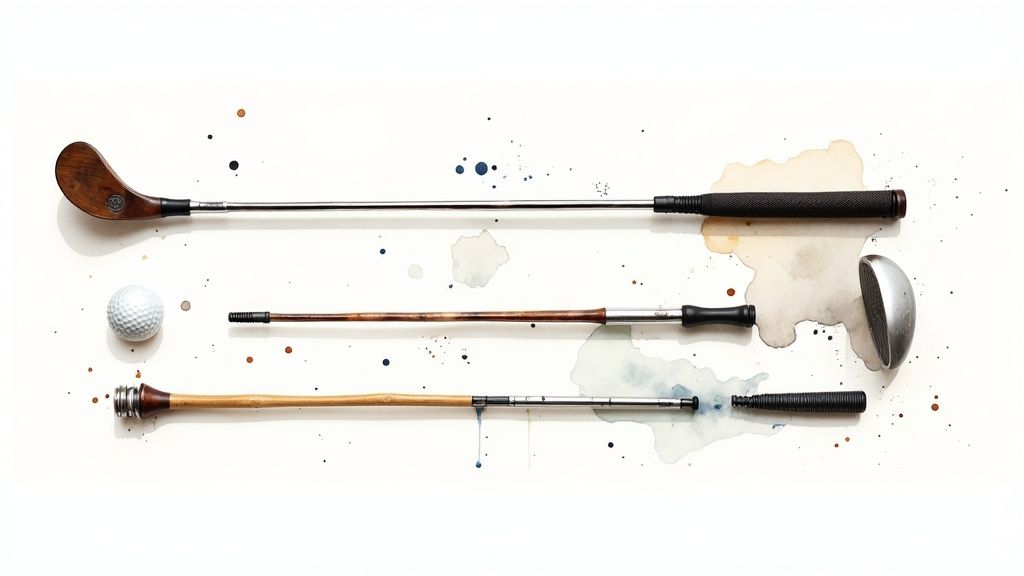
Alright, you’ve got a handle on your skill level and you’ve taken your measurements. Now it’s time to pop the hood and look at what makes a golf club tick. Every club is made of three key parts: the head, the shaft, and the grip. They have to work in harmony, but understanding what each one does is the secret to knowing why one club feels perfect and another feels like you’re swinging a 2×4.
Think of it like this: the clubhead delivers the message, and the grip is how you talk to it. But the real star of the show—the part that generates and transfers all your power—is the shaft. It’s the engine of your golf club, and getting it right is an absolute game-changer.
Decoding the Golf Clubhead
The clubhead is where you see the most obvious technology, especially when you’re looking at irons. You’ll mainly run into two designs here: cavity-back and muscle-back (often called blades).
A cavity-back iron has a hollowed-out section on the back of the head. This clever design pushes weight to the edges of the club, making it far more stable when you don’t hit the ball dead center. It’s the ultimate forgiveness feature, helping your mishits fly straighter and nearly as far as your pure strikes.
Muscle-back irons are the complete opposite. They’re forged from a solid chunk of steel with the weight concentrated right behind the sweet spot. This design gives incredible feedback and control for players who consistently find the middle of the face, but they won’t offer you much help on your off-days.
When we talk drivers, modern clubheads are engineering marvels built for one purpose: raw speed. They’re typically crafted from super-light materials like titanium and carbon fiber, which lets designers max out the head size (up to the legal 460cc limit) without making it feel like a sledgehammer. This creates a massive sweet spot and helps you launch the ball high with low spin—the perfect recipe for distance. To dig deeper into how these designs differ, you can check out a detailed chart of golf club degrees and lofts.
The Shaft: The True Engine
If the clubhead is delivering the payload, the shaft is what gets it there. It’s arguably the most critical piece of the puzzle when you pick out clubs because it dictates how efficiently you transfer energy from your body into the golf ball. Two main factors define any shaft: its flex and its material.
Shaft flex is simply a measure of how much it bends during your swing. Matching the flex to your swing speed is non-negotiable if you want to hit the ball both far and straight.
Picking a shaft that’s too stiff for your swing will rob you of distance and often cause the ball to fly lower and leak to the right. A shaft that’s too flexible, on the other hand, can lead to uncontrolled, high shots that can go anywhere, but often hook left.
Finding Your Perfect Shaft Flex with Golf Clubs
So, how do you figure out which flex is for you? It all boils down to your swing speed. A professional fitting with a launch monitor is the gold standard for getting a precise number, but you can get a pretty good estimate based on how far you hit your driver.
To make it simple, here’s a quick guide to help you match your swing speed with the right shaft flex.
Shaft Flex vs. Swing Speed
| Driver Swing Speed (MPH) | Recommended Shaft Flex | Typical Golfer Profile |
|---|---|---|
| Below 75 MPH | Ladies (L) | Players with drives under 180 yards. |
| 75-85 MPH | Senior (A) | Players with drives between 180-210 yards. |
| 85-95 MPH | Regular (R) | The most common flex for male golfers, driving 210-240 yards. |
| 95-110 MPH | Stiff (S) | For stronger players consistently driving 240-270 yards. |
| Above 110 MPH | Extra Stiff (X) | Reserved for the fastest swingers, carrying drives over 270 yards. |
Choosing the correct flex is the single most important decision you’ll make about your shafts. It ensures the clubhead arrives at impact in a square, powerful position time and time again.
Steel vs. Graphite Shaft Golf Clubs
The final piece of the shaft puzzle is what it’s made of. Your choice is between two materials: steel and graphite.
Steel shafts are heavier, which offers more control and feedback to your hands. They’re the standard for irons in the bags of most intermediate-to-advanced players because they promote a consistent, penetrating ball flight that cuts through the wind.
Graphite shafts, on the other hand, are significantly lighter. That reduced weight allows you to swing the club faster, generating more clubhead speed and, ultimately, more distance. This is exactly why graphite is the universal choice for drivers and fairway woods. It’s also a fantastic option in irons for players with slower swing speeds, like many seniors and beginners, who need that extra boost.
Budgeting and the Value of a Golf Club Custom Fitting
Let’s talk money. Golf clubs are a serious purchase, and your budget is going to be a huge factor in what ends up in your bag. It’s way too easy to get caught up in the marketing hype for the latest and greatest driver, but spending smart will do a lot more for your game than just buying the most expensive gear on the rack.
The real goal is to find that sweet spot where affordability and performance meet. From all-in-one box sets for beginners to tour-level custom builds, the price range is massive. Knowing what you actually get for your money is the key to making a confident investment in your game.
Setting a Realistic Golf Club Budget
A new set of premium irons from a major brand can easily set you back $1,200 or more, and that’s before you even think about a driver, woods, wedges, or a putter. For a lot of golfers, especially if you’re just getting into the game, that number just isn’t realistic. The good news? You’ve got fantastic options at every price point.
Here’s a breakdown of what you can expect to spend:
- Entry-Level Box Sets ($300 – $600): This is the perfect place to start for new golfers. You get a complete, matching set—driver, fairway woods, hybrids, irons, a putter, and a bag. They’re all designed for one thing: maximum forgiveness to help you get the ball in the air and have fun.
- Used Clubs ($400 – $800): The pre-owned market is an absolute goldmine. You can often snag premium clubs from just a season or two ago for a fraction of what they cost new. This is a brilliant strategy for intermediate players looking to upgrade their tech without emptying their wallet.
- New Mid-Range Sets ($800 – $1,500): This category is the sweet spot for many dedicated golfers. You get a great blend of modern technology, forgiveness, and feel. These clubs will perform for years to come.
- Premium & Custom Builds ($1,500+): At this level, you’re paying for cutting-edge innovation, the best materials, and usually, a custom fitting that dials in every single detail to your specific swing.
Remember, the best value isn’t always the highest price tag. A used set that has been professionally fitted will almost always outperform a brand-new, expensive set that’s fighting your natural swing.
Why a Golf Club Custom Fitting Is the Best Investment You Can Make
If you take one thing away from this guide, let it be this: a professional custom fitting is the single most valuable investment you can make in your golf equipment. It’s a total myth that fittings are only for scratch golfers. Honestly, beginners and high-handicappers often see the biggest and most immediate improvements.
A fitting session isn’t about a salesperson pushing the priciest clubs on you. Think of it as a diagnostic process to match the equipment to your unique swing DNA.
During a fitting, a certified pro will have you hit balls on a launch monitor. This machine is incredible—it captures a ton of data about what your club is doing at impact.
They’ll look at things like:
- Clubhead Speed: This is the main factor in determining the right shaft flex for you.
- Ball Speed & Launch Angle: Crucial for optimizing your driver loft to get maximum distance.
- Spin Rate: Can tell you if your current clubs are costing you yardage or control.
- Attack Angle & Lie Angle: This ensures your irons make solid, clean contact with the turf every time.
The fitter uses these numbers to build a blueprint for your perfect set. They’ll have you try different heads, shaft weights, and flexes until they find the magic combination that produces the best, most consistent results. They might find that a shaft just 10 grams lighter adds 15 yards to your drives, or that adjusting your iron lie angle by 2 degrees completely straightens out that slice you’ve been fighting for years.
A proper fitting takes all the guesswork out of buying clubs. It ensures every dollar you spend goes toward equipment that is scientifically proven to help your game, not hurt it.
At the end of the day, a set of $600 fitted irons will bring you more confidence and better scores than a $1,400 set right off the rack that isn’t built for your swing. The fitting itself might cost between $100 and $250, but the value it delivers over the life of your clubs is just immeasurable. It’s the smartest money you can possibly spend on your journey to better golf.
FAQ’s
Ultimately, knowing how to pick out golf clubs is a process that can lead to a more enjoyable and successful golfing experience.
Even with the best game plan, a few nagging questions always seem to surface right before you pull the trigger on a new set of clubs. Let’s walk through some of the most common dilemmas golfers run into. Getting these final details ironed out will give you the confidence to know you’re making the right call.
Choosing clubs is a personal journey, but a lot of us share the same uncertainties. Let’s clear them up so you can invest in gear that actually improves your game from the very first swing.
Should I Buy a Complete Set or Individual Clubs?
This is one of the first major decisions you’ll face, especially if you’re new to golf. Thankfully, the answer is usually pretty clear.
If you’re just starting out, a complete, all-in-one box set is almost always your best bet. These packages are incredibly cost-effective and are specifically engineered to be as forgiving as possible for a developing swing. You get every club you need to hit the course without the stress of trying to piece together a bag from different brands and models.
As your skills develop, you’ll start to notice where your bag is lacking. Maybe the driver from your starter set just isn’t cutting it anymore, or you find yourself needing more specialized wedges for better control around the greens. That’s the perfect time to start upgrading, buying individual clubs that solve specific problems in your game.
This is exactly what intermediate and advanced players do—they almost exclusively build their sets one club at a time to optimize every single spot in the bag.
How Often Should I Upgrade My Golf Clubs?
There’s no magic number here, but club technology definitely doesn’t stand still. Major advancements in driver and iron tech tend to come in waves, usually every 4-6 years. If your clubs are older than that, chances are a modern equivalent will offer you a noticeable boost in both distance and forgiveness.
But it’s not just about age. You also have to consider the wear and tear on your current gear, particularly your wedges.
Wedge Grooves: A dedicated golfer who plays and practices often can wear out the grooves on their wedges in just 2-3 years. Once those grooves are worn down, they can’t grab the ball as effectively, which dramatically reduces spin and makes it tough to control your shots around the green.
Your Swing: This is the most critical factor. If you’ve been taking lessons and your swing has changed—maybe you’ve picked up speed or your mechanics are different—your old clubs could be holding you back. A quick fitting session can reveal if your current set is still a good match for your improved game.
Is a Club Fitting Worth It for a High-Handicapper?
Yes. A thousand times, yes. This is easily one of the biggest myths in golf: the idea that you need to be a “good” player to get anything out of a custom fitting. In reality, it’s often the high-handicappers who see the most immediate and dramatic improvements.
Think about it—an inconsistent swing is only made worse by equipment that doesn’t fit. If your clubs are too long, too short, or have the wrong shaft flex, you’re forced to make awkward adjustments just to make decent contact. This drills bad habits into your muscle memory and makes it nearly impossible to improve.
A club fitter’s job is to find equipment that encourages your best, most consistent swing. By matching the club’s length, lie angle, and shaft to your body and swing, they make it easier for you to find the center of the face and hit straighter, more solid shots.
Playing with properly fitted, forgiving clubs takes the equipment out of the equation. It makes the game less frustrating and a whole lot more fun, allowing you to focus on your technique. For a high-handicapper, that is the single fastest way to shoot lower scores.
At Golf Inquirer, our goal is to give you the knowledge to make smart choices on the course and off. We believe the right information is the best tool any golfer can have. Explore our guides and tips to keep elevating your game. Find your next insight at https://golfinquirer.com.