Choosing the right golf ball isn’t about finding the “best” one; it’s about finding the best one for you. It’s a personal match between the ball’s design—things like compression and its cover material—and your unique swing. A golfer with a more relaxed swing, for instance, will squeeze more distance out of a low-compression ball. On the other hand, a skilled player chasing birdies needs the bite of a multi-layer, urethane-covered ball to make their approach shots dance.
Understanding how to choose golf balls is crucial for maximizing your performance on the course. Knowing your swing characteristics will help you make a more informed decision. In this article, we’ll guide you on how to choose golf balls that will suit your unique game style.
- Essential Tips on How to Choose Golf Balls
- Why the Right Golf Ball Is Your Secret Weapon
- Start by Understanding Your Own Golf Game
- Getting to Know Your Golf Ball: Construction and Feel
- Putting It All Together: How Ball Design Shows Up on the Golf Course
- Getting a Real Feel: How to Test and Find Your Perfect Golf Ball
- FAQ's
Essential Tips on How to Choose Golf Balls
Choosing the right golf ball isn’t about finding the “best” one; it’s about finding the best one for you. It’s a personal match between the ball’s design—things like compression and its cover material—and your unique swing. It all starts with understanding how to choose golf balls that cater to your strengths and weaknesses. A golfer with a more relaxed swing, for instance, will squeeze more distance out of a low-compression ball. On the other hand, a skilled player chasing birdies needs the bite of a multi-layer, urethane-covered ball to make their approach shots dance. So let’s dive into the specifics on how to choose golf balls that fit your unique golfing style.
Why the Right Golf Ball Is Your Secret Weapon
Let’s review how to choose golf balls that can truly make a difference. When considering how to choose golf balls, remember to factor in your individual swing characteristics.

It’s easy to just grab the cheapest box on the shelf or play the same ball you see the pros launching on TV. But that simple choice could be what’s holding your game back. Think about it: the golf ball is the only piece of gear you use on every single shot. The question is how to choose golf balls that suit your playing conditions. Finding one that actually works with your swing instead of against it is a total game-changer. This isn’t about spending more money; it’s about spending smarter. The journey of how to choose golf balls is just as important as the destination.
We’re going to cut through the confusing marketing jargon and get straight to what matters for your game. My goal is to give you a practical, human-friendly way to pick a ball that adds a few yards, tightens up your accuracy, and just feels right when you’re standing over that must-make putt.
Matching Technology to Your Golf Game
A golf ball is a tiny, highly engineered piece of equipment. You wouldn’t pull out your driver in a greenside bunker, and using the wrong ball can create just as many problems. A ball that’s actually suited for your game can make a huge difference:
- More Distance: When a ball’s compression is right for your swing speed, it maximizes energy transfer at impact. That translates directly into extra yards off the tee.
- Better Accuracy: If you battle a slice or a hook, certain low-spin balls can act like a gentle course correction, helping straighten out your ball flight and keeping you in the fairway more often.
- Improved Control: For skilled players, high-spin balls with soft covers are everything. They’re what allow you to hit those crisp approach shots that land, take one hop, and stop on a dime.
The global golf ball market is valued at over USD 1.2 billion for a reason. This reflects the constant innovation from manufacturers who are designing balls for every possible type of player.
The secret is finding the balance that helps your specific weaknesses without sacrificing your strengths. Choosing the right ball is one of the easiest ways you can directly influence your performance and see for yourself why the right golf ball lowers your handicap.
Start by Understanding Your Own Golf Game
Before you even glance at dimple patterns or price tags, the first step is a moment of honest self-assessment. You need to build a personal player profile that will guide your search. So many golfers just grab whatever their buddy uses, but that’s a direct path to frustration and a lighter wallet.
The goal here is simple: find a ball that actually helps your game and your specific tendencies. For instance, if you have a 90 mph swing speed, playing a high-compression “tour” ball is like trying to drive a nail with a rubber mallet. You’re just leaving distance on the table because your swing can’t generate enough force to properly compress the core. Knowing a simple fact like that can immediately slash your options in half. At the end of the day, knowing how to choose golf balls is about enhancing your experience.
What Is Your Main Goal on the Golf Course?
Your number one priority on the course should be the deciding factor. How to choose golf balls effectively will enhance your entire game. Are you constantly fighting a slice and just desperate to find more fairways? Or are you a seasoned player who needs surgical precision on your approach shots to hunt for pins?
- Chasing More Distance: If adding yards off the tee is your mission, you should be looking at low-compression, two-piece balls engineered to reduce spin. Less spin means a straighter, longer flight.
- Needing Greenside Control: If you want your chips and pitches to take one hop and stop, a ball with a softer, urethane cover is non-negotiable. It’s the only way to generate that high, checking spin.
This image really drives home how different cover materials affect the ball’s performance around the green.
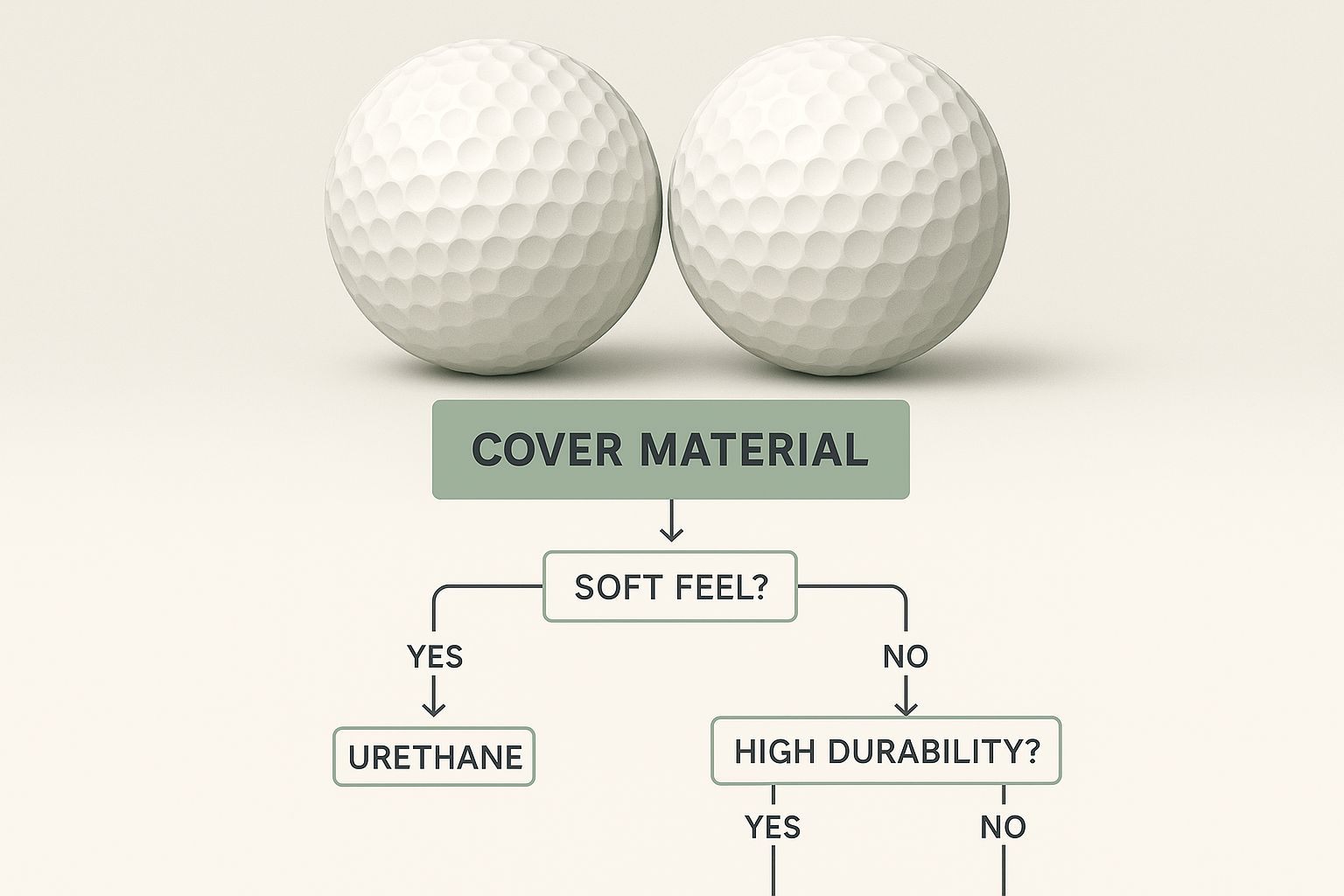
The texture and material of the cover play a massive role in how the ball grabs the clubface, especially on those delicate feel shots. This is why it’s so critical to understand that a golf ball is a highly engineered piece of equipment. If you’re still on the fence, the answer to the question “is a golf ball just a golf ball? Think again!” is a definite no.
Key Takeaway: Choosing the right golf ball begins with pinpointing your biggest weakness or most important on-course goal. A ball can’t fix a bad swing, but it can absolutely complement a good one and help soften the blow of your typical misses. Now that you understand how to choose golf balls, you can dive deeper into the specifics.
Matching Your Game to the Right Golf Ball Type
To make things a little easier, I’ve put together this table as a solid starting point. Use it to see which type of golf ball generally aligns with different player profiles and on-course goals. It’s not the final word, but it’s a great way to narrow down the overwhelming number of choices. As you refine your skills, learning how to choose golf balls will become second nature.
| Player Profile | Typical Swing Speed | Primary Goal | Recommended Ball Type |
|---|---|---|---|
| Beginner/High-Handicapper | Under 90 mph | Maximize distance and forgiveness | 2-piece, low-compression, Surlyn cover |
| Mid-Handicapper | 90-105 mph | A blend of distance and greenside feel | Multi-layer (3-piece), mid-compression |
| Low-Handicapper/Advanced | Over 105 mph | Pinpoint control and maximum spin | Multi-layer (3-5 piece), high-compression, Urethane cover |
Remember, this is a guide. The best way to find your perfect match is to test a few options from your recommended category and see what feels and performs best for you.
Getting to Know Your Golf Ball: Construction and Feel
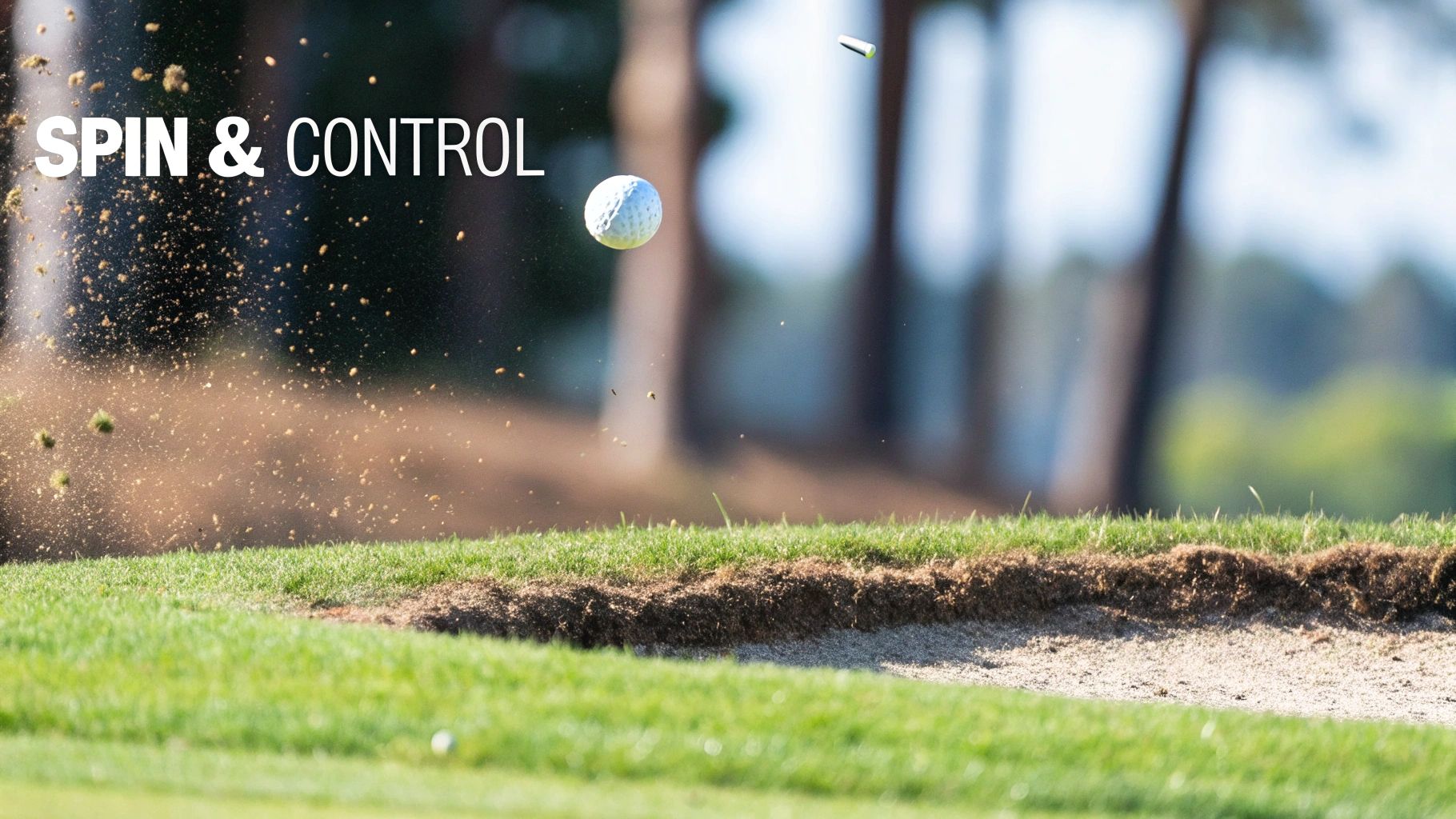
Let’s cut through the confusing tech jargon you see on the side of the box and talk about what it actually means for your shots. How a golf ball is built is the biggest factor in how it behaves, from launching off your driver to checking up on the green. Once you get the basic designs, you’ll have a much easier time finding a ball that fits your game.
The simplest design out there is the two-piece ball. It’s just a big, solid rubber core with a tough cover wrapped around it. Think of this ball as an engine built for two things: distance and durability. That combination makes it a fantastic choice for beginners and high-handicappers who just want to get the ball down the fairway without breaking the bank.
Then you have the more complex three-piece and multi-layer balls. These introduce specialized layers between the core and the cover. Each layer has a specific job—one might be engineered to keep spin low on your drives, while another is designed to ramp up spin on your wedge shots. This sophisticated construction is why these balls deliver that sought-after all-around performance, blending distance with a much softer feel and serious stopping power around the greens.
Golf Ball Cover Material: The Secret to Spin and Feel
The cover is where you’ll feel the biggest difference, especially in your short game. You’ll mainly find two types of materials, Surlyn and Urethane, and they represent a classic trade-off.
- Surlyn Covers: This is an ionomer resin that’s incredibly durable. It’s tough, resists scuffs, and helps lower spin rates, which is great for maximizing distance and straightening out that slice or hook. It’s the go-to cover for most two-piece distance balls.
- Urethane Covers: This is a much softer, premium material. Because it’s so soft, the grooves on your wedges can really “bite” into the ball at impact. This generates a ton more spin, giving you the control to stop shots quickly on the green.
Here’s a real-world example: if your chip shots keep running out way past the hole, switching to a ball with a urethane cover could be a game-changer. That extra grab is what lets you hit those delicate shots that land softly and stop on a dime.
Matching Compression to Your Golf Swing
Finally, let’s talk compression. You can think of it as the “springiness” of the ball’s core. A ball’s construction, cover, and compression all work together to influence its speed, spin, and feel. Compression ratings generally run from below 50 (very soft) to over 100 (very firm), and pairing this number with your swing speed is crucial for unlocking maximum distance. You can learn more about the technical details of the golf ball market and its specifics.
A low-compression ball is softer and squishes more easily at impact. This is perfect for players with slower swing speeds (under 90 mph) because it helps launch the ball with more energy, leading to more yards. But if a fast-swinging player uses this same ball, it can feel mushy and result in a loss of control.
On the flip side, a high-compression ball needs a faster swing speed to properly activate its core. When a powerful swing compresses it, the ball rebounds with incredible velocity. This gives faster players the explosive distance and crisp, responsive feel they need to work the ball and control its flight. Learning how to choose golf balls is a valuable investment in your game.
Putting It All Together: How Ball Design Shows Up on the Golf Course
This is where the rubber meets the road—or, more accurately, where the ball meets the clubface. All that tech talk about layers, covers, and compression finally translates into actual results on your scorecard. Every golf ball is a series of trade-offs, and understanding them is the secret to picking one that actually helps your game.
Think of it this way: a low-spin “distance ball” with a firm Surlyn cover can be a godsend if you fight a slice. It’s built to reduce sidespin, which can straighten out your drives and maybe even add 10-15 yards. But here’s the trade-off: that same low-spin design means it won’t bite on the green. Expect it to hit and roll out quite a bit on your approach shots.
On the flip side, a premium multi-layer ball with a soft urethane cover is all about control. That buttery feel and high-spin nature give you incredible stopping power, letting you fire at pins knowing the ball will check up. The catch? That extra spin can punish your mis-hits off the tee, turning a little fade into a full-blown slice that sends you searching in the trees. Mastering how to choose golf balls is an ongoing journey.
Real-World Scenarios
Let’s ground this in a couple of situations you’ve definitely faced on the course.
-
You’re an aggressive player who wants wedges to bite hard. If you live for that feeling of a perfectly struck wedge shot that lands, hops twice, and stops dead, then a urethane cover is non-negotiable. That soft material is what allows the grooves on your wedges to grab the ball and generate the high spin you need for precision.
-
You’re tired of being the first one to hit the approach shot. If you consistently find yourself outdriven by your buddies, a two-piece, low-compression ball could be a revelation. Its entire design is geared toward maximizing energy transfer for slower swings, helping you squeeze out every last yard and hit a shorter club into the green.
Golf ball technology has been marching in this direction for years, catering to these very specific player needs. Research has shown that players with slower swing speeds can see distance gains of 10-20% just by switching to a softer, lower-compression ball. Meanwhile, high-speed players get more out of firmer, higher-compression models that give them the control they demand. You can learn more about the evolution of golf ball technology and market trends to see how we got here.
The core idea is simple: stop fighting your equipment. Instead of trying to force a high-spin ball to fly straight, find a low-spin ball that naturally complements your swing. Choosing the right golf ball is one of the easiest ways to make the game a little less frustrating.
Getting a Real Feel: How to Test and Find Your Perfect Golf Ball
Reading reviews and dissecting tech specs on a box can only get you so far. The real truth comes out where it matters most: on the golf course. Forget the driving range for this—those perfectly uniform range balls and forgiving mats can be misleading. You need feedback from real grass and actual playing conditions to make a smart choice.
The best method is to grab a sleeve of two or three different models that seem like a good fit for your game. Then, it’s time for a head-to-head showdown, working backward from the green to the tee. This method rightly puts the emphasis on feel and short-game performance, which is where strokes are really saved.
Start your experiment on the putting green. Drop a few of each model and hit some putts. Pay close attention to the sound and feel as the ball comes off the putter face. Do you prefer a soft, quiet “thump,” or a firmer, more responsive “click”? There’s no right answer, only what feels best to you.
From Delicate Chips to Full-Throated Drives in Golf
Next, head over to the chipping and pitching area. Hit a handful of different short shots with each ball and watch what happens. See how they launch, feel how they come off the clubface, and—most importantly—notice how they check up and stop on the green. You might find one ball releases and rolls out quite a bit, while another digs in and stops on a dime.
This is where you’ll really see the difference between a urethane cover and a Surlyn cover. The gap in greenside spin can be massive, and seeing it firsthand is the only way to truly understand what you’re gaining or giving up.
Only after you’ve put the balls through their paces around the green should you move on to full iron shots and, finally, the driver. On the course, notice the ball flight, the feel at impact, and, of course, the overall distance.
Once you have a clear winner, commit to it. Seriously. Playing the same ball model every single round builds a deep-seated consistency and predictability in your game. You’ll instinctively know how it’s going to react on a delicate chip or a full-power drive, which builds the kind of confidence that shaves strokes off your score. In conclusion, learning how to choose golf balls will be a game-changer for many.
FAQ’s
You’ve done the research, you’ve narrowed it down, but a few questions are probably still bouncing around in your head. It happens to everyone. Let’s clear up some of the most common things golfers ask right before they pull the trigger on a new box of balls. Knowing how to choose golf balls is essential for both beginners and experienced players alike.
Getting these last few details sorted is the final step to picking your next golf ball with total confidence. Ultimately, knowing how to choose golf balls will lead to better performance on the green.
Does a Higher Price Tag Mean a Better Ball?
In golf, you often get what you pay for, and balls are no exception. That $45+ price tag on a dozen premium balls isn’t just clever marketing. You’re paying for advanced engineering—a complex multi-layer construction and, most importantly, a urethane cover.
This combination is the holy grail of golf ball performance. It gives you explosive distance off the tee while also delivering the high spin you need to make your wedges bite and stop on the green.
On the other hand, budget-friendly balls (usually under $25) are typically built with a tough-as-nails Surlyn cover and a simple two-piece design. They’re engineered to fly far and resist scuffs, making them a fantastic, wallet-friendly choice for beginners. But as your game sharpens, the greenside control a premium ball offers can genuinely start saving you strokes.
Should I Play the Same Ball as a Tour Pro?
It’s tempting, right? If a Titleist Pro V1x is good enough for a Tour winner, it must be good enough for you. But that line of thinking is a classic trap.
Tour professionals swing their drivers at blistering speeds, often topping 115 mph, and they generate an incredible amount of spin. The balls they use, like that Pro V1x or a TaylorMade TP5x, are specifically designed to perform under those extreme forces.
For the average amateur swinging around 90 mph, that same high-compression tour ball could actually rob you of distance. You simply don’t have the clubhead speed to compress it properly and unlock its full potential. It’s always smarter to match the ball to your swing, not your favorite player’s.
What Matters More: Compression or Cover?
This is a fantastic question because both are critical, they just handle different jobs.
Here’s a simple way to think about it:
Compression is all about your swing speed. It’s the engine for your long game. Nailing the right compression maximizes energy transfer, which means more yards off the tee.
Cover Material (Urethane vs. Surlyn) is the key to greenside spin and control. This dictates whether your chip shots check up and stop on a dime or release and roll 15 feet past the hole.
For most amateur golfers, finding the right compression for their swing speed is the best place to start. Once you’ve got that dialed in, you can fine-tune your choice based on how much spin and soft feel you crave for your short game.
Here’s a good rule of thumb: anytime your game changes significantly, it’s time to re-evaluate your golf ball. That could mean you’ve taken lessons and bumped up your swing speed, or maybe your goal has shifted from just hitting it far to needing more precision with your irons.
At Golf Inquirer, we believe that understanding your equipment is the first step to playing better golf. Understanding how to choose golf balls is a foundational skill for any golfer. We provide tips and insights to help you navigate every aspect of the game, from choosing the right gear to discovering your next favorite course. Explore more expert advice at https://golfinquirer.com.