Thinking about getting into golf? If there’s one piece of advice I can give you, it’s this: take lessons. Seriously. Taking golf lessons for beginners is the single best investment you can make in your game. It’s the difference between building a solid foundation from day one and spending years trying to fix bad habits you didn’t even know you had. Taking golf lessons for beginners ensures you learn the right techniques from the start, setting you on a path to success.
Why Starting With Golf Lessons Is a Smart Move
Make the decision today to engage in golf lessons for beginners for a brighter golfing future.
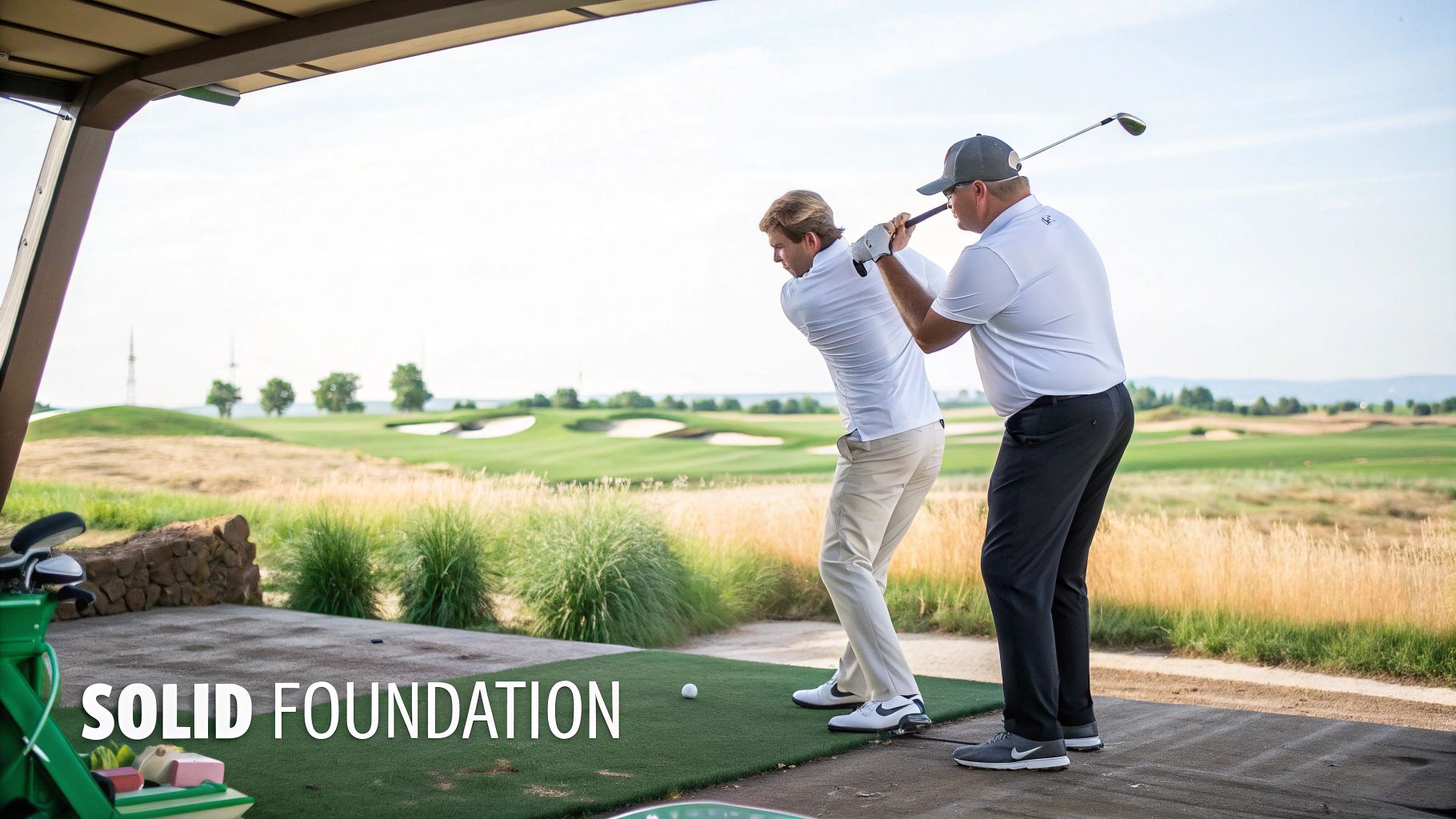
Jumping into golf without any guidance is like trying to assemble furniture without the instructions. You might end up with something that vaguely resembles a chair, but it’s probably wobbly and bound to collapse. A professional instructor gives you the blueprint for a solid, repeatable swing right from the start.
They’ll help you dial in the fundamentals—grip, stance, posture, and alignment. Getting these right from day one saves you from the massive headache of unlearning bad habits later on. I’ve seen countless self-taught players develop funky, inefficient swings that only lead to frustration and inconsistent shots. A good coach nips those issues in the bud immediately. Investing in golf lessons for beginners is a smart choice that pays off in the long run.
Build Confidence and Have More Fun with Golf
Let’s be honest, stepping onto the first tee can be nerve-wracking when you’re not even sure you’re holding the club right. Lessons strip away that uncertainty.
When you understand the why behind the swing mechanics, not just the how, you feel a sense of control. That confidence is a game-changer. You’ll start enjoying your time on the course instead of agonizing over every single shot. Remember, the goal of your first few lessons isn’t to be perfect; it’s to build a simple, repeatable motion you can trust. Understanding the value of golf lessons for beginners can enhance your overall experience in the sport.
Accelerate Your Learning Curve in Golf
Sure, you can watch YouTube videos or get tips from your buddy who shoots in the 90s, but nothing beats the personalized feedback from a trained pro. An instructor can spot tiny flaws in your setup or swing that you’d never catch on your own. This kind of targeted advice helps you improve way faster than just banging a bucket of balls and hoping for the best. Many golfers have found that golf lessons for beginners can significantly reduce their learning curve.
The real value of a lesson is having an expert simplify a complex motion. They can break down the golf swing into manageable pieces, allowing you to focus on one or two key thoughts instead of fifty.
You’re not alone in wanting to learn the game. Golf is booming, with participation in the U.S. hitting a record 47.2 million players recently. A huge chunk of that growth comes from newcomers—about 3.4 million people played on a course for the very first time. According to the annual golf report, the sport has welcomed over 3 million new players annually for four years straight, creating a massive demand for quality instruction.
Of course, lessons are just one piece of the puzzle. An instructor can also guide you on equipment, helping you find the best golf clubs for beginners that fit your swing without breaking the bank. Many players discover that golf lessons for beginners are crucial in avoiding common pitfalls.
How to Find the Right Golf Coach for You
Finding the right golf instructor isn’t about tracking down some big-name swing guru you saw on TV. It’s about finding a genuine partner for your golf journey. The connection you have with your coach—their personality, communication style, and teaching philosophy—will make or break your progress. This is the person who will help you build your swing from the ground up, so putting in a little effort now will pay off massively down the road. Many students realize that golf lessons for beginners offer invaluable insights into the game.
The easiest place to start your search is usually the most convenient: your local golf course or driving range. Most facilities have teaching professionals on staff who are well-versed in giving golf lessons for beginners. Just pop into the pro shop and ask about their instructors. The staff can usually give you a quick rundown of each coach’s style, availability, and who they recommend for new players.
Exploring Different Teaching Styles for Golf
Not every golf coach teaches the same way. What clicks for one player might completely confuse another. Getting a feel for the two main approaches can help you find a great match right from the start.
-
The Technical Coach: This instructor lives in the world of mechanics—think angles, positions, and the physics of the swing. They often use tools like video analysis to give you a clear, data-driven look at what you’re doing. If you’re an analytical thinker who appreciates precise instructions, this style will likely be a perfect fit.
-
The Feel-Based Coach: This type of instructor uses analogies, drills, and mental pictures to help you feel the right motion instead of just thinking about it. They might say something like, “Feel like you’re skimming a stone across a lake,” to help you create a smoother, more natural swing. If you’re someone who tends to overthink every little detail, a feel-based coach can help you get out of your own head and just swing the club.
Neither style is inherently better; it’s all about what resonates with you. Don’t hesitate to ask a potential instructor how they explain concepts to new players. Their answer will tell you everything you need to know about their approach.
A great player isn’t always a great teacher. Look for someone who is passionate about helping others improve and has a proven track record with beginners, not just someone with a low handicap.
Key Questions to Ask a Potential Golf Coach
Before you commit to a package of lessons, have a quick chat with the instructor. Treat it like a mini-interview to make sure you’re on the same page. Any good coach will be happy to answer your questions. Taking golf lessons for beginners allows for personalized feedback that is hard to find in videos.
Here are a few essential things to ask:
- Do you have experience with brand-new golfers? Teaching a beginner is a completely different skill than tweaking an advanced player’s game. You want someone who knows how to build a foundation from scratch.
- What does a typical first lesson look like? This will give you a great sense of their process and what you can expect when you show up.
- What’s your communication style between lessons? It’s helpful to know if they’re open to answering a quick text or email if you run into a problem during your practice sessions.
The infographic below shows how professional instruction is directly linked to faster improvement and, ultimately, more fun on the course.
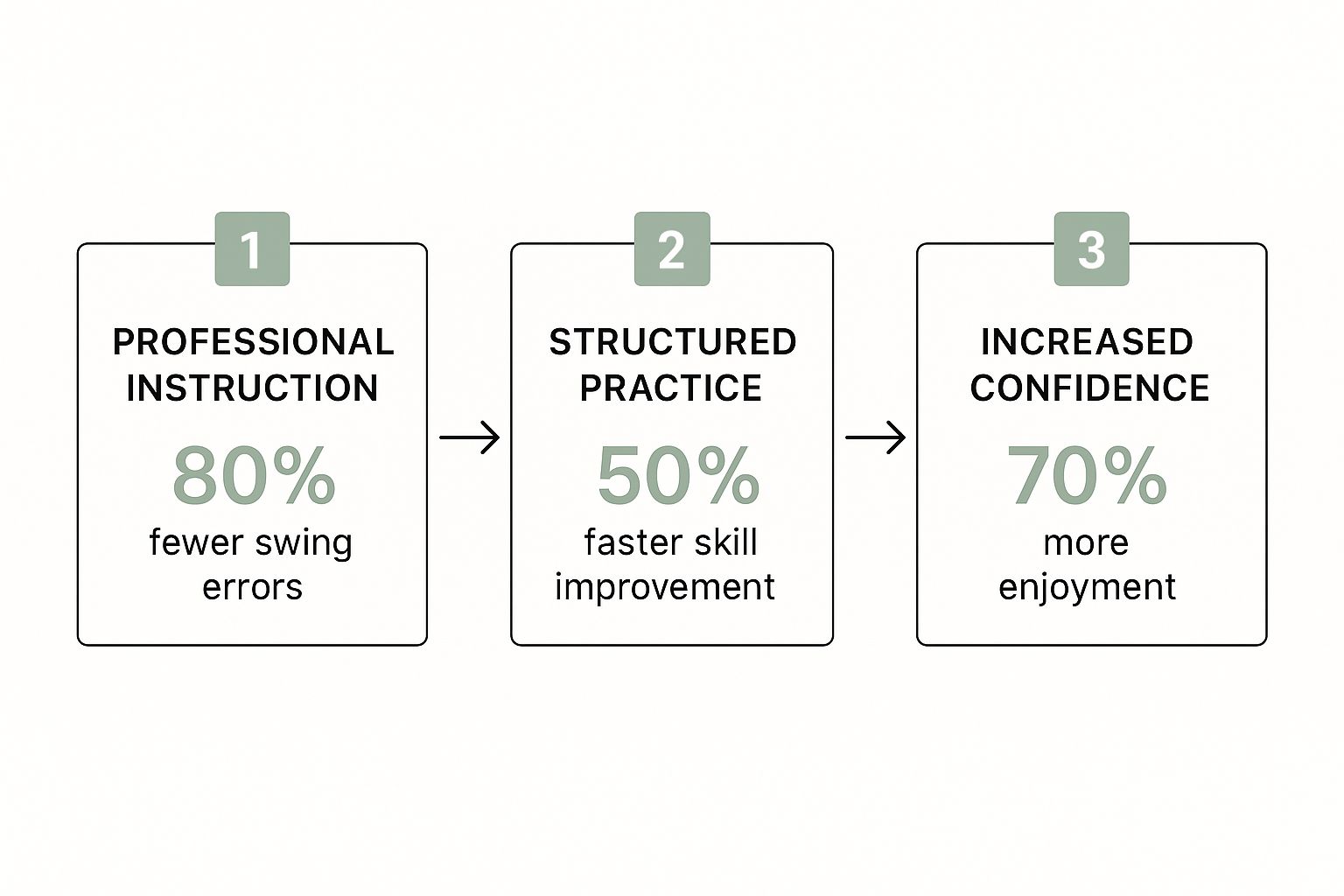
This process really drives home the point that structured lessons are the catalyst for building a solid foundation. That foundation is what boosts your confidence and makes the game enjoyable. Finding an instructor who can guide you through these steps is the key.
Breaking Down the Cost of Golf Lessons
Alright, let’s talk about the elephant on the fairway: the price tag. Figuring out the cost of golf lessons for beginners is a big deal. It helps you set a realistic budget and, more importantly, see instruction as a smart investment in your future enjoyment of the game, not just another expense.
The cost of a golf lesson isn’t some number pulled out of a hat. A few key things determine what you’ll pay, and once you understand them, you can find the best value for your money.
What Drives the Price of Golf Lessons
An instructor’s experience and certifications are huge factors. A highly decorated PGA professional with a proven track record is naturally going to charge more than a newer assistant pro who’s still building their reputation. You’re paying for their expertise.
The type of facility matters, too. Lessons at a fancy private country club will almost always cost more than those at a public driving range or a municipal course. You’re not just paying for the lesson; you’re paying for the premium amenities and perfectly manicured grounds.
Finally, the biggest price difference usually comes down to the format you choose. Private, one-on-one sessions offer tailored attention, while group clinics give you a more social—and more affordable—way to learn.
Typical Price Ranges and Golf Lesson Packages
So, what should you actually expect to shell out? Golf instruction is a massive $1 billion industry in the United States, which just goes to show how many people are investing in getting better. On average, you can expect a single lesson to run you about $75. That said, about 27% of golfers are happy to pay over $100 for high-quality coaching.
Here’s a general breakdown of what you might find:
- Single Private Lesson: $60 – $125+ for a 45-60 minute session.
- Group Clinic (4-6 people): $30 – $50 per person for an hour.
- Lesson Package (3-5 lessons): This is where you find the deals. Packages often come with a 10-20% discount on the per-lesson price.
Buying a package of 3 to 5 lessons is often the smartest move for a beginner. It commits you to the process and ensures you have enough time to cover the fundamentals without feeling rushed in a single session.
Beyond lessons, you could even think about other golf-related upgrades down the road, like looking into the cost of installing a backyard putting green, which can vary quite a bit. But for now, professional instruction will give you the biggest and fastest return on your investment. Grabbing a multi-lesson package is a great first step, locking in a better rate while you build a solid foundation with your coach.
What Really Happens in Your First Golf Lesson
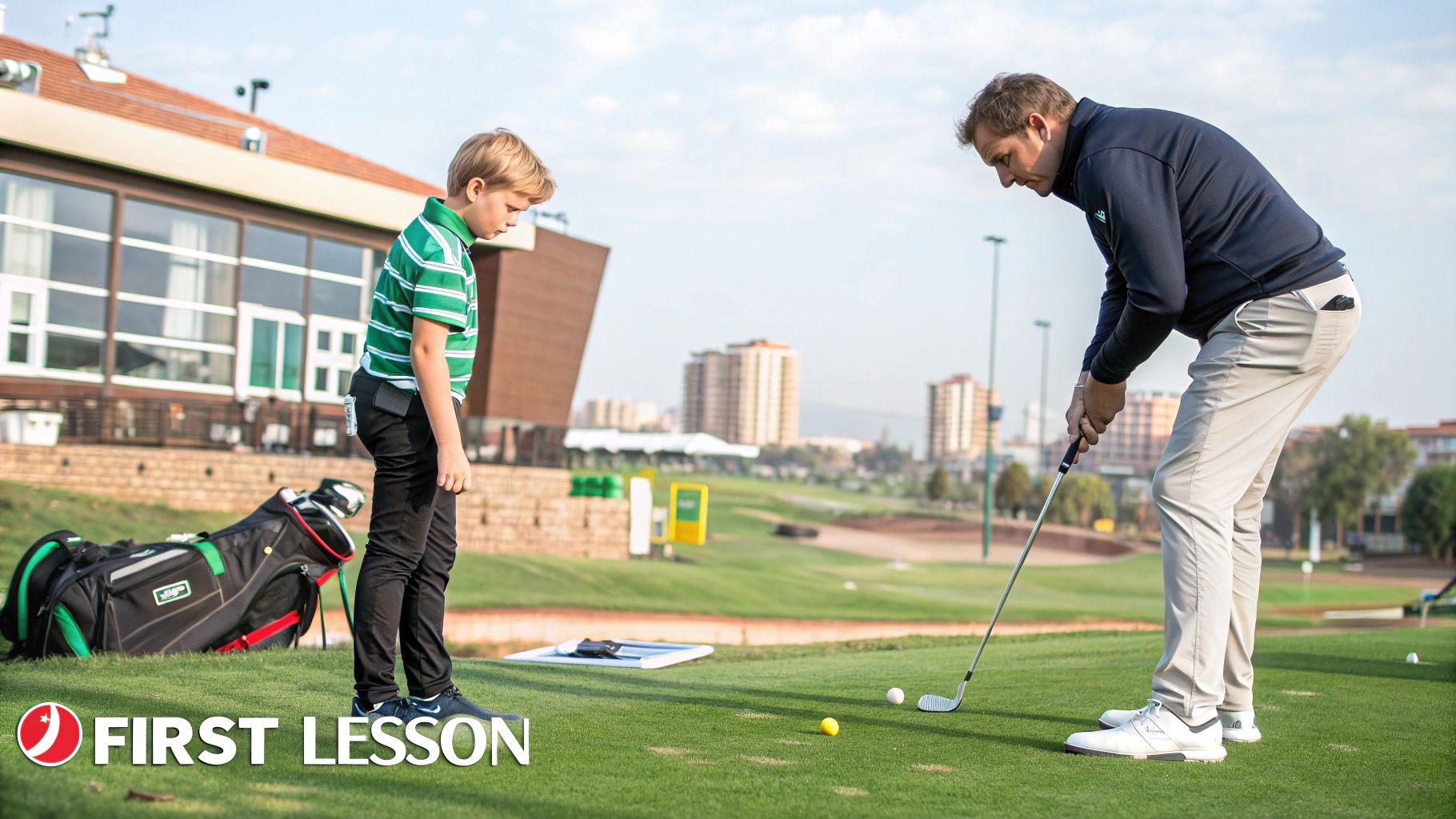
Walking onto the driving range to meet your instructor for the first time can feel like the first day of school. You get that mix of excitement and a little bit of anxiety. The good news? Your coach knows exactly how you feel and is there to make the whole thing as comfortable and straightforward as possible.
Forget any ideas about needing to hit perfect shots right out of the gate. Your first lesson isn’t a performance test; it’s a conversation with some hands-on guidance mixed in. A good instructor will just start by chatting with you to understand your goals and any experience you have (even if that experience is zero).
The Initial Chat and Setting Some Goals for your Golf Game
The lesson will probably kick off with a few simple questions. Your instructor just wants to get a baseline for why you’re there.
They might ask things like:
- “Ever swung a golf club before, even just messing around in the backyard?”
- “What are you hoping to get out of our time together?”
- “Are there any old injuries or physical limitations I should know about?”
This isn’t an interrogation. It’s all about tailoring the lesson to you. Your goal might be as simple as, “I just want to make contact with the ball,” or as big as, “I want to play in my company’s tournament next year.” Whatever you tell them, it helps the coach frame the session around what matters most to you.
Getting into the Golf Fundamentals
After you’ve talked for a bit, it’s time to grab a club. They’ll likely hand you a mid-iron, maybe a 7-iron, because it’s one of the most versatile clubs and perfect for learning. From there, the instructor will break down the absolute essentials of your pre-swing setup. This is the foundation for everything else.
You’ll focus on three core components:
- Grip: You’ll learn exactly how to hold the club. The instructor will show you one of the common grips (interlocking, overlapping, or ten-finger) and help you figure out which one feels the most natural and secure.
- Stance: Next up is your foot position. Your coach will guide you on how wide to stand and how to distribute your weight to stay balanced. It feels weird at first, but it’s crucial.
- Posture: This is all about learning to bend from your hips, keep your back relatively straight, and let your arms hang naturally. Getting the posture right from day one prevents a ton of bad habits from forming.
Don’t stress about memorizing a dozen different things at once. A good pro will give you just one or two key feelings or “swing thoughts” to focus on. The goal here is progress, not perfection.
The bulk of the lesson will be spent making slow, deliberate practice swings without even hitting a ball. The coach will physically adjust your hands on the club or gently guide your shoulders into the right position. This hands-on feedback is priceless—it’s something you just can’t get from watching a YouTube video.
Eventually, you’ll start hitting a few balls. The focus won’t be on how far or straight they go, but on simply trying to repeat the basic motions you’ve just learned. Your instructor will give you simple, clear feedback after each shot. They’ll celebrate the small wins with you, like the first time you make solid contact and the ball actually gets airborne.
To wrap up, you’ll review the main takeaways from the day, and they’ll give you a simple drill to practice before you see them again.
Squeezing Every Last Drop of Value from Your Golf Lessons
A golf lesson is a great starting point, but let’s be honest—the real, lasting improvement happens in the time you spend between your sessions. If you view your lesson as the kickoff to a weekly learning cycle, rather than just a one-off event, you’ll build a swing you can actually trust under pressure.
It’s the simple habits you build around your instruction that make all the difference.
One of the easiest wins? Just show up early. Arriving 15 minutes before your lesson gives you time to stretch, grab your clubs, and hit a few gentle warm-up shots. That little buffer means you’re physically and mentally ready to learn the moment your instructor arrives, so not a single minute of your paid time gets wasted on getting loose.
Here’s another simple but powerful trick: use your phone. At the end of the lesson, ask your instructor if you can take a quick video of them summarizing the main swing thought or drill for the week. A 30-second clip of your coach explaining a key concept is an incredible reminder when you’re out on the range a few days later, trying to remember what you were supposed to be working on. Completing golf lessons for beginners will ensure that you’re ready to hit the course with confidence.
Turning Golf Instruction into Ingrained Skill
The single biggest mistake I see beginners make after a lesson is heading straight to the range to mindlessly bash a bucket of balls, just hoping the new information sinks in. That’s not practice; that’s just getting some exercise. The goal is to engage in purposeful practice, which means focusing exclusively on the specific feelings and drills your coach gave you.
If your lesson was about maintaining your posture through the swing, then every single practice rep should be dedicated to that one feeling. Don’t even worry about where the ball goes for a while. The outcome of the shot is completely irrelevant when you’re rewiring a fundamental movement.
The quality of your practice is infinitely more important than the quantity. A focused, 20-minute session where you correctly perform a drill is far more valuable than hitting 100 balls with no specific goal.
To make this even more effective, many golfers find that physical tools can help reinforce what they’re learning. The global market for golf training aids was valued at a whopping $1.17 billion and is still growing, mainly because amateurs are realizing how these tools can lock in the feelings from a lesson. You can see just how much this market is expanding in this comprehensive market report.
Building Your Golf Practice Framework
Your coach provides the “what” to practice, but it’s on you to create the “how.” Building a simple structure around your range sessions makes them way more effective and a lot less intimidating.
Here’s a simple framework to get you started:
- Start with the Drill (No Ball): Begin every session by performing the specific drill your instructor assigned, but do it without a ball for 5-10 minutes. This is all about ingraining the correct feeling before you get distracted by ball flight.
- Alternate Drill and Shot: Once you feel comfortable, hit one ball while focusing on that key thought from the drill. Then, step back and perform the drill again without a ball. This 1-to-1 ratio is crucial for preventing you from slipping back into your old, comfortable habits.
- End with a Quick Review: Wrap up by re-watching that short video you took or glancing at your notes from the lesson. This reinforces the main takeaway and helps it stick.
This focused approach is the bridge between hearing instruction and actually seeing real, on-course improvement. For more ideas on structuring your time, check out our guide on effective golf drills and practice routines to make every session count. In conclusion, golf lessons for beginners are vital for anyone serious about improving their game.
FAQ’s
Stepping onto the range for your first lesson can feel a little intimidating. It’s totally normal to have a bunch of questions buzzing around your head. Don’t worry, every single golfer has been there. Embracing golf lessons for beginners can set you up for a lifetime of enjoyment in this sport.
Knowing what to expect takes the pressure off and lets you focus on what really matters: learning the game and having fun. Let’s clear up a few of the most common questions so you can walk into your first session feeling confident and ready to go.
Do I Need My Own Clubs for My First Lesson?
Not at all. In fact, it’s probably better if you don’t. Almost any place that offers lessons will have loaner or rental clubs available for students, so just ask when you book.
Here’s why this is a good thing: your instructor gets to see your natural swing tendencies first, without you trying to force a swing to fit a specific club. They can then recommend a type of club that fits your height, strength, and swing style. This advice is gold—it keeps you from buying a set that’s totally wrong for your game, saving you a ton of frustration and money right out of the gate.
Once you get a few lessons under your belt, you’ll want to start thinking about your own set. Getting the right gear is a big step, and it pays to do a little research on finding the best golf sets for the money when the time comes.
How Many Lessons Does a Beginner Really Need?
There’s no magic number here, as everyone picks things up at their own pace. But a package of 3 to 5 lessons is a fantastic starting point for most new players. It’s enough time for you and your coach to build a solid foundation without feeling rushed.
A typical 5-lesson series might look something like this:
Lessons 1-2: All about the fundamentals. You’ll spend a lot of time on the pre-swing stuff like grip, stance, and posture.
Lessons 3-4: This is where you start building the actual swing. You’ll work on the basic mechanics of the backswing and downswing.
Lesson 5: Putting it all together. You’ll review everything and maybe get introduced to different clubs, like your driver or a wedge.
After that initial block, you and your instructor can figure out what’s next. Maybe it’s a monthly check-in or another small package to tackle the short game.
Should I Choose Group or Private Lessons?
This one really comes down to your personality, how you like to learn, and your budget. Both options are great for beginners, but they offer very different experiences.
Lesson Type
Best For
Key Benefit
Private Lessons
Focused, accelerated learning
One-on-one attention and feedback that’s 100% about your swing.
Group Lessons
Social, low-pressure environment
More affordable and a great way to meet other people learning the game.
A lot of people find a hybrid approach works best. You could start with one or two private lessons to really nail down the core fundamentals. Once you feel a bit more comfortable, hopping into a group clinic can be a fun, relaxed way to practice and keep learning.
The most important thing is to just get started. Don’t let the decision between group and private lessons hold you back. Either choice is a massive step in the right direction.
What Should I Practice Between My Lessons?
This is where the real improvement happens. Your instructor is going to give you one or two specific drills to work on. Your job is to resist the temptation to do anything else. Seriously.
Your goal is focused repetition, not just mindlessly banging a bucket of balls down the range. If your coach told you to work on your takeaway, a 30-minute practice session focused only on that one move is infinitely more valuable than two hours of hitting random shots. It’s all about quality over quantity.
At Golf Inquirer, we emphasize the importance of golf lessons for beginners in shaping a golfer’s journey.Our goal is to provide tips and insights that help you fall in love with the game. For more guides on gear, courses, and improving your play, visit us at https://golfinquirer.com.