
That monster slice sending your ball into the next fairway isn’t just bad luck—it’s a mechanical issue with a clear cause. When I’m working with a student who slices their driver, we almost always zoom in on two things first: an open clubface at impact and an out-to-in swing path. Understanding how to fix slice with driver is crucial for improving your game. To effectively learn how to fix slice with driver, consistent practice is necessary to develop the right muscle memory and techniques.
Nailing these two elements is the fastest way I know to get your tee shots flying straight, long, and finally, where you’re actually aiming.
When you master how to fix slice with driver, you’ll notice a significant improvement in your overall performance and enjoyment of the game.
Understanding Why You Slice Your Driver in Golf
That confidence-killing, banana-shaped shot feels like a complete mystery on the course, but it all boils down to simple physics. When your ball curves hard to the right (for a righty), it’s because the clubface was open relative to the path it was traveling on when it hit the ball. That’s it. This combination puts nasty sidespin on the ball, sending it on that unwanted detour. By focusing on how to fix slice with driver, you can transform your golfing experience and reduce frustration on the course. With time and effort, learning how to fix slice with driver will lead to more consistent and enjoyable rounds of golf.
Here’s a simple way to picture it: your swing path is the road the club travels on, and the clubface is the steering wheel. If your path is good but the steering wheel is pointed right, the ball is going to start right.
Now, if your path is already cutting across the ball from outside to in (what we call an “over-the-top” swing) and the steering wheel is open, you’ve got the recipe for a massive, frustrating slice.
So, what causes these two fundamental errors? From my experience, it almost always boils down to a few key culprits in your setup and swing:
- A Weak Grip: This is public enemy number one. A “weak” grip makes it nearly impossible to square the clubface at impact without some wild compensation, so it usually stays open.
- Poor Alignment: So many golfers I see unconsciously aim their bodies way left to “play” their slice. The irony is that this actually encourages an even more aggressive out-to-in swing path, making the slice even worse.
- Incorrect Ball Position: If the ball is too far back in your stance, you’ll hit down on it steeply. With a driver, you need a sweeping, upward strike, and proper ball position is critical for that.
One of the first things I check is the grip. It’s a huge cause of that open clubface at impact. As a quick check for right-handed golfers, the ‘V’ formed by your thumb and forefinger on your lead hand should point toward your right shoulder. Just this one small adjustment can help you square the face and dramatically reduce your slice. Understanding how to fix slice with driver also involves recognizing the common mistakes many players make, which can hinder their performance. If you want to dive deeper, you can find great resources for mastering your grip on GolfTrainingAids.com.
Before we get into the fixes, here’s a quick reference guide for when you’re at the range and things start going sideways.
Quick Fix Checklist for Your Driver Slice in Golf
| Common Cause | The Immediate Fix | Why It Works |
|---|---|---|
| Weak Grip | Strengthen your grip by turning your lead hand more over the club so you can see 2-3 knuckles. | This helps your wrists rotate and square the clubface naturally through impact without you having to “force” it. |
| Aiming Left | Set alignment sticks down to ensure your feet, hips, and shoulders are parallel to your target line. | Correct alignment promotes a more neutral, in-to-out swing path instead of an over-the-top motion. |
| Over-the-Top Swing | Place a headcover or empty sleeve of balls just outside and behind your golf ball. | This forces you to swing from the inside to avoid hitting the object, grooving a better swing path. |
| Ball Too Far Back | Play the ball off the inside of your lead heel. | This position encourages you to hit the ball on the upswing, which is key for both distance and a straighter flight. |
This checklist is your go-to for those moments of frustration. It addresses the most common slice-inducing habits with simple, actionable adjustments you can make right on the spot.
Key Takeaway: Your slice isn’t some complex, incurable swing disease. It’s a direct result of an open clubface and the wrong swing path. The good news is that both are completely fixable with the right adjustments to your setup and mechanics. This guide will walk you through those exact fixes, one step at a time.
Building a Slice-Proof Setup Before You Golf Swing
So many slices are baked in before the club even moves an inch. It’s a hard truth, but it’s also a hopeful one. Why? Because it means you can often fix the problem without a complete swing overhaul.
Think of your setup as the foundation of a house. If it’s crooked, the whole structure will be unstable, no matter how great the rest of it looks. Your pre-shot routine is where you really win the battle against the slice. These aren’t just generic tips; these are the specific, actionable checkpoints for your grip, stance, and alignment that will set you up for success.
Your Grip: The Steering Wheel of the Golf Club
Your grip is the single most important connection you have to the golf club, and for slicers, it’s almost always the primary culprit. Most amateurs who slice have what’s called a “weak” grip, where their hands are rotated too far to the left (for a right-handed player). This position makes it incredibly difficult to square the clubface at impact—it naturally wants to stay open, sending the ball spinning off to the right.
We need to get this fixed by adjusting to a neutral or even a slightly “stronger” position. Here’s a simple check you can do right now:
- Look down at your lead hand (left hand for righties). You should be able to clearly see two to three knuckles. If you can only see one, your grip is almost certainly too weak.
- Check the “V”s. The V-shape created by your thumb and index finger on both hands should point roughly toward your trail shoulder (your right shoulder if you’re a righty).
This stronger position helps your hands and forearms rotate much more naturally through the swing, allowing the clubface to close and square up at impact without you having to consciously manipulate it. If you want a deeper dive, you can learn more about the importance of grip in our hand-by-hand guide.
Dialing in Golf Ball Position and Stance
Where you place the ball in your stance dictates your angle of attack. With a driver, you want to hit the ball on the upswing to maximize your launch angle and minimize that nasty, slice-inducing spin. The wrong ball position can completely sabotage this goal.
For a reliable, upward strike, position the ball just off the inside of your lead heel. This gives the driver head enough time to reach the bottom of its arc and begin its ascent right before making contact.
Pair this with a shoulder-width or slightly wider stance. This isn’t just about feeling balanced; a stable lower body prevents you from swaying and promotes the proper weight shift needed for power.
A common mistake I see on the range is players teeing the ball up in the middle of their stance, just like they would with an iron. This forces a steep, downward strike, which with a modern driver, almost guarantees a high, spinney slice.
Correct Body Alignment playing Golf: Stop Aiming for Trouble
Finally, let’s talk about where you’re aiming. Many golfers who slice unconsciously aim their bodies far to the left of the target, trying to compensate for the ball’s expected curve. This is a trap.
Aiming left actually encourages an “over-the-top” swing path, which is the very move that causes the slice in the first place. You’re making the problem worse before you even start your backswing. You need to aim your body where you want the ball to start, not where you’re afraid it will end up.
- Feet: Your feet should be parallel to your target line.
- Hips: Your hips should also be parallel to that same line.
- Shoulders: This is the most critical one. Your shoulders need to be parallel, too. Slicers almost always have their lead shoulder open (pointing left of the target), which pre-sets that out-to-in swing path.
Grab a couple of alignment sticks the next time you’re at the range. Lay one down for your target line and another for your feet. It might feel like you’re aiming way out to the right at first, but trust the process. A square setup is the final, essential piece of your slice-proof foundation. Many golfers ask how to fix slice with driver effectively, and the answer lies in understanding both technique and practice.
Correcting Your Golf Swing Path for Power and Accuracy
Alright, with your setup dialed in, it’s time to get to the heart of the matter—the real engine behind that nasty slice. I’m talking about the dreaded “over-the-top” swing. It’s that move where your shoulders and arms lunge forward from the outside, cutting across the ball and sending it spinning weakly off to the right.
Believe me, this out-to-in path is the number one slice-killer for amateur golfers. To fix it, we need to completely reshape that swing into a powerful, in-to-out motion. This isn’t just about hitting it straighter; it’s the secret sauce for unlocking that high, powerful draw every golfer dreams about.
The graphic below recaps the foundational checkpoints we’ve already covered—grip, ball position, and alignment—which are all crucial for building a better swing path.
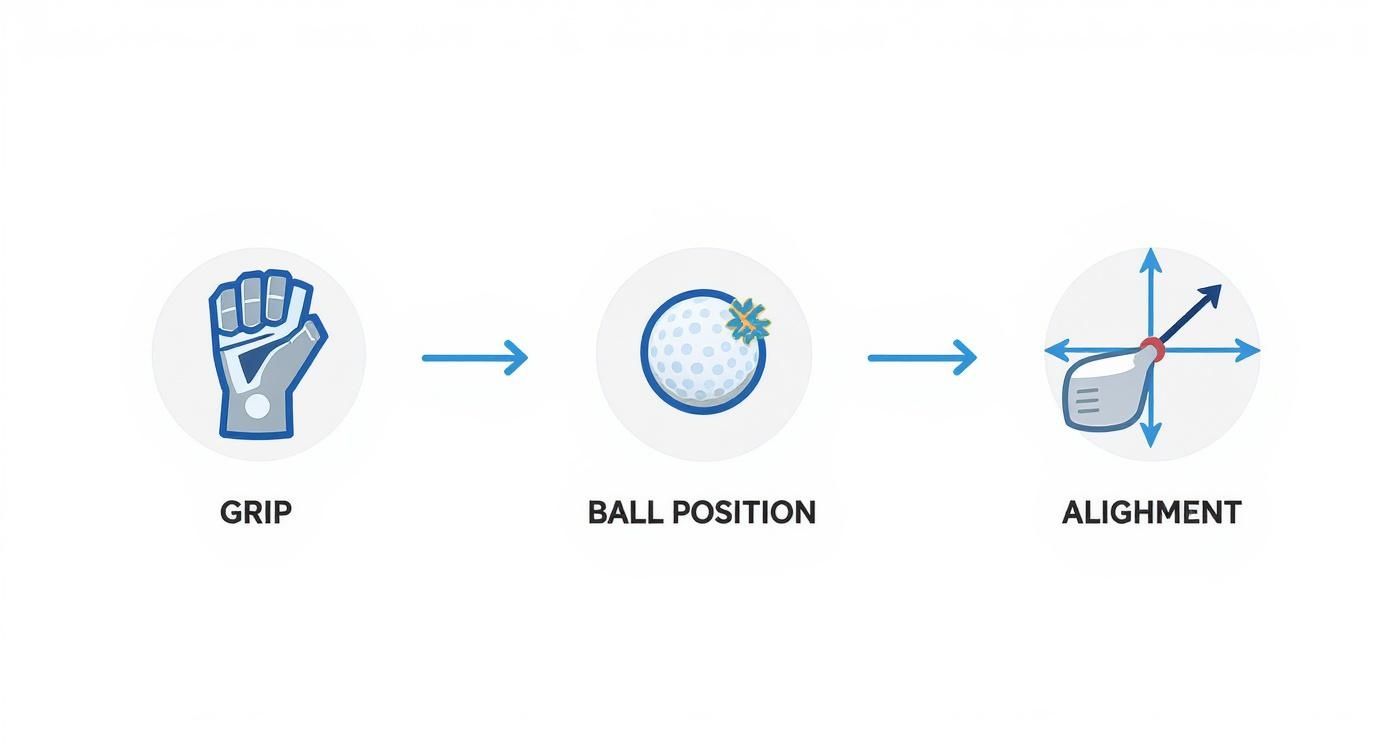
Think of this as a quick reminder: a good swing path doesn’t just happen. It’s built on a solid, slice-proof foundation.
Initiating the Golf Downswing From the Ground Up
The classic mistake I see from nearly every slicer is starting the downswing with their upper body. They fire their shoulders first, which immediately throws the club outside the proper plane and guarantees that over-the-top move.
The correct sequence is the exact opposite. It starts from the ground up.
Your very first move from the top of your backswing should be a subtle bump of your hips toward the target. Picture your lead hip starting to turn open just a fraction. This tiny lower-body move is a game-changer because it creates the space needed for your arms and the club to drop down onto an inside path. This is what you hear pros talk about when they say “dropping it in the slot.”
This sequence is everything. It keeps your upper body “closed” for a split second longer, preventing that early spin-out and allowing the club to approach the ball from the inside, where all the power is.
Pro Tip: A fantastic swing thought is to feel like you’re keeping your back facing the target for as long as possible while your lower body starts the downswing. This feeling makes it almost impossible for your shoulders to spin out too early, promoting that powerful inside-to-out path.
The Feeling of an Golf Inside-Out Swing
Rewriting years of muscle memory is all about focusing on the right feelings. You have to train your body to understand what an inside-out swing actually feels like. Here’s a mental image I constantly use with my students:
- Imagine a clock face on the ground, with your golf ball right in the center. The target line is pointing at 12 o’clock.
- Your old slice swing path was probably moving from around 7 o’clock to 1 o’clock as it crossed the ball.
- Our new goal is to feel the clubhead travel from 4 o’clock out to 10 o’clock through impact.
This sensation of swinging “out to right field” (for a righty) is exactly what you’re after. I’ll be honest, it will feel incredibly weird and exaggerated at first, but it’s the necessary over-correction to neutralize that old out-to-in habit.
The data doesn’t lie about how destructive that old path is.
TrackMan data from golfers with severe slices often shows an out-to-in club path of -11 to -12 degrees left. When you pair that path with a steep, negative attack angle and a spin rate climbing toward 4,900 RPM, you’re creating a massive amount of side spin. Considering the optimal spin rate with a driver is closer to 2,000 RPM, you can see just how much performance you’re losing. If you’re a numbers geek, you can find more data insights on slice mechanics over at GolfSenseiTraining.com.
Getting that clubhead to approach the ball from the inside is non-negotiable if you want to finally kill your slice. It’s the only way to consistently square the clubface at impact and launch the ball down the fairway with authority, turning that weak, floating slice into a powerful, penetrating ball flight.
Drills to Make a Straight Drive Feel Automatic in Golf
Incorporating drills focused on how to fix slice with driver into your practice routine can lead to lasting improvements.

Knowing the theory behind fixing your slice is one thing, but actually ingraining it into your muscle memory is a whole different beast. You can’t stand on the tee box thinking about five different swing positions. It just doesn’t work.
The goal is to make a straight, powerful drive feel completely automatic. That’s where targeted drills come in.
These aren’t just random exercises to kill time at the range. They are specific, repeatable movements designed to give you instant, undeniable feedback on your swing path and clubface control. This is how you overwrite those old, slice-producing habits for good.
The Golf Headcover Drill for an Inside Path
This one is an oldie but a goodie. It’s probably one of the most effective drills out there for curing that dreaded “over-the-top” swing, and you don’t need any fancy training aids. Its beauty is in its simplicity.
All you have to do is place your driver’s headcover (or an empty sleeve of balls) about six inches outside and slightly behind your golf ball. Your only job? Hit the ball without hitting the headcover.
If you make your usual slice swing, you will hit the headcover. It’s impossible not to. This drill gives you instant negative feedback, forcing your brain and body to find a new way to deliver the club to the ball—from the inside. The “feel” you’re chasing is the club dropping behind you and approaching the ball on a much shallower, inside-out path.
This simple exercise retrains your entire swing sequence. To avoid the obstacle, you’ll naturally start your downswing with your lower body, which is the key to creating space and dropping the club “in the slot.”
For golfers who want to get even more precise with their practice, there are tons of great golf alignment stick drills that can provide even better visual cues for your setup and swing path.
The Golf Gate Drill for a Square Clubface
Once you start grooving a better swing path, the next piece of the puzzle is ensuring the clubface is square at the moment of truth. The “gate drill” is perfect for this.
- Setup: Take two extra tees. Place one about two inches outside your ball and the other about two inches inside your ball. This creates a narrow “gate” for your clubhead to pass through.
- Execution: Make a smooth swing, focusing only on swinging the clubhead cleanly through that gate without hitting either tee.
This drill really sharpens your focus on the impact zone. If you clip the outside tee, it’s a clear sign your path is still coming too far out-to-in. Hitting the inside tee often means you’ve over-corrected and your path is too far in-to-out.
Sending the clubhead whistling cleanly through the middle is the proof you need that your path and face are finally working together.
Your Go-To Anti-Slice Golf Drill Guide
I’ve seen these drills work for countless golfers. To make it even easier to know which one to pull out of your toolbox at the range, here’s a quick reference guide. As you continue to explore how to fix slice with driver, celebrate your progress and the milestones you achieve along the way.
| Drill Name | What It Fixes | Equipment Needed | Best For |
|---|---|---|---|
| Headcover Drill | The “over-the-top” swing path | Driver headcover or empty ball sleeve | Golfers who lunge at the ball with their shoulders and cut across it. |
| Gate Drill | Inconsistent swing path & clubface control | Two extra golf tees | Players who have a decent path but still struggle with pushes or hooks. |
| Split-Hand Drill | Lack of proper hand and arm rotation | Just your driver | Anyone who feels “stuck” at impact and doesn’t release the club properly. |
That last one, the split-hand drill, is fantastic for feeling the proper release. Simply separate your hands on the grip by a few inches and make slow, half-swings. This drill really exaggerates the feeling of your forearms rotating and the clubface closing through impact. It’s a powerful way to develop the sensation of a square, slice-free release.
By dedicating real time to these drills, you’ll stop thinking about how to fix your slice and finally start feeling what a straight shot is all about.
Using Your Golf Equipment to Tame the Slice
While your swing mechanics are the real engine behind a dead-straight drive, don’t forget about the steering wheel—your driver. Making your equipment work for you, not against you, is a smart way to support all the hard work you’re putting into your swing. Ultimately, your journey in learning how to fix slice with driver is uniquely yours and should be approached with an open mind.
Honestly, sometimes the club in your hands is part of the problem.
This isn’t about blaming your tools or searching for a magic bullet. It’s about being smart and understanding how modern driver tech can give you a much-needed assist. From simple loft adjustments to shifting a weight, a few tweaks can make it a whole lot easier to get that clubface square at impact. That alone can be a huge confidence boost on the tee.
Why Higher Loft is a Slicer’s Best Friend in Golf
One of the easiest changes you can make is simply adding more loft to your driver. I see it all the time—amateurs struggling with a slice are playing drivers with 9 degrees of loft because they think it equals more distance. The hard truth is, for most players, that low loft just cranks up the sidespin that causes that nasty slice in the first place. Regularly revisiting how to fix slice with driver can help maintain your improvements and keep your game at its best.
Making the switch to a driver with 10.5 degrees of loft or more can be a total game-changer.
Here’s the simple breakdown of why it works:
- It Kills Sidespin: More loft puts more backspin on the ball. That backspin acts as a stabilizer in the air, fighting against the slice-inducing sidespin you’re trying to eliminate.
- It Helps You Launch It Higher: A higher launch means more carry distance, especially for golfers with average swing speeds who are bleeding yards with low, weak slices.
This isn’t just my opinion; it’s a principle widely recognized by club fitters and equipment experts. The consensus is clear: bumping up your loft is one of the fastest ways to minimize that left-to-right curve. If you want to get into the nitty-gritty of the technology, you can discover more insights about anti-slice driver designs on GolfMonthly.com.
Unlocking Your Adjustable Golf Driver
Most drivers sold in the last decade have adjustable features that, frankly, most golfers never even touch. If that sounds like you, you’re leaving a powerful anti-slice tool sitting in your bag. These adjustments are designed specifically to influence ball flight without you having to change a single thing in your swing.
Key Takeaway: Adjusting your driver isn’t cheating; it’s optimizing your gear. Use the technology the engineers built into it to make finding fairways a little easier while you work on your swing.
You’ll want to look for two main adjustment points: the hosel sleeve and any movable weights on the sole of the club.
-
Hosel Adjustments: This is where the shaft connects to the clubhead. By using the little wrench that came with your driver, you can change the setting to “Draw” or “Upright.” This subtly closes the clubface at address, which makes it much easier to get it back to square when you swing.
-
Movable Weights: A lot of drivers have a sliding weight track or interchangeable weights. To fight a slice, you want to slide the weight toward the heel of the club. This creates a “draw bias,” which helps the clubhead’s toe release and rotate through impact, closing the face down. It’s a simple tweak that has a surprisingly noticeable effect on ball flight.
Many golfers struggle with understanding how to fix slice with driver, but with the right mechanics and adjustments, it can be achieved.
FAQ
Even with the best advice in the world, trying to fix a slice brings up a lot of questions. Let’s tackle the most common ones I hear from golfers who are trying to straighten out their drives.
How Long Does It Really Take to Stop Slicing My Driver?
This is the big one, isn’t it? The honest-to-goodness answer is: it depends. Every golfer is different.
For some, a simple grip adjustment is all it takes, and they’ll see a straighter ball flight in a single bucket of balls. But if you’re overhauling a deeply ingrained over-the-top swing path, you’re looking at a few weeks of dedicated, mindful practice.
The single most important thing is patience. Don’t try to fix everything at once. Start with your setup and grip, nail that down, and then move on. Golf improvement is never a straight line—there will be good days and bad. Learn to celebrate the small victories.
Can I Actually Fix This Myself Without Getting a Lesson?
You absolutely can. Many golfers have made huge strides just by understanding the two root causes—an open face and an out-to-in path—and working on the drills in this guide. Your smartphone is your best friend here; recording your swing gives you instant, undeniable feedback on whether what you feel is what’s actually happening.
That said, a good lesson can be a massive shortcut. A qualified instructor can often spot the core issue in just a few swings and give you drills designed specifically for your swing, not just general advice.
I Fixed My Swing Path, but Now I’m Hitting a Nasty Hook! What Gives?
First off, congratulations! This is a fantastic problem to have. It means you’ve successfully stopped coming over the top and are now swinging from the inside.
A hook is almost always the result of an in-to-out swing path combined with a clubface that’s closing too fast through impact. You’re one adjustment away from a perfect shot.
You’ve fixed the path, now you just need to get the face to match. Here’s what to check:
Your Grip: It’s probably too “strong” for your new, improved swing path. Try weakening it just a touch by turning your top hand slightly back towards the target.
Hand Action: You might be consciously trying to “flip” or roll your hands over through the ball. Relax your hands and arms and let the club release naturally.
Seriously, you’re closer to hitting a baby draw than you think.
Is a “Strong” Grip the Magic Bullet for a Slice?
A stronger grip is an incredibly effective fix for a slice caused by an open clubface, but it’s not a cure-all. It’s just one piece of the puzzle.
If your primary fault is a severe out-to-in swing path, strengthening your grip might just turn that high, weak slice into a low, pull-hook that dives left. That’s not much of an improvement.
This is why it’s so important to figure out your main issue first. For the vast majority of amateur slicers, a weak grip is a major culprit, which is why it’s always the best place to start your journey to finding more fairways.
Here at Golf Inquirer, our mission is to provide clear, practical advice that helps you play better golf and have more fun doing it. For more in-depth guides, honest gear reviews, and tips to fuel your passion, visit us at https://golfinquirer.com.