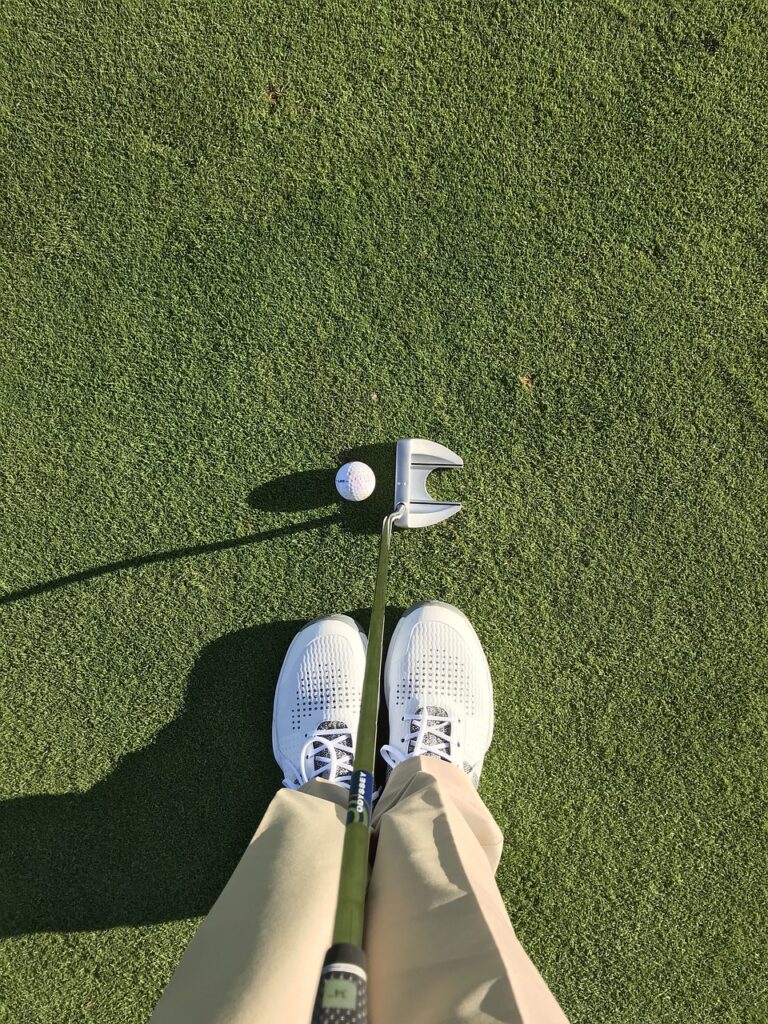
Putting is where scorecards get real. It is also where small fit issues show up fast: a putter that sits a hair too upright, a grip that fights your wrists, a head shape that makes you aim left without realizing it. A good putter fitting is not about buying the fanciest model. It is about matching your setup, your stroke, and your eyes so the face returns to square more often. Watch more here
A well-fit putter will not make every 20 footer, but it can make your start line more repeatable and your speed control calmer.
- Why golf putter fitting is different from full-swing fitting
- Start with your golf stroke, but don’t obsess over labels
- Aim and alignment: the hidden reason people miss
- Length, lie angle, and your setup posture
- Loft and roll: getting the ball to track instead of skid in golf
- Head design, hosel style, and toe hang
- Weight, tempo, and why “feel” is partly physics
- Grip size and shape: quieting the wrists or freeing them
- What a good golf putter fitting session looks like
- A simple do-it-yourself fitting flow (that actually works)
- Common fitting myths that waste time (and money)
- A quick buying checklist you can keep in your pocket
- FAQ's
Why golf putter fitting is different from full-swing fitting
Drivers and irons are about impact dynamics at speed. Putting is slow, precise, and heavily influenced by what you see. That’s why putter fitting usually starts with how you aim and set up, not how “hot” the face feels.
The goal is simple: get the ball starting on the line you intend with a roll that holds that line.
Many golfers are shocked to learn they “aim” several degrees left or right with their gamer. That is not a character flaw. It is a visual and setup mismatch, and it is fixable.
Start with your golf stroke, but don’t obsess over labels
You will hear “straight back straight through” and “arc stroke” a lot. Most strokes have some arc because the putter swings on an inclined plane. The useful question is: how much does the face rotate relative to your path?
A fitter may measure your stroke with a putting analysis system or high-speed video. If you are doing this yourself, record from down the line and face-on, then watch where the toe points through the stroke. A little rotation is normal.
A simple check that works at any practice green is to roll five putts with your eyes focused on the front edge of the ball. If your contact point drifts (you start catching it toward the toe or heel), your current length, lie, or balance may be pulling you off your natural motion.
Aim and alignment: the hidden reason people miss
Most missed putts are missed at the start line, not because you misread the break. And start line often begins with aim.
Head shape, sightlines, flange width, and even finish (bright vs muted) can change where you think “square” is. Some golfers aim better with a single top line. Others need a long line that frames the ball. Some aim best with no line at all.
Before you change anything else, do an aim check:
- Set a ball down and place an alignment stick or club on your intended start line.
- Aim the putter face at the stick without looking at the stick while aiming.
- Step back and see where the face actually points.
Repeat it with different head shapes if you can. The “best” alignment aid is the one that makes you aim correctly without extra effort.
Length, lie angle, and your setup posture
Putter length is not about your height alone. It is about where your eyes fall relative to the ball, how your arms hang, and whether the putter sole rests flat.
A too-long putter often forces you upright and can push the lie too flat (toe up). A too-short putter can pull you too bent over and drive the heel up. Either way, the face tends to point offline at impact because the putter is not returning to the ball the same way each time.
Signs you should test a different length or lie:
- Your impact tends to live on the toe or heel
- You feel crowded or stretched over the ball
- The sole looks tilted at address (toe up or heel up)
Many fitters will adjust lie so the sole sits neutral at your natural address position, then confirm it with tape marks and roll results. If you tinker on your own, start by choking down 1 inch and rolling ten putts, then add an extension grip feel by holding the very end. Notice which setup makes center contact easier.
Loft and roll: getting the ball to track instead of skid in golf
Putter loft is small, yet it matters because the ball usually sits slightly down in the grass. You need enough loft to lift the ball out of that depression and start it rolling, but not so much that it launches and bounces.
A fitter will look at your launch angle, initial skid, and roll. If your hands are pressed forward a lot, you de-loft the putter and may need more loft. If you add loft through impact (hands behind the ball), you may need less.
Green speed and grass also matter. On slow, grainy greens you might get away with a touch more loft. On quick, smooth greens too much loft can turn into inconsistent distance.
Head design, hosel style, and toe hang
This is where “stroke match” actually becomes practical. The main pieces are head type (blade vs mallet), where the shaft enters (hosel), and how the head balances (toe hang or face balanced).
Rather than chasing a rule, use these as starting points, then let your roll and aim decide.
| What you tend to do | Helpful balance tendency | What you’ll often see |
|---|---|---|
| Very little face rotation, more “quiet” hands | Face balanced or minimal toe hang | Many center-shafted mallets, some double-bend shafts |
| Moderate arc, natural release | Moderate toe hang | Classic blades, mid-mallets with plumber’s neck |
| Strong arc, lots of release feel | More toe hang | Flow-neck blades, some compact mallets with toe hang |
Toe hang is not a grade of “better.” It is just a way the putter wants to rotate when you swing it.
Also, do not ignore how the head frames the ball. A large mallet can boost stability and help some golfers see the line. A clean blade can help others free up their release and improve pace on fast greens.
Weight, tempo, and why “feel” is partly physics
Putter head weight and total weight influence tempo. A heavier head can smooth out quick hands and make short putts feel steadier. Too heavy can make long putts feel like you are steering. A lighter setup can help distance control for some players, yet it can also amplify nerves on three footers.
Many modern putters offer interchangeable sole weights. This can be a big deal in fitting because you can keep the same head shape and alignment picture while tuning pace.
A quick way to test weight without buying anything is to try three putters at a shop practice area: one clearly lighter, one medium, one heavier. Hit 20 to 30 footers and pay attention to whether you keep leaving them short or blowing them past. Your best match usually “lands” near the hole more often, even when you mis-hit slightly.
Grip size and shape: quieting the wrists or freeing them
Grip choice is personal, but it is also a fit variable that can change your face control.
Thicker grips tend to reduce wrist action. Pistol shapes can encourage a bit more feel in the trail hand. Flat-front grips can help some golfers keep the face more stable. Counterbalanced grips can change how heavy the head feels and how the putter swings.
If you struggle with yips or flippy hands, a slightly larger grip can be a clean first experiment. If you struggle with dead pace and no touch, going too large can make distance control harder.
Here are a few practical grip checkpoints:
- Grip pressure: steady, not squeezing
- Hand placement: consistent every time
- Comfort: you should not “search” for the position at address
What a good golf putter fitting session looks like
A solid fitting is part measurement, part feedback, part reality check on what you actually do under pressure. Expect to hit putts from a mix of distances, not just three footers.
Bring the putter you game now, and be ready to talk about your typical miss. Also be honest about where you play most often. The green speeds at your home course can guide weight and loft choices.
It helps to show up with a short list of preferences, while staying open to surprises. Many golfers walk in thinking they need a mallet and leave rolling blades beautifully, or the other way around.
Before your session, it’s smart to have a few basics ready:
- Your current putter specs (if you know them)
- The ball you normally play
- A glove, if you wear one for putting
- Your typical green speed and grass type at home
A simple do-it-yourself fitting flow (that actually works)
A full fitting with a trained fitter and proper tech is ideal, but you can still make meaningful progress on your own if you test in a disciplined way. Change one variable at a time and track results with start line and speed, not just makes.
Use this sequence if you’re testing at a shop or practice green:
- Check aim with your current putter using a straight reference line.
- Test head shapes for aim first (blade vs mallet), then keep the one that aims best.
- Dial in length by choking down, then holding full length, and choosing the setup that gives you center contact.
- Compare toe hang styles that match your stroke feel, then choose based on start line consistency.
- Fine-tune weight and grip for speed control and comfort.
If you do only one step, do the aim check. A putter you aim well is a putter that gives your read a chance.
Common fitting myths that waste time (and money)
Marketing can make putters feel mysterious. They are not. A few beliefs keep golfers stuck in trial-and-error mode.
- “Face balanced is for straight strokes only”: Many golfers with a slight arc putt great with face-balanced heads if they aim them well and like the look.
- “Mallets are always more forgiving”: They can be, yet some players deliver the face better with a blade because the look matches their release.
- “The best putter is the one that feels soft”: Feel matters, but start line and speed control matter more. A firmer face that rolls true can beat “soft” every day.
A quick buying checklist you can keep in your pocket
When you’ve narrowed it down to two or three options, stop thinking about brand and start checking performance details. Roll ten putts from six feet to a chalk line, then ten from 25 to 35 feet to a target fringe.
If one option keeps your misses tighter and your speed steadier, you have your answer.
The right putter is the one that helps you aim without fighting your eyes, sets you up comfortably, and produces a roll you trust when the match is on the line.
FAQ’s
How do I know whether I need a blade or a mallet putter?
Your choice depends primarily on the visual shape you prefer at address and how much forgiving tech you need:
Blade putters feature a classic, slim profile. They provide direct feedback, precise distance control, and cleaner alignment for players who prefer a traditional look.
Mallet putters have larger head profiles that shift weight toward the perimeter and rear. This creates higher Moment of Inertia (MOI), making the putter face more resistant to twisting on off-center hits. If you struggle with consistent strike location or alignment, a mallet offers maximum forgiveness.
Should I use a putter with toe hang or one that is face-balanced?
This decision should match the natural path of your putting stroke:
Face-Balanced: If you hold the shaft horizontally on your finger and the face points straight up to the sky, the putter is face-balanced. This works best for golfers with a straight-back, straight-through stroke path because it resists rotation during the swing.
Toe Hang: If the toe sants down toward the ground when balanced, the putter has toe hang. This is designed for golfers who have an arced putting stroke (where the putter head naturally opens on the backstroke and closes through impact). The more arc in your stroke, the more toe hang you generally need.
How do length, lie angle, and loft affect my putter performance?
These three fitting metrics directly dictate your posture, eye position, and launch roll:
Length: Getting the correct length (typically between 33 and 35 inches for most golfers) allows your eyes to sit directly over or slightly inside the target line while letting your arms hang naturally.
Lie Angle: If your putter length is wrong, the heel or toe will lift off the ground at address. If the toe is up, putts tend to pull left; if the heel is up, putts tend to push right. Proper lie angle ensures the sole rests flat at impact.
Loft: Standard putters typically have 3 degree to 4 degree of loft. This slight lift lifts the ball out of its initial depression on the turf, allowing it to transition quickly into a smooth, true forward roll without hopping.
Why does putter alignment line design matter, and how do I test one?
Alignment aids (single lines, multiple dots, high-contrast visual cues, or target-tracking lines) guide how your brain perceives straight alignment to the hole:
Different visual setups affect aim bias—some players visually aim right with single lines, while others aim left.
Testing: The best way to evaluate alignment is to set up a straight 8-to-10-foot putt without a hole, aim at a tiny mark or laser line, and check if the face is truly square to the target before stroke execution. Pick the head geometry and visual alignment system that lets you align square naturally without micro-adjusting your hands.
At Golf Inquirer, we know it’s these little details that separate good golfers from great ones. Our goal is to give you the kind of insights that not only help you score better but also let you enjoy the game more. To keep learning, explore more tips and guides at https://golfinquirer.com.