
If you’ve spent any time on a golf course, you know the slice. That wild, high-flying shot that robs you of distance and sends your ball careening into the trees on the right. It’s the bane of many amateur golfers. But what if I told you there’s a version of that shot that pros actually try to hit?
That shot is the cut, and it’s a world away from a slice. A cut golf shot is a controlled, intentional shot that curves gently from left to right for a right-handed player. It’s often called a fade, and it’s one of the most reliable and strategic tools you can have in your bag.
Let’s clear this up right now: a cut is not a slice. The key difference is one powerful word: control. A slice is an accident born from swing flaws. A cut is a deliberate, precise maneuver.
So, how does it work? It all comes down to the relationship between your clubface and your swing path at the moment of impact. To hit a cut, your clubface needs to be slightly open to your target line, but closed relative to your swing path. You achieve this by swinging on an “out-to-in” path—meaning the club travels from outside the target line to inside it through impact.
This combination imparts a gentle, controllable left-to-right spin on the ball, causing it to start left of your target and curve back toward it.
For a clearer picture, let’s quickly compare the cut to its opposite, the draw.
What Is a Cut Shot, Really?

Let’s clear this up right now: a cut is not a slice. The key difference is one powerful word: control. A slice is an accident born from swing flaws. A cut is a deliberate, precise maneuver.
So, how does it work? It all comes down to the relationship between your clubface and your swing path at the moment of impact. To hit a cut, your clubface needs to be slightly open to your target line, but closed relative to your swing path. You achieve this by swinging on an “out-to-in” path—meaning the club travels from outside the target line to inside it through impact.
This combination imparts a gentle, controllable left-to-right spin on the ball, causing it to start left of your target and curve back toward it.
For a clearer picture, let’s quickly compare the cut to its opposite, the draw.
Cut Shot vs Draw Shot At a Glance
Here’s a simple breakdown of how a cut (fade) and a draw compare for a right-handed golfer.
| Characteristic | Cut Shot (Fade) | Draw Shot |
|---|---|---|
| Ball Flight | Moves gently from left to right | Moves gently from right to left |
| Trajectory | Typically higher | Typically lower and more penetrating |
| Landing | Softer landing with less roll | More roll-out after landing |
| Common Use | Attacking tucked right pins, avoiding left-side hazards | Hitting dogleg lefts, maximizing distance |
| Feel | More of a “glancing” or “wiping” blow | Feels more compressed and solid at impact |
Understanding these fundamental differences is the first step toward knowing which shot to play and when.
When to Play a Cut Shot
Knowing how to hit the cut is only half the battle; knowing when to use it is what separates good players from great ones. The cut isn’t just a party trick; it’s a strategic weapon that can get you out of trouble and set up easy birdies.
You’ll find the cut is your best friend in a few common on-course scenarios:
- Navigating Dogleg Right Holes: Instead of hitting a straight shot and hoping it doesn’t run through the fairway, a well-played cut lets you work the ball around the corner, leaving you in the perfect spot for your approach.
- Attacking Tucked Pins: Is the flagstick sitting on the right side of the green, guarded by a bunker or water? The cut is your go-to play. It flies in from the left and lands softly, moving toward the pin instead of away from it.
- Avoiding Hazards on the Left: If there’s a pond, out-of-bounds stakes, or thick woods down the entire left side, playing a cut is a brilliant strategy. By starting the ball left and fading it back to the fairway, you can take that trouble completely out of play.
A controlled fade is often easier to repeat under pressure than a draw. Its higher, softer landing makes it a go-to for many pros when they need to hit a green and stop the ball quickly.
Why Pros Favor the Fade
There’s a reason the term cut golf shot is so common in pro circles. Many of the world’s best players, from Jack Nicklaus to Dustin Johnson, have built their careers on a reliable, go-to fade. Why? Predictability.
The spin axis of a fade tends to be more stable, which means the shot is often more repeatable, especially when the pressure is on. This shot-shaping ability is essential for scoring well on tough courses where precision is paramount. For a deeper dive, you can find great insights about the tactical use of different shots in golf, but the bottom line is that mastering the cut is a huge step toward playing smarter, more consistent golf.
Nailing Your Setup for a Perfect Cut Shot
A reliable cut golf shot is built from the ground up, long before you even start your takeaway. The real secret is in a few small, deliberate tweaks at address. These adjustments pre-load your swing for that perfect out-to-in path.
Get this part right, and the swing itself feels less like a complicated maneuver and more like a natural reaction.
The entire foundation for this shot is the open stance. All this means is aiming your body—feet, hips, and shoulders—a little to the left of where you want the ball to land (for a righty). You’re essentially creating a new swing line for your body to follow.
Why the Open Stance Works
Think of it like laying down railroad tracks. For a dead-straight shot, one track represents your body line and the other represents the ball-to-target line; they run perfectly parallel. To hit a cut, you just angle the “body” track to the left while keeping the “ball-to-target” track pointed right at your destination.
This simple change encourages your arms and club to swing naturally along the path your body is aligned to—an out-to-in path relative to the flagstick. That path is the engine that puts the left-to-right spin on the ball, giving you that beautiful, controlled fade.
Your setup is basically programming your swing. By opening your stance, you’re giving your body a clear set of instructions. It makes hitting a cut feel automatic, not forced.
Adjusting Your Ball Position
Okay, you’ve got your body aligned. The next piece of the puzzle is where you put the ball. For a cut, you’ll want the ball slightly more forward in your stance than you would for a standard shot.
- With an iron: If you normally play it in the middle, try moving it just one ball-width forward.
- With a driver or 3-wood: Instead of well inside your lead heel, position it just off the inside of that heel, maybe even directly in line with it.
This subtle shift does two critical things. First, it gives the club more time to travel from outside the target line back to the inside before impact, reinforcing that out-to-in path. Second, it promotes a clean strike, helping you catch the ball at the bottom of the swing arc instead of hitting down on it too steeply.
Finding a Neutral to Weak Grip
Your grip is the final dial you can turn in this setup. To hit a proper cut, you need to stop your hands from rolling over and slamming the clubface shut through impact. The easiest way to do that is with a neutral or slightly “weaker” grip.
A neutral grip is when you can look down at address and see about two knuckles on your lead hand (your left hand, for right-handers). To get a weaker grip, just rotate that lead hand a bit to the left, so you only see one or one-and-a-half knuckles.
This grip makes it physically harder to close the clubface. It helps the face stay square or even slightly open to your swing path at impact. When you combine that open clubface with your out-to-in path, you get that predictable, controllable cut. With these setup pieces locked in, you’re ready to make the swing.
Executing The Cut Shot Swing Path
You’ve got your setup dialed in, and now comes the fun part: the swing itself. The good news is, if you’ve done the prep work correctly, the swing is surprisingly simple. Your goal isn’t to invent some wild, complicated move. It’s all about trusting the groundwork you just laid.
Think of it this way: you just need to swing along the line your body is already aimed at—your feet and shoulders. Don’t try to steer the club back toward the flag.
This is the exact spot where most golfers get themselves into trouble. They set up with their body aiming left but then instinctively try to swing the clubhead directly at the pin. This creates a massive conflict in your swing and leads to all sorts of inconsistency. The beauty of the open stance is that it naturally encourages the correct out-to-in swing path. All you have to do is commit to it.
The Feeling of a Cut Shot Swing
Let’s get one thing straight: you don’t hit a cut with your hands. Forget trying to consciously hold the face open or manipulate the club. Instead, the focus should be on your body’s rotation.
A great swing thought is to feel your lead hip clearing early and aggressively on the downswing. This powerful rotation is what pulls your arms and the club right down the intended path. Another key is to feel like you keep your chest turning through the ball, all the way into a full, complete finish. The moment your body stops rotating, your hands tend to take over, which is a recipe for a hook or a nasty pull. Keep the big muscles moving.
The secret to a great cut shot isn’t in your hands; it’s in your pivot. When you rotate your body correctly along your open stance line, the club has no choice but to follow the perfect out-to-in path. Let your body lead the way.
This whole process is built on the foundation you create at address.
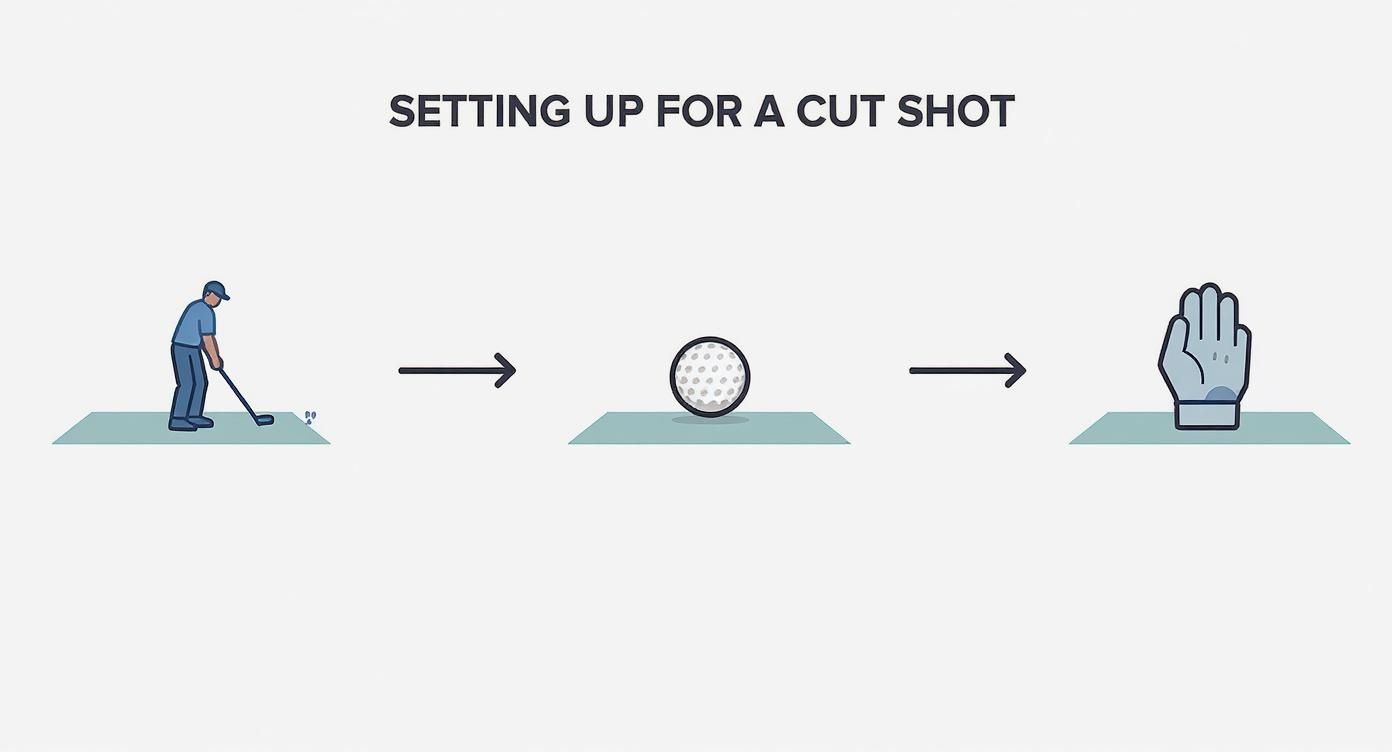
Nail these setup pieces before you even start your backswing, and the correct motion will feel far more natural and a whole lot less forced.
Let The Clubface Do Its Job
One of the biggest myths about hitting a cut is that you need to actively hold the clubface open through impact with your hands. That’s a one-way ticket to a weak, powerless slice that balloons up into the wind.
Your actual goal is to maintain a clubface that is square to your final target—where you want the ball to end up—even though your body is swinging left of that line. Your neutral grip and open stance have already done the hard work for you. As you swing along your body line, the clubface is naturally “open” relative to that swing path, which is what creates that beautiful, controllable cut spin. It’s a subtle but crucial difference.
Swing Thoughts For a Consistent Cut
To really groove this motion on the range, ditch the complicated mechanical thoughts and focus on simple, actionable cues.
Here are a few of my favorites:
- “Swing to left field.” This is a classic for a reason. It’s a great visual that helps you fully commit to swinging along your body line and fights the urge to push the club out toward the target.
- “Keep the back of your lead hand facing the target.” This thought is fantastic for preventing your hands from getting too active and rolling over early, which helps keep the clubface square to the target through the hitting area.
- “Finish high and left.” A full, committed follow-through where your hands finish high up and over your lead shoulder is a clear sign that your body has rotated properly.
To make this swing path feel even more natural, you might want to incorporate some specific golf mobility exercises for a better swing to ensure your body can make the turn it needs to.
And while the cut shot is often used interchangeably with the term “fade,” there are some small differences. To sharpen your shot-shaping knowledge even more, check out our guide on how to hit a fade.
Proven Drills to Groove Your Cut Shot

Knowing the theory behind a cut golf shot is one thing, but actually pulling it off consistently is a different beast entirely. That only happens on the driving range, where you can put in the reps to burn the feeling into your muscle memory.
These drills are my go-to’s for moving the cut from a conscious, mechanical thought to a natural, athletic motion you can call on anytime. We need to ingrain the proper feel, and that starts with getting some undeniable feedback on what your club is really doing.
The Alignment Stick Gate Drill
This is, without a doubt, my favorite drill for grooving the cut shot swing path. Why? Because the feedback is instant and you can’t cheat it. The whole idea is to build a “gate” that forces your club to travel on that crucial out-to-in path through impact.
How to Set it Up:
- Stick one alignment rod in the ground a couple of feet behind your ball, positioned just outside your target line.
- Place a second rod a couple of feet in front of the ball, but this time just inside your target line.
- These two sticks should create a narrow, diagonal gate for your club to pass through.
Now, take your open setup and just try to swing through the gate. If you hit the back stick, your takeaway is getting sucked too far inside. If you hit the front stick, you’re swinging too far out to the right (an “in-to-out” path), which is the opposite of what you want.
This drill physically guides you onto the right path. While there are tons of great golf alignment stick drills out there, this one is pure gold for learning the cut.
The Step-Through Drill for Rotation
A classic mistake when trying to hit a cut is stalling your body rotation. The player gets so focused on the arms that the lower body just stops, leading to a weak, handsy swing. This drill is a fantastic fix for that. It teaches you to feel the proper sequence, making sure your lower body leads the charge.
Address the ball like you normally would, but then slide your trail foot (right foot for right-handers) up so it’s nearly touching your lead foot. As you start your downswing, take a decisive step forward and out with that trail foot, planting it back in its normal spot just as you swing through impact.
That stepping motion physically forces your hips to clear and your body to rotate through the ball with some speed. It kills any tendency to stall and helps you feel the powerful, body-driven motion you need for a solid cut.
Key Takeaway: You’re not just trying to swing your arms on an out-to-in path. You need to pivot your entire body along that same line. This drill connects your upper and lower body so they work together.
The Exaggeration Drill
Sometimes the fastest way to find the middle is to explore the extremes. For this drill, forget about hitting a good shot. Your only mission is to hit the biggest, ugliest, most banana-shaped slice you can possibly imagine.
Open your stance way up. Weaken your grip. Make a comically over-the-top, out-to-in swing. Don’t even look where the ball goes—that’s not the point. The goal is to feel what it takes to put an insane amount of cut spin on the golf ball.
After hitting a few of these massive slicers, start to dial it back. Make your setup just a little less open. Make the swing path a little less extreme. You’ll be amazed at how quickly you find the sweet spot for a controlled, playable cut golf shot—what will eventually become your stock fade. This process of exaggerating and then refining is one of the best ways to develop a real feel for controlling your clubface and path.
Fixing the Cut Shot When It Goes Wrong
Even when you feel like you’ve nailed the setup and have the right swing thoughts, the golf ball can have a mind of its own. Don’t sweat it. Learning to shape your shots comes with some trial and error, and every single golfer has been there. Let’s walk through how to diagnose the most common problems and get you back on track right on the course.
The most baffling miss is usually the pull. This is that shot where you’ve geared up for a nice, gentle cut, but the ball just starts left of your target and keeps going straight left. It never even thinks about curving back. You feel like you did everything right, but the ball flight tells a completely different story.
Nine times out of ten, this problem comes down to one thing: your clubface. A pull happens when your clubface is closed relative to your target line when it meets the ball. So even though your swing path was out-to-in, that closed face overrode any cut spin you were trying to create and just sent the ball packing.
The Overcooked Cut That Turns Into a Slice
On the flip side, you have the cut that curves way too much—the dreaded slice. The ball might start left like you want, but then it takes a huge, looping turn to the right, bleeding distance and sending you scrambling. This is what happens when your out-to-in swing path is just too severe, your clubface is wide open at impact, or (most likely) a bit of both.
A controlled cut is a game-changer, but an accidental slice is a score-wrecker. The fix is often less about a massive swing overhaul and more about dialing back the adjustments you’re making in your setup or swing path.
To fix these all-too-common misses, here are a few quick checks you can do right on the range or in the middle of a round.
- Check Your Grip: Is your lead hand (left hand for righties) too strong, meaning it’s turned too far away from the target? This is a classic culprit for a closed face and a pulled shot. Try weakening your grip just a touch by turning that hand more toward the target.
- Examine Your Alignment: Are you aiming way too far left? Sometimes we overdo it. An excessively open stance can actually promote a steep, over-the-top swing, which is a one-way ticket to a big slice. Just make sure your body is aimed only slightly left of the target.
- Feel Your Release: Are you actively trying to hold the clubface open through impact with your hands? It’s a common thought, but it can lead to that weak, floaty slice. Instead, trust that your body’s rotation will bring the club through the ball naturally.
The ability to move the ball both ways is what separates good players from great ones. Just look at the pros. Statistical analysis from the PGA Tour shows that players use intentional cuts on 20% to 30% of their approach shots to get around trouble and attack tucked pins. Mastering shots like the cut is a direct path to a lower scoring average, highlighting just how valuable it is. You can discover more insights about the cut shot’s role in professional golf and see why it’s a skill worth putting in your bag.
FAQ’s
Even after you start getting the hang of it, a few questions always seem to pop up when golfers are learning to shape the ball. Let’s tackle some of the most common ones I hear about the cut golf shot so you can step up to the ball with total confidence.
Lots of players get a little worried when they notice their cut doesn’t fly as far as their normal straight shot or a draw. This is completely normal—in fact, it’s part of the design. A cut shot has a higher trajectory and more backspin, which is what gives it that nice, soft landing. That combination naturally scrubs off a bit of roll and total distance.
Think of it as a strategic trade-off. You might give up 5-10 yards of distance, but you gain a massive amount of control and predictability. For an approach shot into a tricky green, that control is worth its weight in gold.
Is a Cut the Same as a Fade?
This is a classic. For 99% of us on the course, “cut” and “fade” mean the exact same thing: a ball that curves gently from left to right for a right-handed player. They’re used interchangeably all the time, and that’s perfectly fine.
If you want to get super technical, some purists might argue a “cut” flies a bit higher and has more spin, making it stop even faster than a “fade.” But honestly, the mechanics—opening your stance and swinging slightly out-to-in—are identical. Don’t get lost in the jargon. Just focus on producing that reliable, repeatable left-to-right flight.
The real distinction isn’t between a cut and a fade. It’s between a controlled cut and an out-of-control slice. As long as you’re in control, you’re winning.
Which Clubs Should I Hit a Cut With?
You can hit a cut with every single club in your bag, from the driver right down to your most lofted wedge.
That said, the easiest place to start is usually with a mid-iron, like a 7-iron or 8-iron. These clubs have enough loft to get the ball up in the air without much effort, but not so much that the spin becomes hard to manage. They’re the perfect training wheels.
Once you’re comfortable shaping your mid-irons, start working your way through the bag. A cut with a driver—often called a “power fade”—is an incredible weapon for navigating dogleg-right holes or steering clear of trouble lurking on the left side. On the other end of the spectrum, a soft-cut wedge is the perfect shot for tucking it close to a pin guarded by a bunker or water. The core principles stay the same, you’ll just need to make tiny tweaks to your ball position and how much you open your stance.
At Golf Inquirer, our mission is to help you peel back the layers of this incredible game, from shot-making strategy to finding the gear that fits you perfectly. We believe smarter golf is better golf. Check out more of our guides and tips to elevate your game at https://golfinquirer.com.