
Every golfer dreams of that perfect, effortless swing—the one that sends the ball soaring down the fairway with a satisfying crack. We chase that feeling with new clubs and endless swing tweaks, but the real engine behind that power isn’t in your arms or legs alone. It’s your core. A strong, stable midsection is the linchpin of a consistent and powerful golf game. It’s the crucial link that transfers energy from the ground up, helps you hold your posture through 18 holes, and wards off the nagging injuries that can keep you off the course.
But this isn’t about getting a six-pack; it’s about building functional strength that shows up on the scorecard. To truly get the most out of these exercises, it helps to understand some fundamental strength training principles. Building on that knowledge, this guide cuts through the noise to give you a detailed list of the most impactful core workouts for golfers. Each one comes with step-by-step instructions, form tips, and a clear explanation of how it will help your swing. Let’s build a foundation that will transform your game from the inside out.
1. Dead Bug Exercise for Golf
Don’t let the goofy name fool you—the Dead Bug is a foundational powerhouse and arguably one of the best core workouts for golfers. It teaches your body a critical skill: how to keep your core rock-solid while your arms and legs are moving. Sound familiar? That’s the controlled chaos of the golf swing. By waking up deep abdominal muscles like the transverse abdominis, this exercise builds the unshakable foundation you need for powerful, repeatable shots.
The magic of the Dead Bug isn’t about speed or heavy lifting. It’s in the slow, deliberate movement that forces your core to fight against rotation and extension. This “anti-movement” strength is exactly what stops you from swaying off the ball or losing your posture as you swing.
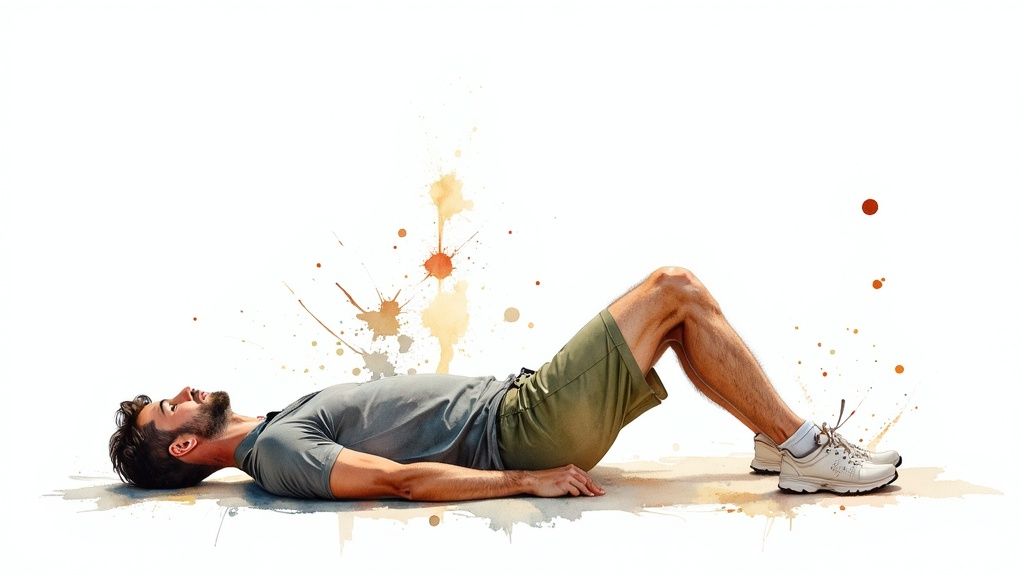
Why It’s a Must for Golfers
The Dead Bug is a go-to for elite golf trainers for a simple reason: it trains lumbo-pelvic control. In plain English, that’s the ability to keep your lower back and pelvis stable while your hips and shoulders rotate. Popularized by movement experts like Gray Cook and baked into the Titleist Performance Institute (TPI) training philosophy, this exercise directly attacks common swing flaws like “S-Posture” or “early extension”—the kind that kill your power and can lead to a sore back.
You’ll find top-tier players like Jason Day incorporating Dead Bug variations into their daily warm-ups to fire up the core and prep their bodies for the rotational demands of a round of golf.
How to Perform the Dead Bug
Good form is everything. Focus on control, not how many reps you can crank out.
- Starting Position: Lie on your back with your knees bent at 90 degrees and shins parallel to the floor (the “tabletop” position). Reach your arms straight up toward the ceiling, directly over your shoulders.
- Engage Your Core: Gently press your lower back into the floor. You want to eliminate any gap between your back and the mat. This connection is key and must be held throughout the entire movement.
- The Movement: Breathe out as you slowly lower your opposite arm and leg toward the floor. Move with total control, taking 3-4 seconds to lower them. Only go as low as you can without your back arching.
- The Return: Breathe in as you bring your arm and leg back to the start with the same slow, deliberate motion.
- Alternate: Repeat on the other side. That’s one rep. Aim for 2-3 sets of 10-12 repetitions per side.
Pro Tip: Imagine you have a full glass of water resting on your stomach. Your mission is to move your limbs without spilling a single drop. This little mental trick keeps your torso perfectly still and stable.
2. Pallof Press for Golfers
The Pallof Press is the ultimate anti-rotation exercise and a non-negotiable part of any serious golfer’s training. Created by physical therapist John Pallof, this move trains your core to fight the rotational forces that try to yank you off balance. This is the secret sauce of stability in the golf swing: the ability to generate insane rotational speed in your hips and shoulders while your torso stays stable and connected.
This exercise isn’t about moving weight; it’s about preventing movement. By holding a resistance band or cable and pressing it straight out from your chest, you create a lever that rotational forces want to twist. Your core muscles, especially your obliques, have to fire like crazy to stop your body from turning. This directly helps you maintain your posture and spine angle from address to impact.
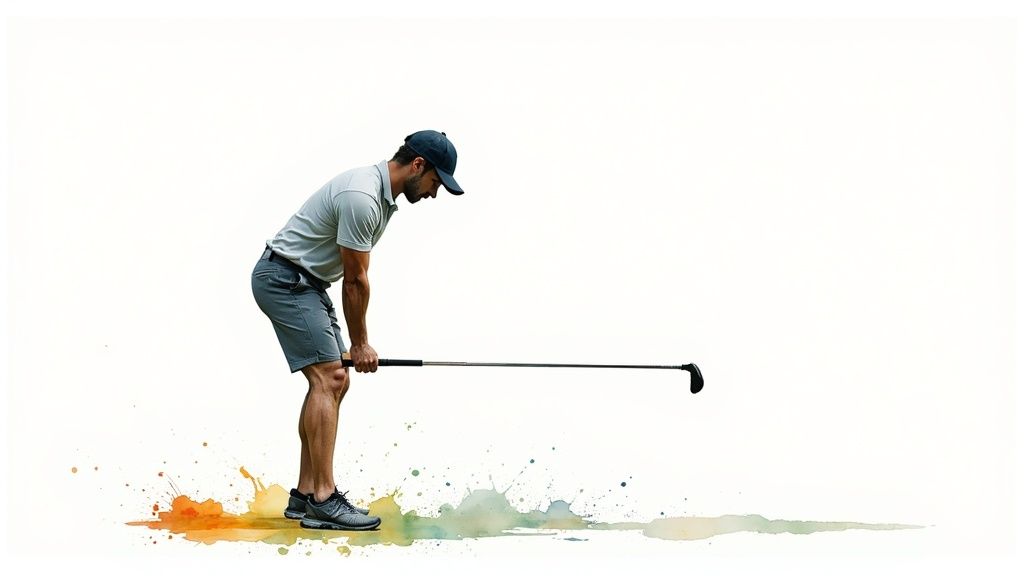
Why It’s a Must for Golfers
The Pallof Press is a pillar of the Titleist Performance Institute (TPI) philosophy and gets tons of love in publications like Golf Digest for its direct, functional benefits. It builds the “rotational core stability” needed to separate your upper body from your lower body, creating the ‘X-Factor’ stretch that is a huge source of power. A weak core lets energy leak out during the swing, but a core trained by the Pallof Press ensures every ounce of force travels from the ground up, through your core, and into the clubhead.
Countless pros, including the powerhouse Rory McIlroy, use Pallof Press variations to build the core stiffness needed for explosive speed while keeping their lower back safe. It’s one of the most effective core workouts for golfers trying to add yards without sacrificing an ounce of control.
How to Perform the Pallof Press
Control and tension are what make this exercise work. The weight should be tough, but not so heavy that your form breaks down.
- Starting Position: Stand sideways to a cable machine or a resistance band anchored at chest height. Grab the handle with both hands and bring it to the center of your chest. Take a step away from the anchor to create tension. Your feet should be shoulder-width apart with a slight bend in your knees.
- Engage Your Core: Brace your abs like you’re about to take a punch. Keep your shoulders pulled back and down, and squeeze your glutes. Your body should feel solid from head to toe.
- The Movement: Exhale as you slowly press the handle straight out in front of your chest until your arms are fully extended. The resistance will try to twist you back toward the anchor; your job is to fight that pull completely.
- The Hold & Return: Hold the extended position for 2-3 seconds, fighting to keep your hips and shoulders perfectly square. Inhale as you slowly bring the handle back to your chest with the same control.
- Alternate: Finish all reps on one side before switching to the other. Aim for 2-3 sets of 10-12 repetitions per side.
Pro Tip: For a more golf-specific challenge, do the exercise from your golf stance. This will train your core to fight rotation from the exact posture you use on the course, leading to a much more direct and noticeable improvement in your swing stability.
3. Plank Variations for Golfers
The plank is a core training staple for a reason: it builds pure, isometric strength and endurance. For golfers, planks aren’t just about holding still; they’re about forging the muscle stamina needed to maintain a solid posture from the first tee to the 18th green. This family of exercises teaches the entire core to work together, creating a rigid “cylinder” of strength that prevents unwanted movement during your swing.
Unlike dynamic exercises, the plank’s power is in its stillness. This isometric hold builds deep core stability, teaching your body to stay connected as you generate rotational force. This is the very thing that lets you transfer energy efficiently from the ground up through the clubhead, plugging power leaks and promoting a more consistent, repeatable swing.
Why It’s a Must for Golfers
Plank variations are a must-have in modern golf fitness, championed by spine biomechanics experts like Dr. Stuart McGill and used by nearly every professional. They are especially good at training lateral and anti-extension stability. Side planks, for example, directly target the obliques and quadratus lumborum (QL)—muscles that are crucial for stabilizing your torso during the backswing and preventing the dreaded “sway.”
The plank is a versatile tool used by the best in the game. Tiger Woods famously used extensive plank holds to rebuild his core strength during his comebacks, while a powerhouse like Brooks Koepka incorporates weighted planks to build next-level stability. These exercises directly impact your on-course performance by giving you the endurance to maintain your swing mechanics even when you’re getting tired.
How to Perform the Plank
Proper alignment is everything. A sloppy plank can do more harm than good, so always prioritize form over how long you can hold it.
- Front Plank: Start on your forearms and toes, with your elbows directly under your shoulders. Squeeze your glutes and abs to create a perfectly straight line from your head to your heels. Don’t let your hips sag or rise too high.
- Side Plank: Lie on your side with your elbow directly beneath your shoulder. Lift your hips off the floor, creating a straight line from your head to your feet. Keep your core tight and your hips stacked one on top of the other.
- Progression: Start by holding each variation for 30 seconds for 2-3 sets. As you get stronger, increase the time or add dynamic movements like plank-to-pushups or side plank hip dips.
- Breathing: Don’t hold your breath! Keep a steady, controlled breathing pattern throughout the hold to keep your muscles oxygenated and working.
Pro Tip: To really fire up your core, imagine you are trying to pull your elbows and toes toward each other without actually moving them. This will light up your entire abdominal wall and seriously boost the exercise’s intensity and effectiveness.
4. Russian Twists Exercise for Golfers
If the golf swing is a powerful, rotational masterpiece, then Russian Twists are the exercise that sharpens the artist’s tools. This classic move directly hits the obliques—the muscles along the sides of your core that act as the primary engine for rotational speed. By training your core to rotate with both force and control, you’re building the exact strength needed to create more clubhead speed and hit longer, more powerful drives.
This exercise is more than just twisting; it’s about controlled rotation and deceleration. The ability to rotate powerfully through the downswing and then safely slow your body down in the follow-through is critical for both performance and avoiding injury. Russian Twists train your core to be the stable link that channels energy from your lower body to the club, making it one of the most golf-specific core workouts you can do.
Why It’s a Must for Golfers
The Russian Twist is essential for developing rotational power, a key ingredient of the “X-Factor” in golf. That’s the separation between your hips and shoulders in the backswing, which creates the torque that gets unleashed in the downswing. A strong, rotationally capable core lets you maximize this separation and transfer energy like a whip.
This exercise is a mainstay in the strength programs of college golf teams and professional players alike. Big hitters like Dustin Johnson are known to use medicine ball variations of the Russian Twist to build the explosive core strength that fuels their incredible driving distances. It is a fundamental movement for any golfer who wants to add more yards to their game.
How to Perform Russian Twists
Form is king here; momentum is your enemy. You want to feel the work in your obliques, not your arms or lower back.
- Starting Position: Sit on the floor with your knees bent and feet flat. Lean back slightly to about a 45-degree angle, keeping your back straight and chest up. You should feel your abs engage to hold you here. For a bigger challenge, lift your feet off the floor.
- Engage Your Core: Clasp your hands in front of your chest or hold a weight (like a medicine ball or dumbbell). Keep your spine long and neutral.
- The Movement: Exhale as you slowly twist your entire torso to one side, bringing your hands or the weight down toward the floor beside your hip. Your head and shoulders should follow your hands. Focus on rotating from your rib cage, not just swinging your arms.
- The Return: Inhale as you return to the center with control, then exhale as you twist to the other side.
- Alternate: Twisting to both sides completes one repetition. Aim for 2-3 sets of 10-15 repetitions per side.
Pro Tip: Imagine your upper body and arms are a single, solid unit. To start the twist, think about pulling from your side abs (obliques) rather than flinging your arms. This ensures your core is doing all the work.
5. Bird Dog Exercise for Golfers
The Bird Dog is a simple but deceptively tough exercise that builds incredible core stability and coordination. From an all-fours position, it forces your core muscles to fire up to keep your spine neutral and hips level as you extend opposite limbs. This movement directly mimics and reinforces the cross-body stabilization patterns you need for a powerful and synchronized golf swing.
This exercise isn’t about how high you can lift your arm and leg; it’s about resisting movement in your torso. Its real value is in the slow, controlled extension that challenges your body’s ability to fight rotation and maintain balance. This develops the kind of stability that keeps your swing on plane and stops the energy leaks that rob you of distance and accuracy.
Why It’s a Must for Golfers
The Bird Dog is a cornerstone of functional training because it works the posterior chain (glutes, hamstrings, back) and deep core stabilizers at the same time. It’s used heavily in physical therapy and by renowned systems like the Titleist Performance Institute (TPI) because it safely builds the strength needed to hold your posture throughout the swing. Poor posture and an unstable core often lead to common swing faults like “loss of posture” and “sway,” which this exercise is designed to fix.
Top players like Jordan Spieth have been known to use Bird Dog variations in their warm-ups to activate their glutes and core. This simple move primes the exact muscle systems used to generate rotational power from the ground up, making it one of the most effective and golf-specific core workouts you can do.
How to Perform the Bird Dog
Precision is everything. The goal is a completely stable torso while your arms and legs are in motion.
- Starting Position: Begin on all fours with your hands directly under your shoulders and your knees directly under your hips. Your back should be flat like a tabletop.
- Engage Your Core: Brace your abdominal muscles as if you’re about to take a punch. Keep your spine long and your neck in line with your back.
- The Movement: Exhale as you slowly extend your opposite arm and leg straight out, parallel to the floor. Extend fully but don’t hyperextend or arch your lower back. Your hips must stay perfectly level and square to the ground.
- The Hold: Pause and hold the extended position for a moment (3-5 seconds), focusing on keeping everything tight and stable.
- The Return: Inhale as you bring your arm and leg back to the start with the same deliberate control. Repeat on the other side. That’s one rep. Aim for 2-3 sets of 8-10 repetitions per side.
Pro Tip: Imagine you have a golf ball balanced on your lower back. Perform the entire movement without letting the ball roll off. This cue forces you to eliminate any rocking or twisting in your hips and torso.
6. Medicine Ball Slam for Golfers
If you’re looking to add some serious pop to your game, the Medicine Ball Slam is your new best friend. This dynamic exercise is less about slow, controlled stability and more about generating maximum force through your core. It teaches your body to transfer energy from the ground up, through your core, and into your upper body—a sequence that perfectly mirrors the kinematic sequence of a powerful golf swing.
This movement is all about speed and aggression, training your core to brace and release explosively. By lifting the ball overhead and forcefully slamming it down, you engage your entire anterior core, lats, and obliques in a way that builds raw, rotational power. This is the kind of strength that adds yards to your drives and helps you muscle the ball out of thick rough.
Why It’s a Must for Golfers
The Medicine Ball Slam is a pillar of power development programs because it builds speed from the ground up. The athletic motion teaches you how to use your hips and core as the engine of your swing, not just your arms. This exercise is a staple for athletes known for their incredible power, like long-drive champion Kyle Berkshire and PGA Tour bomber Cameron Champ, who famously use slam variations to hone the explosive strength that produces incredible ball speeds.
Strength coaches and power-focused golf instructors, like those who worked with Bryson DeChambeau during his body transformation, rely heavily on this exercise. It bridges the gap between gym strength and on-course power, making it one of the most effective core workouts for golfers looking to unlock more distance. For a deeper dive, check out this great resource on how to improve your golf swing speed.
How to Perform the Medicine Ball Slam
Good technique is crucial to maximize power and prevent injury. Focus on being explosive.
- Starting Position: Stand with your feet shoulder-width apart, holding a medicine ball in both hands. Keep a slight bend in your knees and your chest up.
- The Lift: Inhale as you raise the medicine ball straight overhead. Extend your whole body, rising onto the balls of your feet to engage your entire posterior chain.
- The Slam: Exhale forcefully as you start the slam. Hinge at your hips and fire your abs, pulling the ball down and throwing it into the ground right in front of you with max force.
- The Catch: Squat down to pick up the ball, keeping a flat back. Don’t round your lower back.
- Repeat: Go right into the next rep. The goal is to be explosive. Aim for 3-4 sets of 8-10 repetitions.
Pro Tip: Think of this as a vertical golf swing. The upward move is your backswing, and the slam is the powerful, core-driven downswing. The key is to lead with your hips and core, not just your arms.
Core Workout Comparison for Golfers
| Exercise | Implementation Complexity | Resource Requirements | Expected Outcomes | Ideal Use Cases | Key Advantages |
|---|---|---|---|---|---|
| Dead Bug | Low – basic movement, focus on form | None – bodyweight only | Core stability, spinal alignment | All fitness levels, rehab | Low impact, scalable difficulty, improves swing stability |
| Pallof Press | Moderate – needs cable/band setup | Cable machine or resistance bands | Anti-rotation strength, improved separation | Golf stance, rotation control | Builds rotational control, functional standing position |
| Plank Variations | Low to moderate – varied holds | None – bodyweight only | Core endurance, multi-plane stability | Endurance training, anywhere | Easy to do, strengthens entire kinetic chain |
| Russian Twists | Moderate – seated with weight | Weight (medicine ball or similar) | Rotational power and endurance | Power and distance focus | Directly mimics golf swing rotation, easy to modify load |
| Bird Dog | Low – basic quadruped exercise | None – bodyweight only | Cross-body stability and coordination | Rehab, balance, swing sequencing | Safe, improves balance, posterior chain strengthening |
| Medicine Ball Slam | High – explosive dynamic movement | Medicine ball (slam ball) | Explosive power and core engagement | Power development, long drive | Dramatically boosts clubhead speed and power transfer |
Integrating Core Strength into Your Golf Routine
So, you’ve seen the foundational exercises that can turn your golf swing from inconsistent to powerful and precise. We’ve covered everything from the stability-focused Dead Bug and Bird Dog to rotational power-builders like Russian Twists and Medicine Ball Slams. The big takeaway is this: a powerful golf swing doesn’t start in your arms; it starts in a strong, stable, and mobile core. These six core workouts for golfers aren’t just random exercises; they’re a targeted system for building the specific strength you need on the course.
Think of your core as the engine of your swing. A weak engine sputters and delivers spotty power. A finely tuned engine, however, generates explosive force reliably and efficiently. By mastering exercises like the anti-rotation Pallof Press and the stability challenge of Plank Variations, you are building that high-performance engine piece by piece. This directly leads to more clubhead speed, better accuracy, and a more resilient body that can handle the demands of the sport.
Creating Your Core Workout Blueprint
Reading about these exercises is one thing, but doing them is where the magic happens. Knowledge is potential; action is power. Here’s a simple, actionable plan to get these movements into your current fitness routine:
- Start Small, Build Momentum: Don’t try to master all six exercises on day one. Pick two or three that address your biggest weaknesses. If you struggle with balance, start with the Bird Dog and Dead Bug. If you crave more power, focus on Medicine Ball Slams and Pallof Presses.
- Prioritize Quality Over Quantity: Your goal is perfect form, not just banging out reps. One set of eight perfect Russian Twists is far better than 20 sloppy ones. Focus on feeling the right muscles work and maintaining control through the entire movement.
- Schedule for Success: Aim to do your chosen core workouts two to three times per week on non-consecutive days. This gives your muscles time to recover and get stronger. To stay consistent and get the most out of your training, it’s worth learning how to reduce muscle soreness and recover faster between sessions.
From the Gym to the Green
The ultimate goal here is to make these strength gains feel automatic on the course. You won’t be thinking about engaging your obliques during your backswing, but your body will just know what to do. A stronger core plugs energy leaks, ensuring the force you create from the ground travels seamlessly through your hips, torso, and into the clubhead at impact.
This is the secret to unlocking effortless power and consistency. By dedicating time to these core workouts for golfers, you’re investing in a longer, more enjoyable, and higher-performing golf career. You’re building a foundation that not only adds yards to your drive but also protects your spine and cuts down the risk of injury, keeping you on the course for years to come. Your journey to a more powerful swing and a lower handicap starts now.
Ready to pair your new-found strength with the best insights and gear reviews in the game? At Golf Inquirer, we dive deep into the equipment, techniques, and strategies that help you play smarter, not just harder. Visit Golf Inquirer to discover expert reviews and tips that will take your performance to the next level.