
If you want to shave strokes off your score—and do it fast—look no further than your putter. It’s the single biggest key to scoring, accounting for a staggering 40% of all strokes in an average round of golf.
Putting is the great equalizer. It’s the one part of the game where feel, precision, and a steady mind matter far more than raw, athletic power. Focusing your energy on what happens on the green is guaranteed to bring immediate and dramatic improvements to your handicap.
Why Your Putter Is the Most Important Golf Club in Your Bag
It’s easy to get mesmerized by a booming drive that splits the fairway or a perfectly struck iron shot that lands softly on the green. But all that great work can be undone with one shaky three-foot putt. The honest truth is, improving your putting gives you the biggest bang for your buck in terms of practice time.
Every hole ends with the putter in your hands. It’s the club that seals your fate, finalizing the number you write down on the scorecard. This isn’t just a feeling; the numbers back it up in a big way.
The Stark Reality of Putting Statistics in Golf
Nowhere is the gap between amateurs and pros more obvious than on the putting surface. For most weekend golfers, the green is a source of immense frustration and wasted shots. The data tells the whole story.
A typical amateur takes around 40 putts per round, which works out to about 2.2 putts per hole. Compare that to a tour professional, who averages closer to 1.8 putts per hole, or roughly 32 putts per round. That eight-stroke difference is almost always the main reason for the massive gap in their final scores. You can dig deeper into these numbers with putting performance data from 18Birdies.
To put that into perspective, here’s a quick look at how the numbers stack up.
Putting Performance Snapshot: Golf Amateurs vs. Golf Pros
This table gives a clear snapshot of just how critical putting is. That seemingly small difference in putts per hole adds up quickly over an 18-hole round.
| Statistic | Average Golfer | Professional Golfer |
|---|---|---|
| Putts Per Round | ~40 | ~32 |
| Putts Per Hole | 2.2 | 1.8 |
| 3-Putt Frequency | High (often 3-5 per round) | Very Low (often <1 per round) |
| Make % from 6 ft | ~35% | ~70% |
The takeaway here is simple but powerful: pros aren’t just better, they are dramatically better at avoiding costly three-putts and converting their shorter opportunities.
“The difference between a scratch golfer and a weekend player isn’t the quality of their best shots; it’s the quality of their worst putts. Minimizing three-putts is the cornerstone of consistent scoring.”
This highlights a crucial lesson. You don’t need a tour-level swing to slash your handicap. What you need is to close that gap on the greens. The road to breaking 90, 80, or even par is paved with fewer putts.
Shifting from Hope to Expectation
The best putters I’ve ever played with all share one common trait, and it has almost nothing to do with their mechanics—it’s their mindset. They don’t hope the ball goes in; they expect it to.
This isn’t arrogance. It’s a quiet confidence born from a rock-solid routine, consistent practice, and a deep-seated trust in their stroke.
To truly get good with the flatstick, you have to shift your focus to the things you can actually control:
- A Repeatable Setup: Your grip, stance, ball position, and alignment need to be identical every single time. Consistency starts before the club even moves.
- Speed Control: Being able to consistently judge pace and get the ball to die near the hole is far more important than reading the perfect line. Good speed turns a tough second putt into a simple tap-in.
- A Confident Stroke: Once you’ve read the green, you have to trust it. Make a committed, decisive stroke without any second-guessing.
By drilling down on these fundamentals, you’ll build the skill and the mental game needed to turn your putter into a score-slashing weapon. This guide will walk you through the actionable steps to make that happen.
Building a Repeatable Golf Putting Stroke You Can Trust
A great putting stroke isn’t something you just find—it’s something you build, piece by piece. It’s grounded in solid, repeatable mechanics that you can absolutely rely on when the pressure mounts. Forget just hoping the ball finds the bottom of the cup; this is about creating a setup so reliable that you expect it to.
It all starts with the three pillars of a consistent setup: your grip, your posture, and your ball position. When you nail these fundamentals, you create a stable foundation that allows a smooth, pendulum-like motion to happen almost automatically. Get the setup right every single time, and the stroke will follow.
Finding the Right Putting Grip for Your Golf Game
Your hands are your only connection to the putter, which makes your grip the first critical checkpoint. Look, there’s no single “correct” way to hold a putter, but the goal is always the same: get your hands working together as a single, unified unit to quiet down any unwanted wrist action.
Let’s walk through a few of the most trusted putting grips you’ll see out there, from your local muni to the PGA Tour.
- Reverse Overlap Grip: This is the old classic for a reason. You start with a standard ten-finger grip, then simply lift the index finger of your lead hand (left hand for righties) and rest it over the fingers of your trail hand. This small move really helps lock the hands together and often gives players a better sense of feel.
- The Claw Grip: You see this one more and more. The claw (and its many variations) is designed to separate the hands and stop that dominant trail hand from getting too twitchy. Your lead hand grips the club normally, while your trail hand holds the putter with the palm facing your body, thumb wrapped underneath, and fingers resting on top—just like a claw.
- Prayer Grip: Also known as the palm-to-palm grip, this style places both hands on the club in a symmetrical, neutral position with the palms facing each other. It’s a fantastic choice for golfers who want to feel their shoulders, arms, and hands moving as one cohesive unit.
The key here is to experiment. Get out on the practice green and spend some real time with each one. Don’t just hit a few putts and decide; you need to roll at least 20-30 balls with each style to really feel which one gives you the most stability and control.
Perfecting Your Posture for Maximum Stability in Golf
Once your hands are set, your posture provides the entire framework for the stroke. For consistent putting, a stable, balanced posture is completely non-negotiable. The whole point is to create a solid base that lets your shoulders rock back and forth without any extra, unnecessary body movement getting in the way.
Take a look at this infographic. It breaks down the key pieces of a balanced and effective putting posture perfectly.
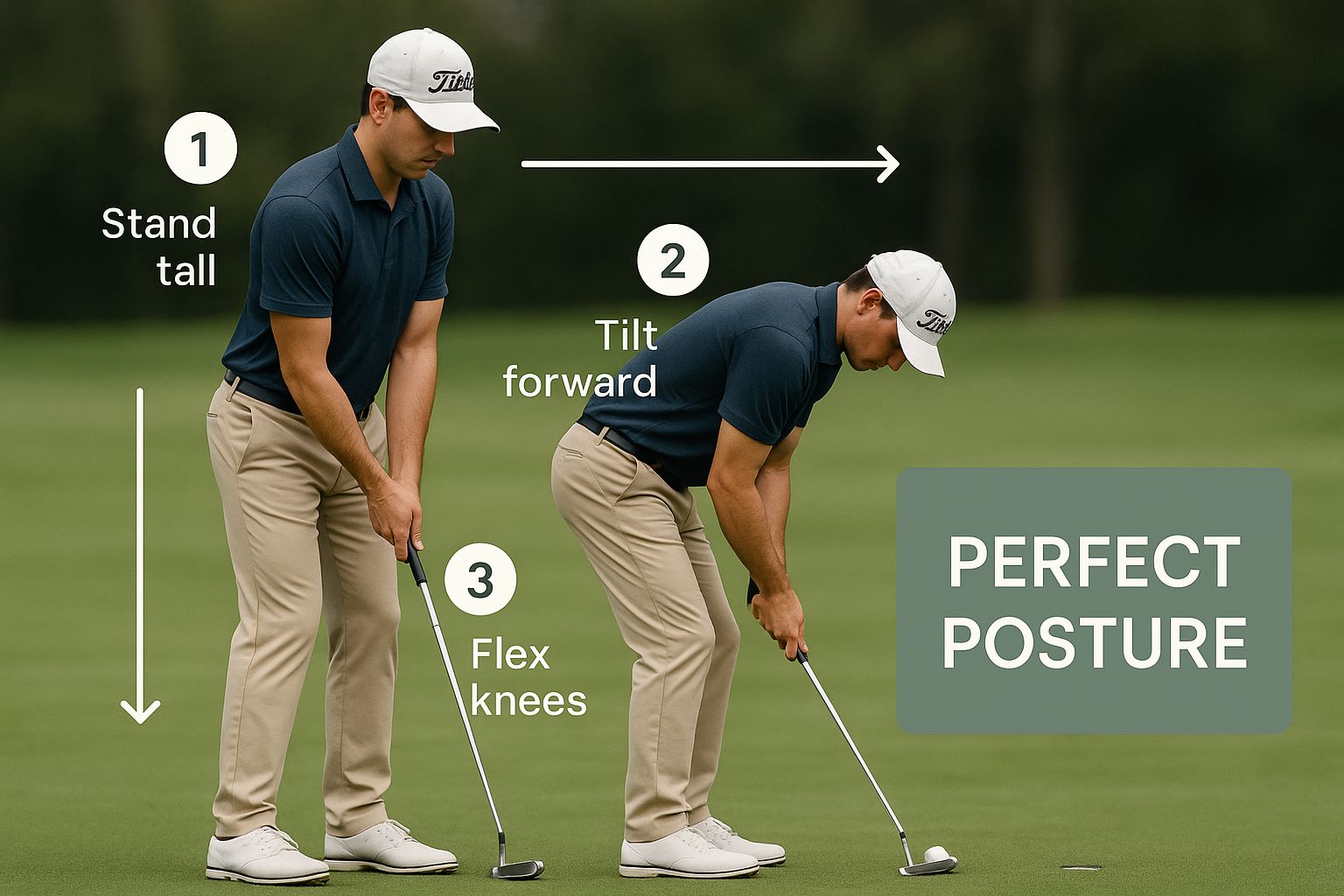
This image really drives home how a proper setup aligns your body to produce that pure, pendulum stroke we’re all chasing.
Your lower body needs to stay completely still throughout the entire motion. Think of it as your anchor. Any swaying in your hips or legs will immediately change the putter’s path, and that’s a recipe for pushed and pulled putts. This is where a solid sense of balance becomes a huge advantage.
For a truly repeatable putting stroke, a strong physical foundation is key. Consider practices that enhance stability and precision, such as improving your balance with yoga poses. A steady base removes variables and breeds consistency.
Here are the checkpoints to run through for your posture:
- Eyes Over the Ball: Your eyes should be positioned directly over, or just a hair inside, the target line. An easy way to check this is to get into your stance and drop a second golf ball from the bridge of your nose. It should land on or extremely close to the ball you’re about to hit.
- Slight Knee Flex: Your knees should have a slight, athletic bend—never locked stiff. This creates stability and engages the larger muscles in your legs to keep you grounded.
- Flat Upper Back: Make sure you hinge from your hips, letting your arms hang naturally down from your shoulders. Avoid hunching over, which really restricts that free-swinging rocking motion your shoulders need to make.
The Critical Importance of Golf Ball Position
The final piece of this setup puzzle is ball position. It might seem like a minor detail, but its impact on the quality of your roll is massive. Where you place the ball in your stance dictates the exact point in the arc where the putter makes contact.
Ideally, you want the putter to make contact just as the putter head begins its slight upward path. This is what imparts a clean, true forward roll, preventing the ball from skidding or hopping off the putter face. That initial skid is a killer for consistent distance control.
To make this happen, you need to position the ball slightly forward of the center of your stance. For a right-handed golfer, that means just inside your left heel. This position ensures the putter face meets the ball at the optimal point in the swing arc for the best possible roll.
Here’s a simple drill: take your stance and place a club or an alignment stick right in the middle. Then, set your ball a couple of inches ahead of that marker. This one tiny adjustment can make a world of difference in getting your putts started on the right line with the right speed. By dialing in your grip, posture, and ball position, you’re not just practicing—you’re building a stroke you can trust on every single putt.
How to Read Greens Like a Golf Pro
A pure putting stroke is a beautiful thing, but it’s completely wasted if you’re aiming at the wrong spot. Sinking more putts isn’t just about mechanics; it’s about learning to interpret the story the green is telling you. Once you master the art of green reading, you stop guessing and start executing a calculated plan.
This whole process kicks off the second you start walking toward the green. Don’t just march up to your ball and start your routine. Use that walk to take in the bigger picture. Look for the major slopes and get a sense of which way water would drain off the surface. This “macro” view gives you the crucial first piece of the puzzle.
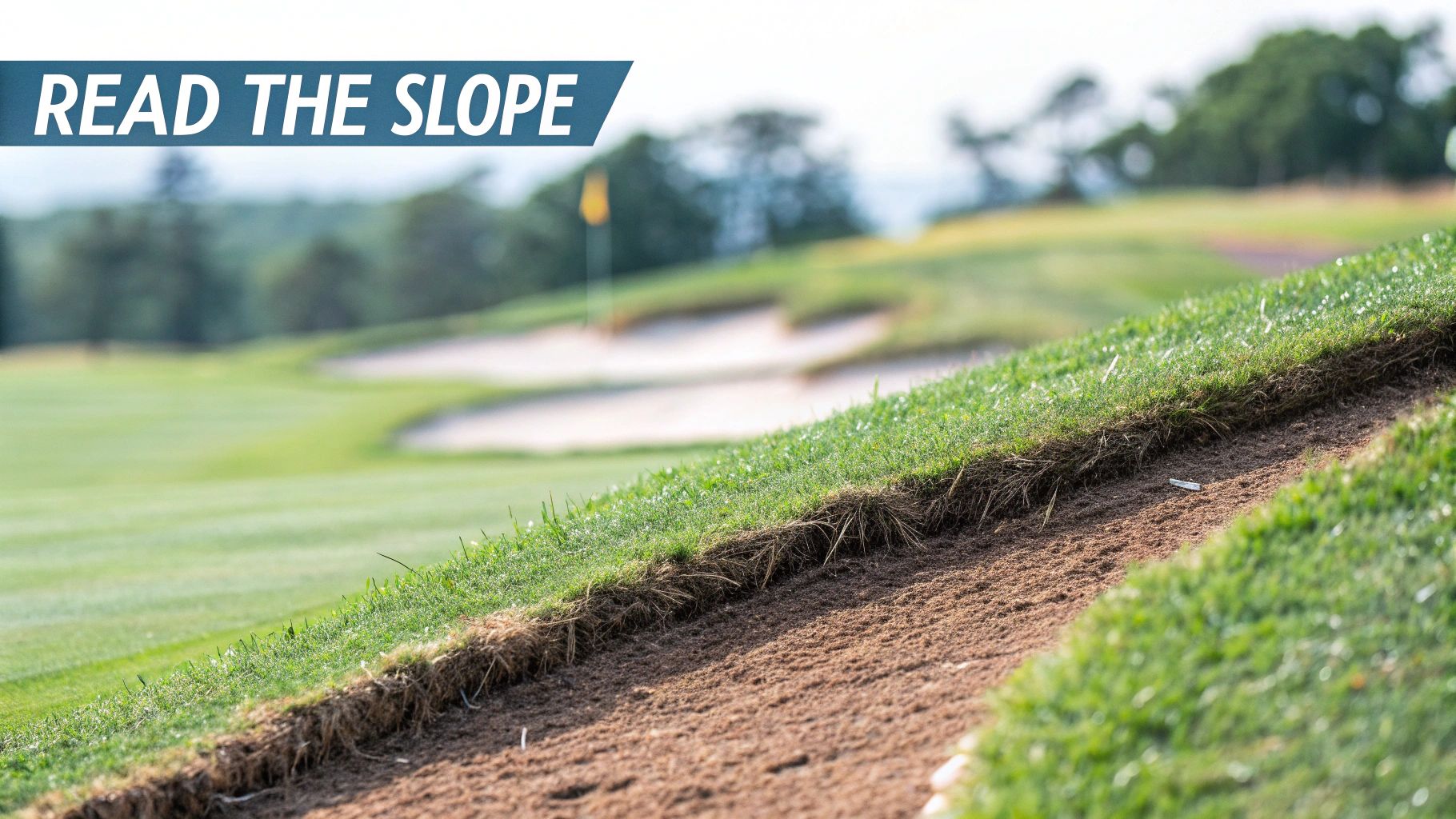
Once your ball is marked, the real detective work begins. You’re gathering clues from different angles to build a complete mental map of the ball’s journey to the cup.
Analyze From Behind the Golf Ball
Your first and most important read happens from directly behind the ball, looking straight down the line to the hole. Get low. Crouch down so your eyes are as close to the putting surface as possible. From this low vantage point, subtle breaks that you’d never see standing up suddenly become obvious.
From here, you’re trying to spot the initial break and the overall tilt. Don’t forget to look at the landscape in the background, either. Nearby hills, water hazards, or even the general lay of the land can give you big hints about the primary drainage patterns, which almost always influence the slope.
Walk to the Low Side
After that initial read, take a walk to the low side of your putting line—this is the side the ball is going to curve toward. Standing at the halfway point of your putt on that low side gives you a completely fresh perspective.
From this angle, the slope often looks much more dramatic. It’s a fantastic way to confirm what you saw from behind the ball and helps you really dial in the amount of break. You might realize that a putt you thought had a tiny bit of break actually has a lot more swing to it.
A classic amateur mistake is only reading the putt from behind the ball. Getting that second look from the low side is like getting a second opinion; it either confirms your read or flags something you missed.
Consider the Grain and Grass Type on a Golf Course
The direction the grass blades are growing, what we call the grain, can seriously mess with both the speed and break of your putt. Spotting it is a subtle skill, but it’s a game-changer.
- Shiny or Light Green Grass: When the grass has a sheen to it, the grain is growing away from you (towards the hole). This is a “downgrain” putt, and it’s going to be quick. Really quick.
- Dull or Dark Green Grass: If the grass looks dark and coarse, the grain is growing toward you. This is an “into the grain” putt, and it will be noticeably slower. You’ll need to give it some extra pace.
Grain can also affect the break. A putt moving across a strong grain will break more, especially as it slows down near the cup. To dive deeper into these nuances, check out our full guide on how to read greens effectively.
Feel the Slope With Your Feet
Sometimes your eyes play tricks on you, but your feet rarely lie. As you walk along the line of your putt, tune into the feeling in your feet. You can often feel subtle uphill or downhill slopes that are nearly impossible to see.
This is a huge help on long lag putts where speed control is everything. If you feel more pressure on the toes of your front foot, you’re likely on a downhill slope. If you feel it more in your back foot, it’s uphill. This sensory feedback is an incredibly powerful tool for getting your distance control just right.
By combining all these different reads—from behind the ball, from the low side, and through your feet—you’re no longer just taking a stab in the dark. You’re building a comprehensive, three-dimensional map of the putt. This systematic approach is how you turn hopeful stabs into confident strokes that find the bottom of the cup.
Developing Unbreakable Distance Control to Avoid Three-Putts in Golf
Three-putts are the silent killers of a great round. They feel like unforced errors, turning potential pars into frustrating bogeys and birdies into disappointing pars. We’ve all been there.
But the root cause usually isn’t a bad read or a wobbly stroke—it’s almost always poor distance control. Getting a solid handle on the speed of your putts is the single most effective way to slash three-putts from your game for good.
The goal with any putt outside of 10 feet isn’t really to hole it. The real goal is to leave yourself a stress-free tap-in. When you can consistently lag the ball into a two or three-foot circle around the hole, you take all the anxiety out of putting. This isn’t about some magical “feel”; it’s about building a repeatable system that connects the length of your stroke to the distance the ball actually rolls.
Calibrating Your Golf Stroke Length
Think of your putting stroke like a volume dial, not an on/off switch. A longer stroke naturally generates more power and sends the ball farther. A shorter stroke? A shorter putt. The trick is making this relationship consistent and predictable.
Forget about trying to “hit” the ball harder or softer. That’s a recipe for disaster. Instead, focus entirely on the length of your backstroke and follow-through.
A simple way to start calibrating your internal distance gauge is to use your feet as a reference point. A backstroke that goes to the inside of your trail foot might be your 10-foot stroke. A stroke that travels to the outside of your trail foot could be your 20-footer. One that goes a few inches beyond that becomes your 30-foot stroke. The key is that your follow-through should mirror the backstroke in length, creating a smooth, symmetrical, pendulum-like motion.
By setting up these simple benchmarks, you’re building a baseline system. This takes the guesswork out of long putts and helps you build a reliable connection between stroke length and distance—the very foundation of elite golf putting.
“The secret to great lag putting is a quiet body and an accelerating putter head. Your stroke should feel like you’re smoothly rolling the ball to the hole, not hitting it. The power comes from the length of the swing, not from a sudden burst of force.”
That feeling of smooth acceleration through the ball is what produces a true, consistent roll. Any sudden, jerky, or handsy movements will throw your speed off and make distance control nearly impossible to get right.
Drills to Eliminate Golf Three-Putts
Building that intuitive sense for speed requires dedicated, purposeful practice. Just rolling putts to random holes won’t do much. You need drills that give you instant feedback and force you to concentrate completely on distance.
Here are a couple of the most effective drills out there for developing tour-level distance control:
- The Ladder Drill: This is a classic for a reason. It’s fantastic for calibrating your stroke for multiple distances in one practice session. Place tees or ball markers at 10, 20, 30, and 40 feet from a hole. Start at 10 feet and hit a putt, then move to 20, and so on. Your goal isn’t to make them, but to get each one to stop just past the hole. Once you hit the 40-foot marker, work your way back down the ladder.
- Putting to the Fringe: This drill is brilliant because it removes the temptation of trying to hole a putt, forcing you to focus entirely on speed. Pick a spot on the practice green and just try to roll balls so they die right before touching the fringe. Make sure you vary your starting points to practice uphill, downhill, and sidehill lies. It’s an amazing way to learn how different slopes affect the speed and roll of the ball.
The Impact of Elite Distance Control in Golf
Mastering speed does more than just save you from three-putts; it seriously elevates your entire game. Advanced PGA Tour data analytics show just how much of an impact it has. Exceptional putting can translate to gaining nearly a full stroke per round compared to the average tour pro.
Take Corey Pavin in 2008, for example. His putting was measured as 0.98 strokes per round better than the tour average. That means over the course of a round, he effectively needed almost one fewer putt than the average player from the same distances. If you’re interested in the nitty-gritty, you can explore the data behind these findings and see how putting truly impacts professional scores.
Adapting to Different Green Speeds
One of the biggest challenges for any golfer is adjusting your internal speed gauge when you play a new course. The same stroke that sends a ball 30 feet on a slow, shaggy muni green might send it screaming 45 feet on a slick, private club green.
Before every round, spend at least 10 minutes on the practice green with one mission: find out the speed of the day.
- Find a Flat 30-Footer: Start by hitting several putts from about 30 feet on a part of the green that’s relatively flat.
- Pace it Off: After you hit your putts, walk up and pace off the distance they rolled. This gives you a real, tangible measurement for what your standard 30-foot stroke is doing on that specific day.
- Adjust Your System: If your normal 30-foot stroke is now rolling out to 35 feet, you know the greens are quick. You’ll need to shorten all your stroke lengths a touch. If it only goes 25 feet, the greens are slow, and you’ll have to add a little more length to every putt.
This pre-round calibration is a simple but incredibly powerful routine. It replaces that nervous first-hole guesswork with confidence, making sure you’re dialed in from the very first green. By building a system, practicing with purpose, and learning to adapt, you can turn lag putting from a weakness into one of the strongest parts of your game.
Pressure-Proof Your Putting with These Tour-Level Drills
You’ve heard it a million times: practice makes perfect. But that’s only half the story. Perfect practice makes perfect. If you really want to dial in your golf putting, you have to stop mindlessly rolling balls toward the cup. The best players on tour build their confidence by making practice sessions harder than the actual round of golf. They create pressure and add consequences, so when that must-make six-footer comes along, it feels like just another Tuesday on the practice green.
This is all about training your nerves to handle the heat. By simulating pressure when you practice, you’re building the mental calluses needed to sink putts when it really matters. You’ll step onto the course knowing you’ve already stared down—and beaten—much tougher situations.

The Gate Drill for a Perfect Start Line
Let’s be honest: if you can’t start the ball on your intended line, even a major-winning green read is completely worthless. That’s where the Gate Drill comes in. It’s a tour-proven classic for a reason—it gives you instant, undeniable feedback on your putter face at impact and forces you to nail your starting line.
Setting it up is simple. Find a straight putt from about six feet. Stick two tees in the ground just a bit wider than your putter head, maybe a foot in front of your ball. That’s your “gate.” The only goal here is to roll the ball straight through the gate without nicking either tee.
If the ball hits the inside tee, your putter face was closed. If it smacks the outside tee, it was open. It’s that simple. This drill ingrains the feeling of delivering a perfectly square clubface, shot after shot.
Mastering Short Putts with the Clock Drill
Those nervy three- to five-footers are what separate a good round from a great one. They’re the putts that save pars and keep your momentum alive. The Clock Drill is the ultimate exercise for building unshakable confidence from this critical range by simulating the pressure of making one short putt after another.
Here’s the setup:
- Place eight golf balls in a circle around the hole, each about three feet away, just like the numbers on a clock face.
- Start anywhere and work your way around the circle, trying to drain all eight putts in a row.
- Here’s the catch: if you miss one, you start the whole drill over from the beginning. No exceptions.
This drill is so powerful because it adds real consequences. By the time you get to that sixth, seventh, and eighth putt, you’ll feel your heart rate climb. That’s the same feeling you get on the course, and learning to handle it here is the key.
Make Practice Harder Than the actual Golf Game
The real secret to building a clutch putting stroke is to turn your practice into a competition. Don’t just go through the motions; create games where the outcome actually matters. Set a tough goal for yourself, like making 25 four-footers in a row. If you miss on putt number 23, it’s back to zero. This kind of practice builds serious discipline and focus.
On the PGA Tour, one-putt percentage is a key stat. In 2023, Taylor Montgomery led the tour by one-putting an incredible 46.62% of the time. Most of the top pros consistently hover between 43% and 45%. They one-putt nearly half the holes they play because they practice under this kind of manufactured pressure.
The goal of these drills isn’t just repetition; it’s about building a deep-seated trust in your stroke. When you’ve made a putt a hundred times with consequences on the line, the one you face on the 18th green feels a whole lot easier.
Of course, mastering pressure putting is also a mental game. It’s worth exploring strategies to improve your focus and concentration so you can stay composed when a putt really counts. When you start adding these tour-level drills and a competitive edge to your practice, your time on the green becomes less of a warm-up and more of a powerful confidence-building machine.
FAQ’s
Even after you’ve spent hours grinding away at your stroke, some nagging questions about golf putting always seem to creep in. Getting these things straight is often the last piece of the puzzle for building that rock-solid confidence you see in the pros.
Think of this as your go-to guide for those persistent “what if” scenarios. Let’s clear up the confusion that can stand between you and a great day on the greens.
What’s the Single Most Important Thing in Putting?
If you had to pick just one thing, it’s speed control. Hands down. You can read the line like a genius, but it’s all for nothing if your pace is off.
Think about it: nearly every three-putt you’ve ever had was because of bad speed on the first putt. Get your distance control dialed in, leave yourself easy tap-ins, and watch your scores tumble.
Spend most of your practice time on lag putting from different ranges—say, 20, 30, and 40 feet. Nailing your speed will save you more strokes than any other putting skill. It’s that simple.
Should I Look at the Hole or the Ball?
For almost every golfer out there, the answer is to keep your eyes glued to the ball. It’s a simple move that keeps your head still, and a stable head is absolutely essential for a consistent putting path.
Looking up too soon is one of the most common mistakes in golf, period. It causes your shoulders to fly open, leading to frustrating pushes and pulls.
That said, a few players—even major winners like Jordan Spieth—have had success looking at the hole, especially on shorter putts. It can sometimes help players who feel too stiff or struggle with the dreaded “yips.” Go ahead and try it out in practice, but always fall back on the “eyes on the ball” method as your solid foundation.
How Do I Pick the Right Putter for My Stroke?
Choosing the right putter isn’t about what looks cool; it’s about matching the club’s design to the way you naturally swing it. When your putter works with your stroke instead of against it, everything gets easier.
Here’s a quick guide to matching your putter to your stroke:
For a Straight-Back, Straight-Through Stroke: If your putter path has very little arc (think “square-to-square”), you need a face-balanced putter. These are usually mallet-style putters designed to resist twisting and help you keep the face square.
For an Arcing Stroke: If your stroke follows a noticeable arc—opening on the way back and closing on the way through—a toe-hang putter is your best bet. Blade-style putters often have toe hang, which allows the putter to rotate naturally with your swing.
You can check a putter’s balance in about five seconds. Just balance the shaft on your finger. If the face points straight up at the sky, it’s face-balanced. If the toe points down, it has toe hang. Finding this match can be a total game-changer for your consistency.
At Golf Inquirer, we believe that mastering the green is the fastest way to enjoying the game more. For more tips, gear reviews, and course guides to elevate your game, visit us at https://golfinquirer.com.