
To pull off a flop shot, you need three things: a high-lofted wedge, an open clubface, and a fearless swing through the ball. The real magic is in the acceleration. You have to commit to the speed and trust the club’s loft to pop the ball high into the sky for a buttery-soft landing.
What the Golf Flop Shot Is and When to Use It
The flop shot is one of the most eye-catching—and frankly, terrifying—shots in golf. It’s that high-arcing, quick-stopping marvel you see pros hit, designed for very specific, high-stakes moments around the green. This isn’t your everyday chip or pitch that uses a lower flight and some rollout. The flop shot’s entire purpose is to fly high over an obstacle and stop on a dime.
Think of it as your get-out-of-jail-free card. Your ball is sitting up nicely in the rough, but there’s a cavernous bunker between you and a pin that’s tucked just a few steps onto the green. A normal pitch would run way past the hole, and a chip is out of the question. This is the exact scenario the flop shot was made for.
The Anatomy of a High-Risk, High-Reward Golf Shot
Let’s be clear: the flop shot is a specialty tool, not your everyday hammer. It looks incredible when it works, but it’s rarely the percentage play. The unique mechanics—an open clubface, a steep swing, and a ton of speed—make it a completely different animal from its short-game cousins.
- The Goal is Height: Your primary mission is to maximize vertical launch and backspin. You want a ball flight that goes up fast and comes down like it has a parachute attached.
- The Lie is Everything: Success hinges on having a good lie. You absolutely need a cushion of grass under the ball to slide that open clubface cleanly beneath it. Trying this from a tight lie is asking for trouble.
- Commitment is Non-Negotiable: A hesitant, decelerating swing is the #1 cause of disaster. It’s the fast track to a bladed shot screaming over the green or a chunked one that goes nowhere.
The flop shot was famously brought into the limelight by players like Phil Mickelson, who turned it into an art form. Modern golf data shows just how specialized it is. While opening the face on a high-loft wedge can reduce rollout by up to 50%, tracking data shows flop shots make up less than 5% of all short-game attempts by professionals. It’s a lifesaver in tricky spots, but its difficulty means it’s kept in the bag for emergencies. You can learn more about the strategic balance of the flop shot on mygolfspy.com.
Here’s a great way to think about it: the flop shot is a problem-solver. If you don’t have a problem to solve—like a bunker, a steep slope, or a lightning-fast green—a simpler shot is almost always the smarter choice.
Before we dive into the “how,” let’s quickly break down how this shot stacks up against a more conventional pitch.
Flop Shot vs Pitch Shot At a Glance in Golf
This table gives a quick side-by-side look at the key differences between a flop shot and a standard pitch, helping you decide which shot is right for the situation you’re facing.
| Characteristic | Flop Shot | Pitch Shot |
|---|---|---|
| Ball Flight | Very high trajectory, almost vertical | Medium trajectory with forward momentum |
| Landing | Extremely soft with minimal to no roll | Soft landing with some forward release |
| Clubface | Wide open at address | Square to slightly open at address |
| Swing | Long, fast, and aggressive through impact | Controlled, smoother tempo, shorter swing |
| Best Lie | Fluffy grass, light rough | Fairway, light rough, firm turf |
| When to Use | Short-sided, over obstacles, to tight pins | When you have green to work with |
| Risk Factor | High – requires full commitment | Low to Medium – much higher margin for error |
Understanding these distinctions is crucial. Choosing the right shot for the job is just as important as executing it well. The pitch is your reliable workhorse; the flop is your high-performance sports car for special occasions.
Knowing When to Keep It in the Golf Bag
Just as critical as knowing when to hit a flop is knowing when not to. Forcing this shot from the wrong lie or in the wrong situation can turn a potential par save into a double bogey before you can blink.
Steer clear of the flop shot when you have:
- A Tight Lie: If the ball is sitting down on firm turf, hardpan, or thin grass, there’s simply no room to slide the club underneath it. You’re begging for a bladed shot.
- Plenty of Green to Work With: Got 30 feet of green between you and the hole? A simple bump-and-run or a standard pitch is a much safer, more reliable play.
- A Lack of Confidence: If you’re standing over the ball and your mind is filled with doubt, listen to it. Opt for a shot you feel comfortable and confident executing.
Ultimately, mastering the flop shot is about more than just swing mechanics—it’s about building your course management IQ. It’s about recognizing those rare moments where this spectacular shot isn’t just an option, but the only option to get the ball close.
Building Your Flop Shot Setup from the Ground Up in Golf
The success of a flop shot is usually decided before you even start your swing. I’ve seen it a thousand times: a player makes a perfect swing, but because their setup was flawed, the result is a disaster. It’s time to forget the generic advice you’ve heard and build a solid, repeatable foundation that gives you the best chance to pull off this shot when the pressure is on.
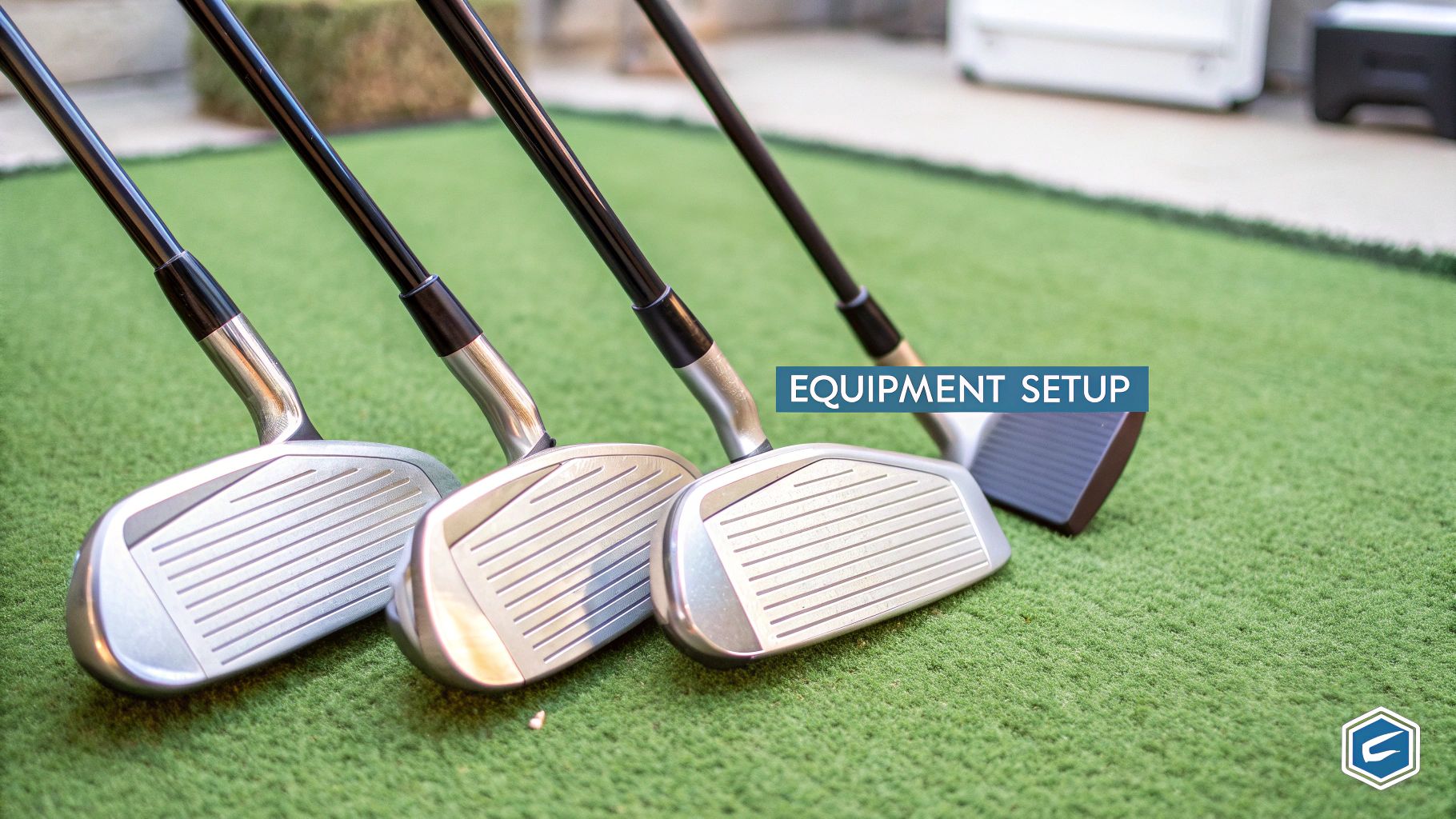
This shot is a specialist’s tool, and it demands a specialist’s setup. Think of it like a surgeon laying out their instruments—every single piece has to be in the right place for the operation to be a success.
Selecting Your Weapon of Choice in Golf
First things first, you need the right club. Sure, you can try hitting a flop shot with a sand wedge, but you’re just making an already difficult shot even harder on yourself. For this shot, a high-lofted wedge is your best friend.
If you want maximum height and a super-soft landing, grab a wedge with 58 to 62 degrees of loft. For a true, sky-high flop shot, this is pretty much non-negotiable. That extra loft helps you get the ball up in the air fast without having to do anything crazy with your hands during the swing. Even the legendary instructor Butch Harmon has said the average golfer probably shouldn’t use anything with more loft than a 58-degree wedge, which tells you it’s the sweet spot for performance and playability.
The Secret to Maximum Loft in Golf
Alright, pay attention, because this is the single most important part of the entire setup. It’s also where I see most amateurs get it completely wrong. The real secret to unlocking massive height is to open the clubface before you take your grip.
Don’t just grip the club and then try to twist your hands open. That won’t work. Instead, do it this way:
- Lay the club on the ground so the clubhead is resting flat on the turf.
- Rotate the face open so it’s pointing way to the right of your target (for a righty). You want it looking almost straight up at the sky.
- Now, take your grip. Only after that face is wide open should you put your hands on the club with your normal grip.
This little sequence is what guarantees the club’s effective loft stays maxed out through your swing. If you grip first and then open the face, your hands will instinctively want to return the club to square at impact, and you’ll have defeated the whole purpose of the shot.
A proper flop shot setup feels weird at first. Your body is aimed left, the clubface is aimed way right, and the ball is forward in your stance. You have to trust it. This strange alignment is the geometric key that makes the shot work.
Positioning Your Body for Success in Golf
Once the clubface is set, your body has to get into a position that accommodates this unique swing. The way you align yourself and distribute your weight is what lets the club slide right under the ball instead of digging into the turf or, even worse, hitting it thin.
You’ll want to take a stance that’s a bit wider than what you’d use for a standard pitch shot. This wider base gives you the stability you need for the aggressive, high-speed swing you’re about to make.
Next, open your stance. Aim your feet, hips, and shoulders well to the left of your actual target (again, for a righty). This automatically sets you up to swing across the ball from out-to-in, which is exactly what you need to add loft and that soft-landing slice-spin. The ball should be positioned forward, just inside your lead heel, to encourage an upward strike.
Finally, and this is crucial, get your weight forward. Shift about 70% of your weight onto your lead foot and keep it there. This steepens your angle of attack, making sure you hit down on the ball and let the club’s bounce do its job. Phil Mickelson, the king of the flop shot, advises putting so much weight forward that you could easily lift your back foot off the ground. It’s this kind of biomechanical precision that prevents that dreaded bladed shot that sails over the green. For a deeper dive, you can explore the precise mechanics of the flop shot setup on friendlygolfer.com.
This entire setup, from your club to your weight, creates the perfect conditions for the shot. Now, all that’s left is to commit to the swing, which is exactly what we’ll cover next.
Making the Golf Swing: The Secret Is Speed, Not Force
Okay, you’ve nailed the setup. Your body and club are in the perfect launch position. Now for the moment of truth: the swing itself. This is where the real magic—and the biggest mental hurdle—comes into play. The motion for a great flop shot feels totally alien compared to almost any other swing in golf, and you have to commit.

It feels completely backward, doesn’t it? You need the ball to travel a very short distance, but the recipe calls for a long, aggressive, and accelerating swing. This is where most players get it wrong. The number one killer of a flop shot is fear, which leads to slowing down. That tentative, decelerating motion causes the club’s leading edge to rise up, resulting in either a bladed shot that screams across the green or a chunked one that barely moves an inch.
Embrace the Speed and Let the Loft Do the Work in Golf
Think of your swing less like a “hit” and more like a release of energy. Your job isn’t to muscle the ball into the air. It’s to generate enough clubhead speed to let the 60-plus degrees of effective loft on your open clubface launch the ball skyward. To do this, your arms and hands need to feel soft and relaxed, almost like whips instead of rigid levers.
The real power shouldn’t come from your arms, but from your body’s rotation. Use your hips and chest to turn back and then fire through the ball. Using these bigger muscles ensures a smooth delivery of speed and prevents that jerky, handsy motion that kills consistency.
The flop shot swing is a paradox: you must swing hard to make the ball go soft. Committing to acceleration through the ball is the only way to let the club’s bounce and loft slide cleanly under the ball and pop it straight up.
Visualizing the U-Shaped Swing Path in Golf
To nail a proper flop shot, your swing path needs to feel different. With your open stance, the club will naturally travel on a slight “out-to-in” path relative to the target line, but the feeling you’re after is a shallow, sweeping motion through the impact zone.
Imagine your swing arc is a shallow “U” shape, not a sharp “V.”
- The “V” Shape: This is a steep, digging motion. It’s great for getting out of a bunker but disastrous for a flop shot off the grass, as it causes the club to get stuck in the turf.
- The “U” Shape: This is what you want. It encourages the clubhead to glide along the grass, letting the sole of the club (the bounce) interact with the turf and slide right under the ball.
You achieve this shallow arc by maintaining your body’s height and using rotation. Don’t chop down on it. Sweep the grass from underneath it with speed.
Keeping the Golf Clubface Pointed to the Sky
This might be the most crucial piece of the puzzle. You have to maintain that open clubface you set up at address throughout the entire swing. The common amateur mistake is to subconsciously “square up” the face at impact by rolling the wrists over. That’s a death move for the flop shot. It closes the face, delofts the club, and all you get is a low, running shot.
To stop this from happening, concentrate on your lead wrist. All the way through—backswing, impact, and follow-through—you want to maintain a feeling of extension (or “cupping”) in that lead wrist. This is the key action that keeps the clubface open and pointing toward the sky.
Once you make contact, keep rotating your body toward the target and finish with a high follow-through. A fantastic checkpoint is to see if the clubface is still pointing up at the sky, or even slightly back at you, at the end of your swing. That high finish is your proof that you kept the face open and let the club’s loft work its magic. Committing to this full, accelerated finish is how you hit a flop shot that lands like a feather.
Common Golf Flop Shot Mistakes and How to Fix Them
Even for the pros, the flop shot is a high-wire act. When it works, it’s pure magic. When it fails… well, it can be a spectacular disaster that turns an easy bogey into a soul-crushing double. Let’s be honest, we’ve all been there.
The good news? Most flop shot failures boil down to just a couple of common, fixable errors. It’s not about a “bad swing,” but about diagnosing the real issue. Once you see it, a simple adjustment is all it takes to get back to hitting those sky-high, soft-landing shots with confidence.
The Bladed Shot That Screams Across the Golf Green
This one is terrifying. You commit to the shot, take a big, confident swing, and instead of that soft “thump,” you hear a sharp, metallic “click.”
The ball shoots off like a rocket, maybe knee-high, and screams across the green, often finding even deeper trouble on the other side. A single shot like that can shatter your confidence for the rest of the round.
So, what causes this bladed or “thin” shot? Almost every single time, it comes down to one thing: fear-driven deceleration.
The aggressive swing needed for a flop feels completely wrong. Your brain knows you only want the ball to go 20 yards, but the shot demands the speed of a 70-yard pitch. This creates a mental battle. At the last second, your hands instinctively slow down, trying to “help” the ball go a shorter distance.
When you decelerate, the clubhead doesn’t have the speed to slide under the ball. The leading edge rises up and smacks the ball’s equator. The result is a low, powerful liner—the polar opposite of what you wanted.
The fix is all about commitment. You have to trust your setup. Trust the loft on the club. Your only job is to accelerate the clubhead through the impact zone and all the way to a high, full finish. It’s a leap of faith, but it’s the only way.
This handy chart breaks down the crucial setup keys that help prevent these common mistakes right from the start.
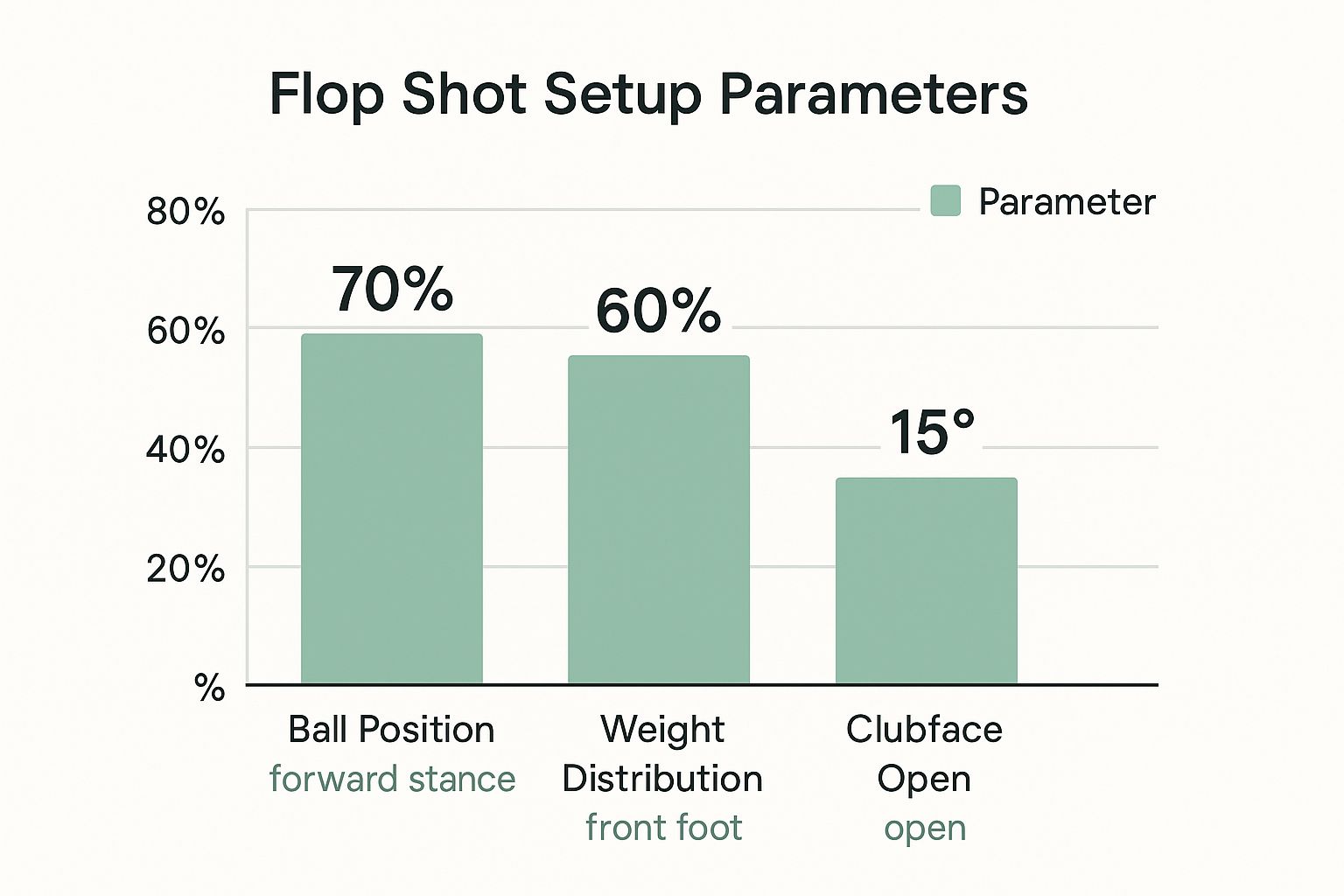
Drilling these specific setup percentages for your ball position, weight, and clubface angle builds the foundation you need for a solid shot.
The Chunked Golf Shot That Goes Nowhere
The second common disaster is the dreaded chunk. You make your swing, but the club digs into the ground way behind the ball, carving out a huge divot. The ball barely moves a few feet, if it moves at all. It’s just as damaging to your score as a blade, and maybe even more embarrassing.
This mistake is all about your swing’s low point—the very bottom of your swing arc. For a flop shot, you want that low point to be right at, or just slightly after, the golf ball. A chunk happens when the low point bottoms out too far behind the ball.
Two main culprits are to blame here:
- Weight on the back foot: A lot of golfers hang back on their trail foot, thinking they need to “scoop” or “lift” the ball into the air. This shoves the low point behind the ball, guaranteeing a chunk.
- A “handsy” or wrist-flipping motion: Trying to flick the ball up with just your wrists instead of rotating your body makes the club bottom out way too early.
To fix the chunk, get back to two setup fundamentals. First, make sure 60-70% of your weight is on your lead foot and stays there for the whole swing. Second, feel like your chest and hips rotate through the shot, pulling the club along for the ride.
This body-driven rotation ensures a consistent low point and lets the club’s bounce glide across the turf instead of digging in. If you’re struggling with swing mechanics in general, check out this guide on one golf swing drill that can fix 80% of mistakes. It can build a solid foundation for all your shots, including the flop.
Mistakes are part of the game, especially with a high-skill shot like this. The key is to know why they happen so you can make a quick fix on the course. Here’s a quick cheat sheet for the most common errors.
Common Flop Shot Mistakes and How to Fix Them
| Common Mistake | Why It Happens | How to Fix It |
|---|---|---|
| Bladed Shot (Thin) | Fear of hitting it too far causes you to slow down the clubhead through impact. | Commit to accelerating through the ball to a full finish. Trust the club’s loft to do the work. |
| Chunked Shot (Fat) | Weight is on the back foot, or you’re trying to “scoop” with your wrists, causing the low point to be behind the ball. | Keep 60-70% of your weight on your lead foot and rotate your body (chest and hips) through the shot. |
| Shank | Standing too close to the ball or throwing your hands out at impact, causing contact with the hosel. | Stand a comfortable distance from the ball and focus on rotating your body, keeping your arms connected. |
| Too Much Roll-Out | Clubface was not open enough at address, or you rotated your forearms through impact, closing the face. | Open the clubface wide at setup and hold that face angle open through the entire swing, all the way to the finish. |
Learning to recognize the cause of your mishit is more than half the battle. Instead of getting frustrated, you can diagnose the issue and know exactly what to focus on for your next attempt.
Practice Drills for a Confident Flop Shot in Golf
Knowing the theory behind a flop shot is one thing. Trusting it under pressure when you’re short-sided with a bunker between you and the pin? That’s a different animal entirely.
That kind of confidence isn’t something you just find; it’s forged on the practice green. Great flop shots are all about repetition, turning a pretty complex set of movements into pure muscle memory.
We’re not just going to tell you to “go practice.” Instead, think of this as a roadmap with specific, progressive drills that build real, usable skill. These will help you turn the flop shot from a hit-and-hope prayer into a reliable weapon in your short-game arsenal.
The Towel Drill
The absolute soul of a great flop shot is sliding the club’s bounce along the turf without the leading edge digging in. The towel drill is the perfect way to burn this feeling into your brain because it gives you instant, undeniable feedback if you get too steep.
Here’s the setup:
- Lay a towel flat on the grass of the practice green.
- Place a golf ball on the towel, maybe six inches in from the edge closest to you.
- Take your normal flop shot setup.
- Your mission: swing and clip the ball cleanly off the towel without moving the towel.
If you’re too steep or you quit on the shot, you’ll smack the towel before the ball. But when you get it right, you’ll feel that perfect, shallow sweep as the ball lifts off. That’s the feeling you’re chasing.
Hitting Over an Obstacle in Golf
Once you’ve got the shallow contact down, it’s time to build trust in your ability to get the ball airborne on command. This drill is fantastic because it kills the biggest mental hurdle for most golfers: the fear of not getting the ball up. It forces you to commit.
Start small. Place something like a headcover or an empty range basket about three to five feet in front of you. Put your ball a couple of feet behind it. Your only goal is to pop the ball up and over the obstacle, letting it land softly on the other side.
Getting comfortable? Up the ante with a slightly larger obstacle, like your golf bag laid on its side. This simple visual cue forces you to stay aggressive and accelerate through the ball—the exact commitment you need on the course.
The flop shot is a high-speed, low-force shot. You must commit to clubhead speed to allow the club’s loft and bounce to work properly. This drill helps eliminate the fear of deceleration by giving you a tangible, immediate goal.
The Ladder Game for Distance Control in Golf
Dialing in the distance on a flop shot is all about adjusting your backswing length while keeping that same aggressive acceleration through impact. The ladder game is a brilliant way to develop this feel and turn a grind of a practice session into a fun challenge.
To get started, set up three targets at different distances. You could use alignment sticks, towels, or other headcovers at, say, 10, 15, and 20 yards away.
The rules are simple:
- Start with the 10-yard target. Hit a successful flop that lands near it.
- Move to the 15-yard target. You can’t move on until you stick one at the current distance.
- Work your way up and then back down the ladder. See how quickly and consistently you can hit all three distances in order.
This game trains you to instinctively shorten or lengthen your backswing to control how far the ball carries, all without messing with your tempo. It’s an essential skill for adapting the shot to whatever crazy situation the course throws at you. For more general practice ideas, you can check out other aids that help fix your golf swing practice drills.
These drills are designed to build your flop shot from the ground up. Start with the towel drill for contact, move to the obstacle drill for confidence, and finish with the ladder game to dial in your distances. Put in the time with these, and you’ll have the skill—and the nerve—to pull this shot off when it really counts.
FAQ’s
We’ve walked through the setup, the swing, and the practice drills you need to build a flop shot you can trust. But let’s be honest, this is a high-skill shot, and specific questions always seem to pop up right when you’re standing over the ball on the course.
Think of this final section as your go-to reference guide. We’re here to tackle those lingering doubts and give you clear, expert answers so you can step up to the ball with conviction and execute when it really counts.
What Is the Best Lie for a Flop Shot?
What Is the Best Lie for a Flop Shot?
The perfect lie for a flop shot is a fluffy one. You’re looking for that moment when your ball is sitting up nicely on a little cushion of grass, usually in some light to medium rough. That bit of air underneath the ball is everything.
That cushion gives you the space you need to slide the open clubface cleanly under the ball without the leading edge digging into the hard ground. It’s the secret ingredient that makes that beautiful, high-launching shot possible.
On the flip side, you should almost always avoid trying a flop from a tight lie. Think firm fairways, hardpan, or thin grass. With no cushion to work with, the club has nowhere to go but directly into the ball or the ground, which drastically increases your chances of a bladed or chunked shot.
Can I Hit a Flop Shot with a Sand Wedge?
Yes, you can absolutely hit a flop shot with a sand wedge, which typically has 54-56 degrees of loft. But you need to know you’re making an already difficult shot even more challenging.
A lob wedge (58-62 degrees) is purpose-built for this shot. Its extra loft does most of the heavy lifting for you, making it much easier to generate the height you need. When you use a sand wedge instead, you’ll have to open the face even more dramatically and swing with more speed to get a similar trajectory.
This just increases the margin for error. While it’s certainly possible, the lob wedge is simply the better tool for the job, giving you a higher, softer shot with far more consistency.
A great rule of thumb from legendary coach Butch Harmon is that the average golfer probably shouldn’t use anything with more loft than a 58-degree wedge. It hits the sweet spot of high performance without becoming too difficult to control.
How Do I Control the Distance of My Flop Shots?
Distance control with the flop shot is one of the trickiest parts to master. It all comes down to adjusting the length of your swing while maintaining your speed through the ball. It’s a feel-based skill, and there’s no shortcut around dedicated practice.
The key is to fight your natural instinct to slow down your swing for a shorter shot. Deceleration is the absolute enemy of the flop shot. Instead, you control how far the ball goes by managing the length of your backswing and follow-through.
Here’s a simple way to think about it:
Shorter Shots: Use a shorter, more compact backswing. A good mental cue is a swing that goes from “hip high to hip high.”
Longer Shots: Employ a longer backswing, maybe closer to “shoulder high to shoulder high.”
Constant Acceleration: No matter the swing length, your commitment and speed through the ball must stay the same. Always accelerate to a full finish.
The “ladder drill” we talked about earlier is the best way to develop this feel. Hitting shots to various targets will teach you exactly how your swing length translates into carry distance, turning guesswork into a reliable skill.
Why Do I Keep Blading My Flop Shots Over the Green?
The bladed flop shot is maybe the most common—and confidence-shattering—mistake in the short game. It’s that terrifying, low screamer that rockets over the green. Luckily, it’s almost always caused by one of two specific and fixable errors.
The number one culprit is deceleration. So many golfers get nervous and instinctively slow the club down right before impact, trying to “guide” the ball softly. This causes the club’s leading edge to rise up and strike the middle of the ball, creating a low, powerful shot instead of a high, soft one.
The other frequent cause is having your weight too far on your back foot at impact. This shallows out your swing and moves the low point behind the ball, making it impossible to get the club underneath it properly.
To fix this, get back to your fundamentals. Make sure about 70% of your weight stays on your front foot throughout the swing. Most importantly, make a conscious effort to accelerate the clubhead all the way through to a high, complete finish. You have to trust the shot and let the speed and loft do their jobs.
At Golf Inquirer, we believe that understanding the nuances of shots like these is what turns a good golfer into a great one. We’re dedicated to bringing you the tips and insights that help you play smarter and have more fun on the course. For more expert advice, gear reviews, and course guides, explore everything we have to offer at https://golfinquirer.com.