If you’re new to the world of golf tournaments, the scoring can feel a bit like trying to read a foreign language. It isn’t just one single method; how a winner is decided changes completely depending on the event’s format. But don’t worry, it all boils down to two fundamental approaches: Stroke Play, where every single shot is counted, and Match Play, a head-to-head battle won hole-by-hole.
Understanding the intricacies of golf tournament scoring can elevate your game and enhance your enjoyment of the sport.
Get a handle on these two pillars, and you’ll be able to make sense of just about any golf leaderboard you come across. Make it a goal to refine your grasp of golf tournament scoring principles.
The Two Pillars of Golf Tournament Scoring
Every round should be an opportunity to practice golf tournament scoring skills.

Players who master golf tournament scoring can adapt their strategies accordingly. At its core, every golf tournament is trying to answer one simple question: who played the best golf today? But how that question gets answered can change dramatically from one event to the next. Two core philosophies shape the competition, forming the foundation for nearly every tournament you’ll ever watch or play in. Exploring the intricacies of golf tournament scoring can lead to improved outcomes for all players.
A great way to think about it is comparing a marathon to a boxing match. In a marathon, every second counts towards your final time, from the starting gun to the finish line. That’s the essence of Stroke Play. In a boxing match, it’s all about winning more rounds than your opponent—the total number of punches thrown doesn’t decide the winner. That’s the spirit of Match Play. Basics of golf tournament scoring provide a foundation for competitive play.
Stroke Play: The Golfer vs. The Course
This is the format you see most often on TV, including all the major championships like The Masters and the U.S. Open. In stroke play, your real opponent is the course itself. The goal is beautifully simple: complete all the holes (usually 18 for a single round or 72 for a four-day pro tournament) in the fewest possible strokes.
Stroke play is a true test of consistency and endurance. Every shot carries the same weight, from a 300-yard drive on the first hole to a 2-foot putt on the last. One disastrous hole can completely derail an entire tournament.
The leaderboard simply adds up everyone’s shots, tracking each player’s cumulative total against the entire field. The lowest number at the very end wins. Simple as that. All serious golfers should familiarize themselves with golf tournament scoring methods.
Match Play: The Golfer vs. The Opponent
Match play, on the other hand, is a direct, head-to-head duel. In this format, your total score over 18 holes is completely irrelevant. The only thing that matters is winning more individual holes than the person you’re playing against. Learning about golf tournament scoring formats will prepare you for any competition.
If you make a 4 on a hole and your opponent makes a 5, you win that hole—it doesn’t matter if you both carded a 10 on the previous one. This format encourages a much more aggressive, risk-reward style of play since a single bad hole won’t sink your entire round. You just lose the hole and start fresh on the next tee.
Grasping the fundamental difference between these two systems is the key to unlocking everything else. Before we get into things like handicaps, Stableford points, or team scrambles, understanding this core concept provides the context you need.
Stroke Play vs Match Play At a Glance in Golf
To make it crystal clear, let’s break down the key differences between these two foundational scoring formats. Think of this as your cheat sheet for understanding the main goal in most golf competitions.
| Scoring Aspect | Stroke Play (Medal Play) | Match Play |
|---|---|---|
| Primary Objective | Achieve the lowest total score over all holes. | Win more individual holes than your opponent. |
| Winning Outcome | The player with the lowest cumulative score wins. | The player who is “up” by more holes than remain wins. |
| Focus | Every single shot counts toward the final tally. | Winning or halving the current hole is the focus. |
So, while both formats use the same clubs and are played on the same course, the mindset and strategy couldn’t be more different. One is a four-day war of attrition against the course; the other is a tactical, one-on-one battle.
Mastering Stroke Play: The Golfer Versus the Course
Understanding golf tournament scoring rules can make you a better player.

Whenever you tune into majors like The Masters or The Open Championship, you’re watching the purest form of golf: stroke play. It’s a marathon, not a sprint. Your main opponent isn’t the person next to you; it’s the 18 holes of turf, trees, and sand in front of you. The goal is as straightforward as it gets—get the ball in the hole in the fewest possible strokes. Players who excel at golf tournament scoring often have a strong competitive mindset.
Every single shot matters. From the first tee shot to the last tap-in, each swing is tallied up. One blow-up hole can send a player tumbling down the leaderboard because you can’t erase that big number from your card. This makes stroke play the ultimate test of consistency and mental toughness. The player with the lowest total score at the end wins. Familiarity with golf tournament scoring rules helps players navigate various events with ease.
Gross Score vs. Net Score Explained in Golf
In the world of stroke play, especially at the amateur and club level, you’ll constantly hear two key terms: gross score and net score. Understanding these is essential to figuring out how golfers of all abilities can compete fairly on the same course.
Your gross score is the raw, unvarnished truth. It’s the actual number of strokes you took to complete your round. If you shot an 88, your gross score is 88. No ifs, ands, or buts.
The net score is where the magic of golf’s great equalizer comes in. It’s what allows a weekend hacker to have a fair match against a scratch golfer. You calculate it by taking your gross score and subtracting your handicap. So, if your gross score is 88 and you have a 15 handicap, your net score is a very respectable 73.
A player’s net score is the great equalizer in golf. It shifts the focus from raw talent alone to playing better than your own established ability, making tournaments competitive for everyone.
How to Read a Golf Stroke Play Leaderboard
At first glance, a pro tournament leaderboard can look like a jumble of pluses, minuses, and letters. But once you know what you’re looking at, it’s actually quite simple. Almost all scores are shown relative to par, which is the expected score an expert golfer would shoot on a hole or for the entire course. Effective golf tournament scoring techniques can lead to improved results.
Here’s a quick breakdown of what those numbers mean:
- -5: The player is five strokes under par for the tournament. They’re playing fantastic golf.
- E: This stands for “Even.” The player’s score is exactly par. A solid, steady performance.
- +2: This means the player is two strokes over par. They’ve got some ground to make up.
Let’s walk through a quick example. Imagine a golfer playing a four-round tournament where par for the course is 72.
- Round 1: Shoots a 70 (-2)
- Round 2: Shoots a 74 (+2)
- Round 3: Shoots a 69 (-3)
- Round 4: Shoots a 71 (-1)
To get their final tournament score, you could add up all the strokes: 70 + 74 + 69 + 71 = 284.
Or, for a much quicker calculation, just add up their scores relative to par: (-2) + (+2) + (-3) + (-1) = -4. The golfer finished the tournament at four-under-par.
Understanding Match Play: The Golfer Versus Opponent
Keeping track of golf tournament scoring is essential for serious competitors.

If stroke play is a steady marathon against the course, match play is a thrilling, head-to-head boxing match. In this format, your total score for the round is completely meaningless. The only thing that matters is winning more individual holes than the person you’re playing against.
Think of it as a series of 18 separate, one-hole competitions. On each hole, the player with the lower score wins that hole. If you shoot a 4 and your opponent makes a 5, you go “1 up.” A disastrous 8 on a single hole doesn’t sink your chances; you simply lose that one hole and move on to the next with a clean slate.
This dynamic completely changes your strategy. Players are way more likely to take aggressive risks, like aiming at a dangerous pin placement or trying to drive the green on a short par 4. A bold play that leads to a birdie can win you the hole, while a mistake only costs you that one hole, not your entire tournament.
Speaking the Language of Match Play in Golf
The scoring in match play has its own unique vocabulary that perfectly captures the back-and-forth nature of the battle. Instead of tracking strokes relative to par, the score is always relative to your opponent. Exploring golf tournament scoring trends also can provide strategic insights.
Here are the essential terms you absolutely need to know:
- All Square (AS): This simply means the match is tied. Nobody is ahead.
- 1 Up, 2 Up, etc.: This shows how many holes one player is leading by. If you’re “2 up,” you’ve won two more holes than your opponent has.
- Dormie: A player is “dormie” when they are leading by the exact same number of holes left to play. For instance, if you are “3 up” with only three holes remaining, you’re dormie. Your opponent has to win every single remaining hole just to tie.
The real beauty of match play is its pure, mano-a-mano nature. The momentum can swing dramatically from one hole to the next, creating a constant sense of drama that lasts until the final handshake.
How a Golf Match Concludes
A match doesn’t always go the full 18 holes. The contest ends the moment one player has an insurmountable lead—when they are “up” by more holes than there are left to play. This is where you see those final scores that look like “5 and 4” or “2 and 1.”
Let’s break down what a “5 and 4” victory actually means. It tells you that one player was 5 holes up with only 4 holes left to play. At that point, it’s mathematically impossible for their opponent to catch up, so the match is over. Everyone can head to the clubhouse for a drink. A “2 and 1” win means the victor was 2 holes up with only 1 hole remaining to play.
The ultimate nail-biter, of course, is a “1 up” victory, where the winner secures the match on the 18th and final hole.
Going Beyond the Basics in Golf : Exploring Fun Alternative Scoring Formats
While stroke play and match play are the bread and butter of competitive golf, the game is packed with other creative ways to keep score. These alternative formats are a huge hit at charity events, corporate outings, and friendly weekend games because they crank up the fun and teamwork, taking the pressure off the traditional grind. Seek advice on golf tournament scoring from more experienced players.
They offer a fantastic change of pace, encourage different kinds of strategies, and make sure golfers of all skill levels can have a great day on the course. Getting a handle on these systems means you’ll be ready for pretty much any golf event that comes your way.
As this diagram shows, Stableford stands right alongside the two main formats as a major scoring system in its own right.
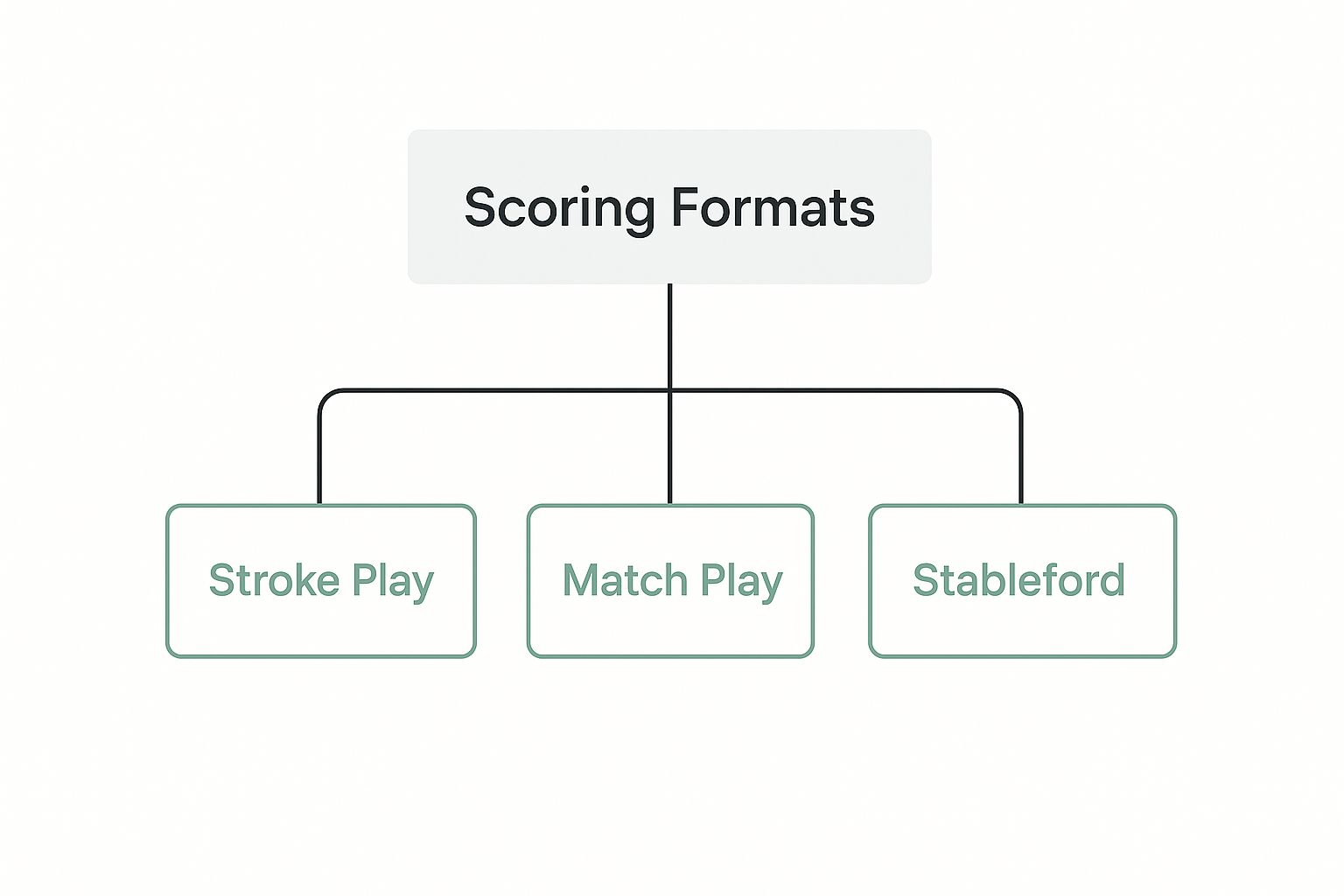
This really highlights that Stableford isn’t just a quirky side game; it’s a distinct and widely used alternative to classic stroke and match play competitions.
Let’s take a look at some of the most popular formats you’re likely to encounter.
Comparing Popular Golf Scoring Formats
To help you get a quick sense of how these games differ, here’s a simple breakdown of the most common formats, their main goal, and the types of events they’re perfect for. Ultimately, mastering golf tournament scoring can distinguish you from your peers.
| Format | Objective | Best For |
|---|---|---|
| Stableford | Accumulate the highest point total. | Players who want to play aggressively without one bad hole ruining their round. Great for club events. |
| Scramble | Achieve the lowest possible team score. | Charity events and corporate outings with players of mixed skill levels. Emphasizes teamwork. |
| Skins | Win individual holes outright for a prize. | Competitive, high-stakes games among friends or small groups. Adds pressure to every hole. |
Each of these brings a unique flavor to the game, shifting the focus from simply counting every stroke to rewarding different aspects of play, from risk-taking to collaboration.
The Golf Stableford System: Rewarding the Bold
Imagine a scoring system where a high score is a good thing and one blow-up hole won’t torpedo your entire day. That’s the beauty of the Stableford format. Instead of counting every stroke, you earn points based on how you score relative to par on each hole.
The goal is to rack up the highest point total, not the lowest stroke count. This structure naturally encourages you to play aggressively—going for that tricky birdie is often worth the risk of a bogey because the potential reward is so much greater.
A common point system looks like this:
- Double Bogey or worse: 0 points
- Bogey: 1 point
- Par: 2 points
- Birdie: 3 points
- Eagle: 4 points
Because a triple bogey gets you the same zero points as a double bogey, you can just pick up your ball after a disaster and move on without wrecking your scorecard. It’s a game-changer for keeping things fun and maintaining a good pace of play.
The Scramble: The Ultimate Team Game in Golf
If you’ve ever played in a charity golf tournament, you’ve probably played a Scramble. This format is universally loved for its low-pressure, team-first vibe. It’s the absolute perfect setup for groups with a wide mix of abilities, from scratch golfers to total beginners. Winning golfers often have a deep understanding of golf tournament scoring principles.
Here’s how it works: everyone on the team (usually four players) tees off. The team then decides which drive was the best, and all four players hit their next shot from that spot. You repeat this process all the way to the green until the ball is in the hole. The team records a single score for that hole.
The Scramble format is brilliant because it minimizes the impact of any single player’s bad shots and puts all the emphasis on teamwork. The final score is a true collective effort, making it an incredibly social and enjoyable way to play golf.
The Skins Game in Golf: High Stakes on Every Hole
For those who love a little pressure-cooker action on the course, the Skins game is a blast. It’s a thrilling format where every single hole is its own self-contained battle for a prize, or a “skin.” Before the round, the group agrees on how much each skin is worth.
The player who posts the single lowest score on a hole wins the skin for that hole—outright ties are not allowed. If two or more players tie for the best score, the skin “pushes” to the next hole. This can create some seriously dramatic moments, especially late in the round when several skins have piled up on one hole, making a simple par putt feel like it’s for a major championship. Many resources are available to help you understand golf tournament scoring effectively.
How Golf Handicaps Create Fair Competition for Everyone
Golf has a secret weapon that most other sports don’t: a built-in system that lets players of all skill levels compete fairly against each other. Ever wonder how a casual weekend golfer can have a legitimate match against their club champion? The answer is the brilliant handicap system.
Think of a handicap as your personal equalizer. It’s a number that represents your playing potential, giving a less experienced player a head start before the first tee shot is even hit. This is what turns a potential blowout into a real, honest-to-goodness competition. In-depth knowledge of golf tournament scoring can enhance your strategic approach during events.
Calculating Your Net Score in Golf
The whole point of a handicap is to figure out your net score. While your gross score is simply the total number of strokes you took, your net score is where the real competition happens. It’s your gross score minus your handicap. Many golfers strive to master golf tournament scoring to improve their competitive edge.
For example, let’s say you go out and shoot a 92. If your handicap is 20, you subtract that from your gross score, and your net score for the day is a very respectable 72. This clever method shifts the focus from who is the best golfer to who played the best relative to their own ability. You’re not just playing the course; you’re playing against your own potential. As you gain experience, your approach to golf tournament scoring will mature.
A handicap isn’t just your average score—it reflects what you’re capable of on a good day. It’s designed to predict your potential, making every tournament a true test of who brought their best game.
How Golf Course Difficulty Changes Everything
Successful players often study golf tournament scoring methods to gain an advantage. But as every golfer knows, not all courses are created equal. Shooting an 85 at your wide-open local course is a completely different achievement than shooting an 85 at a monster track like Bethpage Black. This is where the World Handicap System (WHS) gets really smart by baking course difficulty right into the formula.
Every course has two key numbers that adjust your handicap for that specific round:
- Course Rating: This tells you what a scratch golfer (a player with a zero handicap) is expected to shoot on a given day. A course rating of 73.1 means a top-tier player will likely finish about one over par.
- Slope Rating: This number, ranging from 55 to 155, measures how much harder a course is for a bogey golfer compared to a scratch golfer. A higher slope means the course gets exponentially tougher for players with higher handicaps.
These two ratings work together to calculate your “Course Handicap” for the day, ensuring the challenge you’re facing is fairly reflected in your score. It’s this smart, balanced approach to golf tournament scoring that gives every amateur a real shot at winning when they step onto the first tee. If you want to get into the nitty-gritty, you can learn more about what a golf handicap is and how it’s calculated. Many online platforms provide tips on golf tournament scoring strategies.
FAQ’s
Even when you’ve got a handle on the main formats, certain scoring situations can still leave you scratching your head. Let’s face it, questions about tiebreakers, team play, and handicaps pop up all the time in the clubhouse but don’t forget , understanding golf tournament scoring nuances can lead to unexpected victories.
Getting a clear answer to these common questions makes all the difference. It clears up confusion fast and makes sure everyone is on the same page when the final scores are posted. Let’s tackle some of the most frequent ones. Understanding the rules of golf tournament scoring can make a significant difference in your performance.
What Happens in Case of a Tie?
A tie for first place brings an extra jolt of drama to any tournament, and how it’s handled comes down to the event’s specific rules. On the professional tours like the PGA TOUR, a tie for the win almost always leads to a playoff.
This can happen in a couple of ways:
Sudden-Death Playoff: This is the most common format you’ll see. Tied players head back to a specific hole (usually the 18th), and the first one to win a hole outright takes home the trophy. The drama is immediate.
Aggregate Playoff: Major championships like the U.S. Open use this method. Players play a set number of extra holes—say, three or four—and the one with the lowest total score over that stretch is crowned the champion.
Now, in most amateur and club events, a full-blown playoff just isn’t practical. Instead, they’ll use a countback (also called a scorecard playoff). An official will compare scores on the back nine holes (10-18). If they’re still tied, they’ll look at the last six holes, then the last three, and finally the 18th hole until a winner emerges without anyone hitting another shot.
Explaining Gross Versus Net Score
The terms “gross” and “net” are the bedrock of handicap competitions, but they can trip up new golfers. The good news is, the distinction is actually pretty simple and it’s the key to making events fair for players of all skill levels.
Your gross score is your actual, raw score. It’s the total number of strokes you took to finish your round. If you shot a 90, your gross score is 90. No mystery there.
Your net score is your score after your handicap has been applied. You calculate it by subtracting your course handicap from your gross score. So, if you shot that 90 and your handicap for the day was 18, your net score is a cool 72. This is the score that actually determines the winner in a handicap event.
The net score is the great equalizer in golf. It shifts the focus from who is the most skilled golfer to who played best relative to their own established ability.
How Does Scoring Work in a Team Scramble?
The Scramble is easily one of the most popular and social formats out there, perfect for charity events and corporate outings. The whole point of its scoring system is to encourage teamwork and take the pressure off any one player. Players often debate the merits of different golf tournament scoring systems.
Here’s the step-by-step:
Every player on the team (usually four people) hits a tee shot.
The team walks or rides up and decides which of those drives is in the best spot.
All four players then hit their second shots from that one “best ball” location.
You repeat this process for every single shot—including putts—until the ball is in the hole.
The team records just one score for the hole, representing the group’s best effort on every shot. It’s a fantastic format for players with different abilities because the great shots get all the glory and the bad ones are quickly forgotten.
Formats like these come with their own lingo that can feel like another language, but you can find easy-to-understand explanations in our comprehensive golf glossary from A to Z.
At Golf Inquirer, our goal is to make every aspect of the game more accessible and enjoyable. Whether you’re deciphering a complex leaderboard or just looking for tips to improve your game, we’re here to guide you. Explore more insights and join our community at https://golfinquirer.com.