Let’s be honest, picking the right golf ball can feel overwhelming. Staring at a wall of boxes, each screaming about “unprecedented distance” and “tour-level spin,” is enough to make anyone’s head spin. But don’t sweat it. Our in-depth golf balls review is here to be your caddie, cutting through the marketing noise to help you find the perfect match for your game.
In March of 2025 we published a blog post called “Is a Golf Ball just a Golf Ball – Think Again! This article https://golfinquirer.com/is-a-golf-ball-just-a-golf-ball-think-again/ talks about how golf balls are actually made, a topic which contributes to understand that the manufacturing process has a lot to do with finding the right golf ball for your game.
The secret isn’t finding the “best” ball on the market; it’s finding the ball that clicks with your unique swing. It’s about that perfect marriage of distance, spin, feel, and price. We’ve put the top models through their paces to see which ones actually deliver on their promises, so you can walk to the first tee with total confidence.
How to Choose the Right Golf Ball
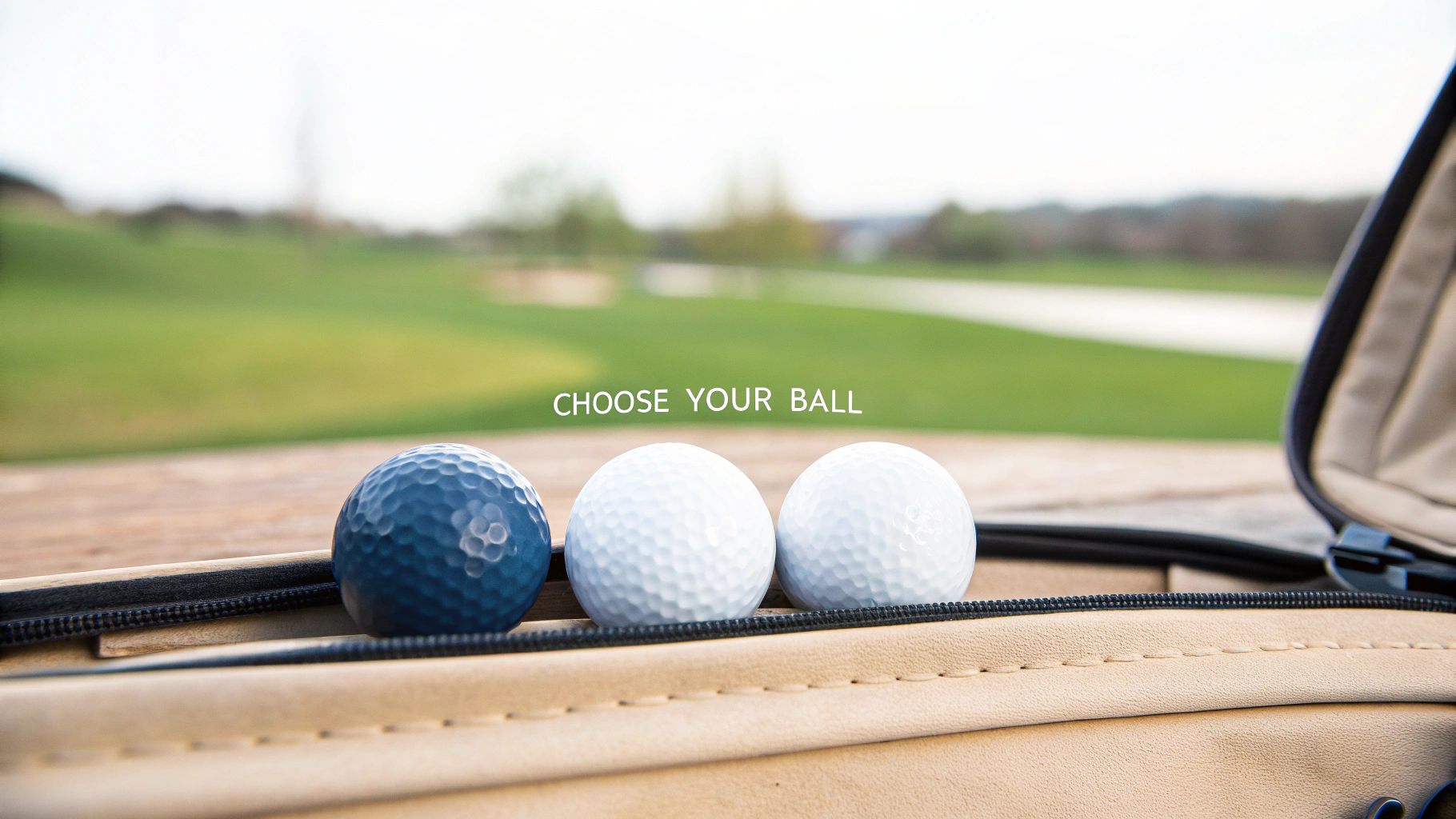
Choosing a golf ball is a bigger deal than you might think. It’s not just about grabbing the first box you see; it’s a genuine equipment decision that directly impacts how you play. The market is absolutely flooded with options, and every single one claims to add 15 yards to your drive or give you pinpoint control. Our mission is to filter out the jargon and give you a straightforward guide to making a smart choice.
The real key is understanding how a ball’s design works with your swing. We’ll break down the essentials—from the material on the cover to the compression of the core—so you can pick a ball that helps your game, not hurts it. A well-matched ball honestly makes golf easier and a heck of a lot more fun.
Core Factors Driving Your Decision
Let’s zero in on the two components that have the biggest say in how a ball performs: its cover and its compression rating. These two elements pretty much dictate how the ball will behave from the tee box all the way to the cup.
-
Cover Material (Urethane vs. Surlyn): The cover is where the real magic happens at impact. Premium balls almost always feature a soft urethane cover. This is what gives you that tour-level spin and control, allowing you to hit aggressive approach shots that bite and stop near the pin. On the other hand, more budget-friendly balls typically use a firmer surlyn cover. It’s tougher, more durable, and spins less—which can actually be a good thing, helping to straighten out a nasty hook or slice off the tee.
-
Compression Rating: This number tells you how much the ball squishes when you hit it. A lower compression ball feels softer and is perfect for golfers with slower swing speeds (under 90 MPH) because it helps you wring every last yard out of your swing. A higher compression ball is built for faster swings, offering more control and a much firmer feel at impact. For a deeper dive, check out our guide on why the right golf ball lowers your handicap.
The golf ball market is massive and projected to jump from USD 3.801 billion in 2024 to USD 6.241 billion by 2035. While durable Surlyn covers still dominate in terms of volume, Cast Urethane is catching up fast as more players demand better performance.
Your golf ball is the only piece of equipment you use on every single shot. Selecting one that fits your game is one of the easiest ways to improve your scores without changing your swing.
A Quick Comparison of Key Features
Making the right call means understanding the trade-offs. Here’s a simple chart to show how these choices play out for different golfers.
| Feature | Slower Swing Speed Golfer | Faster Swing Speed Golfer |
|---|---|---|
| Ideal Compression | Low (Under 70) | High (90+) |
| Best Cover for Control | Urethane (for spin) | Urethane (for precision) |
| Best Cover for Distance | Surlyn (low spin) | Surlyn (low spin) |
| Primary Goal | Maximize distance and forgiveness | Optimize control and feel |
Of course, playing your best isn’t just about the ball. Dedicated athletes know that a holistic approach is key, which includes everything from proper practice to finding the best recovery tools for athletes to stay in peak physical shape. It’s all connected.
How We Test Every Golf Ball
To give you a review you can actually trust, we do a lot more than just hit a few balls at the range. Our process is built on total transparency, blending hard data with real-world, on-course experience. Why? Because we know a great golf ball has to perform in the controlled environment of a simulator and out in the wild where golf is actually played.
It all starts with the numbers. We use a top-tier launch monitor to get precise, unbiased data on every ball. This is the only way to capture the raw stats that define a ball’s true performance potential.
Capturing the Data
The first phase is all about controlled, repeatable testing. We stick to a consistent set of clubs—a driver, a mid-iron, and a wedge—which lets us isolate the ball’s performance and measure the critical metrics that matter most to you.
- Ball Speed: This is the velocity of the ball right off the clubface. It’s the purest indicator of a ball’s raw distance potential.
- Launch Angle: We measure the ball’s initial trajectory to see if it’s designed for a high, floating flight or a more piercing, wind-cheating path.
- Spin Rates: We capture both backspin and sidespin with every club. This tells us everything from how well a ball will bite on the green to how much it might tame a slice off the tee.
Getting this data right is the foundation for everything that follows. If you’re curious about the tech behind it, check out our guide on finding the best golf launch monitor.
The most insightful reviews don’t just present data; they translate it. The numbers from a launch monitor are meaningless until they’re connected to what a golfer actually experiences on the course.
Real-World On-Course Testing
Numbers only tell half the story. That’s why we take every single ball out for extensive testing with a panel of real golfers. We use players with different swing speeds and skill levels to gather the kind of subjective feedback a machine could never give us.
Out on the course, we focus on how the ball performs in real-game situations. We’re paying close attention to the feel off the putter face, how the ball behaves in a crosswind, and the control we get on delicate chips and pitches. We need to know how it reacts everywhere, from a tight fairway to a tricky greenside lie.
Finally, we test durability. A premium ball isn’t worth much if it scuffs after one bunker shot. We hit shots out of the sand and fire off full wedges to see exactly how well the cover holds up. This combination of objective data and hands-on experience is how we make sure our recommendations are balanced, reliable, and genuinely useful for your game.
Comparing Premium Tour Golf Balls
When you get serious about your game, picking a premium tour ball isn’t just about grabbing a “good” one—it’s about finding the right one for you. This is the top tier, the pinnacle of golf ball engineering, where tiny design tweaks can make a huge difference. We’re going beyond the marketing hype to put the industry titans head-to-head.
The names are probably familiar: Titleist Pro V1, TaylorMade TP5, Callaway Chrome Soft. Each one is a complex marvel of multi-layer construction and fancy urethane covers. But don’t be fooled—they each cater to slightly different swings, shot shapes, and preferences. Getting a handle on those subtle differences is how you start shaving strokes off your score.
To get the full picture, we broke down our comparison into three key areas: hard data from the launch monitor, real-world feedback from golfers like you, and on-course durability testing.
This method ensures our findings aren’t just lab-perfect theory; they hold up under the unpredictable conditions of a real round of golf.
Titleist Pro V1: The Standard for Consistency
For years, the Titleist Pro V1 has been the benchmark that all other tour balls are measured against, and for good reason. It’s a workhorse, delivering a potent blend of distance, impressively low spin with the long clubs, and a penetrating ball flight that cuts through the wind. Our testing absolutely backed up this reputation for being a rock-solid, consistent performer.
Off the driver, the Pro V1 gives you a mid-launch trajectory that just seems to bore through the air, often leading to more roll-out. With the irons, it feels soft but solid, giving skilled players that crisp feedback they need to shape shots on command.
The real magic of the Pro V1 is its predictability. You know exactly what you’re going to get from tee to green. That consistent feel and flight make it a go-to for players who value control above all else.
The one catch? That lower spin off the driver isn’t always a friend to players who struggle to get the ball in the air. Also, golfers looking for a higher launch and a bit more spin might actually prefer its sibling, the Pro V1x.
Callaway Chrome Soft: Exceptional Feel and Greenside Spin
Callaway’s Chrome Soft is built for a different kind of golfer. The focus here is on an incredibly soft feel and tons of greenside spin. If you’re an artist with your wedges, this ball is your canvas, letting you hit aggressive chips and pitches that bite hard and stop on a dime.
Its unique construction is engineered to deliver high ball speeds on full swings while still maintaining that signature soft touch. Our launch monitor confirmed this, spitting out some seriously impressive wedge spin rates that often topped 10,000 RPM on pure strikes.
But that performance comes with a trade-off. Some golfers with faster swing speeds might find the feel a bit too soft—almost “marshmallow-like”—off the driver. For them, it could mean sacrificing a little distance to gain that world-class control on approach shots.
TaylorMade TP5: A Five-Layer Powerhouse
TaylorMade threw out the rulebook with its TP5 series, using an innovative five-layer construction. This design gives their engineers more dials to turn, creating a ball that’s fast off the tee, controlled with irons, and grabs hard with wedges. Compared to the Pro V1, the TP5 generally produces a higher ball flight.
The secret sauce is the progressive stiffness from the inner core out to the cover. It helps generate explosive speed on your long shots, while the soft urethane cover digs into the grooves of your wedges for maximum spin.
- TP5: Gives you a slightly softer feel and more spin with the wedges, making it a fantastic all-around tour ball.
- TP5x: Has a firmer feel and launches higher, designed for players trying to squeeze out every last yard of distance with a piercing flight.
Choosing between them really comes down to your preference on feel and trajectory. The TP5 family offers a superb alternative for players who want tour-level performance but with a flight characteristic that stands apart from its rivals. It’s no wonder the global golf ball market is booming, hitting USD 1.42 billion in 2024. Material advancements like these are a big reason why, and you can see more on the market’s growth over at Research and Markets.
Premium Tour Golf Ball Performance Matrix
To really boil it down, this table breaks down the key performance metrics from our testing. It’s a simple side-by-side look at how these elite golf balls stack up.
A comparative analysis of leading tour-level golf balls across key performance metrics, based on launch monitor data and on-course testing.
| Golf Ball Model | Cover Material | Driver Performance (Distance/Spin) | Iron Performance (Control/Feel) | Wedge Spin (RPM) | Best For Golfer Profile |
|---|---|---|---|---|---|
| Titleist Pro V1 | Cast Urethane | Excellent / Low | Superb / Soft | 9,500+ | Players seeking a penetrating flight and consistent control. |
| Callaway Chrome Soft | Tour Urethane | Very Good / Low | Excellent / Very Soft | 10,000+ | Golfers prioritizing soft feel and maximum greenside spin. |
| TaylorMade TP5 | Cast Urethane | Excellent / Low-Mid | Superb / Soft | 9,800+ | Players wanting high launch and all-around performance. |
At the end of the day, the “best” premium tour ball is a deeply personal choice. Your swing speed, the ball flight you want to see, and what feels good to you should be your guide. Our best advice? Grab a sleeve of each and see for yourself which one fits your game.
Finding Value in Mid-Range Golf Balls
Not everyone needs a tour-level ball that costs over four bucks a pop. Let’s be real: it hurts a little less when a mid-priced ball finds a watery grave. For most of us weekend warriors, the smartest money is spent right here in the mid-range category.
This is where you find a fantastic blend of modern tech and real-world value. These balls are built for the amateur who still wants quality, bridging the gap between premium urethane models and basic distance rocks. Think of it as finding the perfect sweet spot for both your game and your wallet.
We’re not just talking about cheaper alternatives, either. These balls are designed so well that they might actually perform better for your specific swing.
The Mid-Range Advantage
The biggest difference you’ll find in this category usually comes down to the cover. While the top-shelf balls have soft, cast urethane covers for insane greenside spin, many mid-range options use a more durable ionomer or a slightly less expensive urethane.
But for the average player, this isn’t a bad thing. An ionomer cover, for instance, is incredibly tough and often spins less off the driver. If you’re fighting a slice, that reduced side spin can be the difference between playing from the short grass and punching out of the trees. It’s all about picking tech that helps your game, not just copying the pros.
The best golf ball isn’t the most expensive one. It’s the one that matches your swing speed and shot tendencies. Mid-range balls often deliver the ideal mix of distance, feel, and forgiveness for most amateur golfers.
Top Contenders in the Mid-Range
Two models that constantly come up in conversation are the Srixon Q-Star Tour and the TaylorMade Tour Response. They both represent the best of what this category has to offer, each with its own personality.
-
Srixon Q-Star Tour: This ball is an absolute gem for players with moderate swing speeds, somewhere in that 80-95 MPH range. It has a soft, urethane cover—the kind you usually only find on premium balls—which gives you fantastic spin and control around the greens. The low-compression core feels soft at impact and helps squeeze out every yard, even if you don’t swing out of your shoes.
-
TaylorMade Tour Response: Built on a similar idea, the Tour Response also uses a urethane cover for tour-level short-game performance. It’s designed to be a little firmer than the Q-Star Tour, which is great for players who like a bit more feedback at impact but still need a ball optimized for average swing speeds.
When Mid-Range Just Makes Sense
Let’s put this into a real-world scenario. Say you’re a 15-handicap with a swing speed around 90 MPH. A premium, high-compression ball like a Pro V1x might feel like hitting a rock. You won’t compress it properly, which means you’re actually losing distance.
Now, hand that same golfer a Srixon Q-Star Tour. It’s engineered for that exact swing. You’ll activate the core more easily, get better energy transfer, and see more distance off the tee. Then, when you get close, that urethane cover will give you the stopping power needed to hold greens. For this player, the Q-Star Tour isn’t a compromise—it’s a straight-up upgrade.
Ultimately, picking a ball from this category comes down to being honest about your game. Do you lose a few balls per round? Is your swing speed more smooth than savage? If so, investing in a high-quality, mid-range ball is one of the smartest gear decisions you can make. You get 90% of the performance for a fraction of the cost, making the game a whole lot more fun.
Best Golf Balls For High Handicappers

If you’re new to golf or find yourself consistently shooting over 100, the right ball can be a game-changer. No, it won’t fix a slice overnight, but it can absolutely make your good swings better and your bad swings a whole lot less punishing. This section of our golf balls review is for players who need more forgiveness, more distance, and a shot of confidence.
The main goal for a high handicapper is simple: find more fairways and greens. To do that, you need a ball designed to minimize those frustrating hooks and slices that can ruin a round. We’re zeroing in on models built to fly straighter and farther, even when your contact isn’t perfect.
Think of these balls as your partners on the course, helping you enjoy the game more while you steadily bring those scores down.
What High Handicappers Should Look For
For a developing golfer, the insane spin control of a tour ball often does more harm than good. Instead, your focus should be on two key features that directly address the most common struggles for beginners.
First up is low compression. A ball with a low-compression core (usually rated between 40 and 70) is much easier for slower swings to deform at impact. This is a good thing—it maximizes the energy transfer from your club to the ball, which means more ball speed and more distance.
Second is a durable, low-spin cover. Most golf balls in this category use a tough surlyn or ionomer cover. This material is not only rugged enough to survive a run-in with a cart path, but it also generates way less side spin than the soft urethane on premium balls. Less side spin means your slice or hook won’t curve as sharply, keeping more of your shots in play.
A huge mistake I see new golfers make is grabbing a ball designed for tour pros. A low-spin distance ball will almost always give you better results and build more confidence than a high-spin tour ball that just magnifies every miss.
Top Models That Build Confidence
When looking at the best options, a few names always pop up for delivering on the promise of distance and forgiveness. These are the balls I recommend to friends who are just starting out or fighting to break 100.
-
Callaway Supersoft: This ball is a fan favorite for a reason. Its super low compression core feels amazing off the clubface and helps slower swingers launch the ball high and long. The cover is specifically engineered to reduce spin and straighten out your ball flight.
-
Srixon Soft Feel: A perfectly balanced choice, the Soft Feel gives you a great mix of distance and straight flight without feeling like you’re hitting a rock. It has a 60 compression rating, making it a fantastic fit for swing speeds in the 80-95 MPH range. It won’t stop on a dime on the greens, but its real value is consistency from the tee.
-
Titleist Velocity: Just like the name implies, this ball is built for one thing: speed. It has a high-energy core and a fast cover designed to squeeze every last yard out of your swing. If getting more distance is your number one priority, the Velocity is an awesome choice.
The market for these types of golf balls is huge because it caters to the majority of recreational players. In fact, the global golf ball market hit a value of roughly USD 1.2 billion in 2024, with North America leading sales. You can dive deeper into this industry with IMARC Group’s full golf ball market analysis.
To help you visualize where each type of player fits, here’s a quick breakdown of our recommendations.
Golf Ball Recommendations by Golfer Type
| Golfer Profile | Swing Speed (MPH) | Primary Need | Recommended Ball Models | Price Category |
|---|---|---|---|---|
| The Beginner | Below 90 | Forgiveness & Straight Flight | Callaway Supersoft, Srixon Soft Feel | Low-Mid |
| The Distance Seeker | 90-100 | Maximum Yards Off The Tee | Titleist Velocity, TaylorMade Distance+ | Low-Mid |
| The Feel Player | Any | Soft Feel Around Greens | Wilson Duo Soft, Titleist TruFeel | Low-Mid |
| The Mid-Handicapper | 95-105 | Balanced Performance | Srixon Q-Star Tour, Titleist Tour Soft | Mid |
| The Skilled Player | 105+ | Spin Control & Precision | Titleist Pro V1, Bridgestone Tour B XS | Premium |
This table should give you a solid starting point for finding a ball that matches your swing and your goals on the course.
Making The Right Choice For Your Game
So, how do you pick between these great options? It really comes down to your biggest challenge on the course.
Are you losing distance because you have a slower swing? The Callaway Supersoft is your best bet. Do you just need a reliable, all-around ball that helps you stay in the fairway? The Srixon Soft Feel is a true workhorse. Or do you simply want to bomb it past your buddies? Go grab a box of the Titleist Velocity.
Ultimately, the best ball for a high handicapper is one that makes the game feel simpler. By choosing a model that focuses on straight-flying distance and durability, you’re setting yourself up for more success, fewer lost balls, and a much better time out there.
FAQ’s
As we wrap up our deep dive into the best golf balls of the year, you might still have a few questions rattling around. That’s completely normal. The golf equipment world is a maze of technical jargon and slick marketing claims that can leave anyone’s head spinning. This section is all about cutting through that noise.
Think of this as a straight-talk session, where we tackle the common questions golfers ask all the time. From how long a ball really lasts to whether that expensive Tour ball is worth the money for your game, we’re here to clear things up. Let’s get you the knowledge to make smarter choices on and off the course.
How Often Should I Change My Golf Ball?
This is one of those classic “it depends” situations, but here’s the guiding principle: it’s all about performance, not some arbitrary timeline. A golf ball is ready for retirement the moment its cover gets damaged enough to potentially affect its flight. A nasty scuff from a cart path or a deep cut from a bladed wedge shot is all it takes to mess with the ball’s aerodynamics.
For a serious competitor or a low-handicap player, this could mean pulling a ball from play after just one unlucky shot from a rocky bunker. For the average weekend golfer, a ball is usually good to go until it’s lost or has several noticeable scuffs across its surface.
Don’t buy into the myth that golf balls “go dead” from just sitting around. Modern, solid-core golf balls have a shelf life of many, many years. The only real reason to swap out a ball is visible damage to the cover, not its age. A good habit is to give your ball a quick inspection after every hole. If you find a scuff you can feel with your fingernail, it’s probably time to put a fresh one in play, especially if a critical shot is coming up.
Does the Dimple Pattern Actually Matter?
Yes, absolutely—but not in the way most people think. The dimple pattern is the secret sauce behind a golf ball’s flight. The specific number, shape, and depth of the dimples are what create lift and reduce drag, helping the ball fly farther and hold its line.
That said, you shouldn’t get lost in the weeds comparing the 338 dimples on one ball to the 360 on another. That’s a job for the engineers spending thousands of hours in wind tunnels to get it just right.
Instead of counting dimples, focus on what the manufacturer says the ball is designed to do.
Is it built for a high, floating trajectory to maximize carry distance?
Is it engineered for a low, penetrating flight to cut through the wind?
Is it optimized for low spin to help tame your slice or hook?
The dimple pattern is just one of the tools engineers use to achieve these flight characteristics. Your best bet is to figure out the ball flight you need and pick a model designed to deliver it, trusting the dimple science is already baked in.
Are Expensive Golf Balls Worth It for Average Golfers?
This is the million-dollar question, isn’t it? The honest answer is that it truly depends on your game and your wallet. For some average golfers, a premium, multi-layer urethane ball is a game-changer. For others, it’s just throwing money away.
The main selling point of a premium ball like a Titleist Pro V1 or TaylorMade TP5 is its soft urethane cover. This material generates a ton more spin on short shots around the green. If you’re an average golfer with enough swing speed and skill to actually use that extra greenside control, then yes, a premium ball can definitely help you shoot lower scores. You’ll hit chips and pitch shots that check up and stop much faster.
However, for most mid-to-high handicappers, the math looks a little different.
You Lose Balls Often: If you lose two or three balls a round, that $4-$5 cost per ball stings. It adds up quickly and can put a lot of unnecessary pressure on your game.
Your Swing Speed Doesn’t Match: Many premium balls have higher compression ratings built for fast swings. If your swing is on the slower side, you might not be compressing the ball enough to get the distance it’s designed for.
You Won’t Feel the Benefit: If your biggest challenge is just keeping the ball in play off the tee, the low-spin design of a good mid-range or distance ball is going to help you way more than the high-spin performance of a tour ball.
For most amateurs, a quality mid-range ball that fits their swing speed delivers the best combination of performance and value. It’s almost always the smarter, more practical choice.
What Is Golf Ball Compression?
Simply put, compression is a rating that tells you how much a golf ball squishes against the clubface at impact. The rating, which usually runs from about 40 (very soft) to over 100 (very firm), is a key piece of the puzzle in matching a ball to your swing.
Think of it this way: a low-compression ball is softer and much easier to deform. This is perfect for golfers with slower swing speeds (generally under 90 MPH). A good strike fully activates the core, transferring maximum energy for more ball speed and distance. A slow-swinging player hitting a high-compression ball is like a toddler trying to bounce on an industrial-strength trampoline—they just don’t have enough force to get a good rebound.
On the flip side, a higher-compression ball is firmer and designed for players with faster swing speeds (over 100 MPH). These golfers generate plenty of force to properly activate all the ball’s layers, unlocking optimal distance and control. If a fast-swinging player hits a low-compression ball, it can feel “mushy” and may lead to a loss of control or even distance.
Matching your ball’s compression to your swing speed is one of the most fundamental things you can do to find the right ball for your game.
At Golf Inquirer, we believe a smarter golfer is a better golfer. We hope this review has given you the confidence and know-how to find the perfect ball for your game.
For more tips, gear reviews, and stories from the course, be sure to visit us at https://golfinquirer.com.