You’ve probably heard fellow golfers toss around the term Slope Rating, but what does that number on the scorecard really mean for you? It’s one of the most misunderstood ideas in golf, often confused with a simple grade of how “hard” a course is. Understanding slope rating explained can help clarify its importance.
Let’s delve deeper into slope rating explained and its significance in the game of golf. For many golfers, slope rating feels elusive, but it’s essential to grasp its implications.
By thoroughly understanding slope rating explained, you empower yourself to make informed decisions on the course.
The concept of slope rating explained plays a crucial role in how golfers evaluate course difficulty and make competitive assessments.
The truth is, it’s a lot more clever—and a lot more helpful—than that.
Let’s make slope rating explained a part of your golfing vocabulary.
What Slope Rating Really Means for Your Golf Game
Think of Slope Rating as a measure of a course’s relative difficulty for a bogey golfer (someone who shoots around 90) compared to a scratch golfer (a zero-handicap player). It’s not about the overall score; it’s about how much harder the course plays for the average player versus the expert. Understanding slope rating explained is vital for strategizing effectively on the course.
Let’s try an analogy. Picture a 16-year-old with a brand-new driver’s license and a professional race car driver. On a wide-open, straight highway, the skill gap isn’t glaringly obvious. Both can handle it pretty well.
But now, put them on a winding mountain road with sharp, blind corners and steep drop-offs. The new driver’s challenge just skyrocketed, while the pro can still navigate it with confidence. That mountain road has a “high slope.”
That’s exactly what Slope Rating does for golf. A course with a high number is loaded with features that punish a bogey golfer’s mistakes far more severely than a scratch player’s. Think forced carries over water, tight fairways lined with trees, or greens protected by deep bunkers. These are the obstacles that can turn a bogey into a triple-bogey in a heartbeat for an average player, but might just be a minor inconvenience for a pro.
The Slope Rating Scale in Golf
For competitive golfers, slope rating explained is essential knowledge. Slope Ratings range from a low of 55 to a high of 155. The baseline for a course of “average” relative difficulty is 113. This magic number is the anchor for the entire handicap system.
Understanding this number is the first step to knowing how many strokes you really get on a given day. It’s the key to converting your Handicap Index into a Course Handicap, ensuring a fair match against any opponent, on any course.
A rating below 113 means the course is relatively more forgiving for the bogey golfer. A number above 113 signals that the challenge ramps up significantly for higher handicappers. For instance, your friendly local muni with wide-open fairways might have a Slope of 105. Meanwhile, a beast of a course like Bethpage Black, a U.S. Open venue, famously has Slope Ratings well over 140. By focusing on slope rating explained, you can tailor your practice sessions more effectively.
To make it even clearer, here’s a quick breakdown of what those numbers generally mean.
Slope Rating at a Glance in Golf
Be sure to consider slope rating when planning your next rounds.
| Slope Rating Range | Relative Difficulty for Bogey Golfer | Common Course Type Example |
|---|---|---|
| 55 – 90 | Significantly Easier | A very short, flat executive course with no hazards. |
| 91 – 112 | Easier than Average | A forgiving municipal course with wide fairways and few bunkers. |
| 113 | Average | The baseline standard; a typical course with moderate challenges. |
| 114 – 135 | Harder than Average | A championship-style course with strategic bunkering and water hazards. |
| 136 – 155 | Significantly Harder | A U.S. Open-caliber course with forced carries, thick rough, and fast greens. |
This table shows how the rating directly reflects the type of test you’re about to face.
Ultimately, knowing a course’s Slope Rating is crucial for a few key reasons:
- It lets you calculate your Course Handicap. This tells you how many strokes you get on that specific course.
- It helps you understand the challenge. A high slope means you need to play smart and avoid big mistakes.
- It levels the playing field. It ensures that a match between a 5-handicap and a 20-handicap is fair for both players.
Slope Rating turns your handicap from a simple number into a dynamic tool that adapts to whatever course you’re teeing it up on. It’s the secret sauce that makes the handicap system work and ensures every round is a true test of your skill for that day.
Why the Slope System Was a Game Changer for Golf
Grasping slope rating allows golfers to adapt to different environments effortlessly.
To really appreciate why Slope Rating is so important, you have to rewind the clock to a time before it existed. Before the late 1980s, the handicap system had a massive, glaring flaw that every golfer felt, even if they couldn’t quite put their finger on it.
Back then, your handicap was just a static number. It was a simple average of your scores that didn’t care one bit about the course you were playing.
This created a totally uneven playing field. Your 15-handicap was a 15 whether you were playing your wide-open, forgiving home course or staring down a monster like Pebble Beach during U.S. Open week. The system basically pretended every course was the same, and any golfer knows that’s just not true.
What did this mean in practice? Higher-handicap players were at a huge disadvantage on tough courses, while scratch players often had an unfair edge on easier ones. There was simply no way to have a genuinely fair match.
A New Standard for Fairness in Golf
Recognizing this problem, the United States Golf Association (USGA) decided to build a better, smarter system. The mission was to make a handicap truly portable—a number that could accurately reflect a player’s ability on any course, anywhere in the world.
The solution that changed everything was the Slope Rating system, which the USGA rolled out nationally in 1987. It was brilliant because it finally accounted for the relative difficulty a course presents to a bogey golfer compared to a scratch golfer. It acknowledged that hazards, narrow fairways, and fast greens punish an average player way more severely.
A rating of 113 was set as the new baseline for a course of “standard” difficulty, giving the whole system a brand new anchor. You can learn more about how this all came together by reading up on the rise of the Slope system on USGA.org.
From Static Number to Dynamic Tool
With Slope, a handicap stopped being just a simple number. It became a dynamic measure of a player’s potential, ready to be adjusted for the specific challenge of the day.
Slope Rating transformed handicaps from a blunt instrument into a precision tool. It ensures that a golfer’s handicap is an equitable measure of their ability, no matter where they play.
This new system allows for a quick calculation that converts your Handicap Index into a Course Handicap for the specific tees you’re playing. On a tougher course (with a Slope Rating above 113), you get more strokes. On an easier one (below 113), you get fewer. Simple as that.
This elegant fix leveled the playing field overnight. It ensured a match between a 5-handicap and a 20-handicap was truly fair, letting skill—not the quirks of the course—decide the winner. The Slope system was the missing piece that made fair, global competition a reality.
How a Golf Course Earns Its Slope Rating
A course’s Slope Rating isn’t some arbitrary number a committee dreams up. It’s the result of a ridiculously detailed evaluation by certified rating teams, all to ensure that your handicap is fair and consistent, no matter where you play.
Think of it like this: the system is built on two core numbers that tell the whole story.
-
Course Rating: This is straightforward. It predicts what a scratch golfer (a 0-handicap player) would likely shoot on a given day. It’s a baseline measure of difficulty, factoring in things like total yardage and major hazards.
-
Bogey Rating: Now, this is where it gets interesting. This number predicts the average score for a bogey golfer, who typically has around a 20-handicap. This rating zeroes in on the stuff that really punishes the average player—think long forced carries over water, nasty green complexes, or thick, unforgiving rough.
The Slope Rating itself is born from the difference between these two ratings. A massive gap between the Bogey Rating and the Course Rating means the course is exponentially harder for the average joe than it is for the pro. That bigger gap equals a higher Slope Rating.
The Anatomy of a Golf Course Evaluation
So, what are these rating teams actually looking at when they walk a course? It’s a deep dive that goes way beyond just the scorecard yardage. When you simplify slope rating you start to appreciate its nuances.
To get it right, teams from the USGA analyze over 460 different variables for each set of tees. It’s an incredibly meticulous process that leaves no stone unturned. You can actually see how the USGA’s formula demystifies course difficulty if you want to geek out on the specifics.
These raters aren’t just eyeballing it; they assign numerical values to a long checklist of obstacles and features. This data-driven approach means every course is graded on the same scale.
Some of the biggest factors they assess include:
- Topography: Are you hitting uphill all day, making the course play longer than its yardage? Or are downhill shots giving you a bit of a break?
- Fairway Width: How much room do you have to land your tee shot? Tight, tree-lined fairways are obviously way more punishing than wide-open ones.
- Green Target: Are the greens big and welcoming, or are they the size of a postage stamp and crowned like an upside-down bowl?
- Recoverability and Rough: If you miss a fairway or green, do you have a shot, or are you hacking out of knee-high fescue with no hope?
- Bunkers: They don’t just count the bunkers. They look at their depth, their shape, and, most importantly, where they’re placed.
- Water Hazards: How often does water come into play, and does it force you to carry it? A pond alongside a fairway is one thing; a 180-yard carry over a lake is another beast entirely.
- Trees: Raters consider how dense the trees are and whether they strategically block the ideal line of play.
From Data Points to a Final Number
Each of these data points, plus hundreds more, feeds into the final Bogey Rating. The team even considers the psychological stress these features create—a key part of what makes a course truly challenging. Embracing slope rating explained can transform your golfing experience.
By evaluating hundreds of variables, the rating system ensures that a Slope Rating is a true reflection of a course’s challenge. It’s not a subjective opinion—it’s a scientific assessment.
In the end, all this analysis produces a Course Rating and a Bogey Rating for every tee box. Those two numbers are then plugged into a specific formula, and out pops the Slope Rating you see on your scorecard. It’s this scientific method that makes your handicap a truly portable tool, giving you a reliable measure of your game no matter where you decide to tee it up.
Putting the Golf Course Slope Rating Formula to Work
So, how does all this theory actually play out on the course? All those evaluations and meticulous ratings boil down to a simple, essential formula. This is the math that translates your general ability—your Handicap Index—into the real number of strokes you get on any given course, on any given day.
First, let’s peek under the hood at how the Slope Rating number itself is born. It’s calculated as (Bogey Rating – Course Rating) x 5.381 for men, or 4.24 for women. In plain English, this formula just puts a number on the difficulty gap between what a scratch golfer and a bogey golfer would likely shoot.
This concept map breaks down how those two core ratings—Course Rating for the scratch player and Bogey Rating for the bogey player—are the foundational inputs for determining the Slope Rating.
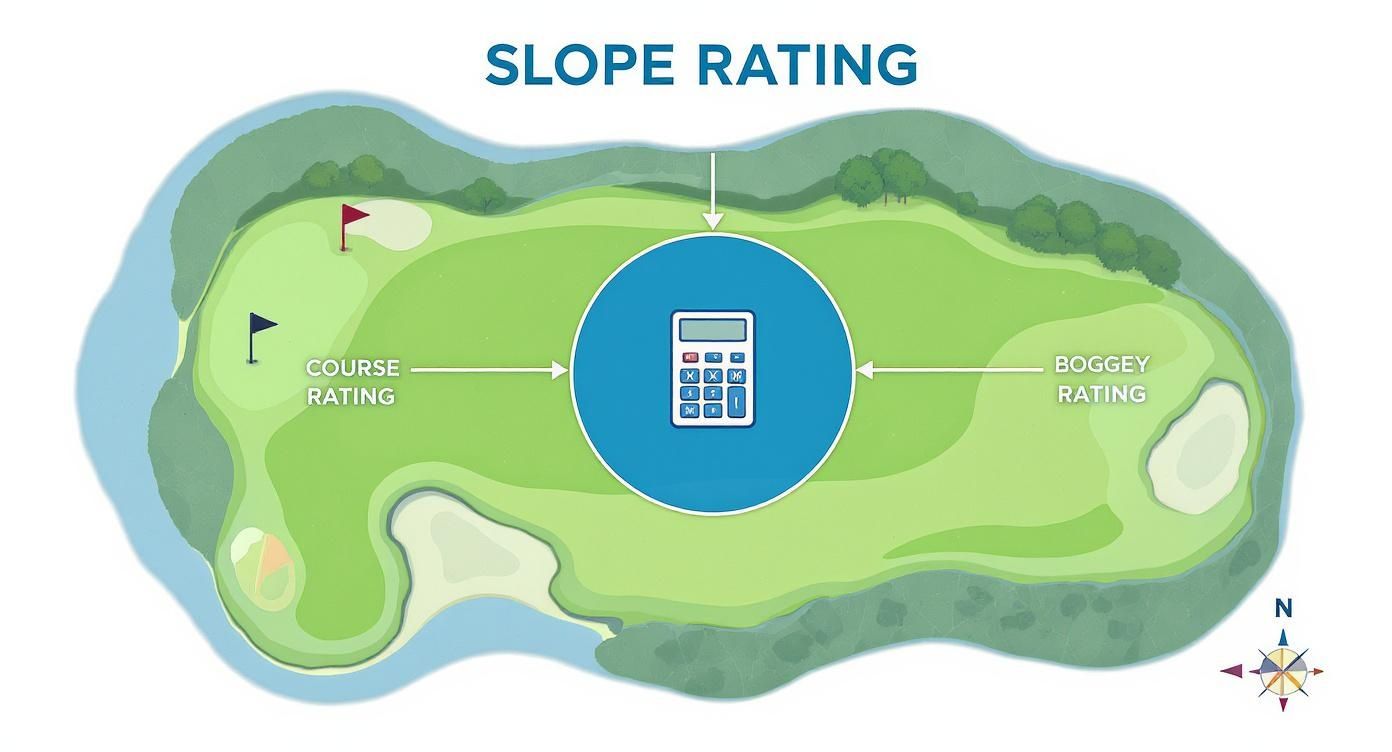
As you can see, the Slope Rating is all about measuring that gap. A wider gap means a tougher walk for the average player, and thus, a higher Slope.
The Most Important Formula for Your Golf Game
While the math behind creating a Slope Rating is interesting, the formula you’ll actually use is the one that really matters for your game. This is how you convert your Handicap Index into your Course Handicap. If you memorize one thing, make it this:
Course Handicap = (Handicap Index x Slope Rating) / 113
So, what’s with the magic number 113? That’s considered the Slope Rating for a course of “standard” difficulty. This formula is brilliant in its simplicity; it adjusts your handicap up or down based on how the course you’re playing stacks up against that average baseline.
This single calculation is what makes the handicap system so powerful. It’s why your handicap is fair and portable, no matter where you tee it up.
Seeing the Formula in Action
Let’s run through a couple of real-world examples to see how this works. Imagine you’re a golfer with a solid 15.0 Handicap Index.
-
Scenario 1: Playing an “Average” Course
- The Course: Your trusty local muni.
- Slope Rating: 113 (the baseline average).
- The Math: (15.0 x 113) / 113 = 15.
- The Result: Pretty simple. On this course, your Course Handicap is the same as your Handicap Index. You get 15 strokes.
-
Scenario 2: Playing a “Difficult” Course
- The Course: A beast of a private club, riddled with water and deep bunkers.
- Slope Rating: 135 (much tougher for a bogey golfer).
- The Math: (15.0 x 135) / 113 = 2025 / 113 = 17.92.
- The Result: Your Course Handicap rounds up to 18. The system sees the challenge ahead and rightly spots you three extra strokes to level the playing field.
This simple math empowers you. It doesn’t just give you a number; it gives you confidence that you’re playing with the correct number of strokes and explains exactly why that number changes from one track to the next. The Slope Rating isn’t just a number on a scorecard—it’s the engine that makes fair competition possible for all of us.
Decoding Golf Course Slope Ratings in the Real World
With slope rating explained, you can better gauge your performance across various courses. So, we’ve talked about the math, but let’s be honest—golf isn’t played on a spreadsheet. The real magic happens when you glance at a scorecard, see that Slope Rating, and instantly know what kind of fight you’re in for. It’s time to build an intuition for what these numbers actually feel like out on the course.

While the official baseline for an “average” course is a Slope Rating of 113, you’ve probably noticed that most courses you play are a bit higher than that. The real-world average actually shakes out closer to 120. Why the difference? Modern courses often feature design elements—like forced carries over water or deep bunkers guarding the greens—that are way tougher for a bogey golfer than a scratch player. If you want to dive deeper into the stats, Pope of Slope offers some great details on course rating averages.
Knowing this helps put the entire spectrum of difficulty into a much clearer perspective. Many golfers find that slope rating explained enhances their understanding of course strategy.
What the Numbers Feel Like
Think of the Slope Rating as a course’s personality profile. As the number goes up, so does the demand on your game management and your ability to recover from a bad shot. Here’s a quick guide to what you can expect in the real world:
- Below 110 (The Welcome Mat): These courses are as friendly as they come. We’re talking wide-open fairways, very few hazards to worry about, and greens that are relatively flat and simple. It’s your classic muni where you can spray it a little and live to tell the tale.
- 110-125 (The Standard Test): This is the sweet spot where most daily-fee tracks and well-kept public courses live. You’ll find a fair challenge here—some strategic bunkers, a bit of rough that makes you think, and greens with enough contour to keep you honest. It’s a solid, balanced test of your game.
A course’s Slope Rating gives you a snapshot of its personality. Is it a gentle giant that lets you get away with mistakes, or a strategic mastermind that punishes every poor decision?
The Upper Echelons of Difficulty in Golf
Once you start creeping past the 125 mark, you’re stepping into a different class of golf. Course management isn’t just a good idea here; it’s essential for survival. The importance of slope rating cannot be overstated for any golfer aiming to improve.
- 126-140 (The Championship Challenge): Welcome to the big leagues. This is the territory of private clubs and high-end resort courses like Pebble Beach, designed to test highly skilled players. Expect forced carries, penal rough, and complex green structures that demand absolute precision. A miss here doesn’t just cost you a stroke—it can completely derail a hole.
- 140+ (The Professional Proving Ground): Now you’re in the land of U.S. Open venues and PGA Tour stops. Legendary brutes like Bethpage Black and Oakmont sit comfortably in this range. Every single shot demands your full attention. Hazards are seemingly everywhere, fairways feel impossibly narrow, and the greens are treacherous. For the average bogey golfer, just finishing a round on one of these monsters is a victory in itself.
FAQ’s
Even after we’ve crunched the numbers and walked through a few examples, some questions about Slope Rating tend to pop up again and again. It’s one of those concepts that can feel a bit fuzzy until it finally clicks. In the end, slope rating explained is not just a concept, it’s a tool for improvement.
Let’s clear up the common points of confusion. Think of this as your quick-reference guide for those “wait, how does that work again?” moments on the course.
Is a Higher Slope Rating Always Harder?
Not necessarily for everyone, and this is a really important distinction to grasp. A high Slope Rating means a course gets exponentially harder for a bogey golfer compared to how a scratch golfer experiences it. It’s all about measuring that “difficulty gap” between different skill levels.
A scratch player, for instance, might find a long, wide-open course with a high Course Rating but a moderate Slope (fewer forced carries or nasty hazards) to be a much tougher test of their game. The best course isn’t just the one with the biggest number on the scorecard; it’s the one that provides the right kind of challenge for your specific skills.
How Is Slope Rating Different from Course Rating?
This is probably the most crucial difference to lock down. These two ratings are a team, but they measure completely different things.
Course Rating is a simple number: it predicts what a scratch golfer (a 0 handicap) would likely shoot on that course. It’s the baseline for raw difficulty. Slope Rating, on the other hand, measures how much more difficult the course becomes for a bogey player (around a 20 handicap).
Here’s an easy way to think about it: Course Rating is “total difficulty,” while Slope Rating is “relative difficulty.” A course can be tough for everyone (high Course Rating) without being a nightmare for bogey golfers (moderate Slope Rating), and vice versa.
Can I Use Slope Rating to Find My Handicap?
Nope, not by itself. The Slope Rating is a critical ingredient in the recipe, but you need to start with your official Handicap Index. That’s the certified number reflecting your potential ability, calculated from all your recent scores.
The Slope Rating is what you use to translate that general ability to the specific challenge you’re facing on a given day. You plug both numbers into the Course Handicap formula to figure out how many strokes you actually get:(Handicap Index x Slope Rating) / 113 = Course Handicap
This little bit of math is what makes your handicap portable and fair, adapting your game to any course you decide to tackle.
Do Different Tees Have Different Slope Ratings?
Yes, absolutely—and this is a non-negotiable detail if you want your handicap to be accurate. Every single set of tees on a course (the tips, the men’s, seniors’, ladies’, etc.) is rated independently. Each one has its own unique Course Rating and Slope Rating.
It makes perfect sense when you stop to think about it. The back tees will almost always have a higher rating because the extra length, tougher angles into greens, and longer forced carries make the course substantially more difficult.
This is precisely why you must always use the Slope Rating from the specific tees you played that day. Grabbing the number from the wrong tee box will give you an incorrect Course Handicap, leading to an unfair advantage or disadvantage.
At Golf Inquirer, we believe that understanding the game’s details makes every round more enjoyable. From decoding a scorecard to discovering the world’s most beautiful courses, we’re here to fuel your passion. Explore more tips, gear reviews, and golf inspiration at https://golfinquirer.com.