If you’re serious about lowering your golf scores, the fastest way to get there starts right in your living room. No, really. Forget the driving range for a second. A small patch of carpet and a few minutes a day can forge the repeatable mechanics and muscle memory you need to sink more putts when it actually counts. This is your secret weapon. Learning how to practice putting at home is essential for improvement.
When it comes to golf, knowing how to practice putting at home can significantly enhance your game.
Why Your Carpet Is the Key to Lower Scores in Golf
It’s easy to write off rolling a few putts on the carpet as just messing around, but trust me, that’s where the real work gets done. Think about it: nearly 40% of all your shots on the course are with a putter. A perfect drive feels amazing, but shaving just two or three putts per round will slash your handicap far more dramatically. That journey begins on your floor.
Build Unshakable Muscle Memory for playing Golf
The real magic of at-home practice isn’t about perfectly mimicking the speed of a tour-level green. It’s about pure, undistracted repetition. When you practice on your carpet, you strip away all the other variables—the break, the grain, the pressure of your playing partners watching—and isolate the putting stroke itself. This is where you can truly focus on the fundamentals.
This consistent repetition is what builds rock-solid muscle memory. Your body learns to execute a smooth, reliable stroke without you having to consciously think about it. You’re grooving a motion that won’t fall apart when you’re standing over a tricky four-footer on the 18th green.
The Confidence Factor in Golf
Confidence on the greens is everything. When you’ve put in the time at home, grooving that consistent stroke over and over, you step onto the course knowing you can start the ball on your intended line. That mental edge is priceless and leads directly to making more putts.
Of course, not all carpets are created equal. To really get the most out of your indoor practice, it helps to understand what makes for a good surface. You can learn more about how to choose a good carpet for your home putting green to really optimize your setup.
The goal of home practice is simple: make your putting stroke so automatic that you don’t have to think about mechanics on the course. You just see the line, feel the distance, and let your well-rehearsed stroke take over.
Creating Your Ideal Home Golf Putting Setup
Let’s be clear: you don’t need some high-tech basement simulator to seriously improve your putting. You can build a genuinely effective practice space in a spare room, a hallway, or even a small slice of your living room. The real secret is making it so easy to use that you actually practice.
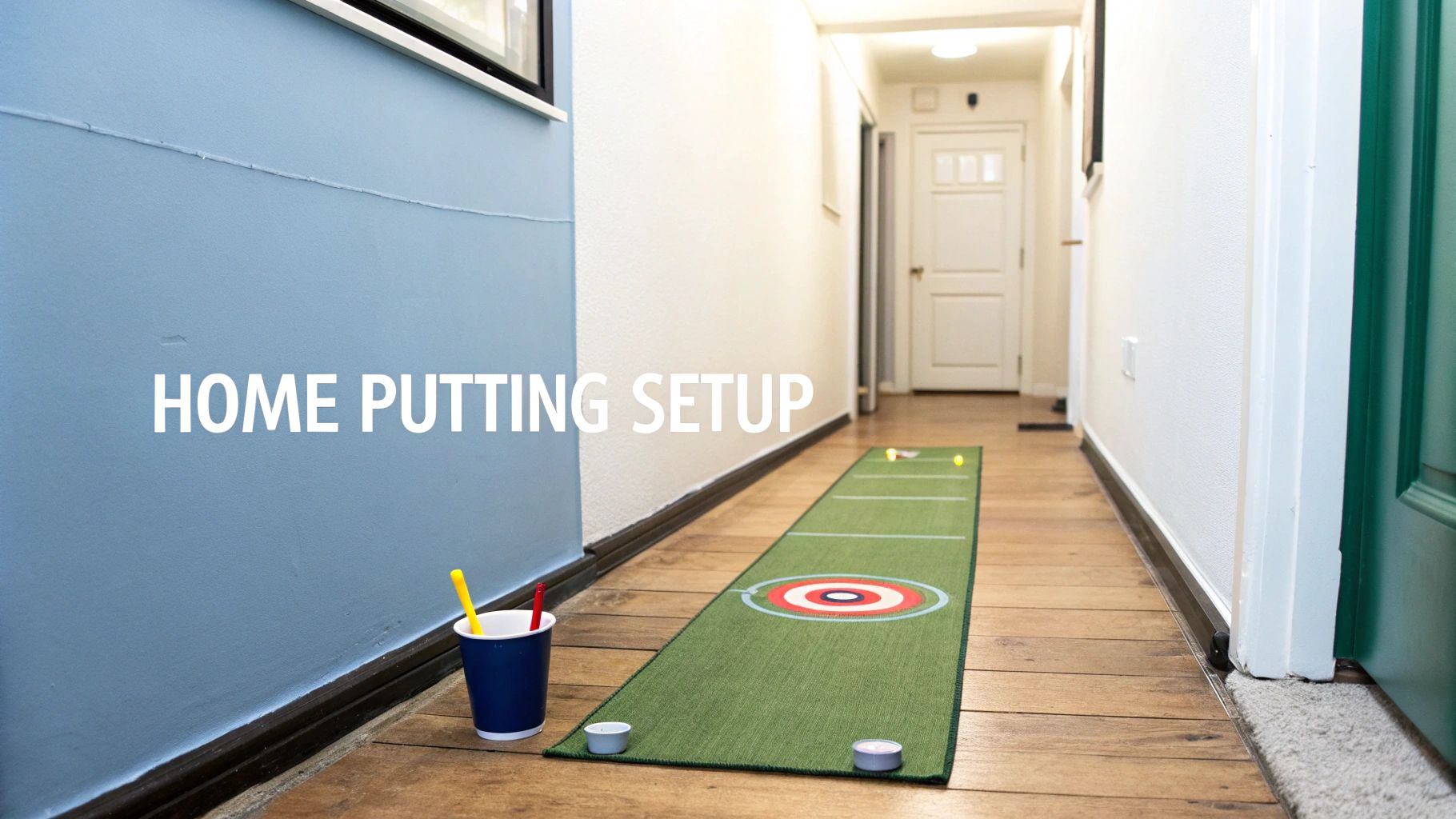
The surface is your foundation. While your living room carpet is a decent place to start, a dedicated putting mat is a game-changer. It gives you a much truer roll and a more consistent speed. You’ll want to find one that rolls flat and has a Stimpmeter reading between 9 and 11—this is the sweet spot that mimics the speed of most golf course greens.
A good mat gives you instant, honest feedback. If the ball starts wobbling or skidding offline right away, you know your putter face wasn’t square at impact. This immediate result is priceless for making tiny adjustments and grooving a repeatable, solid stroke.
Finding the Right Space and Gear to practice Golf at home
Your practice area doesn’t need to be massive. The goal is to have enough room for putts from three to ten feet. This is the money zone, where most strokes are either gained or lost on the course. To really get the most out of your spot, a basic understanding space planning can help you lay things out for maximum efficiency without taking over the whole house.
Once you’ve staked out your territory, you can start simple. You don’t need to rush out and buy every training aid you see on Instagram. In fact, a couple of the best tools are probably already sitting in your kitchen cabinet or garage.
- DIY Target: A coffee mug or a plastic cup turned on its side is a fantastic target. You get that satisfying “clink” for feedback, and since it’s smaller than a real hole, it forces you to be more precise.
- Simple Alignment: Grab some painter’s tape or a yardstick and lay it down on your mat. This creates a perfect visual guide for your stroke path and helps you train your eyes to see the start line clearly.
The best home putting setup is the one you actually use. Always choose convenience over complexity. If you can get it set up and start rolling putts in less than 30 seconds, you’re far more likely to practice consistently.
Essential vs Optional Home Golf Putting Gear
Deciding what gear to buy can be overwhelming. Here’s a no-nonsense breakdown of what you absolutely need versus the nice-to-have upgrades you can add later.
| Equipment Category | Essential Items | Optional Upgrades |
|---|---|---|
| Putting Surface | A flat area of carpet | A dedicated putting mat (stimps 9-11) |
| Target | Coffee mug or plastic cup | A regulation-size putting cup or device |
| Alignment | Painter’s tape or a yardstick | A putting mirror or laser alignment tool |
| Feedback | Your eyes and feel | A stroke path training aid (e.g., The Pill) |
Focus on the essentials first. You can build a killer practice routine with just a putter, a ball, and a coffee cup. Once you’ve made practice a habit, then you can look into the optional upgrades to fine-tune specific parts of your stroke.
Building a Repeatable and Reliable Golf Putting Stroke
Great putting isn’t some secret gift you’re born with. It all comes down to building a fundamentally sound motion and repeating it with precision. This is where at-home practice is an absolute game-changer. It lets you strip away all the distractions and just focus on building that rock-solid, reliable putting stroke.
Before you even think about reading greens, you’ve got to dial in the mechanics that make the ball go where you want it to.
Nailing the Setup Fundamentals in Golf
It all starts with the unsung heroes of a great stroke: grip pressure, a solid posture, and the correct ball position. Think of your grip like a firm handshake—strong enough so the putter won’t twist in your hands, but light enough that you can still feel the clubhead. Too much tension in your hands and arms is a classic stroke-killer, leading to jerky, inconsistent results.
Your posture and ball position are the foundation. The idea is to bend from your hips, letting your arms hang naturally right beneath your shoulders. This setup promotes a simple pendulum motion, taking any extra, unnecessary body movement out of the equation.
Here’s a fantastic way to check your setup using just your smartphone:
- Place a ball on your putting mat or carpet.
- Get into your normal putting stance over the ball.
- Hold your phone in selfie mode, camera facing down, just above your eyes.
The screen should show your eyes positioned directly over the golf ball. If they’re inside or outside the ball, tweak your posture until you get it just right. This simple check guarantees you’re seeing the line correctly from the very start. To really round out your knowledge, you can explore more of the essential putting techniques in golf.
A stable lower body is the anchor for your entire putting stroke. While practicing, make it your mission to keep your legs and hips completely still. The only things that should be moving are your shoulders and arms.
Grooving a Golf Square Putter Face
Once your setup feels solid, the next mission is to ensure your putter face is perfectly square at impact. Being off by even a degree or two can send your putt veering offline. The good news? You can build a super effective training aid with stuff you probably have lying around the house.
Grab two books, two golf ball sleeves, or even a couple of stacks of coins. Place them on your putting surface just wider than your putter head to create a “gate.”
The drill is as simple as it sounds: practice swinging your putter through the gate without bumping into either side. This gives you instant, undeniable feedback on your stroke path and trains your muscle memory to deliver a square face every single time. Get this down, and you’ll see the ball start rolling true.
Drills for Accuracy and Distance Control in Golf
Alright, you’ve got your home setup dialed in and your stroke fundamentals feel solid. Now it’s time to practice with a purpose. Forget just mindlessly whacking balls at a cup—we’re going to work on drills designed to sharpen your accuracy and perfect your distance control, the two pillars of great putting.
A solid stroke always begins with a solid foundation: the right grip, a stable posture, and getting your eyes in the correct position. The infographic below breaks down these core mechanics into a simple, repeatable process.
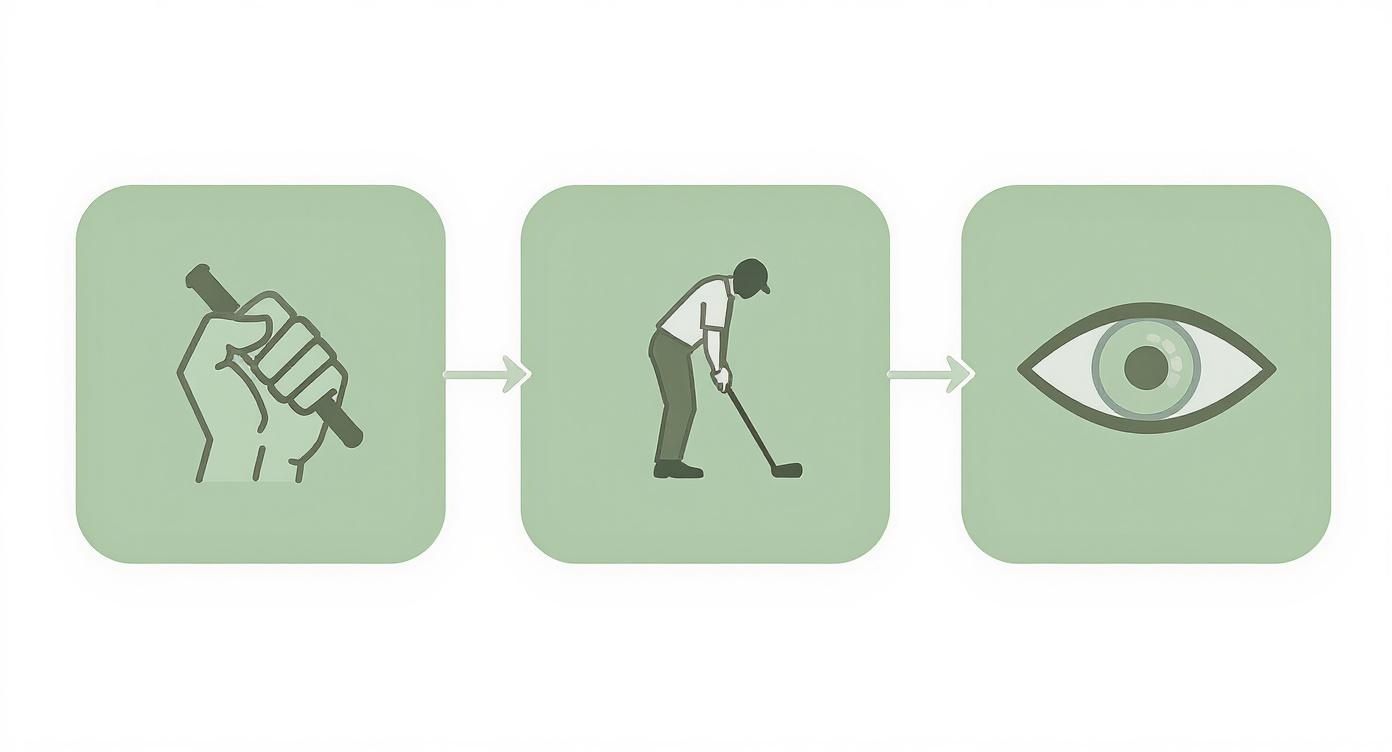
This visual is a great starting point. It shows how a proper setup puts your body in the perfect position to make that smooth, pendulum-like stroke we’re all chasing. It’s the bedrock for every drill we’re about to cover.
Golf Drills for Pinpoint Accuracy
Accuracy is everything, especially on those pesky short putts. The stats don’t lie: research shows that 41% of all putts are from five feet and in. If you can master these short ones at home, it’s the fastest way I know to slash strokes off your score.
Here are a couple of my favorite, incredibly simple drills to build that rock-solid confidence.
- The Clock Drill: This one’s a classic for a reason. Place one ball about three feet from your target. Then, arrange five or six more balls in a circle around the hole, just like the numbers on a clock face. The challenge? Sink every single one without a miss. If you miss, you start the circle over. It’s brilliant for building incredible mental toughness for those must-make putts.
- The Gate Drill: If you struggle with your start line, this is your new best friend. Place two tees or coins on the floor to create a “gate” just a little wider than your golf ball. Set this gate about a foot in front of your ball, directly on your intended line. The only goal is to roll the ball cleanly through the gate. It provides instant feedback on whether your putter face was square at impact.
Mastering Distance Control at Home in Golf
Want to eliminate three-putts? It boils down to one thing: distance control. Now, you obviously can’t practice a 40-footer in your living room, but you can absolutely calibrate your stroke length to control how far the ball rolls. Even on a short mat, you’re teaching your brain to connect the feel of a certain stroke size with a specific distance. This skill is critical. After all, knowing how to read greens is only half the battle if you can’t match your speed to the line you’ve chosen.
My absolute go-to for this is the Ladder Drill. Just place pieces of tape or other small markers on your floor or mat at three, six, and nine feet from where you’re putting. Start by hitting a putt that just reaches the first marker without going past it. Then, hit one to the second marker, and one to the third. Finally, work your way back down the ladder. This simple exercise builds an incredible feel for distance.
Making Golf Practice Engaging and Tracking Your Progress
If your home practice feels like a chore, you’re not going to stick with it. Simple as that. The secret to consistency is finding a way to turn mindless repetition into a fun, engaging challenge. That’s how you stay motivated and see the benefits show up where it counts: on your scorecard.
Instead of just rolling putts into a cup, start tracking some simple numbers. A fantastic place to start is your make-percentage from a set distance, like five feet. Hit 20 putts from that spot and just write down how many you sink. The simple act of measuring your performance instantly adds a layer of focus and purpose to your session.
Turn Golf Practice into a Game
Once you start tracking, you can create simple games and pressure drills that actually mimic the nerves you feel on the course. This is where the real improvement happens, helping you build a stroke that holds up when it really matters.
Here are a couple of challenges I use all the time:
- Make 10 in a Row: This is my personal favorite. Pick a spot about four or five feet from the hole. Your only job is to make 10 consecutive putts. If you miss one—even the ninth one—you go all the way back to zero. It’s tough, but it’s an incredible way to train yourself to handle pressure.
- Beat Your Score: Remember that 20-putt challenge? Let’s say you made 14 out of 20 last time. Today, your only goal is to make 15. This creates a constant, incremental push to get just a little bit better every single time you practice.
Tracking your progress isn’t just about the numbers; it’s about proving to yourself that the work you’re putting in is actually paying off. Seeing your make-percentage climb is one of the most powerful motivators you can have.
These small wins build massive confidence. Think about it: 10-handicap golfers make 94% of putts from 3 feet and in, while 20-handicappers drop to 89%. Seeing your own 3-foot make rate climb from 85% to 95% over a few weeks shows tangible improvement that will absolutely lower your scores. You can discover more stats on short putt performance to see just how critical these short ones are.
FAQ’s
Even with a perfect setup, questions are bound to pop up. Let’s dig into some of the most common ones I hear from golfers trying to dial in their putting at home. Getting these answers straight will keep you on the right track.
How Long Should I Really Practice?
This is a big one. Forget spending hours on the mat. What you’re really after is consistency.
A focused session of 15-20 minutes, maybe three or four times a week, is far more powerful than one marathon practice on a Sunday. Short, regular work builds that crucial muscle memory and keeps your stroke feeling sharp without burning you out.
Will Practicing on My Carpet Ruin My Feel for Real Greens?
Not at all—as long as you’re practicing the right things. Look, we all know your living room carpet isn’t rolling like the greens at Augusta. But that’s not the point. Home is where you perfect your mechanics.
Your #1 goal at home is to groove a repeatable stroke. Think stroke path, face angle at impact, and solid alignment. Nail those fundamentals, and they’ll transfer to any putting surface you encounter.
What’s the Single Most Important Skill to Work On?
If you only practice one thing, make it start-line control. No question.
Your ability to get the ball rolling exactly on your intended line is the foundation of all good putting. This is why drills like the “Gate Drill”—where you putt the ball through a narrow opening of two tees—are so valuable. If you can’t start the ball where you’re aiming, even the best green read in the world won’t save you.
Can I Actually Improve Distance Control on a Short Mat?
Absolutely. You might think you need a 30-foot green, but you can get a ton of work done on a short mat.
Distance control is all about calibrating the length and rhythm of your putting stroke. Use pieces of tape to create different targets on your mat. Practice hitting putts that stop precisely at each marker. This trains your brain to connect a specific stroke size with a specific distance, a skill that is absolutely essential for eliminating those frustrating three-putts on the course.
At Golf Inquirer, we believe that a better golf game starts with passion and the right knowledge. We’re here to guide you with tips, gear reviews, and inspiration for every step of your journey on the green.