
Let’s cut to the chase. If you want to learn how to hit a draw in golf, it all boils down to two key ingredients: an in-to-out swing path and a clubface that’s slightly closed to that path when you make contact. Nail that combo, and you’ll impart that beautiful, controlled right-to-left spin on the ball (for right-handers, of course). This isn’t just about finally ditching your slice; it’s about adding a strategic weapon to your arsenal that will fundamentally change how you play the game.
Why a Draw Can Revolutionize Your Golf Game
For many weekend golfers, hitting a draw feels like some kind of dark art, a mythical shot only tour pros can pull off. But it’s so much more than just a pretty ball flight. It’s a genuine tool that opens up a whole new world of strategy and injects a ton of confidence into your game. Once you grasp the real-world advantages, you’ll understand why it’s one of the most valuable skills you can add to your arsenal.

Honestly, this one shot is often what separates the elite players from the rest of us. If you look at PGA Tour ball flight data, you’ll see that the best players who prefer a draw use it on over 60% of their drives. That’s no accident. It’s a deliberate choice they make to gain an edge. You can read more about how the pros shape their shots to get a feel for their on-course strategy.
The Strategic Advantages of a Draw
So, what makes the draw such a game-changer? It delivers some serious practical benefits that will absolutely help you shoot lower scores and, frankly, have more fun out there. Instead of just reacting to what the course gives you, you start dictating the terms of engagement on every hole.
Here’s what you gain:
- More Distance: It’s simple physics. A draw has less backspin and a touch more topspin, which translates to more roll once the ball hits the fairway. This can easily add 10-15 yards to your drives. Suddenly, that long-iron approach shot becomes a much more manageable mid-iron.
- Taming Doglegs: That tricky par-4 that bends hard from right to left? A draw is the perfect prescription. You can shape the ball right around the corner, effectively shortening the hole and leaving yourself a simple wedge into the green.
- Attacking Tucked Pins: When the flag is stuck on the left side of the green, trying to fade one in there is asking for trouble. A draw is the smarter play. You can start the ball safely at the middle of the green and let it gently curve back toward the hole, using the entire putting surface as your landing area.
Learning this one shot shape adds a completely new weapon to your bag. It elevates you from someone who just hits the ball to a golfer who truly plays the game.
Building Your Draw from the Ground Up
A powerful, repeatable draw isn’t something you force during your swing. It’s something you build before you even take the club back. The secret is baked right into your setup—those small, deliberate adjustments at address that set the stage for the perfect inside-to-out swing path.
Think of it like laying the foundation for a house. If the foundation is crooked, you’ll spend all your time trying to fix things later. But get the setup right, and the rest of the swing just seems to fall into place.
Many golfers think the pros only hit fades, but that’s a myth. The draw has long been the signature shot of elite ball-strikers. A survey of 210 PGA Tour players revealed that about 40% preferred a draw, while only 30% favored a fade. You can see how the pros shape their shots for more on that.
These little pre-shot tweaks are what make a draw feel fluid and athletic, not forced and manufactured.
The Grip: Your Draw’s Engine
Your hands are your only connection to the golf club. That makes your grip the absolute command center for controlling the clubface. To encourage a draw, you need what we call a “stronger” grip. Now, this has nothing to do with squeezing the life out of the club; it’s all about how your hands are rotated.
For a right-handed golfer, a stronger grip means rotating both hands just a touch to the right on the handle. When you glance down at address, you should easily see two or even three knuckles on your left hand. Your right hand will naturally settle a bit more underneath the grip to match.
This simple rotation pre-sets your hands to release and close the clubface through the hitting area. It’s the quickest shortcut to getting that right-to-left spin you’re looking for.
Aligning Your Body for Success
Got the grip? Great. The next piece of the puzzle is alignment. This is where a lot of golfers tie themselves in knots, but the idea is actually pretty simple. To swing the club from the inside, your body needs to be aimed slightly to the right of your final target (for a righty).
Here’s the relationship you need to burn into your brain:
- Clubface: Aim it directly at your final target (where you want the ball to end up).
- Body Line (Feet, Hips, Shoulders): Aim it slightly to the right of the target.
This “closed” stance is what gives you the room to swing from inside the target line. I like to picture a set of train tracks. The outside track is your body’s alignment, pointing right of the flag. The inside track is your club’s path, also heading right, but with the clubface pointed back down the line to your destination.
This setup is the cornerstone of hitting a draw. It practically forces the club to approach the ball from the inside. If you skip this step, you’ll spend the whole day fighting your own body to produce the right swing path.
Setup Adjustments for a Draw vs a Fade
Understanding the subtle differences in setup is key to controlling your ball flight. This table breaks down the fundamental changes between setting up for a draw and a fade for a right-handed golfer.
| Setup Element | For a Draw (Right-Handed Golfer) | For a Fade (Right-Handed Golfer) |
|---|---|---|
| Grip | Stronger (hands rotated slightly right) | Weaker/Neutral (hands rotated slightly left) |
| Stance | Closed (feet, hips, shoulders aim right of target) | Open (feet, hips, shoulders aim left of target) |
| Ball Position | Slightly further back in stance (promotes in-to-out path) | Slightly more forward in stance (promotes out-to-in path) |
| Shoulder Tilt | More tilt (right shoulder lower than left) | Less tilt (shoulders more level) |
Notice how each element for a draw encourages an inside-to-out path, while the fade setup does the exact opposite. Mastering these adjustments gives you ultimate control over shot-shaping.
Mastering an In-to-Out Swing Path
Alright, you’ve got your setup dialed in. Now for the fun part: the swing itself. This is where a lot of golfers get lost in the weeds, trying to memorize a million different mechanical positions. Let’s forget that. Instead, we’re going to focus on the feel of an in-to-out swing path, creating a simple thought that your body can easily translate into action.
The whole goal here is to get the club coming at the ball from inside the target line. The opposite of this is that dreaded “over the top” move from the outside that causes a slice.
Here’s a great mental image: imagine you’re a baseball player trying to hit the ball to the opposite field. If you’re a right-handed golfer, this means feeling like you’re swinging the clubhead out towards right-center field. That single thought helps prevent your shoulders from spinning open too early—the number one killer of a good swing path. When you try to hit it to “right field,” your body naturally keeps the club on a shallower, inside track.
This simple graphic breaks down how your setup makes this swing path possible.
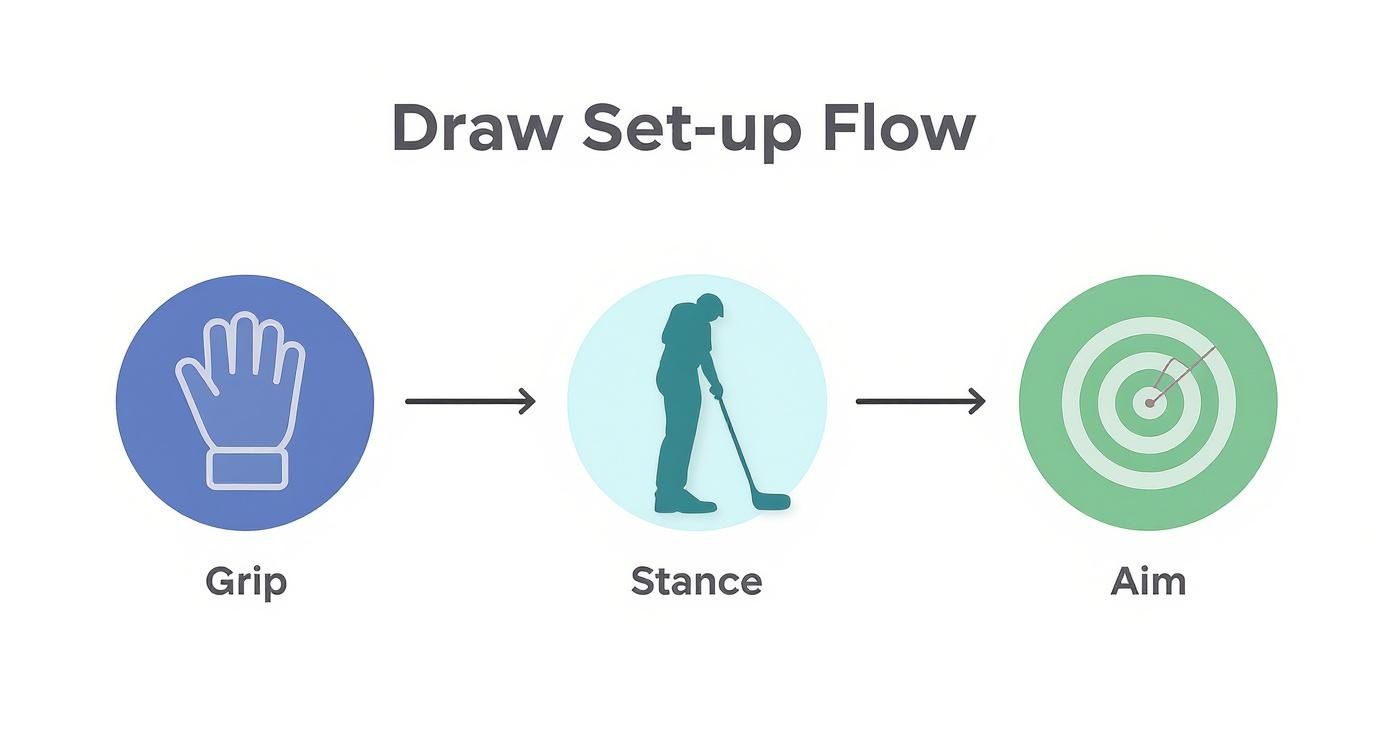
As you can see, a reliable draw starts before you even swing. It begins with the grip, flows into your stance and alignment, and is finalized by where you aim. It’s a complete package.
Let Your Lower Body Lead the Way
One of the biggest mistakes amateur golfers make is starting the downswing with their upper body. When you fire your shoulders and arms first, you throw the club outside the target line, forcing that steep, out-to-in path that produces a slice.
To groove an in-to-out path, your downswing has to start from the ground up. The first move should be a feeling of your left hip (for a righty) clearing as it rotates toward the target. This one simple move is a game-changer because it does two incredible things:
- It creates space: As your hips clear out of the way, your arms and the club have room to drop down into the “slot”—that perfect inside position you’re looking for.
- It generates lag: Starting with the lower body lets the clubhead trail behind your hands, storing power that you can release like a whip through impact.
Think about cracking a whip. The handle (your hips) moves first, sending a wave of energy down the line that ends with a powerful snap (the clubhead).
The Numbers Behind the Perfect Draw
From a technical standpoint, hitting a draw is a science. You need a specific relationship between your swing path and your clubface. Biomechanics studies have shown that for a right-handed golfer, the ideal draw involves:
- A swing path that is about 3 to 5 degrees from inside to outside.
- A clubface that is about 1 to 2 degrees open to the target at impact, but still closed relative to the swing path.
That precise combination is what makes the ball start just right of the target and then curve gently back. You can dive deeper into how these numbers translate to your swing on golfwrx.com.
Your posture is the glue that holds this whole thing together. If you lift your chest or stand up through the shot, you lose your angles. The club will inevitably reroute, and you’ll probably come over the top. Try to feel like you keep your chest pointed down at the ball for as long as possible through impact.
This feeling of “staying in the shot” is absolutely critical. It keeps your swing plane consistent and lets the club follow that inside path without any extra manipulation. When you combine a lower-body-led downswing with stable posture, you’ve got the one-two punch that will finally kill your slice and make hitting a draw feel effortless.
Practical Drills to Ingrain Your Draw
Theory is great, but your muscles don’t learn from reading. To really lock in that beautiful draw, you have to translate concepts into feelings. Drills are how we do that—they’re the bridge between knowing what to do and actually doing it, building the muscle memory you need for a consistent swing.
Of course, before you start swinging, a proper effective warm-up routine is non-negotiable. It’ll get your body ready and help keep you off the injured list.

These two drills are absolute classics for a reason. They’re simple, you can set them up in a minute on any driving range, and they give you instant, undeniable feedback on your swing path and body connection—the two pillars of a reliable draw.
The Headcover Gate Drill
This is my go-to drill for anyone struggling with that dreaded over-the-top move. By creating a physical “gate,” you pretty much force your club to approach the ball from the inside, making an in-to-out path feel completely natural.
- Set Up Your Gate: Pop your first headcover on the ground a few inches outside your target line and just behind the ball. Place a second one a few inches inside your target line and just past the ball.
- Swing Through: The mission is simple: swing the clubhead through the gate without hitting either headcover. If you come over the top, you’ll smack the outside headcover. Swing too much from the inside, and you might clip the inside one.
The Feeling: When you get it right, you’ll physically feel the club dropping behind you and swinging “out to the right” (for a righty) through impact. It’s the perfect way to groove that shallow, inside path you’re after.
This drill is brutally honest. There’s no guessing if your path was correct—you’ll know instantly if you hit a headcover. It’s an incredibly effective way to retrain your swing path away from that slice-inducing move.
You can also create a similar, more defined path using alignment sticks. If you want to dive deeper, exploring a variety of golf alignment stick drills can add a ton of value to your practice sessions.
The Towel Under the Arm Drill
A huge cause of the slice is the arms disconnecting from the body during the swing. This simple drill forces you to keep everything working as one unit, promoting a swing powered by your body’s rotation, not just an arm-flinging motion.
- Tuck the Towel: Grab a small golf towel and tuck it under your lead arm (left arm for a right-handed player), pinning it against your chest.
- Take Your Swings: Start with some easy half-swings. Your only focus is keeping that towel snug. Once that feels comfortable, you can build up to fuller swings.
- The Goal: That towel should stay put until after you’ve made contact with the ball.
If the towel drops out early, either in your backswing or downswing, it’s a dead giveaway that your arm is flying away from your body—a classic move that throws the club “over the top.”
The Feeling: When you nail this, it feels like your torso and arms are moving in perfect sync. You’ll feel your body turn pulling the club through the hitting zone, which naturally keeps it on that crucial inside path. It’s all about creating a powerful, body-driven swing built on rhythm and connection, not brute force.
Troubleshooting Common Draw Mistakes
So, you’ve put in the reps. You’ve tweaked your grip, closed your stance, and you’re really feeling that inside-out swing. But for some reason, the ball just isn’t cooperating, and that beautiful, gentle draw you’re picturing remains elusive.
Don’t get frustrated. This is the most common part of the process. Every bad shot is a piece of the puzzle, a clue telling you exactly what needs a little adjustment. Let’s play swing detective and figure out what’s really going on.
The Overcooked Snap Hook
First up is the dreaded snap hook. This is the shot that starts right (or maybe straight) and then takes a sharp, aggressive dive to the left, usually finding the deepest trouble on the course. It’s a classic case of too much of a good thing.
The good news? You’ve probably nailed the swing path! Getting the club coming from the inside is a huge win. The problem is that your clubface is shutting down way too fast through impact. This usually points to one of two culprits: a grip that’s too strong or hands that are getting too “flippy” at the bottom of the swing.
Here’s how to dial it back:
- Grip Check: Look down at your left hand (for a right-handed golfer). If you can see four knuckles staring back at you, your grip is way too strong. Weaken it by rotating that hand back toward the target until you only see 2 to 2.5 knuckles.
- Quiet the Hands: The feeling you want is your body’s rotation squaring the clubface, not a conscious roll of the wrists. Think of your arms and the club as one solid unit being pulled through by the turn of your torso.
The Dreaded Push to the Right
Next, we have the push. This shot starts right of your target and just keeps sailing straight in that direction, never even thinking about curving back. It’s a crystal-clear sign that your swing path is inside-to-out (which is great!), but your clubface is staying wide open through the hitting area.
Basically, your path is perfect for a draw, but your face is matching that path instead of being slightly closed to it. This often happens when your body’s rotation stalls or if you’re subconsciously trying to “hold off” the club’s release for too long.
A push means your draw is halfway home. The in-to-out path got the ball started right, but an open face never gave it the signal to turn back left. You just need to get the face squared up.
To fix this, get in touch with a proper release. It should feel natural, like skipping a stone across a pond or throwing a frisbee—your forearm and wrist just rotate. Practice making some slow-motion swings where you feel the toe of the club overtaking the heel just after you make contact with the ball.
The Frustrating Straight Pull
Finally, there’s the straight pull. This is the shot that launches left of your target and flies dead straight on that line. When this happens, it’s often your old swing habit sneaking back in. A pull is caused by an out-to-in swing path (the classic “over the top” move) combined with a clubface that’s square to that path.
It’s the polar opposite of a push. Many golfers fall back into this pattern when they get a little anxious and initiate the downswing with their shoulders and arms instead of their lower body.
If this sounds familiar, it’s a great time to review the fundamentals. Our complete guide on how to stop slicing the golf ball has some fantastic drills for retraining that over-the-top motion.
The fix here is to get back to basics. Really concentrate on starting your downswing with your lower body. Feel your hips clearing out of the way to create space, allowing the club to naturally drop “into the slot.” The “Towel Under the Arm” drill we covered earlier is the perfect antidote for this mistake.
Understanding how to hit a draw in golf can elevate your game significantly.
FAQ’s
Even after getting the setup, swing path, and drills down, it’s totally normal to have a few nagging questions. Learning to hit a draw is a process, and getting these last few details sorted out can be the final piece of the puzzle you need to confidently take this shot from the range to the first tee.
Let’s clear up some of the most common questions I hear from golfers who are dialing in their draw.
Does My Equipment Affect My Ability to Hit a Draw?
Absolutely. While your technique will always be the most important factor, your clubs can either work with you or against you.
Modern drivers are a perfect example, as many now come with adjustable weights. By sliding a weight toward the heel of the club, you make it easier to close the face through impact—it’s a feature designed specifically to encourage a draw.
Clubs with more offset can also give you a helping hand. Offset is when the leading edge of the clubface is set back from the hosel, giving you a split second longer to square the face at impact. If you’re in a constant battle with a slice, it might be worth looking at clubs with these draw-biasing features.
A well-fitted club can make the whole process feel much more intuitive. But remember, no amount of technology can completely fix a major swing flaw. Your technique and your equipment have to be on the same team.
What Is the Difference Between a Draw and a Hook?
This is a critical distinction to understand. A draw is a controlled, go-to shot shape; a hook is a costly, round-wrecking mistake. While both shots curve from right to left (for a right-handed player), the real difference is in the degree and predictability of the curve.
A draw is a thing of beauty. It starts just a little right of your target and curves gently back toward it, landing softly. It’s the shot you’re trying to hit.
A hook is the draw’s ugly cousin. It often starts straight or even left of the target before taking a sharp, uncontrollable dive to the left. It’s what happens when your clubface is way too closed relative to your swing path.
Think of it this way: a draw is like a surgeon’s scalpel, and a hook is like a sledgehammer. If you find yourself hitting hooks, it’s a clear sign you’ve overdone one of the draw fundamentals. Most of the time, the culprit is a grip that’s too strong or hands that are flipping over too aggressively at impact.
Do I Need to Change My Technique for Irons vs. a Driver?
Yes, but the changes are subtle. The core principles—an in-to-out swing path and a clubface that’s slightly closed to that path—are exactly the same. The main differences are in your setup and your angle of attack.
With a driver, you need to hit up on the ball. To do this, you’ll have a wider stance, and the ball will be positioned forward, just inside your lead heel. This setup naturally promotes the shallower, sweeping in-to-out path you’re looking for.
With your irons, you’re hitting down on the ball to create that pure, compressed strike. The ball moves back toward the center of your stance, and your angle of attack becomes steeper. The key is to maintain your closed body alignment to the target, which still gives you the space you need to swing from the inside.
At Golf Inquirer, we believe that digging into the nuances of shots like the draw is what makes this game so addictive. For more practical tips, honest gear reviews, and everything else you need to elevate your game, explore our articles and join a community that’s as passionate about golf as you are. Find your next insight at https://golfinquirer.com.