Let’s get one thing straight: the fastest way to finally break 100 has absolutely nothing to do with playing like a pro. In fact, it’s the exact opposite. It’s about playing smart, disciplined, and sometimes even a little boring. Understanding how to break 100 in golf is essential to achieving your goal. To truly understand how to break 100, you must commit to the process.
In this article, we will explore practical strategies for how to break 100 and improve your overall game. It’s a simple but powerful mindset shift: start embracing bogey golf as your new gold standard. Your focus should be entirely on eliminating the big mistakes—those soul-crushing penalty strokes and infuriating three-putts. This game isn’t about perfection; it’s about damage control.
For those eager to learn how to break 100, remember that patience is key. Every golfer’s journey is unique, and improvements will come with time.
Your Realistic Path to Breaking 100 in Golf
The quest of how to break 100 is not just about numbers; it’s about personal growth as a golfer.

Welcome to one of golf’s most common—and frustrating—milestones. For a lot of golfers, scoring in the double digits feels like a distant dream, but the truth is it’s far more achievable than you might think. While you practice how to break 100, focus on areas that will yield the greatest return on your time investment.
The journey isn’t paved with perfectly striped drives or gutsy shots over water. It’s built on a foundation of smart course management, disciplined shot selection, and a dead-simple short game. So, forget trying to copy the pros you see on TV. Their game isn’t your game. Your new mission is to play smarter, not harder, by consistently avoiding the “blow-up” holes that absolutely wreck a scorecard.
The core idea is simple: your main goal on every single hole is to take anything worse than a double bogey completely out of play. By aiming for the fat part of the fairway and the center of the green, you trade risky, low-percentage hero shots for safe, high-percentage results.
Understanding the Milestone in Golf
Remember that how to break 100 is a journey, and every golfer faces challenges along the way.
This shift from chasing birdies to just preventing disaster is the absolute key. It’s a mental game just as much as a physical one. If you’ve been stuck hovering over 100, you’re not alone. In fact, finally breaking through that barrier puts you in some pretty good company. Each time you apply what you’ve learned about how to break 100, you’ll gain valuable experience.
According to industry data, only about 55% of golfers who keep an official handicap can consistently break 100. That stat shows that nearly half of all dedicated players struggle with this benchmark, which proves just how big of an achievement it really is. You can dig into more golfer scoring data over on Nexbelt’s blog.
This guide gives you a clear roadmap built on three pillars of smarter golf:
- Intelligent On-Course Strategy: Learning how to think your way around the course and steer clear of trouble.
- Disciplined Shot Selection: Knowing which club to hit and, more importantly, which one to leave in the bag.
- A Simplified Short Game: Focusing on repeatable, easy techniques that shave strokes off your score around the green.
Winning the Game Before Your First Golf Swing
When considering how to break 100, focus on your mental approach as much as your physical skills. Your round of golf doesn’t start on the first tee box; it begins the moment you decide to play. I’ve seen it time and time again: the difference between a frustrating day hacking it around and a personal best often comes down to what you do before that first swing. How you show up mentally can be just as crucial as any shot you hit.
Instead of getting hung up on a final score like 99, let’s try a different approach. Set a simple, process-oriented goal for the day. This shifts your focus from an outcome you can’t fully control to actions you absolutely can.
Maybe your goal is “no three-putts today.” Or perhaps it’s “avoid all penalty strokes.” This small mental switch takes the pressure off and helps you zero in on making good decisions, one shot at a time. When you start nailing these smaller goals, the score has a funny way of taking care of itself. To unlock your potential and learn how to break 100, keep a positive mindset even when the game gets tough.
Conduct a Practical Golf Bag Audit
Alright, let’s talk about your clubs. There’s a common myth floating around that you need a full set of 14 clubs to play your best. Frankly, for someone trying to break 100, carrying too many options often creates more problems than it solves, leading to indecision and poor choices on the course. It’s time for a quick, honest bag audit.
Be real with yourself: which clubs are your troublemakers? For a lot of high-handicappers, the usual suspects are the driver and the 3-wood. They promise glorious distance but too often deliver a wicked slice into the trees or a topped shot that dribbles ten feet in front of you.
Key Takeaway: If a club costs you more strokes than it saves, it doesn’t belong in your bag for this round. Your ego might take a small hit, but your scorecard will thank you profusely.
One of the smartest, most strategic decisions you can make in your quest to break 100 is leaving the driver in the car. This isn’t a sign of weakness; it’s the mark of a player who understands their game and is playing to win their own battle.
Leaning on a more reliable club off the tee—like a trusty hybrid or even a 7-iron—immediately sets a foundation of confidence. Hitting a fairway, even if you’re a bit shorter, is infinitely better than punching out sideways from the woods for your third shot. This minimalist approach simplifies your decisions, calms the on-course anxiety, and lets you start the day with a solid, repeatable plan. You’re finally playing your game, not the one you think you should be playing.
Smart Golf Course Management to Avoid Big Numbers
The single fastest way to finally break 100 has almost nothing to do with your swing. It’s about learning to think your way around the golf course like a chess player, not a long-drive champion. Forget the heroic, high-risk shots. Your mission is to play the percentages and steer clear of those big numbers that absolutely destroy a scorecard. If you want to understand how to break 100, start by analyzing your past rounds for opportunities to improve.
This is where the “bogey golf” philosophy really comes alive. It’s a simple tactical approach built on one rule: avoid trouble at all costs. Birdies are a nice surprise and pars are great, but bogeys are perfectly fine. The real enemy is the double bogey or worse, and those almost always start with a bad decision, not a bad swing.
Golf: Target the Widest Part of the Fairway
Picture this: you’re on the tee box of a tricky par 4. There’s a bunker on the right and a line of trees down the left. The average golfer sees the flag in the distance and just aims for the middle, which is often the narrowest and most dangerous path.
A smarter golfer ignores the pin entirely. Instead, they scan the hole and find the widest, safest part of the fairway—even if it isn’t the most direct route. Aiming for this “fat” part of the fairway gives you a massive margin for error. A slice that would have ended up deep in the trees might now just be in the first cut of rough.
This simple shift in thinking makes club selection easier, too. It’s not always about grabbing the driver.
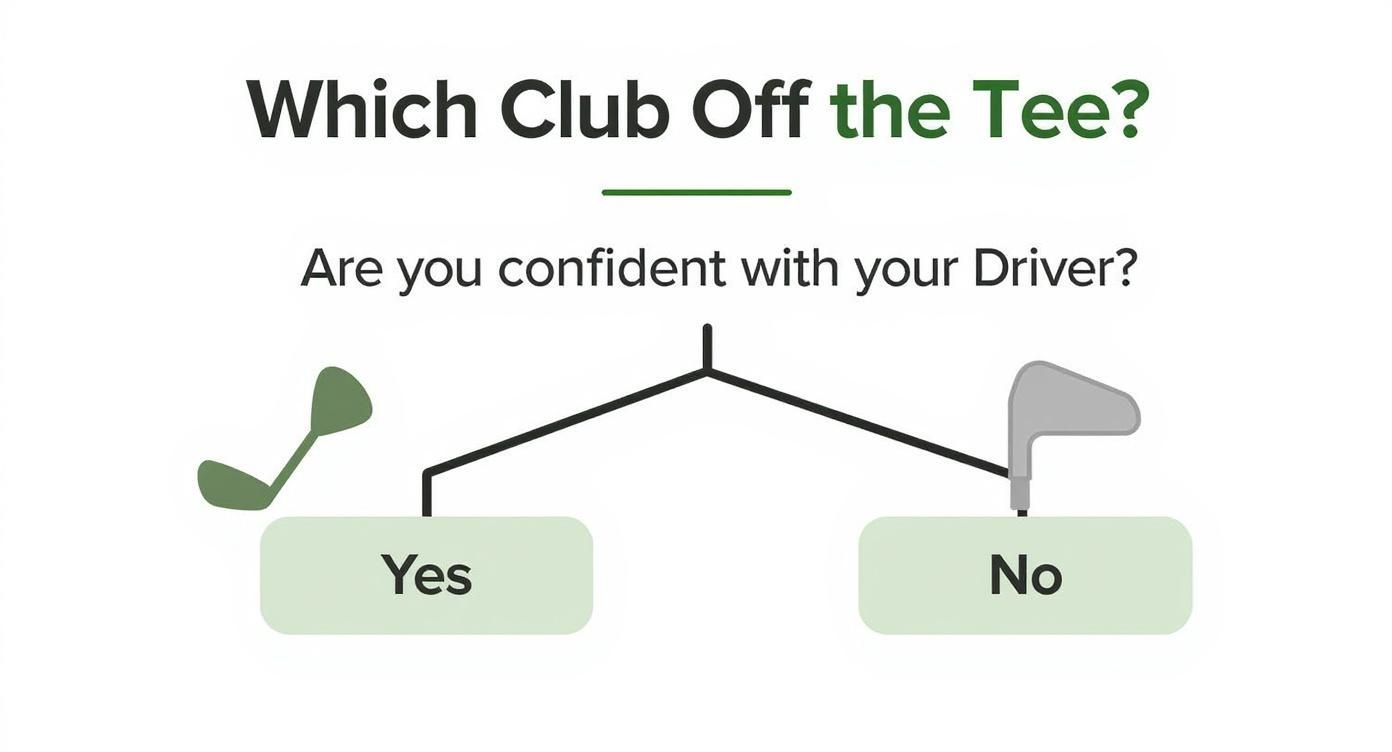
The key takeaway is that your confidence—not the potential for an extra 20 yards—should dictate your club choice off the tee. When in doubt, a hybrid or a long iron is the smarter play.
Always Aim for the Center of the Green in Golf
This same logic applies to your approach shots. Hunting for pins is one of the biggest mistakes amateur golfers make. Those flags tucked behind bunkers or hugging the edge of the green? They’re “sucker pins,” designed to tempt you into a low-percentage shot that often ends in disaster.
Your target on every single approach shot should be the center of the green. Always. This strategy does two critical things for your score:
- It maximizes your margin for error. A slight pull or push still finds the putting surface instead of landing you in a bunker or that thick, nasty rough.
- It eliminates big numbers. Getting stuck in a greenside bunker can easily add two or three strokes to your score. Hitting the green leaves you with, at worst, a long putt for a simple two-putt bogey.
By consistently aiming for the middle of the green, you’ll trade a few potential birdie opportunities for a massive reduction in doubles and triples. This trade-off is the mathematical secret to breaking 100.
Another game-changer is simply taking one extra club. Most amateur golfers come up short on their approach shots. Hitting a 7-iron when you think it’s a perfect 8-iron ensures your ball carries any trouble at the front of the green. Trust me, a long putt from the back edge is always better than a delicate chip over a bunker.
Don’t underestimate this accomplishment. Estimates suggest that only about 55% of golfers who track their scores manage to break 100. And that number is probably inflated, as many players don’t follow the rules strictly. If you’re curious, you can learn more about these stats by checking out research on the topic.
To put this all into perspective, here’s a look at how these decisions play out on the course.
On-Golf Course Decisions for Breaking 100
| Situation | Common Mistake (Score Inflator) | Smart Strategy (Score Saver) |
|---|---|---|
| Tricky Tee Shot | Grabbing driver automatically, aiming for the pin, and hitting into trouble. | Choosing a club you’re confident with (like a 5-wood or hybrid) and aiming for the widest part of the fairway. |
| 150-Yard Approach | Pin-hunting a tucked flag and missing the green, leading to a tough chip from a bunker or rough. | Aiming for the center of the green, taking one extra club to be safe, and ensuring a putt for your next shot. |
| Over a Water Hazard | Trying a low-percentage hero shot to carry the water from a long way out. | Laying up to a comfortable wedge distance, taking the hazard completely out of play. |
| Punching Out of Trees | Trying to advance the ball 100+ yards through a small gap and hitting another tree. | Taking your medicine. Punching out sideways back to the fairway, even if it feels like losing a shot. |
Thinking this way turns a potential blow-up hole into a manageable bogey, which is the entire secret to shooting in the 90s.
A Real-World Scenario in Golf Strategy
Let’s walk through a difficult hole. Imagine a 380-yard par 4 with a pond guarding the front right of the green.
- The Common Mistake: The average golfer grabs driver, slices it into the trees, and has to punch out. Now lying two, they’re 170 yards away and try a heroic shot over the water. They chunk it into the pond. After taking a drop, they’re lying five and still aren’t on the green. This hole quickly spirals into an 8 or 9.
- The Smart Strategy: The savvy player hits a 5-iron off the tee to the widest part of the fairway, leaving 190 yards in. They then hit another 5-iron to a safe layup area about 40 yards short of the green, well away from the water. From there, it’s a simple wedge onto the center of the green and two putts for a stress-free bogey 5.
That conservative game plan turns a potential disaster into a routine score. This is proof that smart course management, not a perfect swing, is your most powerful tool for breaking 100.
Simplifying Your Short Game to Save Strokes in Golf

If you’re looking for the fastest path to finally breaking 100, forget about your driver for a minute. The real magic happens inside 100 yards. This is where scores are made, but more importantly for us, it’s where they’re saved. You don’t need a tour pro’s silky touch; you just need a few simple, repeatable shots that you can count on when the pressure’s on.
So many golfers get stuck because they piece together advice from buddies or try to figure it out alone. It’s a tough road. But by stripping things down to the basics, you can build a short game that consistently shaves strokes off your score.
Master One Go-To Chip Golf Shot
Standing just off the green can feel overwhelming. Should you hit a high, soft flop shot? A low spinner? This indecision is a recipe for disaster, often leading to a chunk or a bladed shot across the green. The fix? Simplify. Master just one shot.
Your new best friend is the bump-and-run. Put that 60-degree wedge away and pull out something like an 8-iron.
- The Setup: Position the ball back in your stance, lean your weight onto your front foot, and take your putting grip.
- The Motion: Use a simple, short stroke—think of it as a firm putt. Your wrists should stay quiet.
- The Goal: Just land the ball a few feet onto the green and let it release and roll toward the pin like a long putt.
This shot is all about minimizing risk. The smaller swing makes it incredibly difficult to hit a truly terrible shot, and the lower loft gives you a predictable roll every time. For a deeper look at these fundamentals, our guide on chipping and putting mastery is a great resource.
By committing to one reliable chip shot, you eliminate indecision and build massive confidence around the greens. Repetition builds consistency, which is exactly what you need to break 100.
Eliminate the Dreaded Three-Putt in Golf
Nothing blows up a scorecard faster than a three-putt. Your primary mission on any green isn’t to hole every putt—it’s to get down in two. For the high-handicapper, speed control is everything. It’s far more critical than finding the perfect line. Get your distance right, and you’ll almost always leave yourself a stress-free tap-in.
A fantastic drill for this is the lag putting ladder. Set up three balls at 15, 30, and 45 feet from the hole. The goal isn’t to sink them, but to get each one to stop inside an imaginary three-foot circle around the cup. This drill hardwires the connection between your stroke length and distance into your brain, which is the key to great lag putting.
Basic Bunker Play for a Simple Escape in Golf
Finally, let’s talk about the beach. Your goal in a greenside bunker is brutally simple: get the ball out on your first try. That’s it. We aren’t worried about cozying it up to the pin. This is pure damage control.
Here’s the only thought process you need for a standard bunker shot:
- Open your clubface so it’s pointing at the sky.
- Take your aim at a spot in the sand about two inches behind the ball.
- Make an aggressive swing and follow through completely.
Don’t try to lift or scoop the ball out. Trust the club’s design. It’s built to glide through the sand, and it’s the sand that will launch the ball up and onto the green. It doesn’t have to be pretty. An escape to anywhere on the putting surface is a massive victory and keeps a potential triple bogey from ruining your card.
How to Practice Golf with a Purpose
Showing up to the driving range and mindlessly hitting a large bucket of balls might feel like you’re putting in the work, but it’s one of the biggest wastes of time in golf. Hitting the same 7-iron over and over does almost nothing to prepare you for the course, where you never get the same shot twice.
If you’re serious about finally breaking 100, your practice sessions need to mirror the challenges you’ll actually face out there. It’s time to ditch the mindless repetition and adopt a structured plan that actually translates to lower scores. To master how to break 100, work with a coach or mentor who can provide personalized feedback.
Adopt the 60/40 Practice Split in Golf
The fastest way to slash strokes off your score is to get better from 100 yards and in. It’s just simple math. So, your practice time should reflect where you’re bleeding the most shots. A great way to start is with the 60/40 rule.
- 60% of your time on the short game. This means putting, chipping, pitching, and bunker shots. This is where you eliminate those soul-crushing three-putts and chunked chips that turn pars into double bogeys.
- 40% of your time on full swings. This covers everything else—your irons, hybrids, fairway woods, and driver.
This simple split forces you to work on the shots that truly matter for scoring. Sure, it’s not as glamorous as trying to bomb drivers for an hour, but dedicated short game work pays off on the scorecard almost immediately.
Simulate Real Golf on the Range
When it’s time for that 40% of full-swing practice, the last thing you want to do is hit your driver on repeat. Instead, turn the driving range into a virtual golf course. This is how you build the on-course adaptability you actually need.
Pick a target on the range and pretend it’s the first hole. Hit the club you’d normally use off the tee. For your next shot, choose a different target that represents the green and select the appropriate iron. Keep going like this, never hitting the same club twice in a row and always picking a specific target. This trains your brain to reset and focus before every single swing, just like you have to do on the course.
Of course, to get the most out of these swings, you need a body that can cooperate. It’s crucial to understand how to improve flexibility to build a powerful and safe golf swing.
A good practice session is about quality, not quantity. Hitting 20 shots with a clear target and a full pre-shot routine is infinitely more valuable than smacking 100 balls without a single thought.
Make Golf Practice Fun and Effective
Let’s be honest—practice can feel like a chore. That’s why turning drills into games is so effective. It keeps you engaged and, more importantly, builds skills that actually hold up under pressure. You can find tons of great golf drills and practice routines to keep things fresh.
Here’s a simple but incredibly powerful pressure-putting game to start with:
- Find a flat spot on the putting green and place five balls in a circle, each about four feet from the hole.
- Your goal is to make all five putts in a row.
- If you miss any of them, you have to start the entire sequence over from the beginning.
This drill does more than just groove your mechanics on short putts. It introduces a little consequence, simulating that nervous feeling you get on the course when you’re standing over a must-make putt.
When you can confidently knock in those nervy four-footers in practice, you’ll build the conviction to drain them when it really counts. Remember, the process of learning how to break 100 can be just as rewarding as the final score.
FAQ’s
Now that you understand how to break 100, let’s tackle those frequently asked questions. Look, even with the best game plan in the world, you’re going to have questions. Everyone does. Let’s run through a few of the most common ones I hear from golfers trying to finally card that sub-100 score. Many golfers wonder how to break 100 consistently. The answer lies in practice and smart choices on the course.
Do I Need Expensive New Clubs?
In a word? No. It’s so easy to get caught up in the marketing hype, but shiny new clubs are not the secret sauce for shooting in the 90s.
Your ability to break 100 comes down to course management, a simple strategy, and consistency. That’s it. It has almost nothing to do with the latest driver tech. In fact, sticking with clubs you know and are comfortable with is a massive advantage. I’d take a player with a trusted 10-year-old 7-iron over someone trying to figure out a brand-new, fancy set any day of the week.
Get good with the tools you have first. Upgrades can wait.
How Much Do I Really Need to Practice?
This is where people get it wrong. They think they need to live at the range. You don’t.
Consistency always beats cramming. One or two focused, one-hour practice sessions a week will do more for your game than one marathon four-hour session ever could. The trick is to practice with a purpose, not just bang balls into a field.
Remember that 60/40 rule? It’s your new best friend. Spend 60% of your time on and around the greens (putting and chipping) and just 40% on your full swing. This is how you attack the part of your game that bleeds the most strokes.
What If I Have a Really Bad Hole?
First off, welcome to the club. Every single golfer, from a Tour pro to a weekend warrior, has blow-up holes. It’s part of the game. What separates the players who break 100 from those who don’t is how they react.
A double or triple bogey doesn’t have to sink your entire round. Once that hole is done, it’s done. Leave it on the green you just walked off and don’t carry that baggage to the next tee.
Here’s your immediate reset plan:
Take a Deep Breath: Seriously. Before you even pull a club, just breathe. Reset your mind.
Recommit to Your Strategy: Go right back to the simple plan. Aim for the biggest part of the fairway. Aim for the middle of the green. No hero shots.
Focus on the Next Shot: The past is gone. The only thing you control is the shot right in front of you. Make it a good one.
Building that mental toughness is just as important as your swing. Don’t let one bad hole cascade into five more. Your ability to shake it off and get back to the game plan is what will finally get that score into double digits.
At Golf Inquirer, we strive to support you as you learn how to break 100 and enjoy the game. Whether you’re just learning the ropes or exploring the world’s most incredible courses, we’re here to guide you. Check out more tips, gear reviews, and stories at https://golfinquirer.com.