
Ever hit a golf ball so pure it feels like you barely touched it, yet it just rockets off the clubface? That feeling isn’t about swinging harder; it’s about swinging smarter. The secret sauce is mastering the effortless dance of weight transfer. When you get it wrong, you get the frustrating stuff: slices, chunks, and shots that go nowhere. But when you nail it, you unlock a powerful chain reaction that delivers speed, consistency, and that oh-so-sweet sound of a purely struck ball.
This isn’t just another list of generic tips. We’re diving into seven specific, actionable golf weight transfer drills that get to the root of common swing problems. Whether you’re feeling the ground through your feet or learning to generate power like an athlete with a medicine ball, each drill is a key to unlocking a better, more repeatable golf swing.
You’ll get a clear, no-nonsense roadmap for each drill—how to set it up, how to do it step-by-step, and the common pitfalls to watch out for. Whether you’re a beginner just trying to find your balance or a seasoned player hunting for an extra 15 yards off the tee, these drills will help you stop swaying and start swinging with real power and intent. Let’s get to it.
- 1. The Pressure Plate or Balance Board Drill
- 2. The Step Drill (Forward Step or Walking Drill)
- 3. The Trail Heel Lift Drill (Heel Raise Drill)
- 4. The Medicine Ball Slam/Throw Drill
- 5. The Split Stance/Split Weight Drill
- 6. The Lead Arm Drag Drill (Shallowing Drill)
- 7. The Single-Leg Balance Drill (Single Leg Stability Drill)
- Golf Weight Transfer — 7-Drill Comparison
- From Practice Range to Fairway: Making These Drills Count
1. The Pressure Plate or Balance Board Drill
This drill is the truth-teller of weight transfer. Using a pressure-sensitive mat or even a simple balance board gives you instant, honest feedback on where your weight is—and where it should be—during your swing. It takes the guesswork out of the equation, turning a vague “feel” into something you can actually see and measure.

There’s a reason the pros on the PGA Tour and top coaches at places like the Titleist Performance Institute are obsessed with this data. It helps train the correct sequence of how and when your pressure moves, which is the foundation of creating power without losing your balance.
How to Execute the Drill
- Setup: Stand on the board or mat in your normal golf posture, feet shoulder-width apart. Start with your weight feeling pretty much 50/50 between your left and right foot.
- Backswing: As you start your backswing, let your pressure flow smoothly toward your trail foot. By the time you reach the top, you want to feel about 80% of your pressure loaded into the inside of that trail heel.
- Transition: This is where the magic happens. As you start the downswing, your pressure needs to move toward your lead foot before your hands and club start coming down. Getting this sequence right is what creates effortless power.
- Impact and Follow-Through: At the moment of impact, you should feel at least 90% of your pressure firmly on your lead foot. Keep rotating through the shot until you’re in a balanced finish, with all your weight posted on that lead side.
Key Coaching Cues and Common Mistakes
- Feel the “Squat”: In that transition from backswing to downswing, feel a subtle squatting motion as you shift forward. This is how you use the ground for leverage, just like a baseball pitcher.
- Don’t Sway: A huge mistake is sliding your hips side-to-side (swaying) instead of rotating. Your belt buckle should stay relatively centered while the pressure under your feet does the moving.
This is one of the most effective golf weight transfer drills because you can’t fake it; the feedback is instant. If you don’t have a high-tech mat, you can still get the same benefit from affordable tools like balance trainers like a yoga stability disc, which will still challenge your stability and highlight where your weight is going.
2. The Step Drill (Forward Step or Walking Drill)
The Step Drill is a classic for a reason: it flat-out works. By physically stepping toward the target as you swing, you force your lower body to lead the downswing. This is a fantastic fix for the dreaded “over the top” move, where your arms and shoulders take over and ruin the shot. The drill exaggerates the feeling of moving from back to front, making the correct sequence feel natural and athletic.
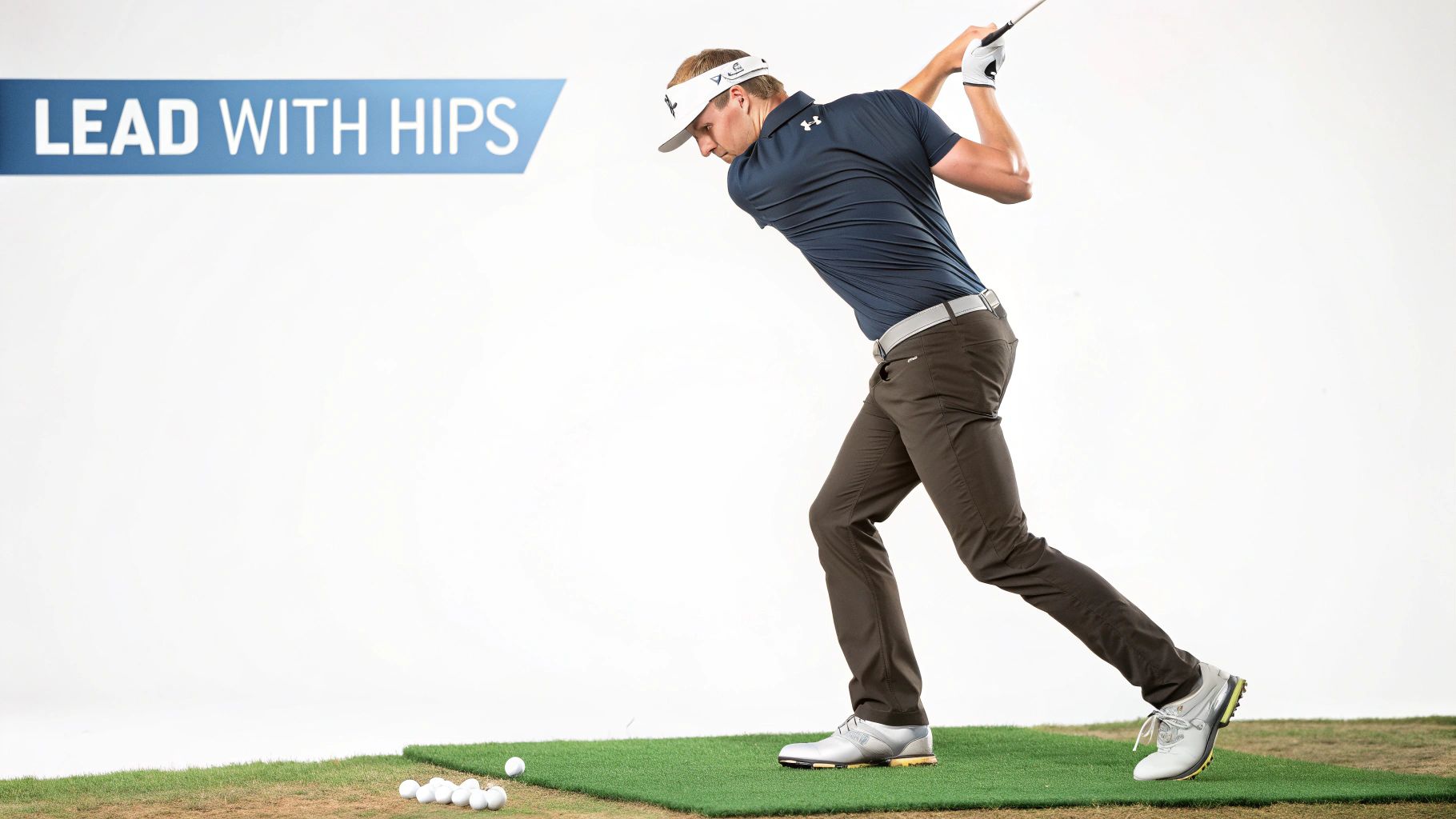
Legendary instructors have been teaching this for decades because it builds a powerful, ground-up swing right from the start. The goal is simple: make shifting your weight forward an instinct, not a thought.
How to Execute the Drill
- Setup: Grab a 7-iron and start with your feet together. This neutral starting point makes the steps feel more obvious.
- Backswing: As you start taking the club back, step back with your trail foot into its normal position. As you finish your backswing, feel your weight loaded onto that foot.
- Transition: Here’s the key move. To start your downswing, step forward with your lead foot, planting it firmly toward the target. This step has to happen before your arms start swinging down.
- Impact and Follow-Through: Once that lead foot is planted, just rotate your body through the ball. The step guarantees your weight is already forward at impact, letting you swing freely to a balanced finish.
Key Coaching Cues and Common Mistakes
- Lead with the Hips: Think about your lead hip starting the forward move. The step should feel like a natural part of your lower body leading the charge.
- Don’t Rush the Arms: A common mistake is to step and then immediately rush the downswing with your arms. Take a moment to feel the ground after you step, then let the arms follow in sequence. It should feel smooth, not frantic.
This is one of the most powerful golf weight transfer drills because it physically forces you to do it right. As you get the hang of it, you can make the step smaller and smaller until it’s just a subtle weight shift within your normal stance. To make this drill even more effective, building your leg strength with a simple Step Up exercise in your workouts will improve your balance and power.
3. The Trail Heel Lift Drill (Heel Raise Drill)
The Trail Heel Lift Drill is a simple but incredibly powerful way to feel a dynamic, forward weight shift. By letting your trail heel come off the ground naturally in the backswing, you make it almost impossible to get stuck on your back foot. This encourages an athletic sequence, creating a smooth flow of energy from the top of your swing right through to impact.
Coaches love this drill because it helps students feel how the lower body should kick off the downswing. The goal is to make the forward shift an automatic reaction, not something you have to consciously think about doing. It helps you get “unstuck” and move through the ball with power.
How to Execute the Drill
- Setup: Take your normal stance with a mid-iron. Your weight should feel centered and ready to move.
- Backswing: As you turn your shoulders and hips away from the ball, allow your trail heel (the right heel for a right-handed player) to lift off the ground. This shouldn’t be a jerky lift; it should be a natural result of a full body turn.
- Transition: At the top, with your trail heel up, your first move down should be to drive your pressure forward into your lead foot. That lifted heel gives you no choice but to move forward.
- Impact and Follow-Through: Swing through the ball, making sure that by the time you make contact, almost all your pressure is on your lead foot. Your trail heel will still be up as you rotate into a full, balanced finish.
Key Coaching Cues and Common Mistakes
- Natural, Not Forced: The heel should lift because you’re making a good hip turn, not because you’re deliberately picking your foot up. If it feels awkward, you’re probably forcing it.
- Don’t Spin Out: A common mistake is to let that trail foot spin out too early. This causes your hips to open too fast and you lose all your power. Focus on driving pressure forward first, then rotating.
This is one of the most effective golf weight transfer drills for any golfer who feels “stuck” on their back foot. Just watch a player like Justin Thomas—he uses a significant trail heel lift to generate incredible power. It’s a truly athletic move.
4. The Medicine Ball Slam/Throw Drill
Ready to feel like an athlete? The Medicine Ball Slam is an explosive drill that builds real-world power and teaches you the correct swing sequence without you even having to think about it. By mimicking the golf swing’s rotation with a medicine ball, you train your body to use the ground and transfer energy from your legs and core, not just your arms.

This is a go-to exercise for golf fitness experts because it develops a powerful, hip-driven motion that ends in a stable finish—exactly what you see from the longest hitters on tour.
How to Execute the Drill
- Setup: Stand in a good golf posture, feet shoulder-width apart, holding a medicine ball (start with 8-14 lbs) at your chest.
- Backswing: Rotate your torso away from a target wall, just like a backswing. Feel your weight load onto your trail leg as you coil your upper body.
- Transition: Start the “downswing” by explosively driving your hips toward the target. Your hips should lead the way, pulling your arms and the ball through.
- Impact and Follow-Through: Slam or throw the ball powerfully against a sturdy wall just outside your lead foot. As you release it, feel all your weight transfer to your lead side, finishing in a balanced athletic stance.
Key Coaching Cues and Common Mistakes
- Hips Go First: This is non-negotiable. The move has to be started by your lower body. The feeling is your hips are pulling everything else through, not that your arms are just throwing the ball.
- Stay in Posture: A classic golf mistake is standing up too early (early extension). Focus on staying in your golf posture and rotating through the throw instead of thrusting your hips toward the ball.
This is one of the best golf weight transfer drills for building raw, usable power. It directly trains the explosive sequence you need for a faster swing. You don’t need fancy equipment to start; a simple option like the Amazon Basics Medicine Ball is perfect for getting this powerful training into your routine.
5. The Split Stance/Split Weight Drill
The Split Stance Drill is all about exaggeration. By setting up with a super-wide stance, you make it impossible to get away with a lazy or incorrect weight shift. It forces you to make a clear, deliberate move from your trail side to your lead side, helping you finally feel what a proper transfer is supposed to be like.
Teaching pros use this drill to help players who sway or slide too much. The extra-wide base of support forces you to load and unload your weight correctly just to stay balanced, ingraining the right feeling.
How to Execute the Drill
- Setup: Tee up a ball. Get into your normal setup, then widen your stance until your feet are significantly wider than usual. You can also try dropping your trail foot back a few inches for a staggered stance.
- Backswing: Make a smooth backswing. You’ll feel a really deep load into your trail hip and leg. Because your stance is so wide, you have to consciously shift your weight—if you sway, you’ll feel off-balance immediately.
- Transition: Start the downswing by pushing off the inside of your trail foot and moving your weight decisively to your lead foot. Feel that lead leg “accept” the weight and stabilize you as you start to unwind.
- Impact and Follow-Through: Swing through to a full finish. By the end of your swing, you should feel like all your weight is on that lead foot, with your trail foot just resting on its toe.
Key Coaching Cues and Common Mistakes
- Feel the Ground: Really focus on how your feet are interacting with the ground. Feel the pressure build up in your trail foot on the way back, then transfer to your lead foot on the way through.
- Rotate, Don’t Slide: A big mistake is sliding your hips laterally toward the target instead of rotating. This wide stance is meant to encourage you to rotate your hips around a stable lead leg.
This is one of the most revealing golf weight transfer drills because the exaggeration makes the correct feel impossible to miss. Once you get comfortable, you can slowly narrow your stance back to normal, bringing that new, powerful weight shift with you.
6. The Lead Arm Drag Drill (Shallowing Drill)
This drill is a bit more advanced, but it’s a game-changer for syncing up your weight shift with your arm swing. The idea is to feel like your lead arm is being passively “dragged” into the downswing by your lower body’s rotation. This stops you from initiating the swing with your arms and shoulders—the classic “over-the-top” move that kills power and causes slices.
Modern coaches who teach a powerful, rotational swing love this drill. It forces you to start the downswing by shifting your weight and turning your hips, which naturally drops the club onto the correct shallow plane for a powerful strike from the inside.
How to Execute the Drill
- Setup: Take your normal setup with a short iron. Start with slow, half-swings.
- Backswing: Make a controlled backswing to the top, feeling your weight load onto your trail side.
- Transition: This is the secret. Instead of pulling the club down with your hands, start the downswing by shifting your weight to your lead foot and beginning to rotate your hips.
- The “Drag” Sensation: As your lower body turns, your lead arm should feel passive, like it’s just being pulled along for the ride by your core. You’ll feel the club naturally shallow and drop into the “slot.”
- Impact and Finish: Continue rotating through the ball, making sure your weight is fully on your lead side at impact. Finish in a balanced position.
Key Coaching Cues and Common Mistakes
- Feel the Separation: Focus on the feeling of your lower body starting to unwind while your upper body and arms lag slightly behind. This separation is the key to creating massive speed.
- Don’t “Yank” it: The most common mistake is to actively pull the handle down with your hands. The “drag” is a passive feeling created by an active lower body, not an active arm pull.
This is one of the more technical golf weight transfer drills, but it’s a huge step toward a professional-level swing. Mastering this is key to learning how to hit your irons flush and consistently. Go slow at first to really groove the correct sequence.
7. The Single-Leg Balance Drill (Single Leg Stability Drill)
This drill is tough, but it’s the ultimate test of your balance and weight control. By making you swing while standing on one leg, it instantly reveals any instability or poor sequencing in your motion. It builds incredible awareness and the muscle stability you need for a swing that holds up under pressure.
This is a go-to drill in elite golf fitness programs for a reason. It exaggerates the feeling of being “posted up” on each leg at different parts of the swing, making it one of the best golf weight transfer drills for fixing deep-seated balance problems.
How to Execute the Drill
You can do this in two ways: one for the backswing and one for the downswing. Start with slow, half-swings without a ball.
- Backswing Variation (Trail Leg): Stand only on your trail leg, lifting your lead foot slightly off the ground behind you. Make slow backswings, focusing on loading into your trail hip without toppling over. This builds stability at the top of your swing.
- Downswing/Follow-Through Variation (Lead Leg): Now, stand only on your lead leg. From here, practice making a downswing motion and rotating to a balanced finish. This teaches you to stabilize over your lead side, which is essential for solid contact.
- Progression: Once you’re steady, try a full swing. Start on both feet, lift your lead foot on the backswing, plant it to start the downswing, and then swing through, lifting your trail foot to finish balanced on your lead leg.
Key Coaching Cues and Common Mistakes
- Engage Your Core: Your balance comes from your core. Tightening your abs will make you dramatically more stable.
- Don’t Topple Over: The goal is to rotate around your stable leg, not lunge or fall forward. If you’re struggling, hold onto a wall or a golf cart for support at first.
This drill directly strengthens the small stabilizing muscles that are so crucial for consistency. To build the core strength needed to nail this drill, check out these effective golf core exercises that will improve your stability on and off the course.
Golf Weight Transfer — 7-Drill Comparison
| Drill | Implementation Complexity | Resource Requirements | Expected Outcomes | Ideal Use Cases | Key Advantages |
|---|---|---|---|---|---|
| The Pressure Plate / Balance Board Drill | Intermediate setup and interpretation; requires learning to read data | Pressure plate or balance board with display; moderate cost | Objective weight-distribution data; improved timing and sequencing | Golfers who benefit from quantitative/visual feedback and performance analysis | Real-time measurable biofeedback; identifies compensatory patterns |
| The Step Drill (Forward Step / Walking Drill) | Low complexity to start; requires refinement to normalize exaggerated motion | None (requires space only) | Enforces lower-body lead; reduces reverse pivot; improves timing | Amateurs with reverse pivot or over‑the‑top tendencies | Natural, easy-to-feel movement with immediate proprioceptive feedback |
| The Trail Heel Lift Drill (Heel Raise Drill) | Low to moderate; simple cue but timing must be managed | None | Prevents hanging back; promotes forward momentum and balanced finish | Golfers who tend to stay on the back foot | Simple, equipment-free method that reliably encourages weight shift |
| The Medicine Ball Slam/Throw Drill | Moderate to advanced; needs correct technique and supervision | Medicine ball (8–14 lb), open space; fitness setup | Builds explosive power, ground reaction force, and rotational sequencing | Golfers seeking increased power and athletic development | Develops golf-specific power and transfers well to full swing |
| The Split Stance / Split Weight Drill | Low to moderate; easy to set up but requires gradual progression | None (optional alignment aids) | Makes weight transfer obvious; eliminates lateral slide | Golfers with sway/slide patterns learning isolated weight shift | Isolates left/right weight action and exposes compensations |
| The Lead Arm Drag Drill (Shallowing Drill) | High; technical and best learned with video/coaching | Video feedback, coach guidance, alignment aids recommended | Improved downswing sequencing, increased lag, fewer over‑the‑top moves | Advanced golfers refining sequencing and efficiency | Promotes correct lower‑body‑first sequence and more efficient power delivery |
| The Single‑Leg Balance Drill (Single Leg Stability Drill) | High; very challenging balance progression required | Minimal equipment; optional balance disc, safety support | Enhanced core stability, balance, and control; reveals deficiencies | Accomplished golfers seeking elite balance and control | Exceptional proprioception and stability development; eliminates sway |
From Practice Range to Fairway: Making These Drills Count
You now have a complete toolkit of seven powerful golf weight transfer drills, each designed to fix a specific part of this critical move. From feeling the ground with the Pressure Plate Drill to building athletic power with the Step Drill, you have a clear path to a better golf swing. We’ve cut through the fluff to give you the exact steps and feels you need to ingrain a proper weight shift once and for all.
But remember, the point isn’t just to get good at the drills. The goal is to absorb these feelings so they become second nature when you’re out on the course. Think of these drills as your personal swing laboratory. They help you diagnose your flaws and feel the difference between a weak, all-arms swing and a powerful, dynamic swing that starts from the ground up. The key is to connect the feeling of a good drill with the result you see in your ball flight.
Turning Practice into Performance
Mastering your weight transfer is what turns a decent-looking swing into a swing that produces consistent, powerful results. It’s the difference between hoping for a good shot and knowing you can produce one. The power you unlock isn’t just about hitting it farther; it’s about gaining control, finishing in balance, and building a swing you can trust when it matters.
To make these drills stick, use this simple framework:
- Isolate: Pick the one or two drills that target your biggest miss. If you sway, live with the Split Stance Drill for a while. If you hang back on your trail foot, make the Trail Heel Lift Drill your best friend.
- Integrate: After a few reps of a drill, immediately hit a golf ball trying to recreate that exact same feeling. This is the crucial step that bridges the gap between practice and play.
- Evaluate: Don’t just watch where the ball goes. How did it feel? Did you finish in balance? Is your weight on your lead foot, with your belt buckle facing the target?
A better golf swing is built on smart, focused practice, not just beating balls mindlessly. These golf weight transfer drills give your practice purpose. By working on them, you’re rewriting the old, bad habits in your swing and replacing them with a new foundation of athletic power and balance. Trust the process, commit to feeling the right moves, and watch your hard work on the range start paying off with lower scores on the course.
Ready to dive deeper and find the perfect gear to complement your improved swing? At Golf Inquirer, we provide in-depth reviews and guides on everything from drivers to training aids. Explore our expert insights and unbiased analysis at Golf Inquirer to ensure your equipment is working just as hard as you are.