For those of us who live to walk the course, the quest for finding the Best Golf Walking Bags for Your Game always leads to one place: lightweight stand bags. These aren’t just scaled-down cart bags; they’re purpose-built machines for comfort and clever storage, typically weighing in at a breezy under 5 pounds.
The top contenders are easy to spot. They boast ridiculously comfortable dual-strap systems, are built from tough-as-nails materials like ripstop nylon, and feature pocket layouts that feel like they were designed by a golfer, not an engineer. A truly great walking bag should feel less like something you’re hauling and more like an extension of yourself.
Why a Great Walking Bag Is Your Best Caddy
Walking the course is one of golf’s purest joys. But let’s be honest—the wrong bag can turn that beautiful stroll into a grueling death march. It’s not just about a sore shoulder; a heavy, unbalanced bag is an energy vampire. It kills your focus and can subtly wreck your swing by the time you make the turn.
This guide is about finding a bag you’ll barely notice you’re carrying.
We’re going to slice through the marketing hype and get down to what actually makes a walking bag great:
- Effortless Weight: How smart design and modern materials create a bag that feels almost weightless.
- Next-Level Comfort: A deep dive into carry systems that distribute weight so well, you can walk 36 and still feel fresh.
- Smarter Storage: It’s not about having a million pockets. It’s about having the right pockets, right where you need them.
The Rise of the Modern Stand Bag
The golf industry has finally caught on and is giving walking golfers the love they deserve. Market research reveals a massive shift toward lighter, more ergonomic designs, cementing the stand bag as the undisputed champion for players who prefer to hoof it. It just makes sense—these bags offer huge benefits, from integrated stands that keep your gear dry to carry systems that drastically reduce the physical toll on your body. You can see this trend in action in some fascinating golf bag market research.
Think of your walking bag not as luggage, but as a critical piece of performance equipment. Just like your driver or putter, the right bag directly impacts your stamina, comfort, and ultimately, how much fun you have out there.
To give you a clear roadmap, here’s a quick look at the most important features to keep an eye on.
Quick Look at Top Walking Golf Bag Features
This table breaks down the essentials, helping you zero in on what truly matters for your game.
| Feature Category | Why It Matters for Walkers | Key Considerations |
|---|---|---|
| Weight | A lighter bag crushes fatigue, saves your energy for the back nine, and prevents strain. | Aim for under 5 pounds. The elite ultralights dip below 3 pounds. |
| Carry System | A great dual-strap harness distributes weight evenly, so one shoulder doesn’t do all the work. | Look for padded, adjustable, self-balancing straps. Comfort is king. |
| Stand Mechanism | A rock-solid stand keeps your bag off wet ground and makes clubs a breeze to grab. | Test the leg action. Carbon fiber legs are the gold standard for light and strong. |
| Storage Pockets | A smart pocket layout gives you easy access to essentials without tempting you to overpack. | Prioritize a valuables pocket, ball pocket, and an insulated drink sleeve. |
| Materials/Durability | High-quality, rugged fabrics that can handle being tossed around for seasons to come. | Ripstop nylon and high-denier polyester are your best friends here. |
Ultimately, a bag that nails this combo will feel less like a burden and more like a trusty sidekick on the course.
We’ll break down exactly what to look for so you can confidently choose a companion that elevates your game. For more insights on equipment, check out our comprehensive guides on golf gear and tips.
Why Bag Weight Is Your Most Critical Decision
When you’re hoofing it for four-plus miles over 18 holes, every single ounce on your back starts to feel like a pound. A lot. While pocket layouts and cool colorways are fun to consider, the weight of your bag is the one factor that will absolutely make or break your walk. Finding one of the best golf bags for walking starts and ends with what it weighs.
Think about it like choosing a backpack for a hike. A small, light pack is perfect for a short day trip with water and a snack. But if you tried to cram that same little pack with a week’s worth of gear, it would become a miserable, back-breaking burden. The same logic applies directly to your golf bag.
Unloaded vs. Loaded: The On-Course Reality
Bag manufacturers always advertise the “unloaded” or “empty” weight, which is a great starting point. The best walking bags often clock in at under 4 pounds, with some ultralight models even dipping below the 3-pound mark. But let’s be real—nobody carries an empty bag.
Once you add 14 clubs, a couple of sleeves of balls, a water bottle, your rangefinder, and maybe a rain jacket, that featherlight bag can easily top 20 to 25 pounds. A bag that starts out just two pounds heavier might feel insignificant in the pro shop, but by the 15th hole, that extra weight will feel like you’re carrying a small child on your back.
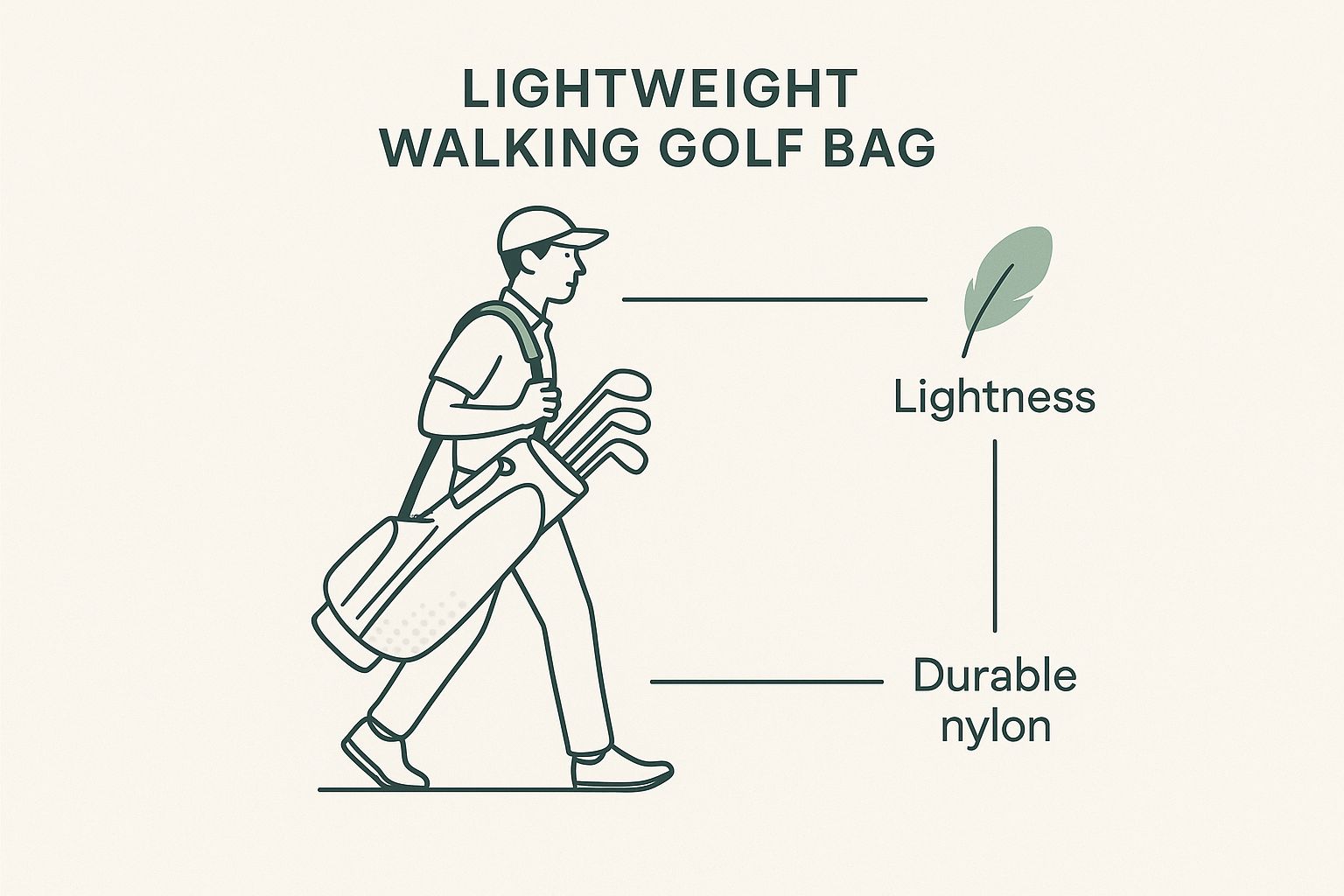
This is where that perfect marriage of lightweight design and bomber materials becomes the secret to a comfortable round.
The Material Science of a Lighter Load
So, how do the top brands build bags that are both tough as nails and light as a feather? The magic is in the advanced materials. The days of heavy leather and canvas are long gone. Today’s premier walking bags are crafted from innovative textiles engineered for peak performance.
-
High-Denier Ripstop Nylon: This stuff is a walker’s best friend. “Denier” refers to the fiber’s thickness—higher numbers mean more durability. The “ripstop” part is a special weaving technique that adds a grid of thicker threads to stop small tears from becoming catastrophic failures, all without adding bulk.
-
Carbon Fiber Legs: The stand mechanism is often a sneaky source of hidden weight. By swapping traditional aluminum for carbon fiber, manufacturers create legs that are incredibly strong and stable yet feel almost weightless.
Your mission is simple: find the lightest possible starting point that still meets your needs for durability and storage. A lower empty weight gives you more freedom to carry what you actually need without paying the price on the back nine.
By making a lightweight, modern-material frame your top priority, you’re setting yourself up for a more energetic and enjoyable round. This single decision directly impacts your physical stamina, which in turn affects your focus and your swing from the first tee to the final putt.
How the Right Carry System Creates All-Day Comfort
A bag’s raw weight is a huge piece of the puzzle, but it’s only half the story. The other, equally crucial half is how that weight feels on your back for four hours. The best walking bags aren’t just containers for your clubs; they’re sophisticated ergonomic equipment. The carry system is the engine that drives your comfort from the first tee to the 18th green.
This is where a brilliantly engineered harness can make a 20-pound loaded bag feel lighter than a 15-pounder with a cheap, flimsy setup. It all comes down to distributing that weight intelligently.

The market has exploded in response to golf’s recent surge in popularity. The number of registered players worldwide jumped from 3.1 million in 2021 to around 8.0 million in 2023—a staggering increase of over 150%. This boom has fueled demand for better gear, especially bags with advanced carry systems built for walkers. You can discover more about the growing golf bag market and see the trends for yourself.
Single Strap vs. Dual Strap Systems
The classic, minimalist “Sunday bag” often has a single strap. While it has a certain old-school cool and is fine for a quick nine, that single strap dumps the entire load onto one shoulder. Over 18 holes, this creates a lopsided pressure cooker of muscle fatigue, strain, and even poor posture that can infect your swing.
Modern stand bags, however, have almost universally adopted the dual-strap, backpack-style system. This design is based on a simple ergonomic truth: splitting the weight across both shoulders engages your stronger back and core muscles. It prevents one side of your body from doing all the work, dramatically boosting your endurance and keeping you comfortable.
A superior carry system isn’t a luxury; it’s a core performance feature. It should feel so balanced and comfortable that you forget you’re even wearing it, letting you focus entirely on your next shot.
Key Components of an Elite Carry System
When you’re checking out a bag, look beyond just seeing two straps. The true quality is in the details. The best systems weave together several key features that create a seamless, comfortable carrying experience.
-
Contoured, Cushioned Straps: Look for straps shaped to follow the natural curve of your shoulders. You want ample, high-density foam padding—this is critical for preventing the straps from digging in and chafing.
-
Ventilated Back and Hip Pads: A quality bag will have padded panels that rest against your back and hips. Strategic air channels or mesh coverings on these pads are a godsend, promoting airflow to keep you cool and reduce that dreaded back sweat.
-
Self-Adjusting Pivot Points: This is a true game-changer. Top-tier bags often have a central pivot mechanism where the straps connect. This system automatically balances and adjusts the bag’s angle as you walk, ensuring it stays stable on your back without swaying. It’s a small feature that saves a surprising amount of energy.
Mastering Smart Storage for the Walking Golfer
It’s easy to get hypnotized by a wall of pockets when you’re shopping for a new golf bag. But for those of us who carry our clubs, more isn’t always better—it’s often just an invitation to carry more junk. The real genius is in the design, where the quality and placement of the pockets matter far more than the quantity.
Think of it like a messy garage versus a well-organized workshop. One is packed with stuff you can never find. The other has a specific home for every tool, making your work smooth and efficient. A great walking bag is a workshop on your back, not a mobile storage unit.
This demand for smarter, specialized gear is why the global golf bag industry hit a valuation of around USD 1.41 billion in 2024 and is projected to climb to USD 1.80 billion by 2032. Golfers are getting wiser and demanding better-designed bags. You can explore more insights into the golf bag market to see how these trends are shaping the gear we use.
Pockets with a Purpose in a Golf Bag
Instead of just counting pockets, let’s look at what they actually do. A streamlined layout with a few essential, easy-to-reach pockets is infinitely better for a walker. It prevents you from packing useless stuff and keeps your on-course routine flowing smoothly.
Here’s a breakdown of the must-haves versus the nice-to-haves:
- Essential Fleece-Lined Valuables Pocket: This is non-negotiable. It protects your phone, keys, and wallet from getting scratched or soaked in a surprise downpour.
- Accessible Ball Pocket: You shouldn’t have to dislocate your shoulder to grab a new ball after finding the woods. A well-placed front pocket is key.
- Insulated Drink Sleeve: Staying hydrated is crucial, especially on a hot day. An easy-to-reach cooler pouch keeps your drink from feeling like bathwater by the 12th hole.
- Nice-to-Have Rangefinder Slot: A dedicated magnetic or slip pocket is a fantastic luxury for quick access, but a standard pocket can work just fine.
- Full-Length Apparel Pocket: One large pocket is usually more than enough for a rain jacket or an extra layer. Any more than that just adds weight and bulk.
The Critical Role of Club Dividers in a Golf Bag
Beyond the pockets, how a bag organizes your clubs is just as important. This is where dividers come in, and for walkers, one feature is king: full-length dividers.
Imagine trying to pull one chopstick out of a tightly packed container—they all jam up. That’s what happens to your club grips at the bottom of a bag without full-length dividers, a frustrating problem known as ‘club tangle.’
A 4-way or 5-way top is the sweet spot for a walking bag, giving you excellent organization without the extra weight of a 14-way top designed for carts. When each of those dividers runs the full length of the bag, it creates individual channels for your clubs. This simple feature stops your grips from snagging and rubbing, making every club a breeze to pull out and put back. It’s a small detail that eliminates one of the biggest little annoyances in golf.
Evaluating Durability and On-Golf Course Stability
A great walking bag should be a long-term investment, built to survive hundreds of rounds in sun, wind, and rain. Beyond the flashy features, the real MVPs of bag design are durability and stability. These are the unsung heroes that determine if your bag becomes a trusted companion for years or just another piece of gear that lets you down.
Spotting quality construction is all in the details. You want to see tough, high-denier ripstop fabrics that can handle being tossed in a car trunk without tearing. But don’t stop there. Look closer at the small stuff, like reinforced stitching in high-stress areas (especially where the straps connect) and high-grade, waterproof zippers that won’t snag or bust when you need them most.

It’s these subtle indicators that separate a well-made bag from a cheap one, ensuring it has the backbone to endure the grind of the game.
The Heart of a Golf Stand Bag: The Stand Mechanism
While the fabric is the bag’s armor, the stand mechanism is its heart. A wobbly or unreliable stand is more than just an annoyance—it’s a recipe for disaster, sending your expensive clubs spilling onto wet, muddy ground. The best walking bags have a stand system that is both rock-solid and buttery smooth.
When you’re checking out a bag, zero in on these critical stand components:
- Leg Material: Look for legs made from carbon fiber or high-grade aluminum. These materials hit the sweet spot with an incredible strength-to-weight ratio, giving you unwavering stability without tacking on unnecessary pounds.
- Non-Slip Foot Pads: Those little pads at the end of the legs are crucial. They should be oversized and textured to grip any surface, from slick morning dew to a tricky side-hill lie.
- Activation System: The mechanism that deploys the legs should feel instant and effortless. A high-quality system engages the second you set the bag down and retracts just as cleanly the moment you lift it.
A bag’s stability is a direct reflection of its engineering. A well-designed stand system should work so flawlessly on any terrain that you never have to think about it, providing a stable base every single time.
Ultimately, a bag that nails both durability and stability is one you can trust completely. You can focus on your game, confident that your gear is secure and built to go the distance.
Making Your Final Choice with Confidence
Alright, we’ve covered a ton of ground. You now know what separates a decent bag from one of the best golf bags for walking. We’ve dug into everything from featherlight materials and cushy carry systems to smart storage that actually helps your game. You have the blueprint—now it’s time to pick your perfect partner for the course.
Think of your walking bag less like an accessory and more like a crucial piece of performance gear, right up there with your driver. The right one simply disappears. It feels so natural that you can focus completely on your shots. The wrong one? It’s a constant, nagging distraction that can ruin a perfectly good walk.
Before you pull the trigger, take a moment to run through this quick mental checklist. This is all about making sure the bag you’re eyeing is genuinely the right fit for you.
Your Golf Bag Pre-Purchase Checklist
Answering these simple questions will bring instant clarity to your decision, helping you land a bag you’ll love for seasons to come.
-
What’s My Absolute Must-Have Feature? Be honest. Is it getting the absolute lightest bag possible (under 4 pounds)? Is it a premium, self-adjusting strap system that promises zero hassle? Or do you just really want that magnetic rangefinder pocket? Pinpoint your top non-negotiable.
-
What’s My Realistic Budget? A quality walking bag is an investment. Set a price range you’re comfortable with, but don’t be afraid to spend a little more for a big leap in comfort and durability. That extra cash often pays for itself in longevity and pure enjoyment.
-
How Can I Test the Fit and Feel? If possible, go to a pro shop and try a few bags on. Seriously. Load them with a few clubs, adjust the straps, and feel how they sit on your back. That hands-on experience can tell you more than a dozen online reviews ever could.
The ultimate goal is simple: find a bag that complements your walk so perfectly that you forget it’s even there. Your energy should be spent on strategy and your swing, not on a sore shoulder or a wobbly stand.
By asking these questions, you’re no longer just shopping. You’re making an informed choice for a piece of gear that will genuinely make every round you walk that much better.
Exploring the Best Golf Walking Bags
FAQ’s
Even after breaking it all down, a few questions always pop up when golfers are hunting for the best golf bags for walking. Let’s tackle those common head-scratchers so you can choose your new bag with total confidence.
How Much Should a Good Walking Golf Bag Weigh?
This is the big one. For an empty walking bag, you should be looking for something under 5 pounds (2.3 kg). The truly premium, ultralight models can even get down closer to 3 pounds. That “unloaded” weight is the key number to look for.
Just remember, that’s before you add a single thing. Once you load it up with 14 clubs, balls, water, and a rain jacket, that weight can easily jump to 20-30 pounds. Starting with the lightest possible base makes a massive difference for your back and shoulders over 18 holes.
Can I Use a Walking Bag on a Golf Cart?
Absolutely! This is a huge point of confusion, but the vast majority of modern stand bags are designed to be “hybrid” bags. They’re built for total versatility.
Most come with clever features like leg-lock systems, which keep the stand from popping out when you strap the bag onto a cart. Their bases are also shaped to sit snugly on both push carts and motorized carts. Think of a quality walking bag as a smart investment that’s ready for any way you decide to play.
Many golfers think walking bags are only for walking. The reality is their hybrid design gives you ultimate flexibility, ensuring you have the right setup whether you’re carrying, pushing, or riding.
What Is the Difference Between a Carry Bag and a Stand Bag?
People often use these terms interchangeably, but there’s a small but important difference. A stand bag is simply a specific type of carry bag—one that has that built-in, retractable leg system.
On the other hand, a more traditional carry bag, often called a “Sunday bag,” is a minimalist’s dream. It’s usually smaller, lighter, and has no stand, so you just lay it on the grass. For most golfers who walk and want to keep their clubs clean, organized, and easy to grab, a stand bag is the clear winner. This is quite different from getting assistance from a person; you can learn more about what a golf caddy does in our detailed article.
How Many Dividers Are Best for a Walking Golf Bag?
This really comes down to personal preference, but the sweet spot for most walkers is a 4-way or 5-way top. This setup provides great organization without the extra weight and bulk that comes with a 14-way top you’d find on a heavy cart bag.
But here’s the most important part: look for full-length dividers. These are partitions that run all the way down the bag, creating separate channels for each group of clubs. This is the secret weapon against “club tangle,” preventing your grips from snagging at the bottom—a tiny detail that solves one of golf’s biggest little frustrations.
At Golf Inquirer, we’re dedicated to helping you enjoy the game to its fullest. Explore our guides and find the gear that makes every round your best one yet. https://golfinquirer.com