Wondering where you stack up on the average golf driving distance by age? It’s a question every golfer asks. For amateur male golfers, guys in their 20s typically lead the pack, averaging around 240 yards. After that, it’s normal to see a gradual drop of about 8-10 yards each decade. Think of your driving distance as a moving target—it evolves with you, and that’s perfectly okay.
- Your Golf Driving Distance Benchmarks at Every Age
- The Science of Why Golf Driving Distance Changes with Age
- The Surprising Peak Years for Golf Driving Distance
- How Skill Level Impacts Your Golf Driving Distance
- Trading Raw Power for Pinpoint Precision in Golf
- How to Maximize Your Golf Driving Distance at Any Age
- FAQ's
Your Golf Driving Distance Benchmarks at Every Age
It’s the question whispered on the driving range and debated over a post-round beer: “How far should I be hitting it at my age?”
Let’s be honest, we all do it. Comparing your driving distance to others is a natural part of the game. But to do it right, you need realistic benchmarks. Forget the superhuman distances you see on TV—the stats for everyday amateur golfers tell a much more relatable story.
Understanding these averages gives you a solid, practical starting point. This isn’t about judging your game; it’s about getting some context for where you stand. Think of these numbers as a way to set achievable goals and appreciate that golf is a journey that changes right along with you.
A Look at the Numbers in Golf
So, what does the data actually say? The most reliable info paints a clear picture of how distance naturally shifts over a golfer’s life.
One of the best deep dives comes from Arccos Golf, which crunched the numbers on over 26 million shots. Their findings show that players aged 20-29 lead the pack with an average drive of 239.7 yards. That number steadily decreases as the years go on, with golfers in their 50s averaging 215.4 yards and those over 70 hitting it about 190.4 yards. You can see more data from this comprehensive study over on GolfWRX.com.
This chart breaks down the typical decline in driving distance across key age brackets, giving you a quick snapshot of the trend.
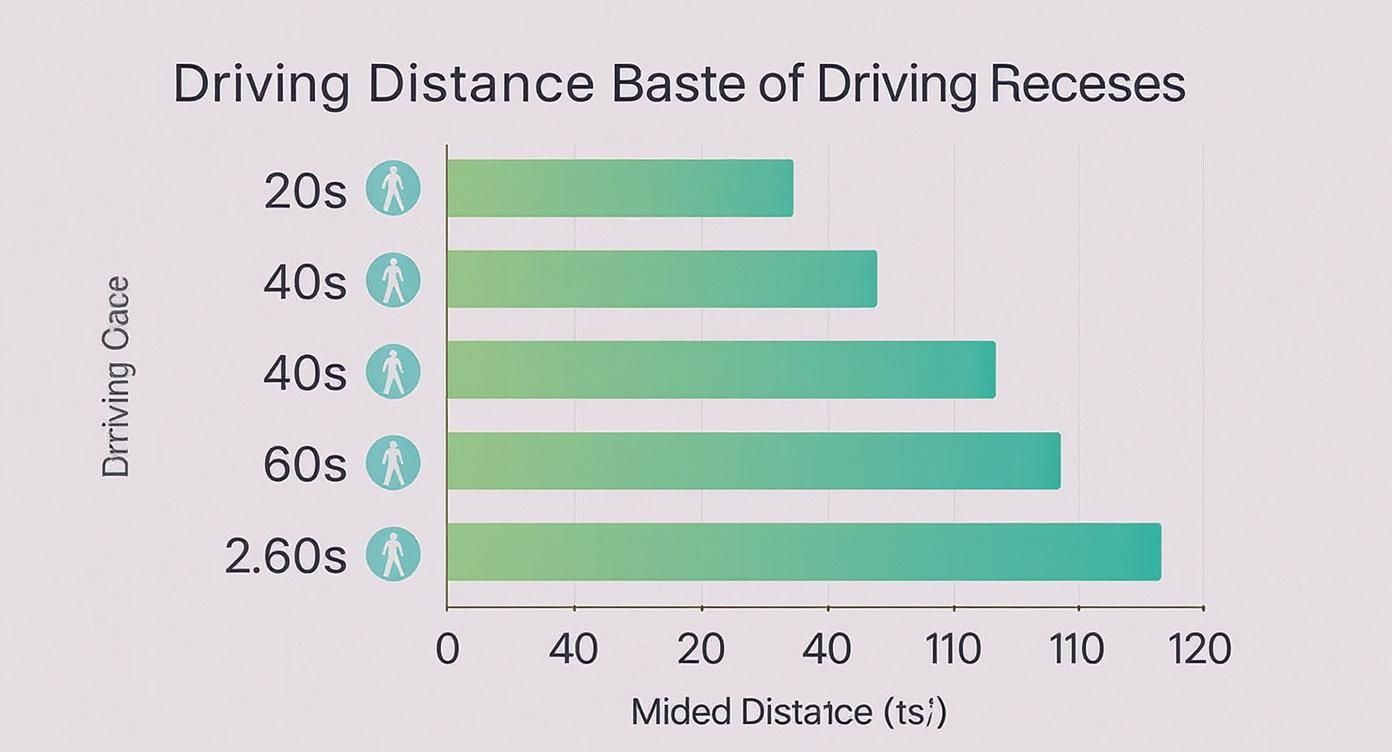
As you can see, the drop-off from a player in their 20s to one in their 60s is pretty significant. It’s a clear reminder of the natural impact aging has on power.
To make it even easier, here’s a quick reference table.
Average Golf Driving Distance by Age Group
| Age Group | Average Driving Distance (Yards) |
|---|---|
| 20-29 | 239.7 |
| 30-39 | 231.2 |
| 40-49 | 223.7 |
| 50-59 | 215.4 |
| 60-69 | 204.6 |
| 70+ | 190.4 |
This table gives you a clean look at the average numbers for amateur male golfers, showing how distance naturally shifts from one decade to the next.
Your age provides a benchmark, but it doesn’t define your potential. Skill, technique, and fitness play equally important roles in determining how far you can really hit the ball.
It’s best to think of these numbers less as a strict report card and more as a helpful guide. They represent the average golfer, but your game is your own. Factors we’ll dig into later—like your handicap, swing efficiency, and even your equipment—can easily help you blow the average for your age group out of the water.
The Science of Why Golf Driving Distance Changes with Age

It’s one of the most frustrating realities in golf. That drive that used to sail past your buddies now seems to land a little shorter every season. Trust me, it’s not just in your head. The slow creep of declining distance is a direct result of the natural physiological changes our bodies go through as we get older.
Think of your swing as a powerful chain reaction. Power starts from the ground, moves up through your body, and is unleashed into the clubhead. As we age, a few links in that chain naturally start to weaken, which cuts down the total force you can generate. This is the root cause behind the shifting average golf driving distance by age.
But here’s the good news: understanding why it happens is the first step to slowing it down and adapting your game. This isn’t about fighting a losing battle with Father Time. It’s about playing smarter and training with more purpose.
The Power Leaks That Sap Your Golf Swing Speed
Clubhead speed is king when it comes to distance. It’s simple physics—the faster the clubhead moves, the more energy it transfers to the ball, and the farther it flies. As we age, a cocktail of factors puts the brakes on our swing speed.
The main culprits are the physiological shifts that curb our body’s ability to create that explosive, athletic power.
- Muscle Mass Reduction: Starting around age 30, it’s common to lose 3-5% of muscle mass each decade. This process, called sarcopenia, directly weakens the “engine” of your swing—your glutes, legs, and core.
- Hormonal Changes: To get a deeper look at the biology at play, it’s worth understanding how testosterone levels change with age. These shifts are a major player in maintaining both muscle and raw strength.
- Slower Nerve Signals: The communication speed between your brain and muscles can also slow down. This impacts the fast-twitch muscle fibers responsible for the explosive snap of a powerful golf swing.
When you add these up, you’re looking at a gradual loss of horsepower. Your body just can’t recruit and fire those muscles with the same velocity it could in its prime.
Flexibility and Rotation: The Keys to a Full Swing in Golf
But power isn’t just about brute strength; it’s also about your range of motion. A long, fluid swing demands serious flexibility, especially through the hips, torso, and shoulders. As we age, our tendons and ligaments lose some of their elasticity, and joints can get stiffer.
This loss in flexibility directly shortens your backswing, which gives you less time and space to build up speed. Think of it like a catapult—a shorter pullback means a much weaker launch.
Maintaining mobility is every bit as critical as maintaining strength. A supple, mobile body can unlock surprising power by creating a wider swing arc and a more efficient transfer of energy.
One of the most effective ways to fight back is by strengthening your core. You can get started with our guide to powerful golf core exercises specifically designed to build rotational power and stability. Focusing on these key areas will help you build a more resilient and powerful swing that lasts.
The Surprising Peak Years for Golf Driving Distance
When do golfers really mash the ball? You’d probably guess it’s during their early 20s when they’re at their absolute physical peak. And while there’s some truth to that, the real story behind average golf driving distance by age is a bit more interesting.
For most amateur golfers, the longest drives of their life actually come in their 30s. This decade is often the perfect storm where physical strength, which is still near its peak, finally meets years of refined technique and on-course wisdom. It’s the point where raw power gets paired with a repeatable, efficient golf swing.
Think of it like a master craftsman. A young apprentice might have all the strength in the world, but the master has learned efficiency. He knows how to get the most power out of every single movement. Golfers in their 30s have had the time to dial in their swing, weeding out bad habits and learning how to squeeze every last yard out of what they’ve got.
The Sweet Spot of Strength and Skill in Golf
By the time they hit their 30s, most golfers have had a decade or more to really learn their game. They’ve moved past just trying to swing out of their shoes and started to understand how to generate clubhead speed the right way.
The peak driving years aren’t just about how strong you are, but about how effectively you can translate that strength into clubhead speed. This is where technical refinement meets physical maturity.
They’ve spent countless hours on the range and the course, developing the muscle memory needed for a powerful swing that stays on plane. This combination is deadly. Instead of wild, uncontrolled power, the 30-something golfer often has a more controlled, explosive force.
The data backs this up. According to a deep dive into Shot Scope numbers, golfers aged 30 to 39 hit the ball farther than any other group, averaging about 256 yards. That’s a hair longer than golfers in their 20s, who average 254 yards. After this peak, the decline is gradual, dropping to 252 yards for the 40s crowd and then down to 243 yards for those in their 50s. If you’re curious about what happens next, you can check out a full analysis of how much distance golfers lose as they age.
Why Experience Outweighs Youthful Power in Golf
So what gives 30-something golfers this slight edge over their younger counterparts? It really comes down to a few key areas where hard-earned experience sharpens raw physical talent.
- Optimized Swing Mechanics: After years of playing, most of the jerky, inefficient moves have been smoothed out, leading to a much more powerful and streamlined swing.
- Smarter Equipment Choices: These aren’t beginners grabbing a driver off the rack. Experienced players are far more likely to have been properly fitted for a driver that perfectly matches their swing.
- Course Management: A more mature golfer knows you don’t have to hit every driver at 110%. They save their biggest swings for the right moments and play smarter off the tee.
This fusion of physical prime and mental sharpness is what truly defines the peak driving years. It’s a great reminder that in golf, wisdom and experience can be just as important as pure, youthful power.
How Skill Level Impacts Your Golf Driving Distance

While age gives us a useful baseline, it’s really just one piece of the puzzle. The truth is, a golfer’s skill level—usually measured by their handicap—plays a much bigger role in how far they launch the ball off the tee. The whole idea of average golf driving distance by age gets a lot clearer when you filter it through the lens of actual ability.
This is where it gets fun. A skilled, low-handicap player in their 60s can absolutely, and consistently, outdrive a less experienced, high-handicap golfer in their 20s. Skill isn’t just about brute force; it’s about efficiency, solid technique, and finding the sweet spot on the clubface time and time again.
Think of it like this: a powerful engine in a car with a terrible transmission won’t win any races. In the same way, a young golfer with plenty of raw strength but a leaky, inefficient swing will lose power all over the place. A savvy senior golfer, on the other hand, has spent years learning how to squeeze every last yard out of their swing through a refined, repeatable motion.
The Golf Handicap-Distance Connection
A player’s handicap is a direct reflection of their scoring ability, and that’s heavily tied to how well they hit the driver. It’s no surprise that lower handicap players consistently generate more clubhead speed, strike the ball more purely, and optimize their launch conditions for maximum carry and roll.
They aren’t just hitting it farther; they’re hitting it smarter. High-handicap players often battle inconsistency, which leads to those frustrating off-center hits that rob you of massive yardage.
A golfer’s handicap is a better predictor of driving distance than their age. A 5-handicap at 60 has a more efficient “distance engine” than a 25-handicap at 25.
To really put this into perspective, let’s see how age and skill work together. This table gives you a much more personalized benchmark by combining age brackets with different handicap ranges. You’ll see just how dramatically skill changes the distance conversation.
Driving Distance Benchmarks by Age and Handicap in Golf
The table below breaks down the average driving distances you can expect based on both your age and your handicap. It paints a clear picture of how technique can trump youth.
| Handicap Range | Average Distance (Age 20-39) | Average Distance (Age 40-59) | Average Distance (Age 60+) |
|---|---|---|---|
| 0-5 (Scratch/Low) | 260+ yards | 250+ yards | 235+ yards |
| 6-15 (Mid) | 235-255 yards | 220-240 yards | 205-225 yards |
| 16-25 (High) | 210-230 yards | 195-215 yards | 180-200 yards |
| 26+ (Beginner) | Under 210 yards | Under 195 yards | Under 180 yards |
As the numbers show, a single-digit handicap golfer is going to hit the ball farther than a mid or high-handicap player, no matter which age group they fall into.
This highlights the most important takeaway of all: improving your technique is the single best way to gain distance at any stage of life. It shifts the focus from what you might be losing to age to what you can gain through practice and smarter play.
Trading Raw Power for Pinpoint Precision in Golf
Losing a few yards off the tee can feel like a step backward, but it doesn’t have to torpedo your scores. For many seasoned golfers, this change actually signals a powerful strategic shift. This is where the game stops being a contest of brute force and becomes a masterclass in precision and smart play.
This isn’t a story of decline; it’s one of evolution. As raw distance naturally tapers off, another crucial skill often takes its place: accuracy. Golfers learn to trade uncontrollable power for the surgical precision needed to hit more fairways—and that’s almost always a better recipe for lower scores.
The Accuracy Advantage in Golf
A fascinating trend emerges as golfers get older. While their average driving distance might dip, their fairway-hit percentages often shoot way up. Honestly, this trade-off is one of the smartest adjustments any player can make.
A deep-dive study from 2019 by the USGA and Arccos proved this point perfectly. Golfers in their 20s averaged a respectable 237 yards off the tee, but they only found the fairway 39% of the time. Now, compare that to golfers in their 70s. They averaged 194 yards but hit the fairway an incredible 56% of the time. The data shows a crystal-clear pivot from a power-first to a precision-first game. You can dig into the numbers yourself in the complete USGA Distance Insights Project report.
This shift completely changes how you approach a hole. Instead of just trying to bomb it past every obstacle, you start to think your way around the course.
The smartest golfers eventually realize that the scorecard doesn’t ask how you got there, only how many strokes it took. Hitting from the short grass is almost always the easier path to a lower number.
Embracing this means reframing what a “good” tee shot really is. It’s less about the sheer yardage and much more about the position it leaves you in for your next shot. By focusing on simply finding the fairway, you set yourself up for higher-percentage approach shots. That leads directly to more greens in regulation and, you guessed it, better scoring opportunities. The game becomes less about strength and more about strategy.
How to Maximize Your Golf Driving Distance at Any Age
Alright, let’s get to the good stuff—how to actually squeeze more yards out of your driver. The secret to keeping—or even gaining—distance as you get older isn’t some magic pill. It’s about making smart, targeted adjustments that work for your body, right now.
Forget the one-size-fits-all advice. A smart game plan for a 65-year-old looks completely different from one for a 45-year-old. The key is to pour your energy into the areas that will give you the biggest bang for your buck, whether that’s building strength, unlocking more flexibility, or just finally upgrading your gear.
Strategies for Golfers in Their 40s and 50s
For a lot of us, this is the crucial window for defending the power we built in our younger years. The main goal here is to get ahead of the natural decline in strength and mobility before it really starts to show up on the scorecard.
Think of your body as a high-performance engine. You can’t just floor it year after year without some proper maintenance. Targeted fitness and flexibility work are your tune-ups to keep that engine running smooth and powerful.
Here are the key areas to zero in on:
- Targeted Strength Training: Focus on the big, compound movements like squats, deadlifts, and kettlebell swings. These build and maintain muscle in your glutes and core—the absolute powerhouse of your golf swing.
- Rotational Power Drills: Start mixing in medicine ball throws and cable wood chops. These moves directly mimic the twisting force of the golf swing, helping you hang on to that explosive speed.
- Dynamic Flexibility: Make dynamic stretches like leg swings and torso twists a non-negotiable part of your pre-round routine. This opens up your range of motion, letting you make a fuller, more powerful turn.
Strategies for Golfers 60 and Over
For senior golfers, the name of the game is efficiency. It becomes less about brute force and more about creating a silky smooth, repeatable swing that gets every last ounce of energy into the ball. Tiny tweaks here can lead to massive yardage gains.
This is also the time to let technology be your best friend. Modern equipment is specifically designed to help golfers with more moderate swing speeds, and frankly, not taking advantage of it is just leaving yards on the table.
The goal for senior golfers is to create the most efficient swing possible. It’s about conserving energy and transferring it perfectly to the ball, proving that great technique can often outsmart raw power.
Consider these game-changing moves:
- Leverage Modern Technology: Lighter driver shafts and more forgiving clubheads are no longer a luxury—they’re a necessity. Using a shaft that’s too heavy or stiff for your current swing speed can easily rob you of 15-20 yards.
- Focus on an Efficient Swing: A smooth tempo and solid contact are your new best friends. To really dive into the mechanics, check out our detailed guide on how to improve your golf swing speed.
- Implement a Smart Warm-Up: A dedicated 10-15 minute warm-up is absolutely essential for prepping your muscles and preventing injury. This small time investment can make a world of difference on your first few holes.
Finally, giving your body the right fuel at a cellular level can play a huge role. For instance, looking into the proven benefits of NMN supplements for healthy aging, which can help boost cellular energy, can be a fantastic way to support your power from the inside out.

FAQ’s
Let’s wrap things up by tackling some of the questions I hear all the time from golfers about how their age affects their tee shots. Getting clear, no-nonsense answers is the best way to set realistic goals and figure out how to keep getting better, no matter how many candles are on your birthday cake.
This little Q&A should clear up any lingering confusion about average golf driving distance by age and give you the confidence to adapt your game for the long haul.
How Much Swing Speed Do Golfers Typically Lose Per Decade?
While there isn’t a single number that fits everyone, a good rule of thumb is a loss of about 1-2 mph of clubhead speed each year once you’re past your physical prime. Over a decade, that can easily add up to a drop of 10-15 mph.
But don’t panic—this isn’t like falling off a cliff. It’s a gradual slope. Things like your fitness level, flexibility, and technique have a massive say in how slow that decline is. A golfer who stays active and works on their mobility can absolutely maintain more speed than a sedentary golfer who’s ten years younger.
Can a Senior Golfer Regain Lost Yardage?
Absolutely. One hundred percent. You might not get back to bombing it like you did in your 20s, but clawing back 10, 20, or even 30 yards is a very real possibility for most senior golfers. The secret is to stop chasing raw power and start focusing on smart strategies.
For senior golfers, the path to more distance isn’t about swinging harder—it’s about swinging smarter. Gains come from improved efficiency, better equipment, and targeted physical conditioning.
The biggest jumps in distance usually come from two places:
Equipment Fitting: This is a big one. Getting properly fitted for a modern, lightweight driver can instantly add yardage just by optimizing your launch angle and spin rate.
Technique & Flexibility: Working with a coach to build a more efficient swing and dedicating real time to mobility work can unlock power you didn’t know you still had.
How Much Can Modern Technology Really Help an Older Golfer?
Modern driver tech is a total game-changer, especially for players with slower swing speeds. Lighter shafts, super-forgiving clubfaces, and adjustable weights aren’t just marketing fluff—they are engineered to squeeze every last yard out of your swing.
A well-fitted driver helps older golfers get the ball in the air with less spin, which is the perfect recipe for maximizing carry distance. For many, just upgrading from a 10-year-old driver to a new model can lead to an immediate gain of 15+ yards. It’s that significant.
At Golf Inquirer, we believe that understanding the “why” behind your game is the first step toward playing better and having more fun on the course. To keep your game sharp for years to come, check out all our guides and tips at https://golfinquirer.com.