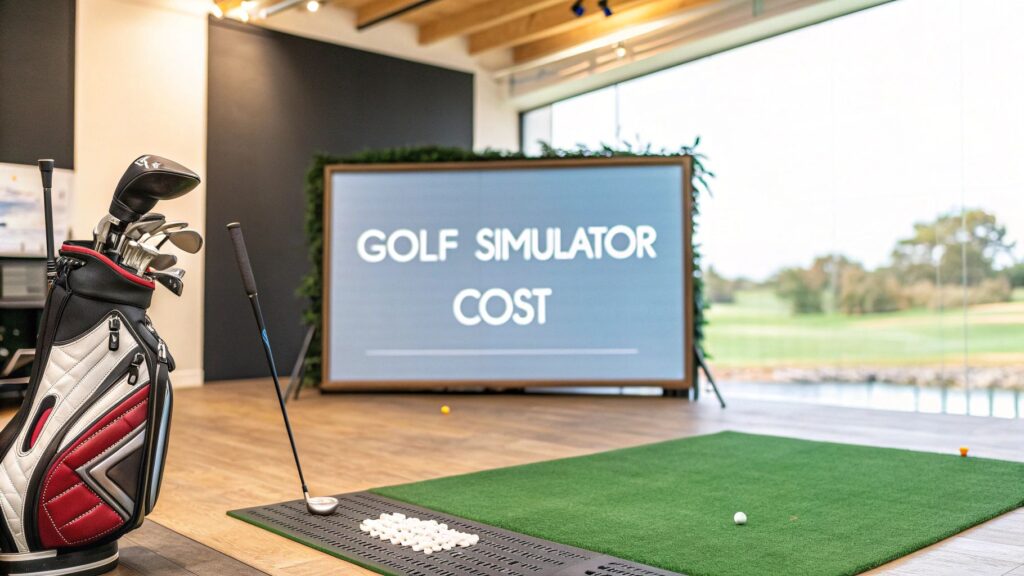
The honest, no-fluff answer to “how much does a golf simulator cost?” is… it depends. You can get a solid, fun setup for around $3,000, or you can go all-in with a pro-level, hyper-realistic experience that runs north of $70,000. Understanding the golf simulator cost is crucial for any aspiring golfer. When planning your golf simulator cost, remember to factor in maintenance as well.
Think of it like building a home theater. You could start with a good TV and a soundbar, or you could install a 4K projector, tiered seating, and a full surround-sound system. The final price tag is all about the components you choose but don’t forget to consider the long-term implications of your golf simulator cost. When reviewing your options, keep your golf simulator cost in mind for maximum efficiency.
When considering the golf simulator cost, think of it like building a home theater. You could start with a good TV and a soundbar, or you could install a 4K projector, tiered seating, and a full surround-sound system. The final price tag is all about the components you choose for your golf simulator cost and lastly being mindful of your golf simulator cost will ensure a fulfilling experience. Finally, your golf simulator cost should match your aspirations as a golfer.
- Your Golf Simulator Cost at a Glance
- Breaking Down the Core Hardware Costs of Golf Simulators
- Understanding Software and Subscription Fees for Golf Simulators
- Planning for Space and Installation Expenses for Golf Simulators
- Finding the Right Setup for Your Golfing Style
- Is a Golf Simulator a Good Investment?
- FAQ's
Your Golf Simulator Cost at a Glance
Trying to figure out the total cost can feel like staring at a massive menu with no prices. But it’s simpler than it looks. Everything really boils down to three core pieces: the launch monitor (the brains), the enclosure and hitting mat (the arena), and the software and PC (the virtual world). Ultimately, your understanding of golf simulator cost will shape your overall experience.
Don’t underestimate the importance of researching your golf simulator cost. Naturally, each of these parts comes in different flavors—from budget-friendly to tour-pro-grade—and that’s what drives the final number. A starter setup might mean a reliable, portable launch monitor and a simple net. A premium build, on the other hand, will feature a commercial-grade monitor and a custom-built enclosure that makes you feel like you’re right on the course. Ultimately, understanding the breakdown of golf simulator cost helps set realistic expectations.
Budget vs Mid-Range vs Premium Golf simulator Set Ups
The price jumps between these tiers are pretty significant, mostly driven by the technology packed into the launch monitor. Entry-level units, which are perfect for casual practice and having a blast with friends, usually fall between $1,000 and $3,000. These give you the core data you need without emptying your wallet. The right balance between features and golf simulator cost leads to satisfaction.
Step up to the mid-range—typically between $5,000 and $10,000—and you’ll see a big jump in accuracy, more data points, and better graphics. Then you have the high-end systems that the pros use, where the launch monitor alone can easily top $20,000. Consider all aspects of the golf simulator cost to maximize your experience.
Knowing where you fit in is the first step. To give you a clearer picture, here’s a quick breakdown of what to expect at each level. Carefully evaluating your golf simulator cost will help align it with your goals.
Estimated Golf Simulator Cost at a Glance
To simplify things, we’ve laid out the typical all-in costs for budget, mid-range, and premium simulator packages. This table gives you a ballpark idea of how the individual components add up. Understanding your own needs will help clarify the appropriate golf simulator cost.
| Setup Tier | Launch Monitor Cost | Enclosure & Mat Cost | Software & PC Cost | Estimated Total Cost |
|---|---|---|---|---|
| Budget | $500 – $2,500 | $800 – $2,000 | $300 – $1,500 | $1,600 – $6,000 |
| Mid-Range | $3,000 – $10,000 | $2,500 – $6,000 | $1,000 – $4,000 | $6,500 – $20,000 |
| Premium | $12,000 – $30,000+ | $7,000 – $20,000+ | $3,000 – $10,000+ | $22,000 – $70,000+ |
As you can see, your choice of launch monitor will have the biggest impact on your budget, but the other components are far from trivial.
Key Takeaway: The launch monitor is almost always the biggest check you’ll write, but don’t underestimate the enclosure, hitting mat, and computer. Those “secondary” items can easily add thousands to your final golf simulator cost.
And don’t forget about installation. If you’re not the DIY type, you’ll need to budget for professional help. A good starting point is to figure out how much does a service cost for item assembly, as this will give you a feel for labor rates and what influences the final price.
Breaking Down the Core Hardware Costs of Golf Simulators
The hardware is where your golf simulator dream starts to take physical shape. Think of it like building a custom home theater—the components you pick will dictate the performance, realism, and, of course, the final price tag. This is where the bulk of your investment will go, so understanding each part is key to building a setup that fits your goals and your wallet. Additionally, assessing the long-term value versus the initial golf simulator cost is essential.
These are the tangible pieces of gear that capture your swing, display the virtual course, and give you a surface to hit from. Let’s walk through the big three so you can see exactly where your money is going.
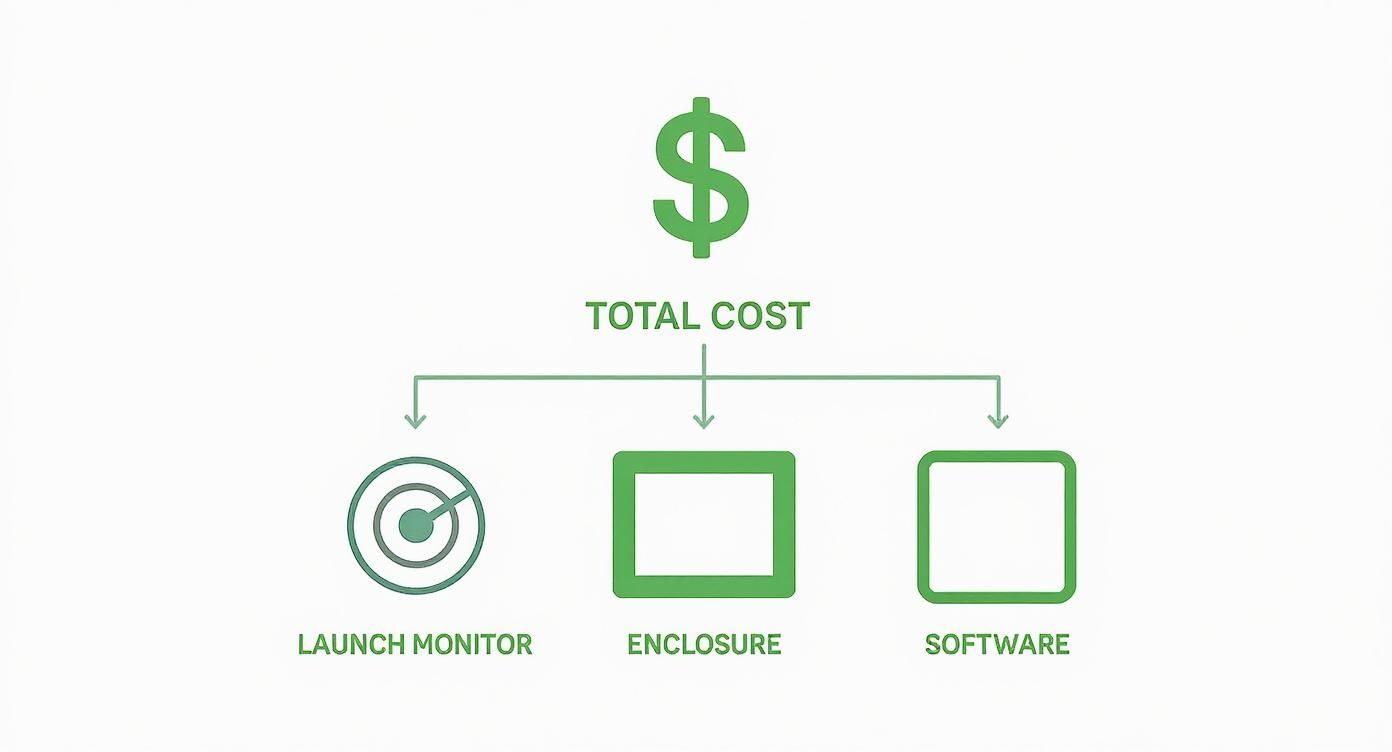
As you can see, the launch monitor, enclosure, and software make up the primary costs. It’s the launch monitor, however, that usually represents the single biggest piece of the pie.
The Golf Launch Monitor: The Brains of the Operation
The launch monitor is the undisputed star of the show. This is the high-tech heart of your entire system, tracking your club and ball at the moment of impact to generate all the data that fuels the simulation.
This one device is responsible for measuring critical metrics like ball speed, launch angle, spin rate, and club path. Its accuracy is everything when it comes to a believable experience, which is why it typically commands the largest part of your budget.
There are two main technologies powering these devices: photometric (camera-based) and Doppler radar-based. Choosing between them often comes down to your space and specific needs.
To help you understand the trade-offs, here’s a quick comparison of the two main technologies.
Golf Launch Monitor Technology Comparison
| Feature | Photometric (Camera-Based) | Doppler Radar-Based |
|---|---|---|
| How It Works | Uses high-speed cameras to capture impact images. | Uses microwave radar to track the ball’s full flight. |
| Best For | Indoor setups with limited space. | Outdoor use or large indoor spaces. |
| Key Strength | Extremely accurate spin and launch angle data. | Tracks the entire ball flight for distance accuracy. |
| Space Needs | Requires less room; only needs to see the impact zone. | Needs significant room behind and in front of the ball. |
| Examples | Foresight Sports GCQuad, Bushnell Launch Pro | TrackMan, FlightScope Mevo+ |
Essentially, camera-based systems are the gold standard for indoor accuracy, especially for spin, because they don’t need to see the ball fly very far. Radar units really shine outdoors where they can track the ball for hundreds of yards, but they need a lot of room to breathe indoors to get a good reading.
Making the right call here is a huge deal. For a deeper dive, check out our guide to finding the https://golfinquirer.com/best-golf-launch-monitor/ that perfectly matches your space and ambitions.
Enclosures, Impact Screens, and Mats for Golf Simulators
If the launch monitor is the brain, then the enclosure, screen, and mat form the body. This is the hardware that transforms your garage or basement from a concrete box into your own private tee box at Pebble Beach.
An enclosure is the frame and fabric shell that contains your hitting area. Its main job is a simple one: stop errant shots from punching holes in your drywall. A well-designed enclosure also helps block out ambient light, making the projected image on your screen look much brighter and more vibrant.
The impact screen is what you’ll be hitting balls into, over and over again. It has to be tough enough to handle thousands of strikes from a driver yet smooth enough to serve as a quality projection surface. A cheap screen will wear out fast and can make a loud, unpleasant thwack on impact. Premium screens, on the other hand, are quieter, more absorbent, and deliver a crisp, clear picture.
Don’t forget the hitting mat. This might be the most underrated part of the whole setup. Hitting off a cheap, hard mat is a recipe for sore wrists and elbows. Quality mats are designed with multiple layers to mimic the feel of a real fairway, giving you better feedback and saving your joints from a world of pain.
Golf simulator Projectors and Displays: Bringing the Course to Life
The last piece of the core hardware puzzle is how you see the course. Most setups use a projector to throw a life-sized image onto the impact screen, creating that fully immersive feeling. When you start shopping for projectors, you’ll see two terms pop up constantly: lumens and throw ratio.
Lumens are just a measure of brightness. For a golf simulator in a room that isn’t pitch black, you’ll want at least 3,000 lumens to get an image that’s bright enough to see clearly without washing out.
The throw ratio tells you how far away the projector needs to be to create a specific sized image. A “short throw” projector is the go-to for simulators because you can mount it closer to the screen—usually on the ceiling just ahead of where you’re hitting. This setup is crucial because it prevents your own body from casting a shadow on the screen as you swing.
While our focus is on simulators, understanding the broader world of large displays can be useful. For a detailed breakdown of related expenses, it’s worth reading up on demystifying display hardware and installation costs.
Understanding Software and Subscription Fees for Golf Simulators
If the launch monitor is the brain and the enclosure is the body, then the software is the soul of your golf simulator. It’s the magic that transforms a garage into the 18th hole at Pebble Beach. But that magic often comes with its own price tag, and it’s a detail where the ongoing golf simulator cost can really sneak up on new owners.
Think of it like buying a new video game console. The hardware gets you in the door, but you still need to buy the games—and that’s a separate, often recurring, expense. Simulator software works in a very similar way.
Many launch monitors will throw in a basic software package to get you started. It’ll probably have a simple driving range and show a few key data points. But if you want the full experience—we’re talking world-famous courses, online tournaments, and deep swing analysis—you’ll almost always need to upgrade.
One-Time Purchase vs. Recurring Subscriptions for Golf Simulators
When it comes to paying for software, you’ll generally find two models. The old-school way is a one-time purchase, where you pay a pretty big fee upfront for lifetime access. It can feel like a steep hit to the wallet at first, but the upside is you’re done—no more monthly bills.
Lately, however, the industry has been moving toward a subscription model. This breaks the cost down into a smaller annual or monthly fee that gives you constant access to the newest courses, features, and online play. It’s definitely easier to swallow in the short term, but those fees become a permanent part of your total cost over the years.
Key Takeaway: Always, always clarify the software cost structure before you buy a launch monitor. A lower price on the hardware might look tempting, but if it’s tied to a mandatory and expensive annual subscription, the long-term value changes completely.
It’s crucial to know exactly what you’re getting for your money. These subscriptions aren’t just for show; they unlock the features that truly define what your simulator can do.
What Do Golf Simulator Subscriptions Typically Unlock?
So, what are you actually paying for with these fees? It’s a lot more than just a pretty picture. Subscriptions grant you access to a growing library of top-tier content and advanced tools that keep the experience fresh and exciting.
Here are the most common perks you’ll find behind a subscription wall:
- World-Famous Golf Courses: This is the big one. Subscriptions are your ticket to playing meticulously rendered versions of legendary courses like St Andrews, Augusta, and Pebble Beach.
- Online Multiplayer and Tournaments: Want to compete against your buddies or players across the globe? Access to online tournaments, leagues, and head-to-head matches almost always requires an active subscription.
- Advanced Data and Analytics: While basic numbers might be free, subscriptions often provide much deeper insights. Think video swing analysis, detailed shot dispersion charts, and performance tracking over time.
- Regular Content Updates: Paid plans ensure you get a steady stream of new courses, game modes, and software improvements as they’re released, so your simulator never feels stale.
This screenshot of the TrackMan software options is a perfect example of how different tiers unlock more powerful features.
As you can see, the basic plan covers the core functions, but the premium tiers are what add the massive course libraries and pro-level analytics that serious golfers crave. Factoring these ongoing fees into your budget from day one is the smartest way to avoid any unwelcome surprises down the road and make sure you get the exact experience you’re paying for.
Planning for Space and Installation Expenses for Golf Simulators
Before you even start dreaming about which launch monitor to buy, you need to answer a much more basic question: where is this thing going to live? The physical space is the absolute foundation of your entire setup. Overlooking the costs to get it ready is one of the quickest ways to completely blow your budget.
This isn’t just about clearing out a corner of the garage. It’s about creating a space that’s safe, functional, and actually fun to be in. Your dream of a home golf sanctuary starts with a simple tape measure. The first, non-negotiable step is making sure you have enough room to swing a driver without a second thought. A nasty crack against a ceiling beam on your backswing will end your session—and your excitement—in a hurry.
Defining Your Minimum Room Dimensions for a Golf Simulator
Every setup is a little different, but the golf simulator community generally agrees on some minimums for a comfortable experience. Think of these as the bare-bones baseline. More space is always better, but this is what you’ll need to avoid feeling cramped or having to alter your natural swing.
- Ceiling Height: You need at least 9 feet, but 10 feet is the gold standard. This gives most golfers plenty of clearance to let the big dog eat without fear.
- Room Width: Aim for about 12 to 15 feet across. This gives you enough elbow room for your swing and keeps the enclosure from feeling like it’s closing in on you.
- Room Depth: A depth of 16 to 20 feet is ideal. This accommodates the hitting mat, provides a safe distance to the impact screen, and leaves room behind you for a radar-based launch monitor to do its job.
Getting these numbers wrong can be a costly mistake, potentially leaving you with an expensive toy you can’t even use properly. For some clever ideas on using different spots in your home, our guide on how to practice golf at home has some great solutions.
Uncovering Potential Hidden Costs for Golf Simulator Installation
Once you’ve confirmed your space is big enough, it’s time to start thinking about modifications. This is where the “hidden” part of the golf simulator cost often sneaks up on people. A spare room or garage is almost never “simulator-ready” right off the bat. When reviewing your options, keep your golf simulator cost in mind for maximum efficiency.
You might need to budget for things like:
- Electrical Work: Are there enough outlets in the right spots for your projector, computer, and launch monitor? You might need an electrician to run new wiring or install a dedicated outlet in the ceiling for a projector, which can easily run a few hundred dollars.
- Specialized Lighting: Your standard overhead garage light is going to create annoying shadows on the impact screen. Many people install track lighting or dimmable spotlights to properly light up the hitting area without washing out the projected image.
- Flooring and Soundproofing: Thwacking a golf ball indoors is loud. Really loud. Adding interlocking foam floor tiles or even sound-dampening panels on the walls can make a world of difference, especially if your simulator room shares a wall with a living space.
These “little” projects can add up fast, turning what seemed like a simple installation into a much more involved and expensive renovation. Understanding all facets of the golf simulator cost is essential for a rewarding investment.
DIY vs Professional Golf Simulator Installation
When planning your golf simulator cost, don’t forget to include installation fees. The last piece of the space-planning puzzle is figuring out who’s going to put it all together. Are you handy enough to tackle it yourself, or should you call in the pros?
A professional installation can add anywhere from $500 to over $5,000 to your total cost, depending on how complex the job is. This can cover everything from building the enclosure and mounting the projector to fine-tuning and calibrating the whole system.
Going the DIY route can definitely save you a chunk of change, assuming you have the tools, time, and patience. But a sloppy installation can lead to endless frustration, from a crooked image on the screen to an impact screen that sags over time. For more complex, custom-built rooms, hiring a professional team is often the smarter long-term move to make sure everything just works perfectly from day one.
Finding the Right Setup for Your Golfing Style
A golf simulator isn’t a one-size-fits-all purchase, and the right setup for you hinges entirely on what you want to achieve. The massive range in golf simulator cost reflects this reality. What works for a casual player is total overkill for a serious competitor, and vice-versa.
To cut through the noise, let’s break it down by creating three distinct golfer profiles. Figuring out where you fit makes the whole process much clearer. Instead of getting bogged down in technical specs, you can focus on a setup that directly matches your ambitions on the virtual links.
The Weekend Entertainer in Golf Simulators
You’re the social golfer. Your main goal is to have a blast playing famous courses with friends and family, maybe over a few drinks. You want a fun, reliable system that’s easy to use and won’t break the bank. You aren’t worried about pinpoint accuracy on spin decay; you just want to hit the ball and watch it fly on a cool-looking course.
- Launch Monitor: A solid entry-level unit like the Garmin Approach R10 or FlightScope Mevo+ is perfect. They provide more than enough accuracy for casual rounds and fun games.
- Software: Stick with the base software that comes with your monitor or opt for an affordable subscription like E6 Connect’s basic plan.
- Enclosure: A pre-packaged enclosure kit or even a high-quality net and mat combo will get the job done without needing a custom build.
- Estimated Cost: You can put together a fantastic entertainment setup for $3,000 to $7,000.
The Dedicated Improver Golf Simulator
You’re serious about your game. You live and breathe golf, and your primary reason for buying a simulator is to practice with purpose and shave strokes off your handicap. You crave accurate, actionable data—especially ball speed, launch angle, and spin rate—to really dial in your swing.
For this golfer, the investment shifts heavily toward the launch monitor. The data it provides is the entire point of the purchase, so this is not the place to cut corners.
Here’s a setup geared for serious improvement:
- Launch Monitor: This is where you invest. A camera-based unit like the Bushnell Launch Pro or Uneekor EYE MINI is ideal, delivering the hyper-accurate club and ball data you need.
- Software: A subscription that offers advanced analytics, video swing playback, and detailed performance tracking is essential.
- Mat: A high-quality hitting mat that mimics real turf is a must-have to protect your joints during long practice sessions.
- Estimated Cost: Expect to invest between $8,000 and $20,000 for a truly data-driven setup.
This focus on practice aligns with the massive growth in the simulator market. Recent data shows there are now about 8.1 million simulator users globally, a staggering 126% increase from five years ago. Interestingly, while only 7% of golf facilities currently have simulators, about 51% of users are non-golfers, showing just how broad the appeal of this tech is. You can read the full report on the growing golf simulator opportunity.
The Ultimate Golf Simulator Realist
For you, budget is secondary to experience. You’re after the most immersive, lifelike simulation possible—a setup so realistic it’s hard to tell from the real thing. You demand instant shot feedback, stunning 4K graphics, and hardware that mirrors what tour pros use. This is the top of the mountain.
- Launch Monitor: You’re looking at top-tier, commercial-grade systems like a Foresight Sports GCQuad or a TrackMan 4. Nothing less will do.
- Software & PC: A premium software package with a full course library and a high-end gaming PC to run it all in glorious 4K resolution are non-negotiable.
- Enclosure & Projector: This means a custom-built enclosure, a premium impact screen that can take a beating, and a bright, 4K short-throw projector for crystal-clear visuals.
- Estimated Cost: High-end, immersive setups start around $25,000 and can easily soar past $70,000.
Is a Golf Simulator a Good Investment?
Beyond the initial sticker shock, it’s completely fair to ask what you’re really getting for your money. Is a golf simulator just an expensive toy, or is it a genuine investment in your home, your family’s entertainment, and your game? To really get to the bottom of that, we need to look at the incredible shifts happening in the at-home golf world right now.
This isn’t some niche hobby for the ultra-wealthy anymore; it’s a full-blown, booming industry. The technology has gotten so good—and so much more affordable—that we’re seeing a massive surge in popularity. That kind of growth is a great sign that this technology has serious staying power.
The numbers really drive the point home. In 2024, the golf simulator market is valued at roughly USD 2.2 billion. Experts are forecasting it to more than double to USD 4.75 billion by 2035, thanks to a huge appetite for these setups in homes and businesses. You can discover more insights about these market trends to see just how big this movement has become.
How Technology Is Changing the Cost Equation in Golf Simulators
Even just a decade ago, getting the kind of shot accuracy you can now buy for a few thousand dollars would have cost a small fortune. That dramatic price drop is all thanks to fierce competition and lightning-fast innovation in the industry. As launch monitor technology gets better and cheaper to manufacture, the barrier to entry for a quality home setup gets lower every single year.
Think about it like flat-screen TVs. What was once a luxury item costing tens of thousands is now a totally affordable staple in most living rooms. The golf simulator market is on the exact same trajectory, which makes the initial golf simulator cost feel a lot less like a hurdle.
Your investment today buys you a level of technology that was previously reserved for PGA Tour professionals. This means the system you buy now is more likely to provide lasting value for game improvement and entertainment.
This isn’t just about making old tech cheaper; it’s about making powerful, brand-new features accessible to the average golfer.
What’s Next for At-Home Golf
The future of golf simulation is where your investment really starts to show its long-term value. The tech is quickly moving beyond just measuring your shot data and into the world of personalized coaching and stunning realism. Remember, a clear picture of the golf simulator cost will drive your purchasing decisions.
Here’s a sneak peek at what’s just around the corner:
- AI-Powered Swing Coaches: Imagine your software analyzing your swing in real-time and giving you instant, helpful feedback. This is already popping up in premium software and will likely become a standard feature for everyone.
- Hyper-Realistic Graphics: With the power of modern gaming PCs, developers are creating virtual courses so detailed you can almost smell the freshly cut grass. The line between playing a simulation and being on the actual course is going to get very blurry.
- Expanded Social and Competitive Play: Online leagues, global tournaments, and cloud-based player profiles are making it easier than ever to tee it up with golfers from all over the world, right from your garage.
Keeping these industry shifts in mind helps you see your purchase not as a one-time expense, but as an investment into a platform that will grow, evolve, and keep delivering incredible golf experiences for years to come. Finally, your overall golf simulator cost should reflect your commitment to the game. Your total golf simulator cost will vary based on the equipment selected, similar to other tech investments.
FAQ’s
After digging into all the components and numbers, a few final questions are bound to pop up. Let’s walk through some of the most common things people ask when they’re putting the finishing touches on their golf simulator budget. This should give you the last bit of clarity you need to move forward with confidence. Understanding the golf simulator cost will prepare you for future upgrades as well..
Can I Really Build a Good Golf Simulator for Under $5,000?
Yes, you absolutely can. A budget under $5,000 is a fantastic starting point for a quality entry-level or even mid-range setup. The secret is just being smart about where your money goes.
For instance, you could grab a highly-rated launch monitor like a Garmin Approach R10 or a FlightScope Mevo+ for well under $2,000. That leaves plenty of cash for a solid enclosure, a good hitting mat, and a decent projector. No, it won’t have the pin-point accuracy of a $20,000 commercial system, but it will be more than enough for fun rounds with friends and truly productive practice sessions.
What’s the Absolute Minimum Ceiling Height I Need?
While 10 feet is the gold standard for total peace of mind, the absolute minimum for most golfers is 9 feet. This usually provides just enough clearance to swing your driver without feeling like you have to flatten your swing or, worse, worrying about clipping the ceiling.
Crucial Tip: Before you even think about buying equipment, take your driver into the room. Make a few slow, easy practice swings. It’s the only real way to know for sure if the space will work for your unique swing.
Are Those Expensive Software Subscriptions Actually Worth It?
This really comes down to what you want to get out of your simulator. If you’re a “Dedicated Improver” looking for deep dives into your shot data, then yes, a subscription is often worth every penny. Same goes for the “Weekend Entertainer” who wants a huge library of world-famous courses to play. The paid plans are what unlock the premium features that make the experience feel truly immersive.
But if your main goal is just to hit balls on a virtual range and check your distances, the basic software that comes with most launch monitors will probably do the trick just fine.
How Much Accuracy Am I Giving Up with a Budget Launch Monitor?
You’d be surprised. Today’s budget-friendly launch monitors are incredibly accurate with core data points like ball speed and launch angle. The biggest trade-off you’ll find when comparing them to high-end units is in the measurement of spin rate and spin axis.
Many budget models estimate spin instead of measuring it directly, so you might see less consistent results on shots with a lot of curve, like a big draw or fade. For straight shots and gapping your clubs, though, they are remarkably reliable and deliver huge value for the price.
At Golf Inquirer, we believe that having the right information is the first step toward building the perfect at-home golf experience. Explore our guides and reviews to find the best gear to elevate your game. Visit us at https://golfinquirer.com to get started.