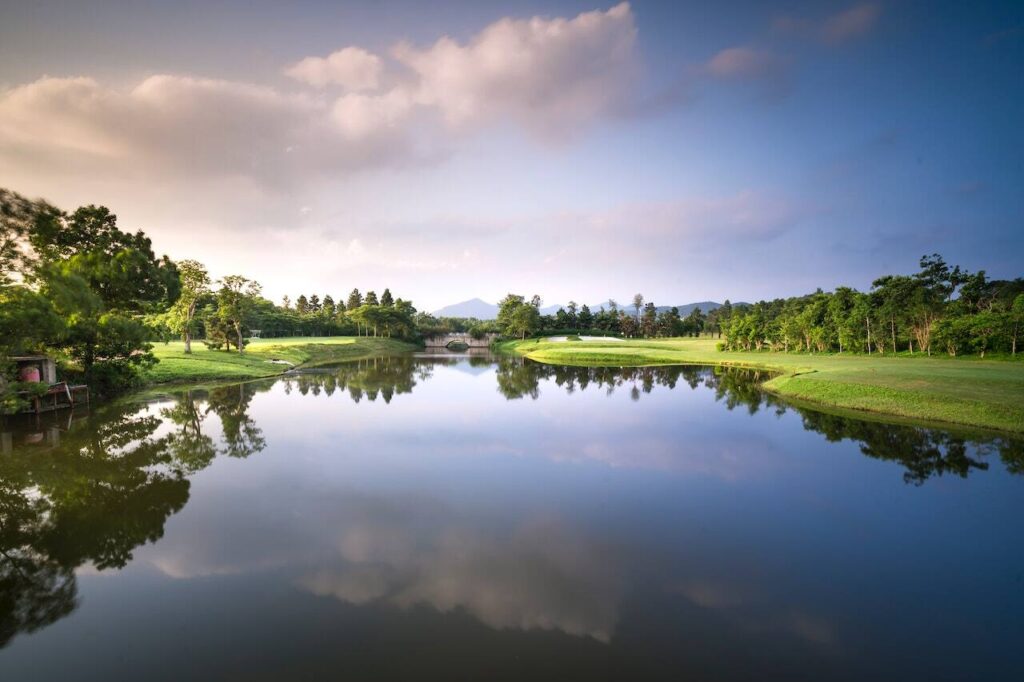
Ever wondered what people mean when they talk about “links golf”? At its heart, a links golf course is the game in its purest, most ancient form. Forget the lush, manicured fairways of your local club—we’re talking about a rugged, wind-swept landscape where golf was born. It’s a raw and beautiful challenge defined by its seaside location, firm, sandy soil, and an almost complete lack of trees.
It’s golf shaped entirely by nature, and playing one is an experience you’ll never forget.
The Original Blueprint for Golf

Long before perfectly manicured parkland courses even existed, there was only linksland. The name “links” actually comes from the Old English word hlinc, meaning “rising ground” or “ridge”—a perfect description of the sandy, dune-covered coastline where the first courses were laid out in Scotland. Golf was first documented on this kind of turf at the Old Course at St. Andrews, with records of play dating all the way back to 1457.
Here’s an easy way to think about it: if a typical parkland course is a carefully curated botanical garden, a links course is a wild coastal nature preserve. The original architects didn’t really create the landscape; they simply discovered fairways and greens among the existing dunes and hollows. This hands-off approach is what gives it such a unique character. You can get a better sense of these environments by exploring various coastal landscapes and beaches.
This natural foundation demands a completely different style of golf. The game is played much closer to the ground, forcing you to rely on creativity and imagination rather than just brute force. You aren’t just playing against the course; you’re battling the wind, calculating the bounces, and embracing the beautiful chaos of the land itself.
The Defining Elements of Golf Linksland
So, what elevates a simple seaside track into a true links experience? It’s much more than just being near the water. A handful of non-negotiable elements have to be there, each one contributing to the unique feel and strategic puzzle of the course.
Here’s a quick rundown of what makes a links course authentic.
Core Characteristics of a True Golf Links Course
| Characteristic | Description |
|---|---|
| Sandy Soil | The foundation is a sandy base, ensuring incredible drainage. This is what creates the famously firm and fast-running turf that lets the ball roll for miles. |
| Coastal Location | A true links course must be right on the coast, fully exposed to the elements. The wind isn’t just a factor; it’s a defining feature of every single shot. |
| Natural Terrain | Fairways aren’t bulldozed into shape. They follow the natural humps, bumps, and swales of the land, which can kick your ball in any number of unexpected directions. |
| Few to No Trees | Links courses are almost entirely treeless. This leaves the course wide open, making the ever-present wind its primary defense against low scores. |
These characteristics don’t exist in isolation; they work together to create a test of golf that is unlike any other.
The interplay between these raw, natural features is precisely what makes links golf so memorable. For a deeper dive into how these elements shape the game, you can learn more about golf course design and how it affects play in our detailed guide.
The Seven Hallmarks of True Golf Links Golf
So, what really makes a links course a links course? It goes way beyond just being near the ocean. These courses are living, breathing landscapes where every element works together to test your skill, patience, and imagination. Let’s break down the seven hallmarks that give links golf its soul, turning a simple game into a battle against the elements.
1. Sandy Soil and Firm, Fast Turf on Golf Links
Everything about links golf starts from the ground up. The foundation of any true links course is its sandy soil, a gift from the ancient seabeds that once covered the land. This is the secret ingredient behind the legendary firm and fast turf that defines the playing experience.
Unlike the soft, lush parkland courses where your ball plugs in the fairway, on a links course, the ground is an active participant in your shot. Think of it like dropping a golf ball on a thick carpet versus a hardwood floor. The carpet deadens the impact, but the hardwood floor sends it skittering and rolling. Links fairways are the hardwood floor of golf.
This firmness brings the “ground game” roaring to life. A well-struck shot might land 30 yards short of the green and chase all the way to the hole—a classic tactic known as the bump-and-run. This sandy base also means links courses drain ridiculously well. Even after a classic Scottish downpour, the playing surfaces are often ready for play in minutes.
2. The Constant Coastal Wind on Golf Links
On a links course, the wind isn’t just weather—it’s architecture. With no trees to offer a reprieve, the coastal gales sweep across the fairways, demanding your attention on every single shot. It’s a relentless, ever-present force you have to learn to work with, not against.
Playing in the wind requires a total shift in mindset. Instead of trying to muscle the ball through a stiff breeze, the best links players learn to cheat it. They hit lower, piercing shots—often called “stingers”—that stay below the wind’s main fury. They learn to aim way out to the side of their target, trusting the crosswind to guide the ball back toward the flag.
The wind on a links course is often called the “15th club in the bag.” It forces you to get creative, scrap your game plan on the fly, and accept that a perfect swing doesn’t always lead to a perfect result.
This constant breeze is also what helps keep the turf firm and the greens slick, reinforcing the ground-hugging nature of the game. It’s the invisible hand that shapes both the landscape and your scorecard.
3. Deep and Revetting Pot Bunkers in Golf
Forget the wide, sprawling sand traps you find on most American courses. Links bunkers are a different beast entirely. They are typically small, shockingly deep, and have terrifyingly steep faces, earning them the name pot bunkers. These aren’t gentle hazards; they’re genuine punishments, often lurking out of sight until your ball disappears into one.
Historically, these bunkers weren’t even designed by architects. They were formed by sheep huddling together in the hollows of the dunes to escape the wind, eventually wearing away the turf and exposing the sand below. Today, their placement is brutally strategic, guarding the ideal lines to greens and fairways.
What makes them so nasty?
- Steep Faces: The walls are often nearly vertical and sometimes reinforced with stacked layers of sod (a technique known as revetting). This makes advancing the ball toward the green next to impossible.
- Small Size: Their tight, pot-like shape gives you very little room to make a proper swing.
- The Only Option is Out: Your number one goal in a pot bunker is simply to get out. That often means hitting the ball sideways or even backward, away from the hole.
Finding a pot bunker is a true one-stroke penalty, and sometimes more. They demand respect and reward the player who thinks two shots ahead.
4. Natural Undulating Fairways
Links courses weren’t built with bulldozers. The original architects simply draped the holes over the natural landscape, embracing the lumpy, bumpy contours of the dunes. The result is undulating fairways full of humps, hollows, and random bounces—a terrain often described as “rumpled.”
A flat lie on a links course is a rare luxury. You’ll constantly face shots with the ball above your feet, below your feet, on an upslope, or on a downslope. A perfect drive piped down the middle can easily catch a mischievous slope and get kicked into the rough or, worse yet, a hidden bunker. This unpredictability is the heart of the challenge. You have to learn to read the land and anticipate the roll.
5. An Absence of Trees
One of the most visually striking features of a links course is the near-total lack of trees. This isn’t a design choice; it’s a direct result of the salty air, whipping winds, and sandy soil that make it impossible for most trees to grow.
This treeless landscape has a huge impact on how you play:
- Total Exposure: With nothing to block the wind, you are completely at the mercy of the elements from the first tee to the 18th green.
- Visual Tricks: The wide-open vistas can mess with your depth perception, making it tough to judge distances accurately.
- No Safety Net: There are no tree lines to stop a wayward shot. A bad slice or hook just keeps on going until it finds something much worse.
6. Gorse and Heather: The Natural Rough
The real defense of a links course, besides the wind and bunkers, is the native vegetation. Instead of neatly manicured rough, you’re faced with dense, thorny bushes of gorse and thick, wiry patches of heather.
Gorse is a prickly, yellow-flowered nightmare of a shrub that eats golf balls for breakfast. If your ball dives into a gorse bush, the best advice is usually to not even bother looking. Just take your penalty and move on. Heather is just as bad, with tough, tangled stems that will grab your club and twist it in your hands, making a clean shot nearly impossible.
7. Unique and Quirky Layouts
Finally, the natural origins of links golf have created some wonderfully quirky design features you just don’t see anywhere else. Because the courses were laid out on smaller parcels of land, the architects had to get creative. A common design is the “out and in” routing, where the front nine holes travel straight out from the clubhouse and the back nine run parallel on the way back in.
This can also lead to oddities like double greens—massive putting surfaces shared by two different holes—or completely blind shots where you have to aim over a dune and trust a marker post. These aren’t flaws; they’re a celebration of working with the land, and they add another layer of charm and strategy to the entire links experience.
Links vs. Parkland vs. Heathland: A Clear Comparison of Golf Links
To really wrap your head around what makes links golf so special, it helps to put it side-by-side with its inland cousins. While every golf course has tees, fairways, and greens, the way they look, feel, and play can be a world away. The big three styles you’ll hear about are links, parkland, and heathland, and each brings its own unique flavor to the game.
https://www.youtube.com/embed/WsqwFZV4ZcY
Knowing the difference isn’t just about golf trivia; it’s about understanding why a links course demands a completely different mindset and shot selection. You wouldn’t play tennis with a squash racket, right? Same principle. Each style of course has its own unwritten rules, dictated entirely by the land it’s built on.
The Manicured Parkland Golf Course
If links golf is a wild, untamed beast, then parkland golf is a perfectly groomed show pony. This is the style most golfers—especially in North America—know and love. Just picture Augusta National, home of The Masters. That’s the quintessential parkland course.
These tracks are almost always inland, defined by their lush, green, and meticulously maintained conditions. They’re built for a specific kind of game.
- Tree-lined fairways create beautiful corridors but will quickly punish a wayward drive.
- Soft turf and receptive greens are the norm, encouraging what we call “target golf”—firing high, spinning shots that land and stop on a dime.
- Rich, clay-based soil holds moisture, which is what gives these courses their soft, green character. It’s the polar opposite of the sandy soil on a links.
- Man-made hazards, like ponds and sprawling, brilliant white bunkers, are strategically placed to challenge your eye and your nerve.
On a parkland course, the game is played almost entirely through the air. The goal is to fly the ball over trouble and land it softly near the pin. The ground game, which is the heart and soul of links golf, barely gets a look-in.
The Hybrid Heathland Golf Course
Heathland courses are the fascinating middle ground, a beautiful blend of the raw coast and the polished inland. Found mostly across the heathlands of England, these courses offer a unique mix of links and parkland traits, creating a challenge that is all their own.
They definitely share some DNA with links courses. You’ll find firm, fast-running fairways thanks to their sandy soil, and the rough is often thick with punishing gorse and heather. But unlike a true links, heathland courses often feature trees—usually pines, birch, and oak—that frame the holes and demand careful strategic planning.
This diagram breaks down the raw, natural elements that define a true links course, putting the focus on wind, sand, and those notorious bunkers.
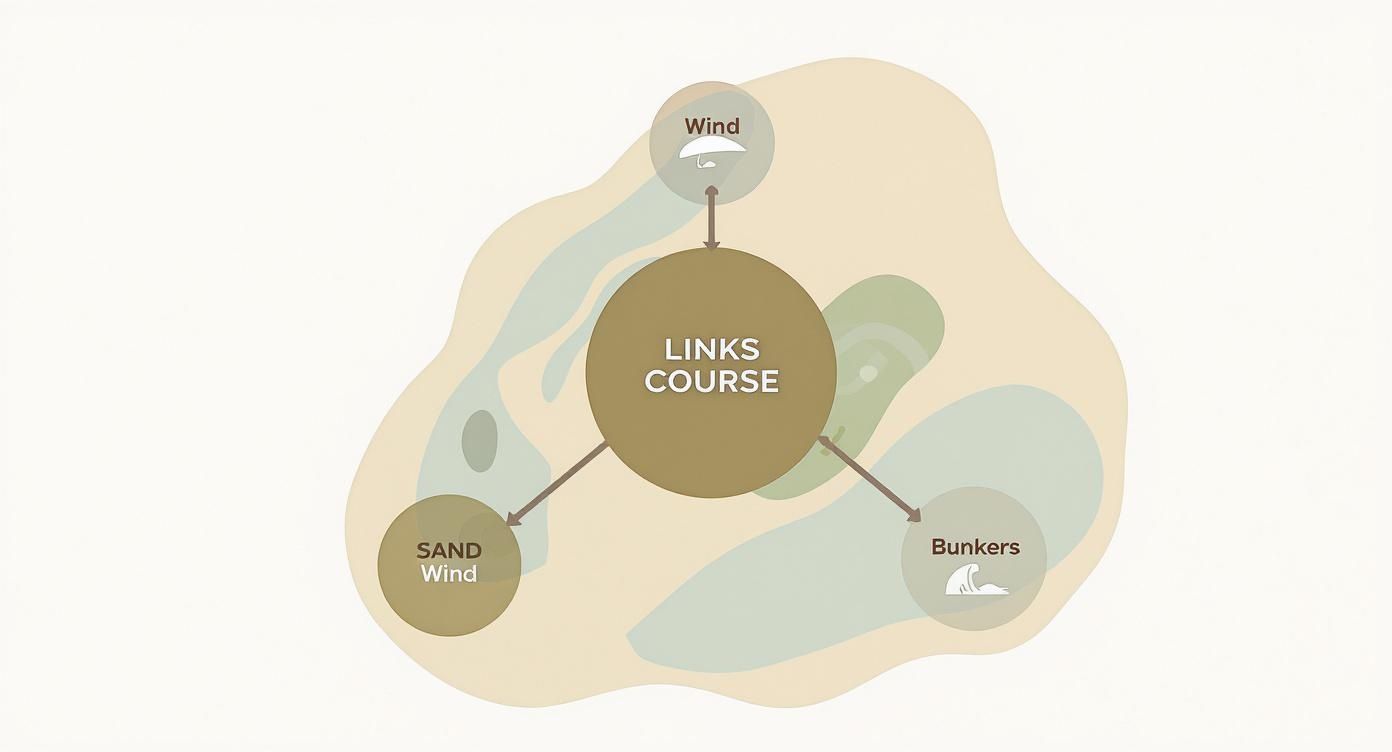
It’s a great visual reminder that on a links course, these forces aren’t just obstacles; they’re fundamental parts of the design that shape every single shot you play.
Comparing Golf Course Styles
Sometimes, the best way to see the differences is to lay them out side-by-side. The style of course you’re playing dictates everything from the shots you’ll need to the type of bounce you can expect. Here’s a direct comparison of the key attributes that define these three iconic types of golf courses.
| Feature | Links | Parkland | Heathland |
|---|---|---|---|
| Location | Coastal, exposed to elements | Inland, often lush and sheltered | Inland, sandy, open terrain |
| Soil Type | Sandy, excellent drainage | Clay-based, holds moisture | Sandy or loamy, good drainage |
| Turf Condition | Firm, fast-running | Soft, receptive | Firm, springy |
| Trees | Virtually none | Abundant, strategically lining holes | Scattered, typically pines and birch |
| Primary Hazards | Wind, pot bunkers, gorse | Trees, water hazards, large bunkers | Heather, gorse, strategic bunkering |
| Playing Style | Ground game, bump-and-run | Aerial game, target golf | A hybrid of ground and aerial shots |
Ultimately, seeing these distinctions makes you appreciate golf course architecture on a whole new level. Each style presents a unique puzzle for the golfer to solve. But it’s the raw, unpredictable, and natural challenge of a links course that makes it the game’s original—and for many, its most compelling—test.
How to Adapt Your Golf Game for a Links Course
Knowing the seven hallmarks of a links course is one thing. Standing on the first tee with a 25-mph crosswind whipping your hat off is something else entirely. Playing links golf well demands a total shift in how you think about the game. Forget trying to overpower the course with brute force; you have to outsmart it.
This is your practical guide to ditching the high-flying parkland game and embracing the creative, on-the-ground challenge that makes links golf so incredibly rewarding.

The biggest adjustment? Learning to see the ground as your ally. On a soft, manicured parkland course, the air is your highway to the hole. On a firm, fast-running links course, the ground is your best friend—a tool to be used, not just a surface to land on.
Embrace the Ground Game
The bump-and-run isn’t just a shot; it’s a philosophy. Instead of hoisting a high wedge that the wind can swat down like a fly, you’ll grab a lower-lofted club like a 7-iron or 8-iron. The goal is to land the ball well short of the green and let it trundle toward the hole like a long putt. This move takes the wind almost completely out of the equation and turns that firm turf into an asset.
Along those same lines, putting from way off the green isn’t just acceptable—it’s often the smartest play you can make. When the fairway is cut tight and the ground is firm, a putter can be far more reliable than a delicate chip.
On a true links course, the fairway is your canvas. Use its humps and hollows to feed the ball toward the hole. A shot aimed 20 yards left of the green might be the perfect line if it catches the right slope on the bounce.
This creative approach requires you to see possibilities you’d never consider on a softer course. It’s all about calculating bounces and rolls, not just carry distances.
Master Ball Flight Control in Golf
That relentless coastal wind is the number one defense of any great links course. Trying to fight it with high, spinning shots is a losing battle every single time. The real secret is to fly the ball under the wind’s main force with controlled, low-trajectory shots.
This is where the “stinger” or “knockdown” shot becomes your go-to weapon. To pull it off:
- Club Up: Take one or even two more clubs than you normally would for the distance.
- Ball Back: Nudge the ball slightly further back in your stance.
- Shorten Your Swing: Make a more compact swing, thinking “three-quarters” back and through.
- Finish Low: Hold your follow-through low to keep that ball’s trajectory down.
This shot produces a lower, more piercing flight that cuts through the wind instead of ballooning up into it. Learning to master windy golf conditions is non-negotiable for links golf, and this shot is your primary tool for the job.
Develop Links Course Management
Smart course management is absolutely vital when every bounce is a mystery. This means leaving the driver in the bag more often and prioritizing position over raw distance. A 200-yard shot into the widest part of the fairway is worlds better than a 280-yard bomb that brings pot bunkers or gorse into play.
Here are a few essential management tips for a links layout:
- Club selection is everything: Playing into the wind? Take more club and swing easy. Playing downwind? Take less club and prepare for the ball to roll out much further than you expect. A gentle 9-iron might travel the distance of a full 7-iron.
- Aim for the front door: Thanks to the firm turf, it’s almost always better to land your approach shots on the front portion of the green and let them release. Flying the ball all the way to a back pin is just asking for it to bound clean over the green.
- Stay patient: Links golf will test your mental game. You will hit perfect shots that take unlucky bounces. Accepting this and moving on is the key to not letting one bad break derail your entire round.
Discover the World’s Most Iconic Links Courses
Reading about firm turf and pot bunkers is one thing, but to really get it, you have to walk the hallowed grounds yourself. These courses are more than just golf holes; they’re living museums of the game, with stories etched into every dune and swale. Let’s take a tour of the bucket-list destinations that define links golf.

The Old Course at St Andrews: The Home of Golf
Any conversation about links golf has to start here. The Old Course isn’t just a course; it’s the cradle of the game itself, with golfers wandering its turf since the 15th century. It’s a public course in the heart of St Andrews, Scotland, and playing it feels like a true pilgrimage for any serious golfer.
What makes it the ultimate links experience is its wonderfully quirky design, shaped not by bulldozers but by centuries of nature and play. You’ll find enormous double greens, the infamous “Road Hole” (the 17th), and bunkers with names and histories of their own. The course’s real defense is its subtlety—hidden pot bunkers, deceptive slopes, and the ever-present wind demand creativity, not just brute force. Playing here is like having a conversation with the history of golf.
Royal County Down: A Masterpiece of Raw Beauty in Golf
Often topping the “best courses in the world” lists, Royal County Down in Northern Ireland is an absolutely stunning—and intimidating—test. Set against the epic backdrop of the Mourne Mountains and Dundrum Bay, its beauty is almost a distraction. The fairways weave through massive dunes blanketed in purple heather and yellow gorse, making it a true visual masterpiece.
Don’t let that beauty fool you, though. This place is tough. Royal County Down is famous for its “bearded” bunkers, with faces layered in thick, wiry fescue that practically guarantees a lost ball. The course features plenty of blind tee shots that require complete trust in your aim and a healthy dose of courage. This is links golf in its most raw, rugged, and breathtaking form.
Playing a course like Royal County Down teaches you a crucial links lesson: the most beautiful path is often the most dangerous. The strategic genius lies in avoiding the stunning hazards that make the course so memorable.
Royal Birkdale: An Open Championship Icon
While Scotland and Ireland are known for their ancient, rumpled links, Royal Birkdale on the English coast offers a slightly different flavor. This iconic Open Championship venue is known for its towering sand dunes that frame each hole, creating incredible natural amphitheaters for spectators. Unlike the blind shots common elsewhere, at Birkdale, the challenge is laid out right in front of you.
The fairways here are relatively flat, running through valleys between the dunes. But the course’s strategic genius lies in its clever bunkering and slick green complexes. It demands precision off the tee to find the right angles for your approach shots. Birkdale proves that a links course doesn’t need quirky bounces to be a world-class test; intelligent design and a relentless wind are more than enough to challenge the best in the game.
FAQ’s
Even after getting a solid grip on the basics, a few questions always seem to pop up about links golf. It’s an ancient, quirky form of the game, so it’s only natural to be curious. Let’s tackle some of the most common ones and get you feeling like you’ve been playing links your whole life.
Are All Seaside Courses True Links Courses?
This is probably the biggest point of confusion out there, and the short answer is a hard no. Just because a course has ocean views doesn’t make it a links.
A true links course must be built on what’s called “linksland”—that specific type of sandy, rumpled turf that acts as a natural buffer between the sea and the richer soil inland. Plenty of gorgeous coastal courses are actually parkland designs that just happen to have a great location. They’ll have lush fairways, trees, and man-made shaping that you’d never find on a traditional links.
The real acid test is the ground beneath your feet. If it doesn’t have that signature firm, fast-running turf that only sandy soil can produce, it’s not a true links course, no matter how close you are to the beach.
Why Are Links Courses Considered So Hard?
Links courses have earned their reputation as golf’s toughest examination, but it’s not about sheer length or impossibly narrow, tree-lined fairways. The challenge comes from a relentless combination of natural elements you have zero control over.
The Wind is Everything: The constant, gusty coastal wind is the course’s number one defense. It can turn a straightforward 150-yard approach into a complex puzzle, forcing you to completely rethink your aim, ball flight, and club choice.
The Bounces (Good and Bad): The firm, lumpy ground means luck is always a factor. You can hit a perfect drive right down the middle, only to see it catch a weird bounce and dive into a hidden pot bunker. It’s a mental grind over 18 holes.
Hazards That Punish: Pot bunkers aren’t just for show; they’re genuine penalties that can easily cost you a shot or two. And the thorny gorse bushes? They’re even meaner—if your ball goes in, it’s probably gone for good.
A Test of Patience: More than anything, links golf tests your mental game. You have to learn to accept the bad breaks, stay patient, and get creative with your shots. It’s a test of resilience just as much as skill.
What Time of Year Is Best for Playing Links Golf?
If you want the best possible conditions, aim for the prime season in Scotland, Ireland, and England, which is generally from late spring to early autumn (May through September).
During these months, you get the benefit of long daylight hours, warmer weather, and the driest, firmest turf. The fescue grasses are in their glory, making the fairways play exactly as they should—fast and true. While you can never rule out a surprise shower (this is the UK, after all!), you’ll have the best shot at a great round. You can play in the winter, as the sandy soil drains incredibly well, but just be ready for tougher winds, colder temps, and softer ground.
Do I Need Specialized Clubs or Gear?
You don’t need a whole new bag of clubs, but a couple of smart tweaks to your setup and gear can make a world of difference.
Bring Out the Driving Iron: Many players swap a fairway wood for a low-lofted driving iron (think 2-iron or 3-iron). It’s the perfect weapon for hitting those low, piercing stingers off the tee that stay under the wind.
Rethink Your Wedges: A wedge with less “bounce” often performs better on the firm, tight lies you’ll face. It helps keep the club from skipping off the turf and into the belly of the ball on delicate chips.
Don’t Skimp on Rain Gear: This is absolutely non-negotiable. A top-quality waterproof jacket and pants can be the one thing that saves your round from becoming a miserable, soggy memory.
Layer Up: Windproof layers are your best friend. Dress in thin, warm layers you can easily add or shed as the weather changes—which it will, probably several times.
Your standard set will get the job done, but the right gear and maybe one extra club can make the experience so much better. And for those looking to explore beyond the coast, there are various golf experiences that offer a different kind of challenge.
At Golf Inquirer, we’re here to fuel your passion for every part of the game. Whether you’re planning to take on a windswept links course or just trying to find the perfect driver, we’ve got your back. Explore more tips, course reviews, and inspiration at https://golfinquirer.com.