
I still remember the day I learned my driver was spinning way too much—every tee shot ballooned, and I was leaving dozens of yards on the table. That’s where a low spin driver comes in. It’s engineered to cut backspin and unleash a flat, wind-piercing trajectory that not only carries farther but also rolls out beautifully once it lands.
What Makes a Low Spin Driver Different?
A low spin driver isn’t a marketing gimmick; it’s a physics hack at impact. Picture a car tire burning out—it’s wasting energy spinning in place rather than moving forward. Replace that tire with a golf ball loaded with backspin, and you get a high, floating shot that bleeds distance.
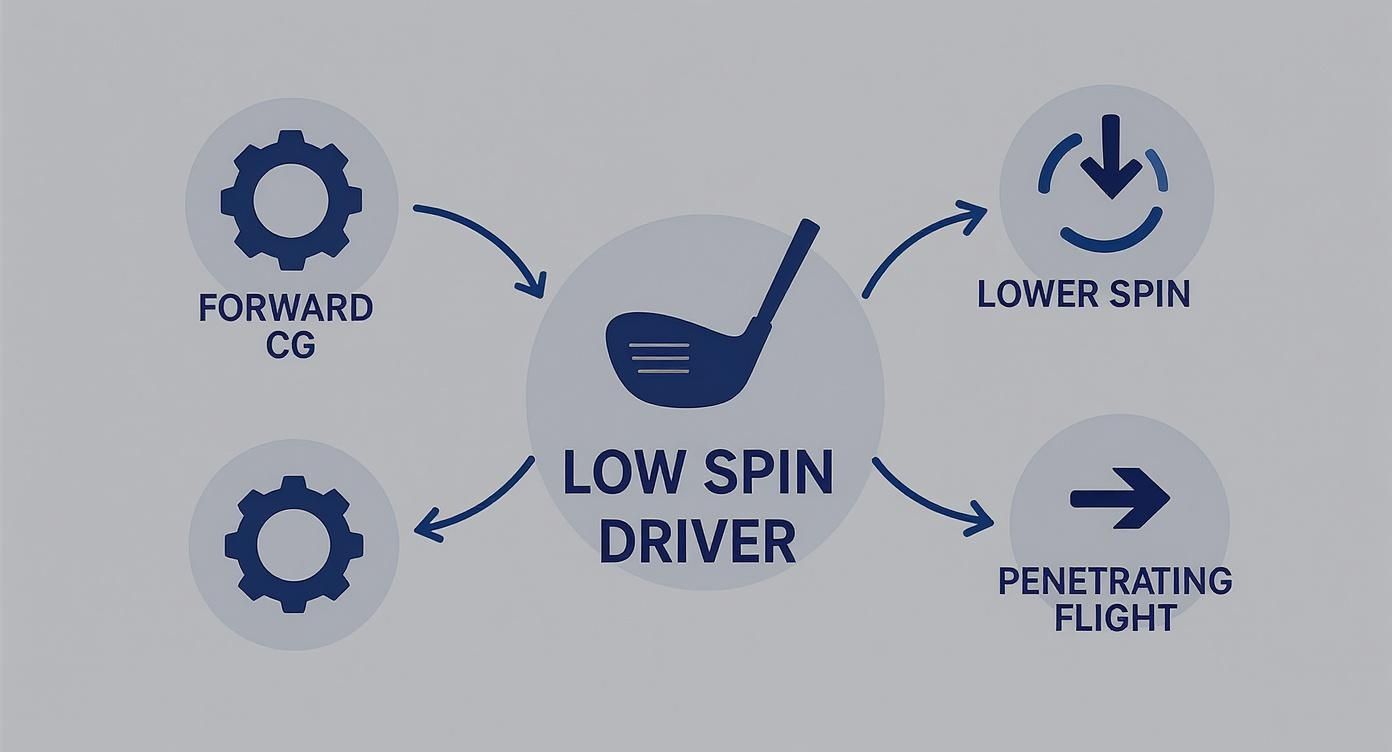
To stop that waste, designers shift the center of gravity (CG) forward, closer to the face. Traditional drivers stash weight low and back for forgiveness and launch help. Low spin models do the opposite. That forward CG squashes spin loft (the gap between delivered loft and angle of attack) and converts more energy into straight-line speed. The result is a piercing ball flight that maximizes carry and roll.
Low Spin Driver Key Characteristics at a Glance
| Characteristic | Description | Performance Goal |
|---|---|---|
| Forward Center of Gravity (CG) | Weight pushed closer to the face | Reduce dynamic loft at impact to lower backspin |
| Lower Loft Options | Often starts at 8° or 9° loft | Promotes a shallower launch angle, matching reduced spin |
| Compact Head Shape | Smaller, pear-shaped heads (430cc–450cc) | Appeals to better players and allows precise CG placement |
| Reduced Forgiveness | Less perimeter weight for stability | Prioritizes spin reduction over off-center forgiveness |
| Adjustable Weighting | Movable weights to fine-tune CG location | Lets golfers dial in their ideal launch and spin combo |
Every design choice is a trade-off: you give up a bit of forgiveness for the spin-slashing magic that unlocks extra yards.
The Goal of Reduced Spin
With a low spin driver, the aim is simple: find the sweet spot where launch and spin work together. Too much loft or spin, and your ball climbs like a balloon; too little, and it never gets enough air time. The perfect blend is high launch plus minimal backspin, translating into maximum total distance.
This setup is transformational for:
- Players with naturally high spin: Regardless of swing speed, some swings produce spin like crazy.
- Golfers hitting up on the ball: Positive attack angles help launch but can also spike spin.
- “Balloon ball” hitters: Those towering drives that stall at peak height, then drop like a rock.
Low spin drivers aren’t just for tour pros anymore. Serious amateurs are demanding equipment that fixes specific launch and spin issues, not generic “one-size-fits-all” clubs.
The global golf driver market reached USD 1.65 billion in 2024, highlighting the appetite for specialized gear. Dive deeper into insights about the golf equipment market from recent analysis.
The Physics Behind Launch, Spin, and Distance
Every powerful drive is an exercise in balance: you need enough launch to stay in the air and just enough spin to keep that flight stable. Think of it like tossing a paper airplane. Too steep, and it stalls; too flat, and it crashes. Golf balls behave identically.
The Engine of Spin
Spin comes from spin loft—the difference between the club’s dynamic loft (what you actually deliver) and your angle of attack (upward or downward path). A steep, downward swing spikes spin loft and backspin, causing ballooning. A shallow or slightly upward strike lowers spin loft, conserving energy for forward speed.
The holy grail for distance? A mid-high launch paired with low spin. That’s the formula for a sizzling, penetrating flight and maximum roll-out.
How Center of Gravity Tames Spin
Moving weight forward is the single biggest factor in reducing spin. With the CG closer to the face, dynamic loft drops at impact—the clubface tilts back less, closing spin loft and “squeezing” out backspin. Energy that would have become rotation now drives the ball forward.
The 2025 driver lineups double down on forward CG. But remember: fitting is crucial. If you already launch low and spin modestly, a low spin driver off the rack could leave you with a scalded shot. Check out matching players to low spin drivers on MyGolfSpy for guidance on finding your perfect fit.
Is a Low Spin Driver Right for Your Game?
There’s a myth that low spin drivers are “pro-only” gear. In reality, it’s about the launch and spin numbers, not just swing speed.
Who Truly Benefits from Lower Spin
If any of these sound familiar, you might be leaving serious yards on the table:
- High Spin Player: Your swing mechanics or steep attack angle create excessive spin and floaty shots.
- “Balloon Ball” Hitter: Towering drives that stall out at the peak.
- Positive Angle of Attack Golfer: You launch high but then spin spikes kill rollout.
Don’t fixate on swing speed alone. If your spin numbers are hurting distance, cutting spin can unleash an extra 15–30 yards off the tee.
Challenging Conventional Wisdom
Old fitting advice said slower swings need more spin. But real-world testing shows forward-CG, low-spin models can benefit moderate swing speeds too. Read more about these unconventional findings for moderate swing speed golfers on MyGolfSpy.
How Equipment And Technique Control Spin
Optimizing spin is a combo of gear tweaks and swing habits.

Forward Center Of Gravity Influence
Forward CG lowers dynamic loft at impact, so more energy goes into horizontal speed instead of spin. It’s the cornerstone of low spin performance.
For fitters, CG location is one of the first specs they check when dialing in a low spin head.
Shaft Flex And Kick Point
Your shaft is the engine. A higher kick point bends closer to the grip, flattening launch and lowering spin. Pay attention to:
- Stiffer Shafts: Reduce twisting, tighten dispersion, often lower spin for faster swingers.
- Kick Point: Changes launch by several degrees, directly affecting spin loft.
- Profile Matching: Align the shaft’s bend profile to your tempo and transition for consistent spin.
Loft Settings And Spin Rate
Loft is the easiest lever. Dropping one degree of loft can cut spin by 300–500 RPM and flatten the flight. Adjustable hosels let you experiment in real time.
Technique Effects On Spin
Your swing sets the stage. Hitting up on the ball lowers spin, while a steep, downward strike spikes it.
- High Impact: Hitting higher on the face can chop up to 500 RPM versus a low strike.
- Neutral Attack: Around zero degrees gives balanced spin and carry.
- Positive Attack: +2 to +4 degrees often pairs best with a low spin head.
Check out our guide on golf club fitting fundamentals for a deeper dive. For a real-world example, see the Josh Kelley Signature Low Taper Fade.
Optimal Driver Spin Rate Benchmarks by Swing Speed
| Clubhead Speed (mph) | Optimal Spin Rate (RPM) | Common Issues Outside Range |
|---|---|---|
| 85–95 | 2600–3000 | Too high: Ballooning. Too low: Not enough carry or roll. |
| 95–105 | 2300–2700 | Too high: Excess spin, poor roll. Too low: Low peak, less carry. |
| 105–115 | 2000–2400 | Too high: Lost rollout. Too low: Hard to launch, control issues. |
Use these marks on your next fitting or practice session to pinpoint where you can gain extra yards.
Practical Ways To Lower Your Driver Spin

Putting low spin theory into action means tackling both your setup and your swing.
Fine-Tuning Your Equipment
In a fitting, expect to dial in:
- Loft Sleeve Adjustments: Each 1° drop cuts spin by 300–500 RPM.
- Shaft Profiles: A higher kick point and right flex flatten trajectory.
- Movable Weights: Slide weight forward for lower spin; back for forgiveness.
Drills To Tame Your Spin
Gear helps, but your swing seals the deal. Try these:
- Tee Height Drill: Teeing higher forces an upward strike and impact toward the upper face.
- Headcover Drill: Place a headcover a foot in front of your tee. Swing “up and through” to avoid it on follow-through.
Pair these with the best golf launch monitor for your budget to track spin and launch changes accurately.
FAQ’s
Even after diving into the how-and-why, you might be wondering if a low spin driver really belongs in your bag. Here are answers to the most common hang-ups:
Will a Low Spin Driver Be Less Forgiving?
Yes, forward CG models usually sacrifice some perimeter weighting. But modern engineering has narrowed that gap, delivering impressive stability. A slight drop in forgiveness is often worth the 20 extra yards you’ll gain.
Can’t I Just Turn Down the Loft on My Driver?
Lowering loft is a quick spin fix—1° down cuts 300–500 RPM—but it opens the face and can twist a fade into a slice. A purpose-built low spin driver solves spin without unwanted face twists.
Do I Need a Fast Swing Speed to Use One?
Not at all. If your spin numbers are high—say 3,500 RPM at 95 mph—you’re losing distance even at moderate speeds. A low spin head can transform your launch data, no matter how fast you swing.
At Golf Inquirer, we believe every golfer deserves gear that matches their game. Explore more tips, gear reviews, and stories at https://golfinquirer.com.