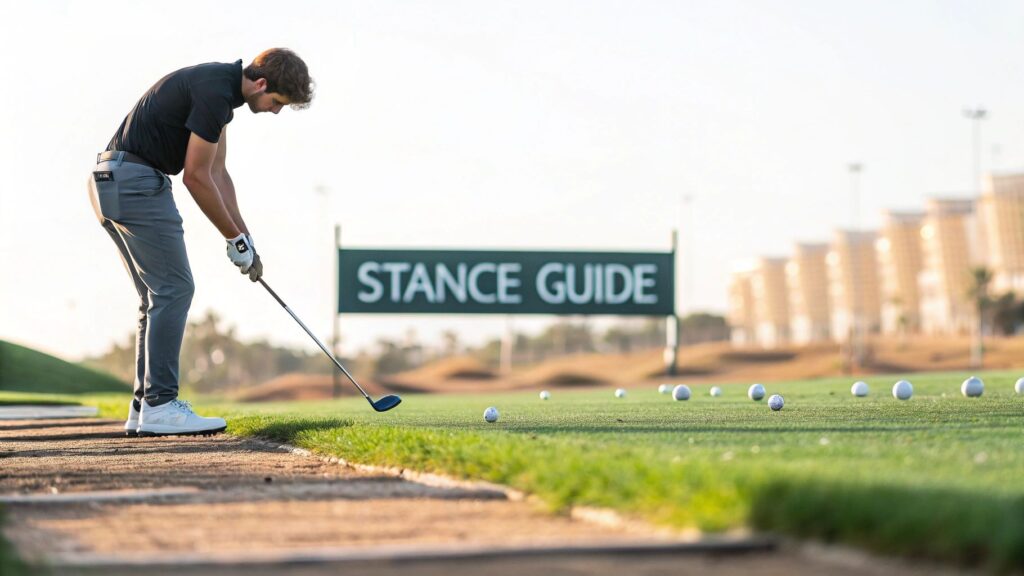
Getting your distance from the golf ball right is one of those simple secrets that makes everything else in the swing click into place. It’s not about finding a magic number; it’s about creating a balanced, athletic setup where your arms can hang naturally, ready to unleash a powerful, consistent swing. Understanding how far to stand from golf ball is crucial to this process.
So, what’s the secret? For most golfers, a great starting point is to have about a hand’s width between the butt end of your grip and your body. This simple, reliable checkpoint is often the key to unlocking consistent power and stopping a whole bunch of common swing flaws before they even start.
Why Your Distance From the Golf Ball Matters
Figuring out how far to stand from the ball is the bedrock of a solid swing, yet it’s a detail so many of us just guess at. This isn’t about perfectly copying what you see a tour pro doing; it’s about finding what works for your body and your swing. When you find that sweet spot, it sets off a positive chain reaction through your entire motion.
Stand too close, and your arms have nowhere to go. You get stuck, forcing a steep, “choppy” swing that robs you of power and often leads to those dreaded shots off the heel—yep, shanks. On the flip side, standing too far away makes you reach for the ball. This throws off your balance from the get-go and encourages that classic “over-the-top” move that produces weak slices and thin shots.
The goal is to find an athletic and balanced position where you feel ready to make a powerful, unrestricted turn. Nailing this at address is infinitely easier than trying to fix bad habits mid-swing.
Get this right, and you’ll see a few key benefits almost immediately:
- Effortless Power: A proper stance gives you the room to make a full shoulder turn and create a wide swing arc. That’s how you generate real clubhead speed without feeling like you’re muscling it.
- Improved Consistency: When your setup is the same every time, your swing becomes far more predictable. That predictability leads to finding the center of the clubface way more often.
- Better Balance: Finding the right distance is crucial for maintaining your balance from the takeaway all the way to a full follow-through, which is absolutely non-negotiable for clean contact.
This is all about putting yourself in a position to succeed before the club even moves.
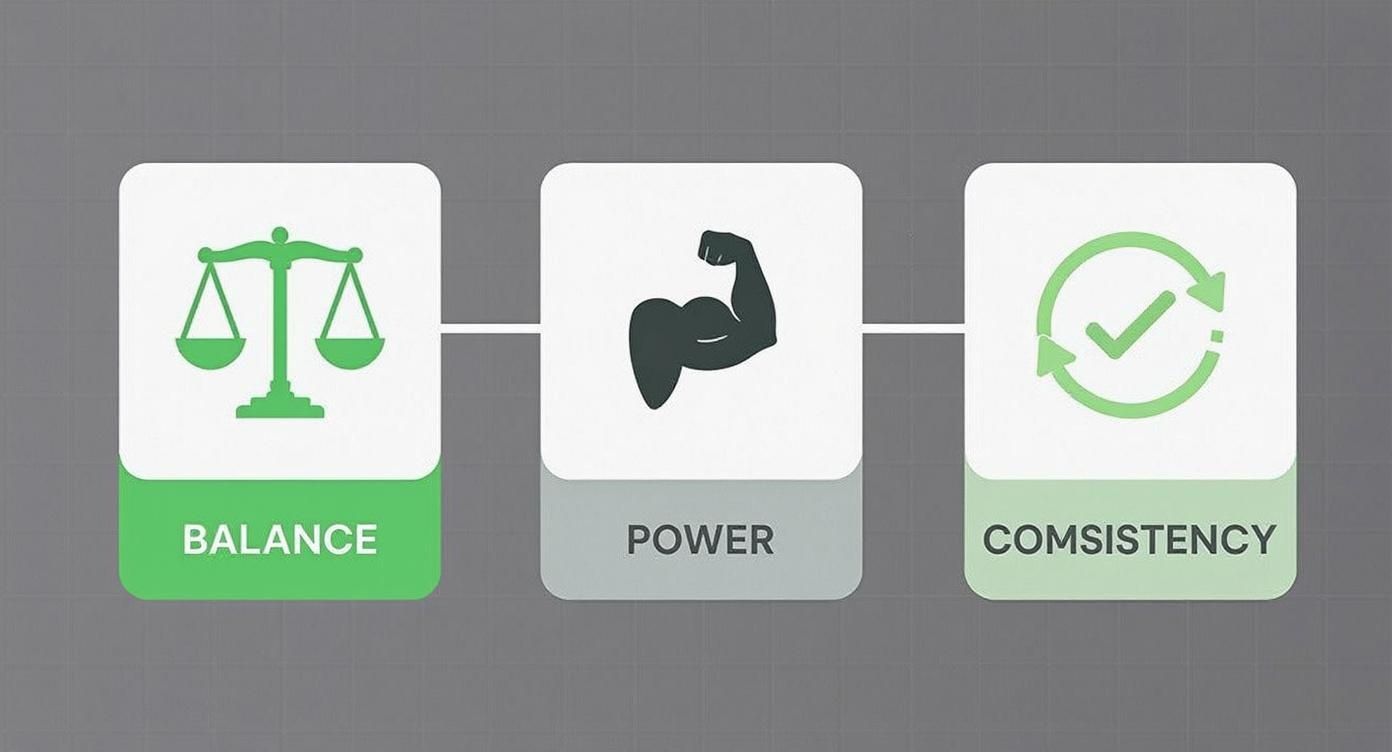
Ultimately, mastering these three elements—Balance, Power, and Consistency—is the key to a repeatable and effective golf swing.
The Science Behind a Good Setup in Golf
Modern golf biomechanics backs this up completely. The distance you stand from the ball isn’t just about comfort; it’s about physics. Data collected from millions of swings confirms a direct link between setup distance and performance.
For example, when looking at driver swings, there’s an optimal range that balances power, control, and accuracy. For a driver with a 45- to 46-inch shaft, pros naturally settle into a position where the grip is around 33-36 inches from the ball. This allows for that full, powerful swing arc we’re all chasing. You can dig into more fascinating data about how amateur golfers perform by checking out the reports on Arccos Golf.
Key Takeaway: Your distance from the ball is not just a preference—it’s a critical component of swing physics. It directly influences your ability to generate speed, control the clubface, and hit the ball solidly.
Instead of getting bogged down by rigid rules, think of your setup as creating a state of athletic readiness. In the next sections, we’ll go over some simple checkpoints and drills to help you dial in this ideal position for every single club in your bag.
Quick Guide to Stance Distance by Golf Club Type
To help you get a feel for this on the range, here’s a quick-reference table. Think of it as a cheat sheet for finding the right starting point with each type of club.
| Club Type | Distance from Ball | Key Posture Check | What It Should Feel Like |
|---|---|---|---|
| Driver/Woods | Farthest. About a hand’s width plus a few inches between grip and body. | More spine tilt away from the target. Weight feels 60/40 on your trail foot. | Athletic but relaxed. Arms fully extended but without tension in the shoulders. |
| Long/Mid-Irons | Medium. Roughly a hand’s width (4-6 inches) between grip and body. | Balanced spine tilt from the hips. Weight feels evenly distributed (50/50). | Solid and stable. You should feel grounded and able to rotate freely. |
| Short Irons/Wedges | Closest. About 3-4 inches (or a few fingers) between grip and body. | Taller posture with less spine tilt. Weight might feel slightly on your lead foot. | In control and “on top of the ball.” Arms are hanging comfortably close to you. |
Remember, these are guidelines, not exact measurements. Use them to build your initial setup, then adjust based on what feels powerful and balanced for your body. The goal is to find a position you can repeat consistently.
Setting Up for Power With Drivers and Woods in Golf

When you pull out the big stick, your goal is simple: launch that ball as far down the fairway as you can. To do that, you need to give yourself enough room to operate. The driver is the longest club in your bag, and standing farther from the ball is key to creating the wide, sweeping swing arc needed to send it high with low spin.
Think of your driver swing as a shallow, sweeping motion, not a steep, chopping one. Creating that extra space lets your arms fully extend through the hitting zone, which is where you generate maximum clubhead speed. If you crowd the ball, you’ll almost certainly get steep and hit down on it—the absolute enemy of a good drive.
Finding Your Driver Stance in Golf
So, how do you find that sweet spot? Here’s a simple, repeatable method. First, get into your stance with your normal grip, and just let your arms hang naturally from your shoulders. From that relaxed position, reach out slightly toward the ball. This little extension puts your arms in a powerful, athletic position without creating any tension.
You should feel balanced and ready to unleash, not stretched out or cramped. A great checkpoint is to look down at the butt end of your grip—it should be about a hand’s width or more from your body. This gives you all the clearance you need to rotate freely.
This setup goes hand-in-hand with proper ball position. With a driver, the ball should be teed up opposite your lead heel. Standing a bit farther away helps accommodate this forward position, making it easier to catch the ball on the upswing and get that ideal high launch.
Pro Tip: Your spine should have a slight tilt away from the target at address. Think of it as creating a “reverse K” shape with your body. This tilt is crucial for promoting an upward angle of attack and preventing that dreaded “over-the-top” move that causes so many slices.
As equipment has changed, so have our setups. Back in 1980, the average PGA Tour driving distance was 256.7 yards. Fast forward to 2016, and that number jumped to 290.1 yards. That 13% increase isn’t just because of better tech; players have learned to optimize their stance. Modern pros typically set up with the end of the club 33 to 34 inches from the ball to get the most leverage out of today’s longer, lighter drivers. You can dive deeper into the game’s transformation by checking out the comprehensive golf overview on Wikipedia.
Golf: Common Flaws and Pro Adjustments
Keep an eye out for bad habits that can sneak into your setup. Are you hunching over with a rounded back? Or are you standing too tall and rigid? Either extreme will throw off your distance from the ball and sabotage your swing before it even starts.
Once you have a solid baseline, you can make tiny tweaks to shape your shots:
- For a high draw: Try standing just a fraction closer. This can help you swing more from the inside.
- For a controlled fade: You might feel a little farther away, which can help neutralize your swing path for that left-to-right ball flight.
Mastering your setup with the driver is all about building a powerful and repeatable foundation. Get your distance from the ball right, and you’re one step closer to bombing it off the tee.
Dialing In Your Golf Iron and Wedge Play
When we get to the irons and wedges, the game changes. Forget about raw power; this is all about precision. These are your scoring clubs, and getting the setup right starts with standing closer to the ball than you do with your driver.
There’s a good reason for this. Getting a bit nearer to the ball naturally steepens your angle of attack. That’s the secret sauce for compressing the golf ball, creating that pure, crisp contact that feels so good and flies right at the pin.
As you work your way down the bag from a 4-iron to a pitching wedge, you’ll want to gradually narrow your stance and shuffle a little closer to the ball. This isn’t a huge, awkward change—it’s a subtle shift that puts you in command. Shorter shafts simply require you to stand closer to maintain a solid, athletic posture.
The Ultimate Golf Iron Checkpoint
Want the simplest, most reliable way to check your distance from the ball with any iron? Here it is. Just get into your stance, bend from your hips, and let your arms hang straight down from your shoulders. No tension, no reaching.
Where your hands naturally hang is exactly where the grip of the club should be. That’s your home base for every iron in the bag.
If you feel like you’re reaching out for the ball, you’re too far away—a classic recipe for thin shots and losing control. On the flip side, if your arms feel jammed up against your body, you’re too close. That’s when you invite fat shots or, even worse, the dreaded shank because you’ve left yourself no room to swing.
The “free arm hang” is the ultimate test. It puts your body in a balanced, ready position, primed to rotate through the ball without any last-second adjustments. Trusting this simple feeling is far more effective than trying to follow a rigid measurement.
Comparing Your Scoring Clubs in Golf
Let’s make this practical. Think about the difference between setting up to a 7-iron versus a sand wedge.
- For a 7-iron: Your feet should be about shoulder-width apart, and the ball will be a couple of inches inside your lead heel. When your arms hang down, you should have about a hand’s width of space between the butt end of the grip and your thighs.
- For a sand wedge: Your stance gets much narrower—your feet might only be a few inches apart. You’ll stand closer to the ball, feeling more “on top of it,” with your hands and the club naturally closer to your body.
This isn’t something you need to obsess over. The shorter the club, the closer you’ll naturally stand to keep your posture and balance intact. Nailing this subtle adjustment is a massive step toward clean, consistent iron shots. If you want to go deeper on this, our full guide on how to hit irons covers even more of these essential techniques.
By dialing in these small setup differences from club to club, you give yourself the best possible chance to control your ball flight and start knocking down pins.
Practical Drills To Groove Your Stance in Golf
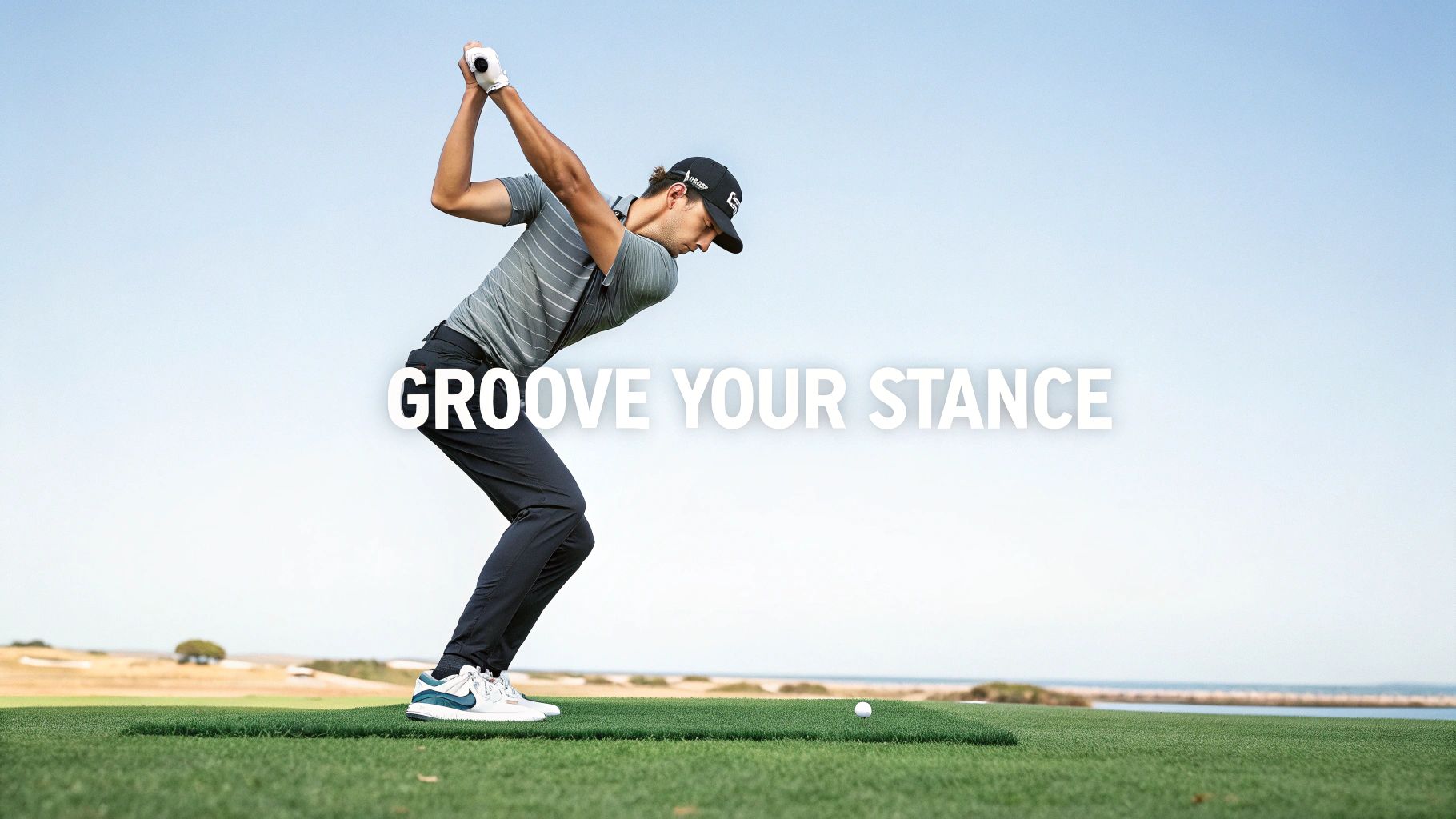
Knowing the right distance from the ball is one thing. Actually making it a natural, repeatable part of your pre-shot routine is what separates the great ball strikers from everyone else.
The goal here isn’t just to learn a position; it’s to build muscle memory. We want to get you to a point where you can stop overthinking your setup and just trust it. These drills are designed to help you internalize that perfect, athletic position so it becomes second nature.
Forget guesswork. Your practice time is for ingraining these feelings until they’re automatic.
The Golf Arm Hang Drill
This is probably the simplest, most fundamental drill for finding a tension-free setup. Its beauty is in its ability to put your body into a naturally balanced position, which is the cornerstone of how far you stand from the golf ball.
Here’s how it works:
- Take your grip and get into your golf posture, but don’t worry about a ball just yet.
- Close your eyes and just let your arms hang completely limp from your shoulders. No tension.
- Feel where the clubhead naturally wants to rest on the ground. That spot is your body’s ideal base position.
- Open your eyes and place a ball right there.
If you consistently find yourself reaching for the ball or pulling your arms in, your posture is likely the culprit. This drill is fantastic for training your body to find a neutral, athletic position that allows for a much more fluid swing.
The Golf Step-In Drill
Great golfers don’t just stand over the ball; they approach it with purpose. This dynamic drill teaches you to find your balance and distance through movement, which is far more effective than trying to set up statically from a dead stop.
Start by standing a few feet behind the ball, facing your target. As you walk toward the ball, take your grip and allow your body to naturally settle into an athletic stance. Your feet should land in a balanced position just as you sole the club behind the ball.
This simple move prevents those stiff, rigid setups that absolutely kill power and consistency. It encourages you to feel your balance from the ground up, ensuring your weight is properly distributed and you’re the correct distance away.
Key Insight: Your setup should never feel frozen or robotic. By walking into the shot, you maintain a sense of athletic readiness that is absolutely crucial for a powerful and coordinated swing.
The Golf Club Checkpoint Drill
If you’re the kind of player who prefers a more concrete, measurable check, this drill is for you. It’s a fantastic way to verify your distance and build rock-solid consistency into your routine, especially if you feel a little lost.
- Establish a Baseline: After setting up to a mid-iron, take a second club or an alignment stick. Lay it on the ground from the ball to the outside of your lead foot and take note of the distance.
- Create a Visual Cue: Many players find that a consistent distance is about two clubheads from the ball to their toes. This gives you a quick visual reference point.
- Repeat and Calibrate: Use this checkpoint religiously at the range. Hit a few shots, then reset and measure again. Over time, you’ll dial in the exact spacing that works for your body and your swing.
This drill works wonders when you combine it with other exercises. For more ways to use alignment sticks in your practice, check out our complete guide to the best golf alignment stick drills you can use to improve your entire game.
Golf Drills to Correct Common Stance Mistakes
Feeling like something is still off? Sometimes a specific problem requires a specific fix. This quick troubleshooting table will help you identify what might be going wrong and give you a simple drill to correct it.
| Common Mistake | What It Causes | Corrective Drill |
|---|---|---|
| Standing Too Close | Feeling cramped, leading to a steep, “choppy” swing and frequent fat or pulled shots. | The Towel Drill: Place a rolled-up towel under your arms. If you’re too close, you’ll feel it pressing uncomfortably. Make practice swings focusing on keeping light pressure on the towel to create space. |
| Standing Too Far | Reaching for the ball, causing loss of balance, thin shots, and slices due to an “over the top” swing path. | The Toe Line Drill: Place an alignment stick on the ground touching the tips of your toes. As you swing, focus on keeping your balance centered, not falling forward over the stick. This forces you to maintain your posture. |
| Too Much Knee Flex | A “sitting” posture that restricts hip turn and kills power. You’ll feel stuck and unable to rotate through the ball. | The Wall Drill: Set up a few inches from a wall, with your rear end just touching it. Practice your backswing, focusing on maintaining contact with the wall. This trains you to hinge at the hips instead of squatting down. |
Use these drills to diagnose and fix those nagging setup issues. A few minutes spent on the right correction can save you hours of frustration on the course.
How Posture and Golf Ball Position Complete the Puzzle
How far you stand from the ball never works in isolation. I like to think of it as one leg of a three-legged stool—the other two are your posture and your ball position. If any one of these is out of sync, the whole foundation of your swing gets wobbly and unreliable. It’s a recipe for inconsistency.
For instance, a golfer with a lazy, rounded-back posture or way too much knee flex is physically forced to stand at an awkward distance just to reach the ball. This single setup mistake triggers a chain reaction of compensations throughout the swing. Before you know it, you’re hitting it thin, chunking it fat, and wondering what went wrong.
On the flip side, a good, athletic posture—with a straight back tilted from the hips—lets your arms hang down naturally. This simple move puts you in a balanced position right away, making it so much easier to find and repeat the correct distance from the ball, no matter which club you have in your hands. It all has to work together.
The Interconnected System of Setup in Golf
Understanding this cause-and-effect relationship is a huge breakthrough for many players. When you move the ball forward in your stance for a driver, you have to do more than just shuffle your feet. You also need to adjust your spine tilt and overall spacing to accommodate that new position, creating a stable base to hit up on the ball.
The same goes for a wedge. The ball moves back toward the middle of your stance, so you’ll naturally stand a bit closer and taller. This promotes the steeper angle of attack you need for those crisp, controlled shots that stop on a dime.
Your setup is a dynamic system. Adjusting one element, like ball position, demands a corresponding adjustment in your posture and distance from the ball to maintain balance and power.
This isn’t a new concept. The evolution of golf equipment, like when the Haskell ball was introduced in the early 1900s, changed how players set up to the ball because it altered how far they could hit it. Today’s principles are built on more than a century of learning how to optimize the swing arc for balance and efficiency—and that always starts at address. The USGA has documented the historical impact of equipment on the game if you’re curious about the deep history.
Creating a Harmonious Foundation for Golf
If you want to build a powerful, repeatable golf swing, you have to treat these three elements—posture, ball position, and distance—as a single, cohesive unit. When they work in harmony, you create a stable foundation that supports your entire motion, from takeaway to a balanced follow-through.
Let’s look at a few practical scenarios:
- The Driver: Ball forward, stance wide, and more spine tilt away from the target. This combination naturally positions you a bit farther from the ball, giving you the room to make a powerful, sweeping arc.
- The Mid-Iron: Ball centered, stance about shoulder-width, and a neutral spine tilt. This setup dictates a medium distance from the ball, perfect for a balanced, rotational swing.
- The Wedge: Ball slightly back, stance narrow, and posture taller. This brings you closer to the ball, encouraging the controlled, descending blow you need for precision.
When you start looking at your setup through this interconnected lens, you can finally stop guessing. You’ll begin building a fundamentally sound address position every single time you pull a club.
FAQ’s
Even after you’ve spent time at the range getting your setup just right, the golf course always throws a few curveballs. Questions inevitably pop up.
Think of this section as your quick-reference guide for solving those tricky setup problems on the fly. We’ll cover everything from how your own body proportions play a role to making smart adjustments when the ground isn’t perfectly flat.
What Are the Biggest Signs I Am Standing Too Close or Too Far Away?
Your ball flight and where you strike the ball on the clubface are the loudest clues. Before you even start tinkering with your swing, your miss-hits are telling you a story about your setup.
A simple way to get undeniable proof is to spray your clubface with foot powder or use impact tape during your next practice session. The marks left by the ball don’t lie.
Signs You’re Standing Too Close: You’ll feel crowded and jammed up over the ball, leaving your arms with no space to swing. This almost always leads to a steep, “choppy” swing motion. The classic miss from here is a shot struck on the heel of the club—and that’s the number one cause of the dreaded shank. You’ll also see a lot of pulled shots because your arms can’t extend through impact.
Signs You’re Standing Too Far Away: Reaching for the ball is an immediate balance killer. Golfers who stand too far away tend to lunge forward during their downswing to make contact. This creates an “over-the-top” swing path, a recipe for thin shots, weak slices, and impact marks all over the toe of the club.
How Should My Height or Arm Length Affect My Stance?
Every golfer’s body is different, so your ideal distance from the ball will be unique to you. A taller player will naturally stand a bit farther from the ball than a shorter player, and that’s exactly how it should be. The goal isn’t to copy some Tour pro’s exact measurements; it’s to find a balanced, athletic posture that works for you.
The real key is finding a distance that lets you maintain great posture—bending from your hips with a relatively straight back. If you’re tall but stand too close, you’ll be forced into a deep hunch, which completely restricts your ability to rotate. Likewise, if you have shorter arms, you’ll likely need to stand a bit closer to avoid reaching and losing your balance.
The Litmus Test: No matter your body type, your arms should be able to hang freely and naturally from your shoulders without any tension. This simple feeling is a far better guide than any rigid, one-size-fits-all rule.
Do I Need to Change My Distance From the Ball on Uneven Lies?
Yes, absolutely. When you’re on a slope, balance becomes priority number one. Your normal, comfortable distance from the ball will almost certainly need a small tweak to keep you stable through the shot.
Making these subtle adjustments on hilly terrain is what separates good ball strikers from the rest. Here’s the simple way to approach it:
Ball Above Your Feet: This lie naturally forces you into a taller, more upright posture. To compensate, you have to grip down on the club, which makes it play shorter. This one adjustment naturally pulls you a little closer to the ball, helping you stay in control.
Ball Below Your Feet: To get down to a ball below your feet, you need to bend more from your hips and add more knee flex. This lowers your center of gravity for stability and, just like with the previous lie, actually moves you slightly closer to the golf ball than your normal stance.
On any uneven lie, the rule is simple: find your footing first. A stable base is completely non-negotiable.
Is There a Quick Way to Check My Distance on the Course?
There’s a fantastic little check you can do right before you hit a shot, and it won’t slow down play one bit. It’s a great way to build confidence that you’re in the right spot before you pull the trigger.
Once you’ve settled into your normal address position, just take your trail hand (right hand for a righty) off the grip and let that arm hang completely relaxed at your side.
If your hand hangs right back where it was on the grip, you’re golden. But if it hangs noticeably inside the grip (closer to your body), you’re probably standing too far away. On the flip side, if it hangs well outside the grip, you’re almost certainly too close.
This is a simple, feel-based check that gives you instant feedback, ensuring you’re in a powerful and repeatable position shot after shot.
At Golf Inquirer, our goal is to give you the tips and insights you need to play your best golf. From setup fundamentals to course strategy, we cover it all. Dive into more expert advice and join a community passionate about the game at https://golfinquirer.com.