
To really learn how to hit a wedge, it all starts with a simple, repeatable setup. I’m talking about a narrower stance, placing the ball just a bit forward of center, and leaning about 60% of your weight onto your lead foot. This little trio of adjustments naturally sets you up for a downward angle of attack, which is the secret sauce for that pure, ball-first contact that generates predictable spin. Nail this setup, and you’re already halfway to a killer short game.
- Fine-Tuning Your Ball Position and Weight in Golf
- The Importance of Consistent Contact plying Golf
- The One-Piece Takeaway
- Powering the Golf Swing with Your Body
- Building Your Clock System for your Golf practice
- The Role of Tempo and Benchmarking in Golf
- Average Wedge Carry Distances by Handicap in Golf
- How to Hit High, Soft-Landing Wedge Shots in Golf
- How to Hit Low, Checking Wedge Shots in Golf
- Adapting Your Golf Shot to Different Lies
- The Towel Drill for Connection practicing golf
- The Golf Ladder Drill for Distance Control
- The Golf Gate Drill for a Pure Path
- Why Do I Keep Hitting My Wedge Shots Thin or Fat?
- Should I Swing My Wedges with My Arms or My Body?
- How Do I Choose the Right Wedge for a Shot?

Great wedge shots don’t just happen by accident; they’re the direct result of a solid, repeatable foundation. Before you even think about taking the club back, your setup is already programming the quality of your strike. This isn’t like hitting a driver where you need a wide, powerful base. With a wedge, it’s all about precision.
That’s why a slightly narrower stance is so important. Try setting your feet just inside your shoulder width. This one simple change helps quiet down any excessive body sway and promotes a more rotational, controlled swing—exactly what you need for those touchy shots around the green.
Fine-Tuning Your Ball Position and Weight in Golf
Okay, so your feet are in position. The next piece of the puzzle is ball position. For your stock-standard pitch or chip, the sweet spot is just a hair forward of the center of your stance. This positioning makes it almost effortless to find the bottom of your swing arc right after the ball, which is the key to that pure, compressed feel.
A classic amateur mistake is playing the ball too far back in the stance, which causes a steep, digging motion. On the flip side, putting it too far forward is a recipe for thinned or bladed shots. Finding that “just forward of center” spot is an absolute game-changer.
Just as critical is where your weight is. At address, you want to feel roughly 60% of your weight planted on your lead foot (that’s your left foot for a righty). This forward lean does two crucial things for you:
- It Promotes a Downward Strike: This encourages a descending blow into the back of the ball, which is non-negotiable for compressing it and getting it to spin properly.
- It Keeps Your Swing Centered: It acts as an anchor, preventing you from swaying back during the takeaway. This helps keep your swing’s low point consistent for much better contact.
By favoring your lead side from the get-go, you’re essentially pre-setting the ideal impact position. It’s one of the fastest ways I know to stop hitting those frustrating “fat” and “thin” shots for good.
The Importance of Consistent Contact plying Golf
At the end of the day, a reliable wedge game boils down to the quality of your strike. Even tiny variations in where you hit the ball on the clubface can send your shot wildly off-target. In fact, one fascinating study showed that shots hit from a perfect lie had an incredibly tight spin rate deviation—only a 239 RPM difference across the entire face. That really drives home how vital centered contact is for getting predictable results. You can find more of these insights in the full wedge study from Adam Young Golf.
When you get these fundamentals dialed in—stance, ball position, and weight—you’re building a setup that all but guarantees better contact before you even start the swing.
The Simple Mechanics of a Repeatable Wedge Swing in Golf
Once your setup is dialed in, it’s time to focus on the swing itself. Great wedge play isn’t about brute force; it’s about creating a connected, rhythmic motion that holds up under pressure. A lot of amateurs kill their short game by trying to muscle their wedges, which just leads to jerky, inconsistent contact.
The goal is to build a swing you can repeat without even thinking about it. A reliable wedge motion has less to do with raw power and more to do with the smooth synchronization of your body, arms, and club. Think of it like a gentle underhand toss to a friend—your body turns, and your arm follows in a fluid sequence.
The One-Piece Takeaway
That first move away from the ball really sets the tone for everything that follows. For a crisp wedge shot, you absolutely need what we call a “one-piece takeaway.” All this means is your hands, arms, chest, and club start moving back together as a single, connected unit.
Picture the triangle your shoulders and arms form at address. Your only job in the takeaway is to maintain that triangle as you start the backswing. This one simple thought keeps you from dragging the clubhead inside or yanking it up with just your hands—two common mistakes that are poison for good contact.
Here’s a great drill to get the feel for this: tuck a headcover under your lead armpit. If it falls out during your takeaway, it means your arms are disconnecting from your body. Keeping it snug forces that connected feeling we’re after.
Powering the Golf Swing with Your Body
The real engine of a great wedge swing? It’s not your arms—it’s your body’s rotation. Relying on your hands and arms is a recipe for disaster. It introduces all sorts of timing issues that are impossible to replicate consistently, especially on those dreaded “half wedge” shots, which are arguably some of the toughest in golf.
Pros like Zach Johnson built incredible careers by avoiding those awkward in-between yardages. At the 2007 Masters, he famously laid up to his full wedge distances on every par 5. This allowed him to make a confident, committed swing instead of a tentative, handsy half-swing.
You should be focused on rotating your chest away from the target on the backswing, then rotating it back through towards the target on the downswing. Letting your big muscles do the work provides stability and guarantees the club returns to the ball on a consistent path. Your arms and hands are just passengers along for the ride.
This body-driven motion does two critical things:
- It creates a shallow angle of attack: This helps the club skim right through the turf instead of digging in, which is the main cause of “fat” shots.
- It ensures smooth acceleration: A rotating body naturally delivers the clubhead through impact with speed, so you don’t feel the need to “hit” at the ball with your hands.
When you combine a one-piece takeaway with a body-powered rotation, you build a swing that is compact, efficient, and—most importantly—repeatable. This mechanic is the foundation for hitting it close from any distance inside 100 yards.
How to Dial In Your Distances Like a Pro in Golf
Hitting your wedge solidly is a great feeling, but the real magic happens when you can make the ball travel a precise distance. Mastering distance control is what separates good wedge players from the great ones, and it’s less about feel and more about having a system. It’s all about building a reliable method to hit your numbers on command, especially inside that crucial 100-yard scoring zone.
The simplest and most effective way to do this is by using the “clock system.” Just imagine you’re standing in the center of a giant clock face. A full swing might take your hands to 11:00 or 12:00, but for these shorter shots, we’re going to rely on shorter, much more controlled backswings. This method gives you a clear visual for calibrating your swing length and, in turn, your carry distance.
This process flow shows how a simple, repeatable motion—combining a connected takeaway, body rotation, and clean impact—is the engine behind consistent wedge shots.
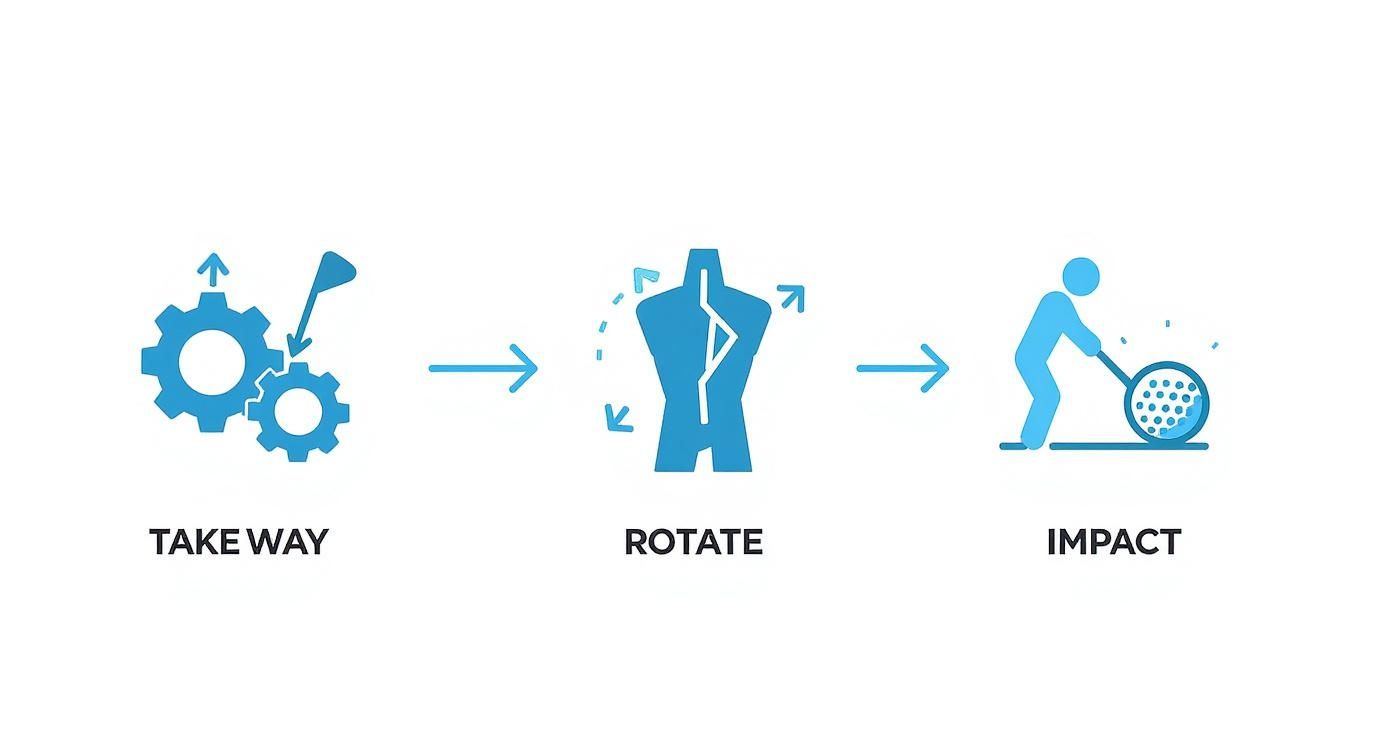
By zeroing in on these core mechanics, you ensure the only thing you’re really changing is your backswing length. This is what leads directly to predictable, repeatable distances.
Building Your Clock System for your Golf practice
To get started, your goal is to establish three core yardages for each wedge in your bag. Think of these as your go-to shots inside 120 yards. The reference points on the clock correspond to where your lead arm (left arm for a righty) is in the backswing:
- 7:30 Swing (Hip High): This is your shortest, most controlled swing. Your hands only need to travel back until they’re about level with your trail hip. It’s a small motion for delicate shots.
- 9:00 Swing (Chest High): For this mid-range shot, your backswing stops when your lead arm is parallel to the ground, literally pointing to 9:00 on the clock.
- 10:30 Swing (Shoulder High): This is your longest “feel” swing, where the club goes back to about shoulder height. It’s a three-quarter motion that gives you a ton of power but with far more control than a full swing.
Now, head to the driving range or a practice area with your gap wedge or sand wedge. Hit 10-15 balls with each of these three distinct swing lengths. You’ll need a rangefinder to measure the carry distance for each shot—don’t worry about the total roll-out. Jot down the average carry for your 7:30, 9:00, and 10:30 swings.
Once you do this for each of your wedges—from your pitching wedge down to your lob wedge—you’ll quickly build a matrix of nine or more reliable yardages. This is how you eliminate those awkward “in-between” distances that so often lead to tentative, poorly struck shots.
The Role of Tempo and Benchmarking in Golf
The glue holding the whole clock system together is consistent tempo. It doesn’t matter if your rhythm is fast or slow, but it absolutely must be the same rhythm for every single wedge shot. Accelerating smoothly through the ball is what makes sure your distance gaps are even and predictable.
Of course, it helps to know where you stand. Knowing your carry distances is crucial, but so is understanding how they compare to other golfers. The table below gives you a solid benchmark for average carry distances based on handicap.
Average Wedge Carry Distances by Handicap in Golf
This table shows the average carry distances for Pitching, Gap, and Sand wedges for golfers with different handicaps, helping you benchmark your performance.
| Handicap Level | Pitching Wedge (PW) | Gap Wedge (GW) | Sand Wedge (SW) |
|---|---|---|---|
| Scratch | 141 yards | 127 yards | 112 yards |
| 5 | 134 yards | 120 yards | 104 yards |
| 10 | 127 yards | 112 yards | 97 yards |
| 15 | 118 yards | 104 yards | 88 yards |
| 25 | 90 yards | 78 yards | 65 yards |
Data like this helps put your own numbers into perspective. For instance, knowing that the average pitching wedge carry for a scratch golfer is 141 yards, while a 10-handicap golfer averages 127 yards, helps you set realistic goals. Also, understanding what degree is a pitching wedge can clarify why these distance gaps exist between clubs.
Knowing these benchmarks helps you set realistic targets for your own clock system and finally build a scoring game you can truly rely on under pressure.
Controlling Golf Ball Spin and Trajectory for Any Situation
Knowing your wedge yardages is a huge step, but if you want to become a true short-game artist, you need to learn how to manipulate the ball’s flight. This is where the real fun begins. It’s less about rigid mechanics and more about feel and creativity—learning to hit those feathery, high-floating shots and those low, zipping darts that slam on the brakes.
The best part? You don’t need to overhaul your swing. Often, a tiny tweak in your setup is all it takes to completely change how the ball launches and reacts on the green. Getting a handle on these nuances gives you the power to go after any pin, no matter how tough the location.
How to Hit High, Soft-Landing Wedge Shots in Golf
Picture this: you’re short-sided, with a deep bunker sitting right between you and the flag. A low runner is out of the question. You need to pop the ball up in the air and have it land with almost no rollout. This is prime time for the high, soft spinner.
Here’s your quick guide for launching it skyward:
- Bump the ball forward: Play the ball a little more forward in your stance, maybe just inside your lead heel. This encourages a shallower angle of attack, letting the club’s loft do the work for you.
- Open the face: At address, open the clubface slightly before you take your grip. Point the face where you want the ball to land, then set your hands. This adds effective loft at impact.
- Lower your hands: Dropping your hands a touch at address can also add a bit more loft to the club, promoting that higher launch you’re looking for.
Think of the swing itself as being wider and more shallow. You’re trying to “sweep” the ball off the grass, not chop down on it. Put these adjustments together, and you’ll start hitting those beautiful, high-arcing shots that stop on a dime.
How to Hit Low, Checking Wedge Shots in Golf
Now, let’s flip the script. You’re hitting into a stiff breeze, or maybe you just need the ball to land, take one hop, and stop dead. This calls for that low, piercing wedge shot that flies under the wind and has some serious bite.
To bring the flight down and pump up the spin:
- Move the ball back: Position the ball just back of center in your stance. This simple move steepens your angle of attack and naturally de-lofts the clubface through impact.
- Press your hands forward: Create a noticeable forward shaft lean by pushing your hands ahead of the ball. This is one of the most effective ways to take loft off the club and keep the trajectory down.
- Finish low and left: As you swing through impact, feel like your hands and the clubhead are staying low and exiting to the left (for a right-handed golfer). This prevents you from “scooping” the ball up into the air.
This shot feels totally different—much more aggressive and powerful. You’re essentially “trapping” the ball between the clubface and the turf with a descending blow. It’s this compression that creates a super high spin rate with a low launch, the holy grail for controlling your wedges.
Adapting Your Golf Shot to Different Lies
Of course, the course doesn’t always give you a perfect, manicured lie. A fluffy lie in the rough demands a completely different approach than a tight lie on a firm fairway. The grass that gets trapped between your clubface and the ball is the real game-changer here, as it kills friction and spin.
There’s plenty of data to back this up. For example, a 60-degree wedge hit from a perfect lie might produce an average spin rate of 6,048 RPM. That same shot from the rough will launch higher, spin a lot less, and roll out way more because you can’t get clean contact. If you want to dive deeper into the numbers, HackMotion has some great data on how lies impact wedge shots.
Understanding this is the key. Once you can predict how the ball will react from different lies, you can make smarter club and shot selections before you even swing.
Practical Drills to Sharpen Your Wedge Game in Golf
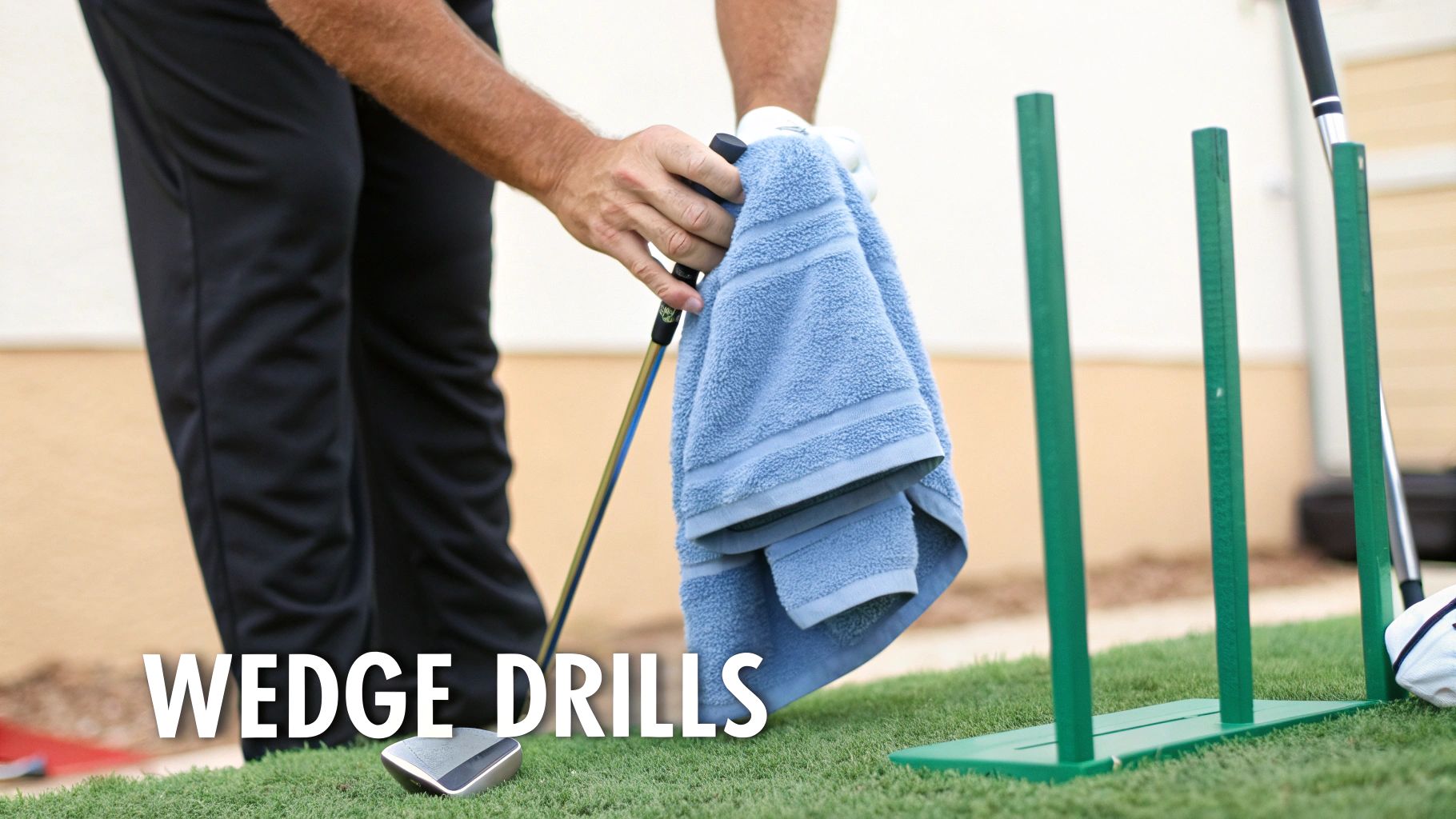
Knowing the theory behind a good wedge shot is one thing. Building the muscle memory to pull it off under pressure? That’s a completely different ball game, and it only comes from time on the practice green.
The right drills are what turn aimless range sessions into productive training. They help you groove the feeling of a solid wedge swing and give you instant feedback on what you’re doing right—and wrong. If you commit to just a few of these, you’ll build the kind of consistency and confidence that completely transforms your short game.
The Towel Drill for Connection practicing golf
This one’s a classic for a reason. The towel drill is fantastic for keeping your arms and body moving in sync, which is a massive problem for a lot of amateurs. So many golfers get “armsy,” letting their arms disconnect from their body’s rotation. That leads to all sorts of inconsistency.
It’s simple: just tuck a small towel under both of your armpits. The goal is to hit short pitch shots without either towel dropping. This forces you to use your bigger muscles—your torso—as the engine of the swing. You’ll quickly get a feel for that connected, one-piece motion that is so much easier to repeat.
This drill is a simple, effective fix for a swing flaw that plagues countless golfers. By keeping the towels in place, you’re training your body to rotate through the shot rather than relying on inconsistent hand and arm action.
The Golf Ladder Drill for Distance Control
Dialing in your yardages with the clock system takes reps, and the ladder drill is the perfect way to get them. This exercise is all about building confidence so you can hit specific numbers on command.
- Set Your Targets: Drop three towels or headcovers on the practice green at what you think are your 7:30, 9:00, and 10:30 swing distances for a single wedge.
- Climb the Ladder: Start with the closest target. Once you land a ball within a few feet, move on to the middle target, and then the farthest one.
- Descend the Ladder: After you’ve hit the last target, work your way back down to the closest one.
This drill really sharpens your feel for different swing lengths and brings a clear purpose to your practice. You can find more drills like this to advance your short game mastery through chipping and putting techniques and become a more complete player around the greens.
The Golf Gate Drill for a Pure Path
To make clean contact, your club path is everything. If your path is too far from the inside (“stuck”) or comes “over the top,” you’re going to hit poor, weak shots. The gate drill provides immediate, can’t-miss-it feedback on the direction of your swing.
Just place two headcovers or even a couple of water bottles on the ground, creating a “gate” just wide enough for your clubhead to pass through on its way to the ball. The objective is simple: swing through the gate without hitting either object. This is a great way to train a neutral, inside-to-square path that delivers the club flush to the ball every single time.
FAQ’s
Even after hours of practice, a few nagging questions always seem to pop up about wedge play. Let’s dig into some of the most common ones I hear from golfers and get you some clear, practical answers you can take straight to the course.
Why Do I Keep Hitting My Wedge Shots Thin or Fat?
This is the million-dollar question, and the answer almost always comes down to where your weight is. Hitting it “fat”—smacking the ground before the ball—is a classic sign that your weight is hanging back on your trail foot through the swing. Catching it “thin” or “blading” it across the green? That’s often a result of your body pulling up at impact, which again, is tied to poor weight transfer.
There’s a surprisingly straightforward fix for this. At setup, feel like 60-70% of your weight is on your lead foot. The real key is to keep it there. This simple move promotes that downward strike you’re looking for, ensuring you catch the ball first and then the turf. It’s the secret to crisp, clean contact.
Should I Swing My Wedges with My Arms or My Body?
Your body is the engine; your arms are just along for the ride. One of the biggest killers of wedge consistency is an “armsy” swing where your hands and arms do all the work independently.
A great wedge swing is driven by the rotation of your chest and torso. Your arms and the club should feel like they’re moving in sync with your body, not separate from it. This bigger-muscle movement is far more repeatable for shots where precision is everything.
How Do I Choose the Right Wedge for a Shot?
Picking the right club is part art, part science. It’s a mix of knowing your distances cold and reading the situation in front of you. First, you absolutely have to know your yardages for a full, three-quarter, and half swing with every wedge in your bag. This isn’t guesswork; it’s what all that practice is for.
Once you know your numbers, you can analyze the shot.
Need to carry a bunker and stop it quick? That’s a job for a higher lofted club like your Sand or Lob Wedge. Think high and soft.
Have plenty of green to work with and want a lower, more controlled shot that will check and release? Your Pitching Wedge or Gap Wedge is probably the smarter play.
The golden rule here is to choose the club that lets you make your most comfortable, controlled swing for the distance you need. Don’t try to force a club to do something it wasn’t designed for.
At Golf Inquirer, we know that dialing in these small details is what leads to big improvements on your scorecard. For more tips and insights to elevate your game, visit us at https://golfinquirer.com.