
The new year is just beginning and we can work on our golf routine with new ideas and resolve. We’ve all been there. You’re running late for your tee time, so you sprint from the parking lot, take two frantic, full-speed practice swings, and then proceed to slice your opening drive deep into the woods.
To enhance your game, it’s essential to establish a golf warm up routine before each round. This golf warm up routine will prepare your body and mind for the challenges ahead.
Your golf warm up routine should include dynamic stretches and specific drills tailored to your needs. A consistent golf warm up routine can significantly improve your performance.
That frustrating start isn’t just bad luck. More often than not, it’s the direct result of skipping a real golf warm up routine.
Why Your Pre-Round Routine (or Lack Thereof) Is Costing You Strokes in Golf
So many of us think a few quick swings on the tee box is all we need. But that common shortcut is one of the biggest reasons for high scores and early-round frustration. The golf swing is a seriously explosive and complex athletic move. It demands your hips, torso, and shoulders to fire in a powerful, synchronized sequence. Focus on executing your golf warm up routine with intention and clarity for best results.
When you skip a proper warm-up, you’re asking cold, unprepared muscles to perform that explosive action. It’s a recipe for disaster.
The Sobering Reality of How Golfers Prepare
This isn’t just a hunch. A deep-dive survey of over 1,000 golfers revealed a telling story. While almost 80% claimed they do some kind of warm-up, the most common activity was just taking a few air swings on the tee. Even more shocking? The study found that nearly half of all golfers don’t warm up at all. You can explore the research findings yourself to see the full picture.
This gap in preparation leads directly to the problems we all hate on the first few holes:
- Inconsistent Contact: Cold muscles mess with your timing, leading to thin shots, fat shots, and everything in between.
- Loss of Power: Your body simply can’t generate its top-end clubhead speed until your muscles are activated and ready to go.
- Higher Injury Risk: Forcing a powerful rotation on a cold body is a classic recipe for pulls, strains, and tweaks that can sideline you for weeks.
The difference in preparation between the average weekend golfer and a skilled, low-handicap player is often night and day. It’s a major reason why one group struggles out of the gate while the other starts strong. Without a dedicated golf warm up routine, you risk underperforming when it matters most.
How Golf Amateurs and Low-Handicappers Prepare Differently
| Warm-Up Habit | Average Golfer | Low-Handicap Golfer |
|---|---|---|
| Arrival Time | Arrives 5-10 minutes before tee time | Arrives 45-60 minutes before tee time |
| Stretching | A few static arm pulls on the tee box, if any | 5-10 minutes of dynamic, golf-specific stretches |
| Range Session | Hits a few balls with the driver at full speed | Starts with short wedges, working up through the bag |
| Short Game | Skips it entirely or rolls a couple of quick putts | Spends 10-15 minutes on chipping and putting |
| Mental Prep | Thinking about not messing up the first shot | Visualizing the first few holes and focusing on a swing key |
This table isn’t about shaming anyone; it’s about showing a clear path. Adopting the habits of a low-handicapper is a proven way to improve your own performance before you even hit a single shot. This is where a personalized golf warm up routine comes into play, catering to your specific needs.
Think of a good warm-up as a performance tool, not just an injury-prevention chore. By investing just 15 minutes before you play, you’re telling your body and mind to get ready to perform from the very first shot—not the fifth. The goal is simple: make your first swing of the day feel as smooth and confident as your last.
Building a Foundation with Dynamic Movements in Golf
If you want a powerful, fluid swing, you have to build it on a solid foundation. That starts with getting your body moving the right way before you even touch a club.
We’ve all seen the old-school approach: golfers grabbing a club and holding a few static stretches for 30 seconds. We now know that can actually do more harm than good, robbing you of power right when you need it.
The modern, effective golf warm-up is all about dynamic movements. These are active stretches that take your joints and muscles through a full range of motion, essentially rehearsing the movements you’re about to make on the course. Think of it as gently waking up your body and reminding it how to be an athlete.
This is a perfect example of what dynamic stretching should look like out on the range.
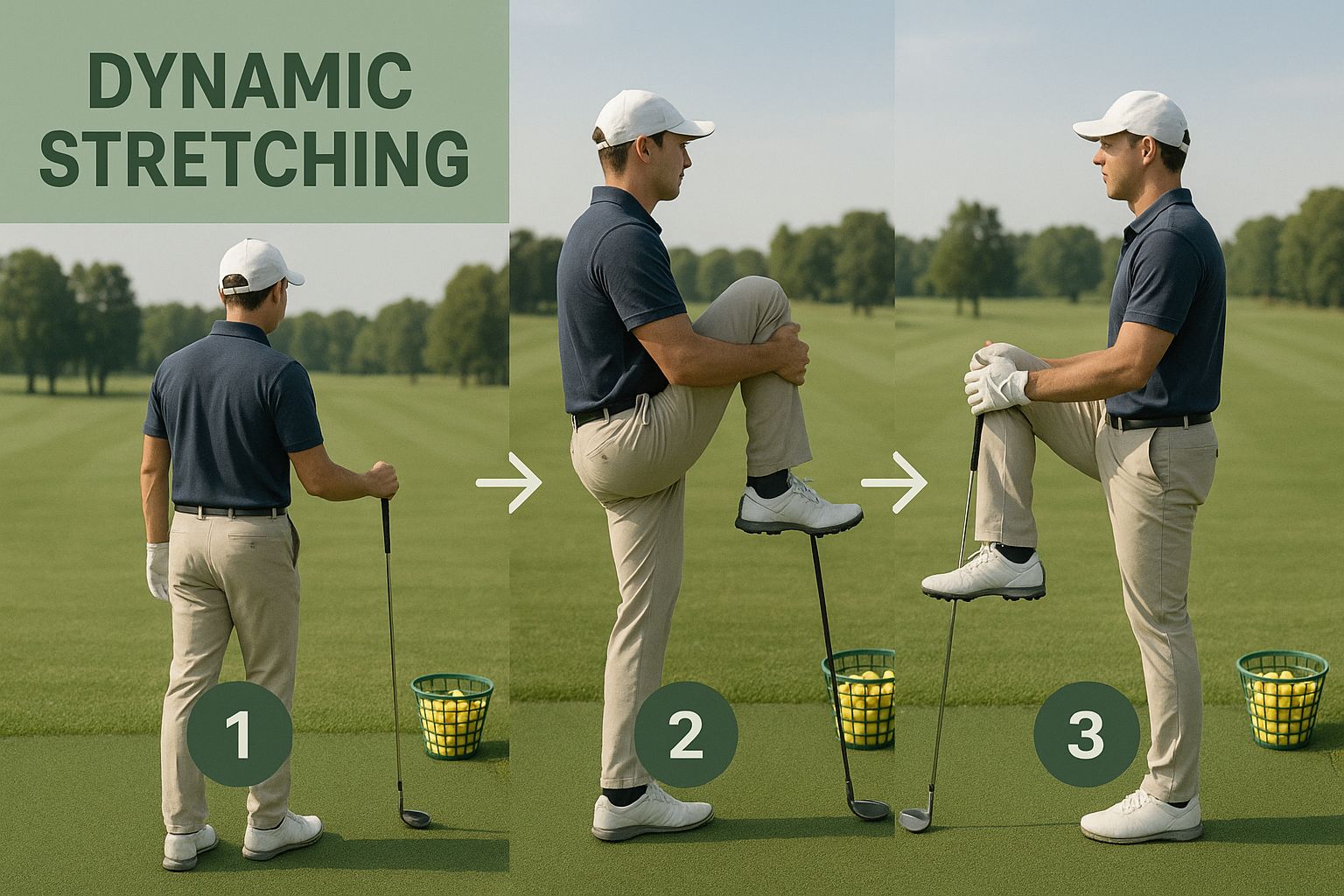
It’s simple, really: movement prepares the body for more movement. It all translates directly to a more connected and powerful swing from the very first tee.
Your Go-To Dynamic Golf Drills
The best part? You don’t need any special equipment for these—just yourself and a golf club for a bit of balance. The key here is to perform each movement smoothly and under control. You’re not trying to force a stretch; you’re just gradually increasing your range of motion.
- Leg Swings (Forward and Backward): Grab your driver or a 7-iron for balance and swing one leg forward and back like a pendulum. Aim for 10-12 reps on each leg. This is fantastic for opening up your hips and hamstrings, which are critical for generating that “ground-up” power.
- Leg Swings (Side-to-Side): Now, face your club and swing one leg across your body, side to side. After 10-12 reps on each leg, you’ll immediately notice more mobility in your hip rotators and groin, which helps you stay stable throughout your swing.
- Torso Twists with a Club: Get into your golf posture and place a club across your shoulders. From there, just gently rotate your torso back and forth while keeping your lower body quiet and stable. This drill zeros in on the thoracic spine (your mid-back), getting it ready for the rotational demands of a golf swing.
The science on this is crystal clear. Multiple studies have shown that static stretching can hurt immediate golf performance, whereas a dynamic warm-up actively improves things like driving power. Your focus should always be on targeted, functional movements. You can read more about these performance findings on PMC. Investing time in a golf warm up routine will not only enhance your flexibility but also help you avoid injuries during your game.
Firing Up Your Lower Body in Golf
Now that your hips and torso are feeling more mobile, it’s time to switch on the big muscles that create speed and stability. These next few movements are designed to bring it all together.
Walking Lunges with a Twist
Take a comfortable step forward into a lunge, then gently twist your torso over your front leg. This single drill is a powerhouse—it activates your glutes, quads, and core all at once, while also continuing to work on that rotational mobility. Just 5-6 lunges on each side will do the trick.
Good Mornings
Stand with your feet about shoulder-width apart, holding a club behind your neck. Keeping your back straight, hinge at your hips with a slight bend in your knees. This move is one of the best for waking up your entire posterior chain—the glutes, hamstrings, and lower back—which is basically the engine of your swing. Perform 8-10 slow, controlled reps.
By dedicating just five minutes to this sequence, you’re priming your body to move efficiently. You’re making sure that first swing of the day isn’t a stiff, awkward lurch, but a smooth, athletic motion.
Firing Up Your Swing Muscles for Speed and Control in Golf
Now that you’ve loosened up with some dynamic movements, it’s time to flip the switch on your golf engine. This next part of your warm-up isn’t about wearing yourself out; it’s all about activation. Think of it as establishing a direct line of communication between your brain and the key muscles in your swing—your glutes, core, and back—so they’re ready to fire on command.
So many common swing faults, like that dreaded early extension where your hips lunge at the ball, often boil down to lazy glutes. A rock-solid core is your anchor for both power and consistency, stopping you from swaying and sliding all over the place. When these crucial muscles are awake and engaged, your swing becomes dramatically more efficient and powerful.
Three Go-To Activation Golf Drills
You don’t need a gym for these. They’re simple, effective, and you can do them right there on the grass before you hit the range.
-
Glute Bridges: Lie on your back, knees bent, feet flat on the ground. Push through your heels to lift your hips, creating a straight line from your shoulders to your knees. Give your glutes a hard squeeze at the top for a two-second count, then lower back down. Knock out 10-12 reps to wake up the biggest power source you’ve got.
-
Band Pull-Aparts: Grab a light resistance band and hold it straight out in front of you at shoulder height. With your arms straight, pull the band apart by pinching your shoulder blades together. This is a fantastic way to light up the upper back muscles that help you maintain a solid golf posture. Aim for 12-15 reps.
-
Bird-Dog: Get on all fours. As you tighten your core, extend your right arm straight forward and your left leg straight back at the same time. Keep your back flat—imagine balancing a drink on it. Hold for a beat, return to the starting position, and then switch sides. This move is a game-changer for core stability and coordination. Do 8-10 reps on each side.
Activation is what transforms a simple stretching routine into a true performance primer. By waking up these specific muscles, you’re not just warming up; you’re setting the stage for a more powerful and controlled swing. It’s a key step to learning how to improve your golf swing speed without losing your accuracy.
If you’re serious about your physical prep, consider using one of the Best Workout Tracking Apps to monitor your progress and see how your off-course work translates to on-course gains. This little bit of effort before you tee off really does pay off big time.
Fine-Tuning Your Golf Swing on the Driving Range
Now that your body is loose and ready to go, it’s time to hit some balls. But hold on—this isn’t about grabbing the biggest bucket and whaling away. A smart driving range session is all about building confidence and finding a nice rhythm, not exhausting yourself before you even step up to the first tee.
The goal here is purpose, not volume. You’re here to groove your swing, not overhaul it.

This isn’t just anecdotal advice, either. A structured warm-up delivers real, measurable results. Research has shown that junior golfers increased their mean club head speed by almost 1.0 mph after a proper warm-up compared to doing nothing at all. If you’re interested in the science behind it, you can read the full research about these findings and see how it translates to better performance.
Start Small to Build Feel in Golf
I know it’s tempting, but whatever you do, don’t pull out the driver first. The best way to start is with your shortest clubs and the smallest, most controlled swings. Grab a sand wedge or pitching wedge to begin.
Your first 5-10 shots should just be gentle half-swings. The only thing you should be thinking about is making clean, center-face contact. Get that feeling of the clubhead striking the ball just before it brushes the turf. This is how you dial in your rhythm and hand-eye coordination right from the start.
Once you feel that crisp contact, you can gradually ease into a full swing with that same wedge, making sure to hold your balance through the finish.
Work Through the Golf Bag with Intention
Feeling good with the wedge? Great. Now you can start moving up through the bag. The trick is to do it with purpose, not just randomly grabbing clubs. You’re not just hitting balls; you’re getting ready to play golf.
The most effective mindset on the range is to ‘play the course’ before you play the course. Instead of hitting ten 7-irons in a row, simulate playing the first hole. This simple mental shift bridges the gap between practice and actual performance.
For instance, after your wedges, pull out the club you plan to hit off the first tee. Hit just one or two shots, but actually visualize the fairway. Then, grab the iron you’d likely hit for your approach and do the same, picking a specific target out on the range. This turns your warm-up into a dress rehearsal and makes it directly relevant to the round you’re about to play.
A Purposeful Golf Pre-Round Range Session
A small bucket of balls is more than enough if you have a plan. This simple structure helps you touch on all the key shots you’ll need, building confidence without draining your energy.
| Club | Number of Balls | Shot Focus |
|---|---|---|
| Wedge | 8-10 | Start with half-swings for contact, then full swings. |
| 8-Iron | 5-6 | Focus on a smooth tempo and solid ball striking. |
| 5-Iron or Hybrid | 5-6 | Find your rhythm with longer clubs. |
| Fairway Wood | 3-4 | Make confident swings, aiming at a wide target. |
| Driver | 3-4 | Commit to a target and make an aggressive, balanced swing. |
| “First Tee” Club | 1-2 | Rehearse your first tee shot with your full routine. |
By the time you hit that last ball, you should feel dialed in and ready. You’ve confirmed your swing feels good, rehearsed the most important shot of the day, and are ready to walk to the first tee with a clear plan.
Mastering the Mental Game Before You Tee Off in Golf
The final 10 minutes of your warm-up have almost nothing to do with your golf swing. You’ve put in the physical work, and now it’s time to shift gears from practice to performance. This is where you sharpen your focus and walk to the first tee feeling composed, confident, and ready to score. Your golf warm up routine should focus on both physical and mental readiness.

Honestly, this last little window of time is what separates a decent warm-up from a truly effective one. It’s all about building confidence and taming those first-tee jitters that have a nasty habit of wrecking a round before it even has a chance to get going.
Dial in Your Speed on the Green in Golf
Stop worrying about making every putt on the practice green. Your only mission here should be speed control. Getting the pace right is infinitely more valuable for avoiding three-putts than holing a couple of short ones.
- Try This Lag Drill: Grab three balls and putt them toward the fringe of the green, not a specific hole. Your goal is simply to get all three to die in the same little area. This simple exercise quickly tunes your brain into the speed of the greens for the day.
Tame Your Nerves with Mindful Breathing in Golf
It’s completely normal to feel a jolt of adrenaline as your tee time gets closer. A quick breathing exercise can work wonders to slow your heart rate and bring a wave of calm over you.
Find a quiet spot for a moment. Inhale slowly for a count of four, hold it for four, and then exhale for a longer count of six. This is often called box breathing, and it’s a game-changer for managing anxiety and pulling your focus back into the present.
Visualize Success Before You Even Step Up in Golf
Finally, take a minute to play the first tee shot in your head. And I mean really play it. See your entire pre-shot routine, from the confident practice swing to stepping into your stance. Picture your target, and then visualize yourself making a smooth, committed swing.
This mental rehearsal makes the real shot feel almost like you’ve already done it. Building these habits is a cornerstone of the mental game of cultivating a golfer’s mindset and will absolutely show up on your scorecard.
Remember, what you eat and drink plays a huge role in your ability to stay sharp for all 18 holes, too. It’s worth understanding how nutrition impacts mental focus for athletes if you want every possible advantage. Ultimately, all these important elements and your golf warm up routine should be a reflection of your goals on the course.
Incorporating a Golf Warm Up Routine for Better Performance
FAQ’s
Let’s clear up a few of the most common questions golfers have about pre-round prep. Nailing these details will help you build a warm-up routine that feels second nature and gets you ready to play your best. Remember, a proper golf warm up routine can make all the difference in your game.
How Long Should a Proper Golf Warm-Up Take?
The sweet spot is around 15 to 20 minutes. You don’t want to burn yourself out before you even get to the first tee.
Start with about 5-7 minutes dedicated to dynamic movements and getting your muscles activated. From there, head to the range for a focused 10-15 minute session. That’s all you need to get your body primed without feeling rushed or tired.
What If I Have No Access to a Driving Range?
No range? No problem. It happens. When you can’t hit balls, just spend a little more time on your dynamic warm-up, extending it to about 10-12 minutes.
Then, find a spot where you can take some slow, deliberate practice swings. Focus on the feeling and sequence of your motion, starting small and building up to a full swing. This is still incredibly valuable for finding your tempo for the day.
Remember, the goal is preparation, not perfection. A thoughtful warm-up with just practice swings is a world away from running to the first tee cold.
Is It Ever Okay to Do Static Stretching Before Golf?
This is a big one. The best advice is to save the static stretching—the kind where you hold a position for 20-30 seconds—for after the round.
There’s a lot of evidence showing that holding stretches like that can actually decrease your muscle power and explosiveness right before you play. That’s the last thing you want when you’re trying to generate clubhead speed. After you play, however, it’s fantastic for recovery and improving your overall flexibility.
Can I Do This Routine If I Have Physical Limitations?
Absolutely. The most important rule is to listen to your body. Never push through pain.
Every movement should feel comfortable. If a particular drill doesn’t feel right, just ease up on the intensity or skip it altogether. A modified golf warm-up routine you can do consistently is infinitely better than one that puts you at risk of injury.
At Golf Inquirer, we believe a great round starts long before the first tee. For more tips, gear reviews, and insights to elevate your game, be sure to check out our site.