
Ever glanced at your scorecard, noticed a number next to “Slope Rating,” and just nodded along without really knowing what it meant for your game? You’re not alone. Let’s break down this crucial number in a way that actually makes sense.
So, what is slope rating? Understanding this concept can significantly affect your game and strategy.
Simply put, a course’s Slope Rating tells you how much harder a course plays for a bogey golfer (someone who averages about 90) compared to a scratch golfer (a zero-handicap player). It’s not about the course’s overall length or score—that’s the Course Rating. Instead, Slope measures the relative difficulty.
Understanding the Numbers on Your Scorecard
I always think of it like a ski mountain. Imagine a green circle run and a black diamond starting from the same peak. An expert skier might find the black diamond a bit more challenging, but a beginner is going to find it exponentially harder. The Slope Rating is golf’s version of that difficulty gap.
This is why two courses can have the exact same Course Rating but feel like totally different beasts. One might be wide open, while the other is riddled with narrow fairways, forced carries over water, and deep bunkers that punish a bogey golfer’s misses far more severely than a scratch player’s.
The Slope Rating answers a crucial question: “How much tougher is this track for me compared to a tour-level player?” It’s the key ingredient that allows the World Handicap System to level the playing field, ensuring your handicap accurately reflects the challenge of the specific course you’re playing that day.
A higher Slope Rating means there’s a bigger gap between how a scratch golfer and a bogey golfer will likely score. It’s the number that truly quantifies the challenge for the everyday player.
Getting a handle on Slope Rating helps you mentally prepare for your round and truly appreciate how the handicap system makes the game fair and fun for everyone, no matter their skill level.
Why Slope Rating Was Created for Average Golfers
The handicap system we know today wasn’t always so fair. Believe it or not, there was a time when a 15-handicap was a 15-handicap, no matter where you teed it up. You’d get the same number of strokes on a wide-open muni as you would at a monster like Bethpage Black.
Anyone who’s walked off a tough course feeling beat up knows that’s a fundamentally flawed system. A scratch player might find a long forced carry or a tight fairway a challenge, sure. But for the average bogey golfer, those same obstacles can be downright disastrous, turning one small mistake into a double or triple bogey in the blink of an eye.
Addressing the Imbalance
The old way of doing things just didn’t account for how differently players of various skill levels experience the same course. Certain elements of difficult golf course design and how it affects play hit higher handicappers much harder:
- Forced Carries: A scratch player confidently flies a ravine. A bogey golfer might lose three balls trying.
- Narrow Fairways: A slight miss for a low-handicapper is in the first cut. For a high-handicapper, that same miss could easily be out of bounds.
- Punishing Hazards: Those deep bunkers and slick, contoured greens are a nightmare for players who don’t have a razor-sharp short game.
Slope Rating was designed to solve this exact problem. It measures the relative difficulty of a course specifically for a bogey golfer compared to a scratch golfer, creating a more equitable handicap adjustment.
This is precisely why the USGA stepped in. The Slope Rating system was officially adopted in 1987 to fix the unfairness baked into the old handicap calculations. The work started back in 1979 with a dedicated Handicap Research Team, and by the time it rolled out nationally, two million golfers at roughly 9,000 clubs were finally using a fairer, more accurate system.
How a Course’s Slope Rating Is Calculated
That three-digit number on your scorecard isn’t just pulled out of thin air. It’s the result of a surprisingly detailed and objective process handled by official rating teams. Far from being a subjective guess, calculating a course’s Slope Rating is a standardized procedure that all boils down to two key evaluations.
First, the raters figure out the Course Rating—basically, the expected score for a scratch golfer (someone with a 0.0 handicap). Then, they determine the Bogey Rating, which is the expected score for a “bogey golfer,” who typically plays to a handicap of around 20.0. This isn’t a quick glance; it’s a meticulous, hole-by-hole assessment of dozens of obstacles.
The Two-Player Perspective
To get this right, raters have to walk the entire course and see it through two different sets of eyes: the scratch player’s and the bogey player’s. They’re constantly asking how specific challenges affect each golfer differently.
They analyze things like:
- Fairway Width: How much more does a tight landing area punish an average player’s slightly wider shot pattern?
- Water Hazards and Bunkers: What’s the real probability that each type of player ends up in trouble, and how severe is the penalty when they do?
- Green Speed and Contours: Do slick, undulating greens cause way more problems for a bogey golfer’s short game?
- Topography: Do uphill approaches and tricky sidehill lies impact one player more severely than the other?
Once the Course Rating and Bogey Rating are locked in, the final number comes from a simple formula. This infographic perfectly illustrates how slope accounts for the difference in difficulty between courses.
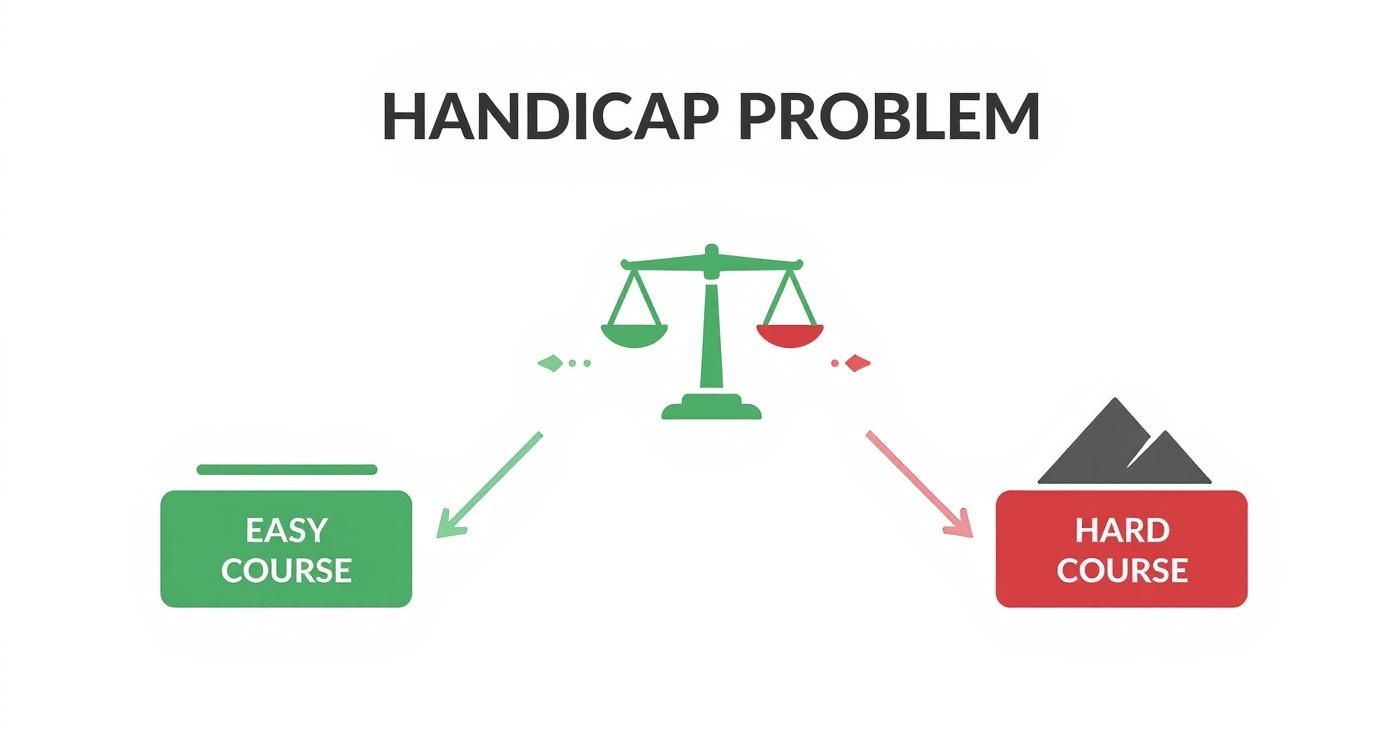
As the image shows, a harder course creates a much steeper climb in score for the average golfer compared to a scratch player. The Slope Rating is what quantifies that exact gap.
The formula is: Slope Rating = (Bogey Rating – Course Rating) x 5.381 (for men) or 4.24 (for women).
That constant (like 5.381) is just a multiplier that scales the result to fit into the standard range of 55 to 155. At the end of the day, the Slope Rating isn’t a measure of raw difficulty—it’s a measure of the difference in difficulty between those two players, neatly packed into a single, useful number.
How to Interpret the Slope Rating Scale
So, you glance at the scorecard and see numbers like 95, 113, or maybe a daunting 140 listed as the Slope Rating. What do these figures actually tell you about the round you’re about to play?
Think of Slope Rating as a course’s personality profile. It gives you a heads-up on the challenge ahead, letting you manage your expectations before you even stick a tee in the ground.
The official scale runs from a gentle 55 (the easiest) all the way up to a brutal 155 (the toughest). Right in the middle is the magic number: 113. This is considered the baseline for a course of “standard” difficulty for a bogey golfer. It’s this number that allows the handicap system to translate your Handicap Index into a Course Handicap for the specific tees you’re playing that day. For a deeper dive into how it all connects, you can check out how the USGA system works.
What the Numbers Really Mean
The easiest way to make sense of these numbers is to see how far they stray from that 113 baseline. The further a course’s Slope is from 113, the more its difficulty will either punish or forgive your misses compared to a scratch player.
A higher slope doesn’t just mean the course is harder for everyone. It means the difficulty ramps up much faster for higher-handicap players than it does for scratch golfers.
Basically, a high slope course has more “danger” lurking—forced carries, thick rough, and slick greens—that will disproportionately affect a bogey golfer’s score.
What Your Course’s Slope Rating Means
To put it into perspective, here’s a quick guide to what you can expect based on the Slope Rating you see on the card. This table should help you size up the course at a glance.
| Slope Rating Range | Relative Difficulty for a Bogey Golfer | What to Expect |
|---|---|---|
| Below 100 | Significantly Less Difficult | A more forgiving layout where missed shots are less likely to lead to a big number. Expect wider fairways and fewer forced carries. |
| 100 – 125 | Standard Difficulty | A fair but solid test of golf. You’ll find a mix of straightforward holes and ones that demand good shot-making. Most courses fall here. |
| 126 – 140 | Considerably More Difficult | A serious challenge where mistakes are punished. Get ready for more hazards, tricky green complexes, and tighter landing areas. |
| Above 140 | Extremely Difficult | Buckle up. Courses like Augusta National (unofficially 141) live in this range, requiring your absolute best strategic golf to score well. |
At the end of the day, understanding Slope helps you pick the right tees and set realistic goals for your round. It’s not just a random number; it’s your key to unlocking a smarter, more enjoyable game.
Calculating Your True Handicap for Any Course

This is where the rubber meets the road. All this talk about Slope Rating comes down to one simple question: how many strokes do you actually get on the course today?
Your Handicap Index is your portable measure of golfing potential—it’s what you take with you from course to course. But it’s not the number you’ll use on the scorecard. To get that, you need to convert it into a Course Handicap, which is tailored specifically for the tees you’re playing.
Think of it as adjusting for the local conditions. This calculation is the engine of the World Handicap System, making sure a match between you and a buddy is fair, whether you’re playing at Pebble Beach or your local muni.
The formula is surprisingly simple:
Course Handicap = (Handicap Index x Slope Rating) / 113
So, what’s with the 113? That’s the magic number representing a course of “standard” or “average” difficulty. The formula basically adjusts your handicap up or down based on how much tougher (or easier) the course is compared to that baseline.
Seeing the Formula in Action
Let’s put this into practice. Imagine a golfer with a 15.0 Handicap Index is about to play three different courses. Notice how their Course Handicap—the real number of strokes they get—fluctuates based on the Slope Rating. If you need a refresher on the basics, our guide on what is a golf handicap is a great place to start.
Here’s how it breaks down for our golfer:
-
Easy Course (Slope 105):
- (15.0 x 10⁵) / 113 = 13.93
- Course Handicap = 14 (rounded)
-
Standard Course (Slope 113):
- (15.0 x 113) / 113 = 15.0
- Course Handicap = 15
-
Tough Course (Slope 135):
- (15.0 x 135) / 113 = 17.92
- Course Handicap = 18
See what happened? The same golfer gets four more strokes on the tough course compared to the easy one. This is exactly why the Slope Rating system exists—it gives you the extra help you need on a beast of a track while keeping things honest on a more forgiving layout. It’s all about leveling the playing field.
FAQ’s
Even after you get the hang of it, Slope Rating can still throw a few curveballs your way on the course. Let’s clear up some of the most common questions golfers have. Think of this as your go-to guide for making sure this crucial number makes sense when you need it most.
Getting these details right will help you understand a new course, set up a fair match with your buddies, and use the handicap system to its full potential.
Does a High Slope Rating Always Mean a Course Is Harder?
Not for everyone, and that’s the key thing to remember. A high Slope Rating means a course gets disproportionately harder for a bogey golfer compared to a scratch golfer. It’s all about the gap in difficulty between those two players.
Imagine a long, wide-open course with almost no hazards. It might have a high Course Rating (making it a beast for scratch players) but a lower Slope. Why? A scratch player’s power is tested, but a bogey golfer has plenty of room to miss without racking up penalty strokes. The difficulty gap is smaller.
Now, picture a shorter course littered with forced carries, nasty rough, and slick, tricky greens. This course could have a lower Course Rating but a sky-high Slope. The scratch player might navigate it just fine, but it becomes a strategic nightmare for the average player, where every single mistake is magnified.
Why Do Different Tees Have Different Slope Ratings?
Simple: each set of tees is basically its own unique golf course. They all present a different set of challenges. The back tees are obviously longer, but they also often bring more hazards into play or force you to hit from tougher angles. This bumps up the difficulty for a bogey golfer much more than it does for a scratch player, which is why the Slope is higher.
The forward tees do the exact opposite. They shorten the course, sometimes taking forced carries and other obstacles completely out of the equation. This shrinks the difficulty gap between the two types of players, leading to a lower, more manageable Slope Rating.
Crucial Tip: Always, always use the Slope Rating for the specific set of tees you’re playing. Grabbing the number from the back tees when you’re playing the front nine will give you a completely inaccurate Course Handicap and throw the whole system off.
Can I Use Slope Rating to Compete Fairly with Friends?
Absolutely! That’s one of the main reasons the system was created. It’s a fantastic tool for leveling the playing field between golfers of different skill levels.
Before you tee off, just have everyone in your group calculate their own Course Handicap. They’ll use their Handicap Index and the correct Slope Rating for the tees you’re all playing. This tells you exactly how many strokes each person gets for that specific round on that course.
From there, you just compete based on your net score. It makes the match a true test of who played better relative to their own ability on that day. It works perfectly, no matter how wide the skill gap in your group is.
At Golf Inquirer, we believe that understanding the little details of the game makes every round that much better. Check out more of our tips, tricks, and course guides to take your game to the next level. Let’s explore the beauty of golf together, one shot at a time